
Quartzsea Acquisition Corp’s Growth Hinges on Successful Initial Business Combination Execution
A nascent Cayman Islands-based SPAC with $82.8 million in trust faces pivotal execution risks and operational challenges.
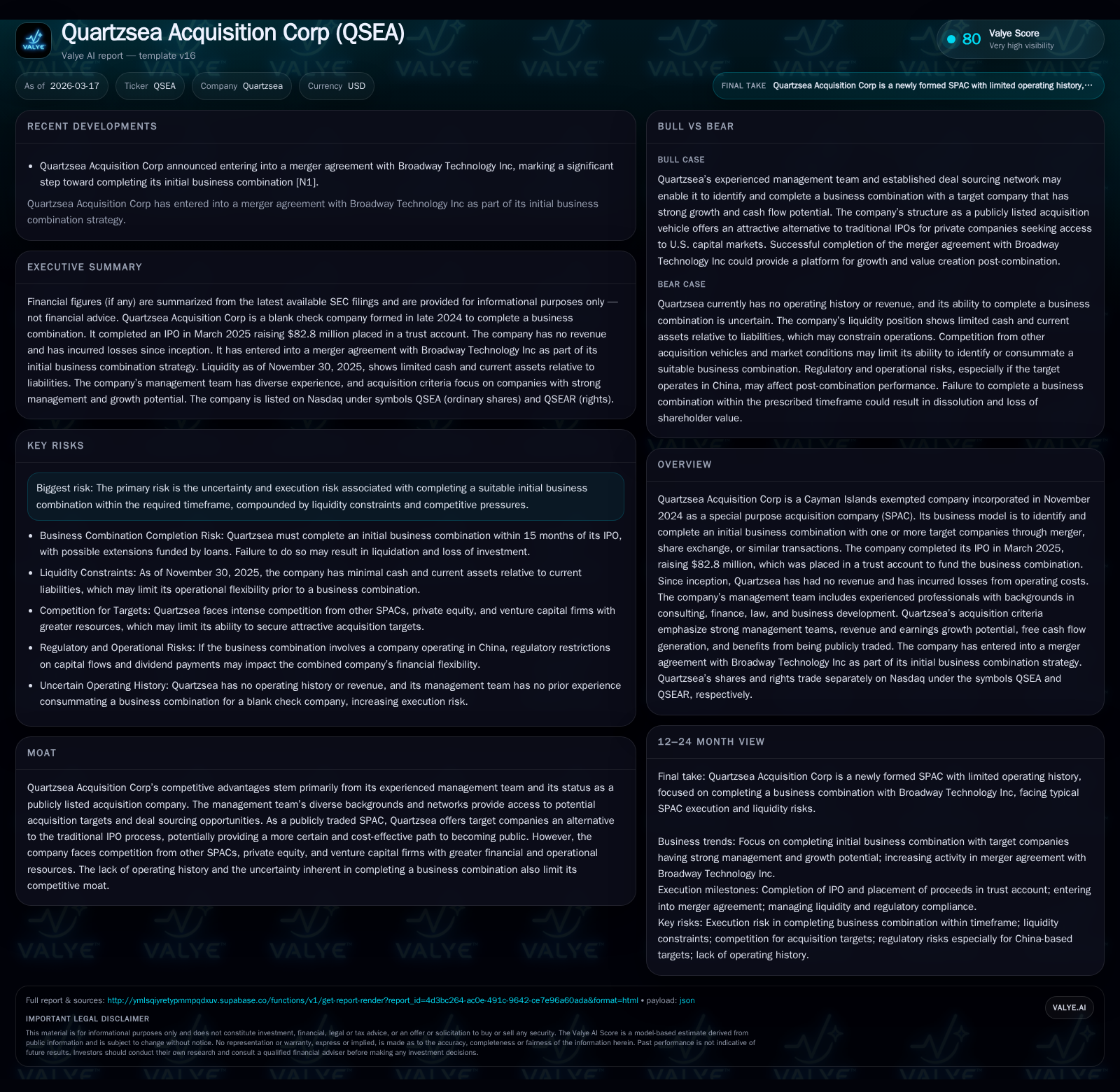
Quartzsea Acquisition Corp, incorporated in late 2024, operates as a Special Purpose Acquisition Company aimed at completing a business combination with a private firm to enter the public markets. It raised $82.8 million in its March 2025 IPO, placing proceeds in trust pending a qualifying acquisition. Without revenue or operational history, Quartzsea relies on an experienced management team and the promise of access to U.S. capital markets for target companies to compete with other SPACs and investment firms. Key risks persist around timely deal closure, market conditions, and liquidity constraints, while returns remain undeveloped given the company’s embryonic stage.
Company Overview and Historical Performance
Quartzsea Acquisition Corp is an exempted Cayman Islands entity incorporated November 5, 2024, structured specifically as a Special Purpose Acquisition Company (SPAC). Its core business model centers on merging with or acquiring one or several private companies to facilitate their transition to public market listing via a business combination. This is the hallmark structure of SPACs seeking alternative pathways to traditional IPOs.
In March 2025 Quartzsea completed its initial public offering (IPO), issuing 8.28 million units at $10 each (including full exercise of over-allotment) raising gross proceeds of $82.8 million. These funds were deposited in a U.S.-based trust account designated for use solely in consummating an initial business combination or returning capital upon liquidation if no acquisition occurs [S1][S5]. Simultaneously, a private placement raised an additional $2.3 million from the Sponsor.
Since IPO completion through fiscal year ending November 30, 2025 (latest reported period), Quartzsea has operated solely in pursuit of suitable acquisition candidates without generating any revenue. Operating losses primarily reflect costs related to corporate formation, administration, legal fees and professional services integral to SPAC operations [F1][S1].
As reported in its latest annual filing, operating income was negative $1.9 million while net income showed a positive figure of just over half a million dollars; this discrepancy may stem from accounting treatments such as interest income on the trust account less expenses accrued [F1]. Liquidity metrics are constrained with current liabilities totaling approximately $742 thousand against current assets below $100 thousand; however this excludes nearly all cash proceeds which reside separately within the trust account [F1]. The company’s current ratio calculated at about 0.12 underscores limited working capital outside the trust funds.
Historical performance (annual)
| FY |
|---|
| 2025 |
Source: SEC companyfacts cache [F1].
Note: The absence of revenue reflects the SPAC's early development stage prior to consummation of any acquisition.
Future Growth Prospects
Quartzsea’s growth narrative fundamentally depends on successfully identifying and closing an initial business combination that meets its strategic criteria: acquisition targets must have compelling economics, demonstrated or anticipated revenue and earnings growth, strong management teams capable of value creation post-merger, stable free cash flows particularly with predictable revenue streams and manageable capital expenditure requirements [S26]. Moreover, the target should benefit materially from accessing public capital markets via the public status Quartzsea can confer.
The company emphasizes leveraging its management team's collective expertise spanning finance, consulting, law, and operational leadership across jurisdictions to source deals offering synergistic value creation opportunities [S4][S26]. However, it also explicitly acknowledges that none of its key personnel have previously completed a business combination within a blank-check vehicle context — flagging execution risk.
Competitive pressures arise from the growing number of SPACs targeting deals simultaneously with private equity firms and venture capital funds that often sport deeper industry specialization or greater financial firepower. Furthermore, market conditions including regulatory scrutiny toward SPAC structures and investor sentiment toward post-merger performance bear heavily on deal feasibility [S6][S9].
Quartzsea does not restrict geographic scope for its search but notes particular attention may be paid to companies based in China or other jurisdictions where cross-border regulatory complexities could affect capital flows post-business combination—such as foreign exchange controls and dividend repatriation issues impacting cash flow visibility post-transaction [S23][S25].
Forecasts and Milestones To Watch
While Quartzsea has entered into at least one binding merger agreement per the disclosures [S3], no detailed financial guidance or timetable for completion is available publicly at present. Key events for monitoring include:
- Official announcement detailing the prospective business combination target(s) including strategic rationale and financial projections.
- Disclosure regarding financing plans accompanying the deal — whether relying solely on trust account proceeds or supplemented by debt/equity issuance.
- Shareholder communications outlining redemption mechanisms available to existing stockholders under SEC tender offer rules or proxy solicitations.
- Subsequent regulatory filings setting terms for vote scheduling or tender offer windows.
- Market reception evidenced by trading behavior upon each milestone unlocking additional deal certainty.
As typical with SPACs, failure to complete a qualifying business combination within prescribed timelines (often 18-24 months post-IPO) necessitates winding up proceedings returning final capital distributions net expenses to shareholders .
Returns and Capital Allocation Strategy
To date, Quartzsea's capital allocation has been prudently constrained by its structure; all IPO proceeds minus expenses are securely held within the trust account exclusively earmarked for consummating an initial business combination or returning capital upon liquidation if no transaction occurs [S7][F1]. The sponsor's founder shares representing approximately 2.9 million ordinary shares provide aligned equity incentives but come coupled with forfeiture provisions pending successful merger execution.
No dividends or share repurchase activities exist as the company lacks operating cash flows; such shareholder distributions will only become viable post-business combination subject to distributable profits under relevant accounting standards governing potential combined entities — especially considering potential regulatory restrictions within China if applicable [S13][S23].
Post-merger capital structure considerations will be critical: depending on deal terms Quartzsea may issue new equity to finance acquisitions or leverage debt instruments enhancing potential returns but augmenting risk profiles as well [S12]. Additionally, redemption rights held by existing shareholders present dilution pressures balanced against flexible transaction structuring features enabling sponsor purchases of shares privately to meet closing conditions if necessary [S16][S17].
Calculations derive approximate return metrics from reported net income relative to equity adjusted for founder shares showing ROE near negative 13%, consistent with an early-stage SPAC incurring startup costs without operating revenues yet realizing nominal profits likely driven by interest income from trust assets [F1].
Competitive Moat and Risks
Quartzsea's main competitive advantage lies less in operational history than in its seasoned management team possessing complementary skills across M&A execution lines combined with public market listing status appealing to prospective private companies seeking alternative routes for liquidity events outside conventional IPO channels [Valye excerpt + S4]. This can afford target businesses negotiated certainty regarding access to financing along with reduced marketing expenditures typically associated with traditional offerings — underscoring value propositions especially amid volatile capital markets.
Nonetheless significant risks abound: failure or delay in completing an initial business combination could erode shareholder confidence and compel liquidation at marginally below IPO prices after adjustment for expenses [S6][S9]. Increasing competition among SPAC sponsors raises valuation pressures while potential regulatory actions targeting blank-check vehicles add further uncertainty over long-term viability within evolving frameworks.
Investor concentration risk is mitigated somewhat by aligned promoter interests who have committed their founder shares without redemption rights enhancing governance stability through voting clout during merger approvals [S16][S19]. However general liquidity beyond trust funds remains minimal indicated by weak short-term solvency ratios underscoring dependence on external financing options once proceeding beyond merger close into active operations phase.
Conclusion
Quartzsea Acquisition Corp exemplifies an archetypal newly formed SPAC positioned strategically to capitalize on transitioning private companies into public markets by harnessing management expertise and providing streamlined deal pathways versus typical IPO processes. Its foundational track record reflects nascent operating status reliant on careful execution of an inaugural business combination within set timelines amid heightened competitive landscapes impacting valuation multiples and investor appetite alike.
Analysts monitoring Quartzsea should prioritize developments around announced merger targets including financing strategies leveraged therein alongside structural terms impacting shareholder voting dynamics plus redemption mechanics which collectively will define Quartzsea’s trajectory toward fulfilling its intended role as an effective vehicle bridging private-public market divides.
This analysis reflects information available as of March 17, 2026. It is intended solely for informational purposes without expressing any investment recommendations or advice.
Disclaimer: This is research-only, informational analysis and not investment advice. It may include AI-generated interpretation and general industry context. Always verify important details using primary sources.

Comments