
X4 Pharmaceuticals Advances Mavorixafor Commercialization While Managing Accelerated Losses and Streamlined Operations
X4 Pharmaceuticals pivots to focus exclusively on its lead drug mavorixafor amid strategic restructurings and deepening investment in Phase 3 chronic neutropenia trials.
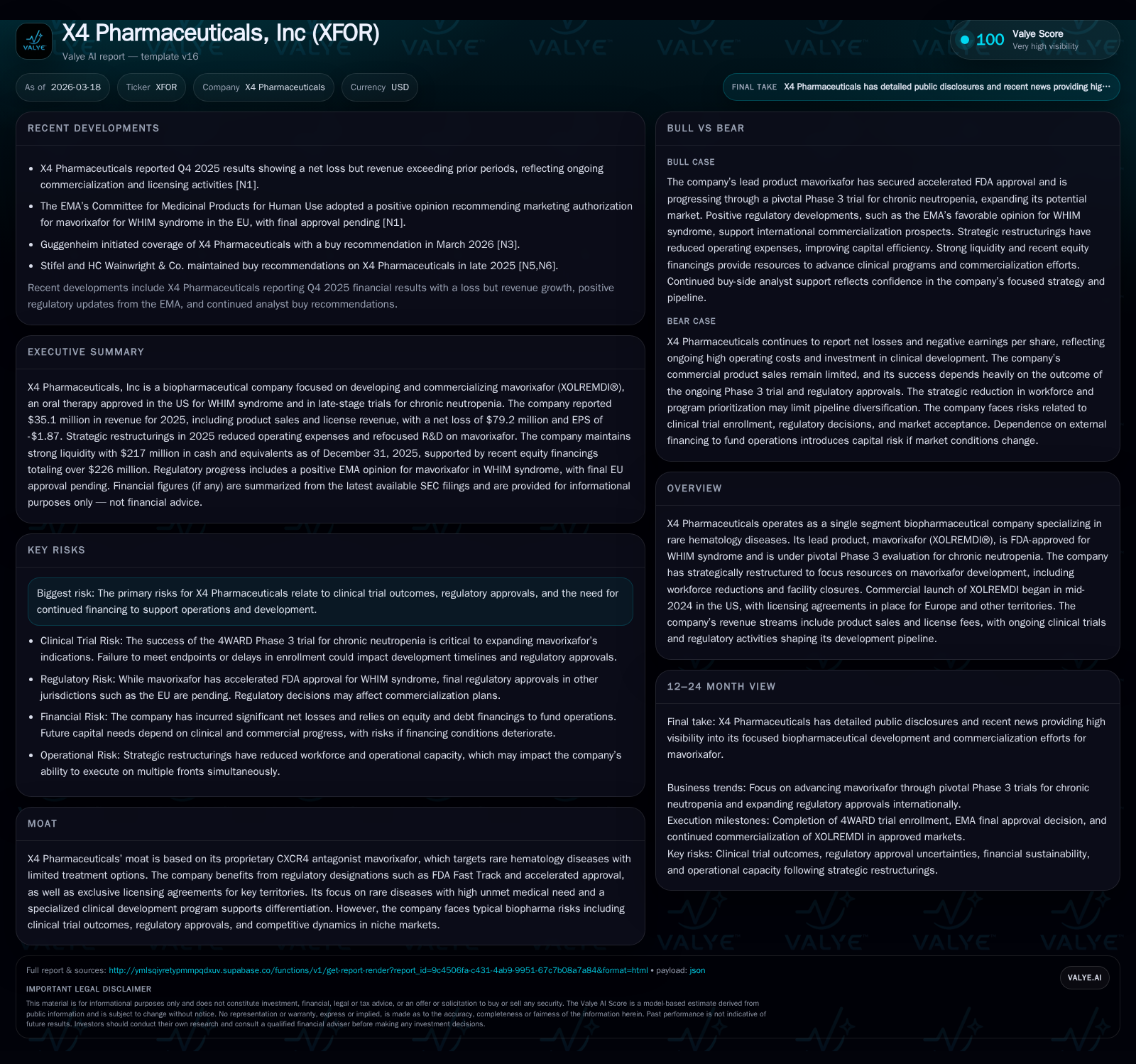
X4 Pharmaceuticals, after receiving FDA accelerated approval for its rare disease drug XOLREMDI (mavorixafor) for WHIM syndrome, has embarked on commercial launches and pivotal Phase 3 trials targeting chronic neutropenia. The company’s recent financials show increasing revenue from product sales and license fees but also sharp rises in operating losses driven by both clinical trial expenses and restructuring charges. Capital raises in late 2025 bolstered liquidity, funding operations through 2028, as the firm continues scaling back non-core programs to concentrate resources on mavorixafor’s broader indications. Key near-term catalysts include pivotal Phase 3 enrollment completion in Q3 2026 and expected EMA approval for WHIM syndrome in Q2 2026.
Company Overview
X4 Pharmaceuticals is a biopharmaceutical company singularly focused on developing therapies for rare hematology disorders. The firm’s lead candidate, mavorixafor (marketed as XOLREMDI®), targets rare primary immunodeficiency conditions involving neutropenia — notably WHIM syndrome and chronic neutropenia (CN). Following FDA accelerated approval in April 2024 for WHIM syndrome among patients aged ≥12, X4 launched its first commercial sales effort mid-2024 in the US market [S1][N1]. Concurrently, the company is advancing the pivotal Phase 3 "4WARD" trial for CN — a multicenter randomized study designed to enroll up to 176 patients with variants of CN characterized by low circulating neutrophils and infection susceptibility [S1].
To channel its resources effectively behind mavorixafor’s development and commercialization, X4 undertook significant restructuring steps starting Q1 2025 including a workforce reduction of approximately 30%, closure of its Vienna R&D site, and pausing other preclinical programs [S1]. These measures intensified later that year with an additional workforce cut approaching 50%, particularly trimming commercial field forces no longer aligned with the company's tight operational focus [S20].
Historical Performance and Financials
The transition from development-stage to commercial-stage biopharma is marked by key inflection points visible in X4's financial trajectory. Prior to FDA approval (pre-2024), revenues were negligible; none reported in FY2023 [F1]. Post-approval, revenue recognition started accruing primarily from product sales and licensing agreements.
Historical performance (annual)
| FY | Net ($mm) | CFO ($mm) | OpInc ($mm) | Net YoY |
|---|---|---|---|---|
| 2025 | -79 | -86 | -87 | -111.5% |
| 2024 | -37 | -131 | -36 | +63.0% |
| 2023 | -101 | -97 | -108 | -7.8% |
| 2022 | -94 | -77 | -88 |
Source: SEC companyfacts cache [F1].
Capital returns and efficiency (annual)
| FY | Buybacks | ROE% |
|---|---|---|
| 2025 | -42.5 | |
| 2024 | -169.1 | |
| 2023 | 0 | -198.0 |
| 2022 | 0 | -126.8 |
Source: SEC companyfacts cache [F1].
*License revenue recognized was approximately $27.6 million in 2025 [S7][S9][F1]
Revenue growth was driven by initial product sales following FDA accelerated approval and licensing agreements such as the exclusive deal with Norgine Pharma UK for European distribution rights [S21][N5].
Operating losses have expanded due to increased clinical trial activity related to the pivotal Phase III "4WARD" study alongside restructuring costs incurred during workforce reductions [S14][S20]. Despite these efforts, total operating expenses remained elevated reflecting continued investments in research and commercialization.
Strategic Restructurings Impact
Two major strategic restructurings since early 2025 reduced total headcount by nearly 80%, including cuts within commercial field teams no longer critical under the refined corporate focus on mavorixafor for CN [S1][S20]. These actions lowered general & administrative expenses while maintaining research spending necessary for clinical development [S25]. Severance charges approximated $7 million associated with these workforce transitions.
Cash Flow, Liquidity, and Capital Allocation
X4’s fiscal year ending December 31, 2025 saw significant capital raises:
- Approximately $81 million net proceeds from a private placement PIPE financing completed in Q3.
- An underwritten public offering netting about $145 million closed in Q4.
- Additional sales under an ATM program totaling roughly $24 million [S9][S26].
These equity financings boosted cash and cash equivalents from $56 million at end-2024 to over $217 million at end-2025 ([F1]), providing runway into at least late 2028 per management guidance [S26]. Operating cash flow remains negative but improved relative to prior years as losses narrowed despite ongoing clinical costs.
The company maintains a term loan facility with Hercules Capital totaling $75 million drawn at an effective interest rate around 11.2%, requiring interest-only payments through maturity on July 1, 2027; principal payment is due at maturity [S8][S16][S19]. Covenants restrict additional indebtedness without lender consent and impose minimum liquidity requirements.
No dividends or share repurchases occurred recently; capital allocation remains focused on sustaining liquidity amid clinical development [F1].
Development Pipeline & Future Growth Prospects
X4’s growth depends largely on expanding mavorixafor's label beyond WHIM syndrome into chronic neutropenia indications representing a larger patient population within rare hematology diseases [S1][N1]. The ongoing international Phase III “4WARD” study aims for full enrollment around Q3-Q4 calendar year 2026 [S1]. Positive results would support label expansion and broader commercialization opportunities.
A key European regulatory milestone was achieved when EMA’s Committee for Medicinal Products for Human Use issued a positive opinion recommending marketing authorization under exceptional circumstances for WHIM syndrome treatment [N5][S20], with final European Commission approval anticipated mid-2026.
Following strategic refocus, further investment outside CN indications appears deprioritized; preclinical programs remain paused post-restructuring [S1].
Industry Context & Risks
Rare hematology therapeutics face challenges including small patient populations and complex reimbursement environments despite potential premium pricing power. Mavorixafor’s novel CXCR4 antagonism mechanism provides differentiation but competitive threats could emerge from alternative modalities or gene therapies targeting similar immune deficiencies.
Patents provide exclusivity aligned with intangible asset amortization periods supporting licensing arrangements [S27]. However, risks include clinical trial outcomes uncertainty, evolving regulatory landscapes beyond US/EU markets, dependency on third-party manufacturers, ongoing capital needs given sustained operating losses, and market adoption dynamics post-launch [S28][N1].
What To Watch Next
- Completion of enrollment for the pivotal CN Phase III “4WARD” trial expected around late Q3/early Q4 calendar year '26 will mark a critical milestone.
- EMA final decision following CHMP recommendation anticipated mid-to-late calendar year ’26 could unlock European commercialization pathways.
- Monitoring quarterly revenue trends post-commercial scale-up alongside licensing income trajectories will offer insights into market uptake.
- Burn rate trends relative to cash reserves will indicate operational efficiency gains versus rising clinical expenditures.
- Regulatory filings or label expansion discussions may broaden addressable markets beyond current rare hematology niches.
Conclusion
X4 Pharmaceuticals is transitioning from developmental stage toward commercial enterprise status backed by an FDA-approved therapy albeit currently limited to a narrow indication subset. Strategic restructurings reflect disciplined capital deployment focusing resources on pivotal trials aimed at expanding mavorixafor’s therapeutic scope while managing burn rates against substantial equity funding inflows.
Investors should weigh operational execution risks around pivotal trial timelines and outcomes alongside regulatory developments that may materially influence valuation prospects within orphan drug markets post-launch expansion phases.
This report is prepared solely for informational purposes; it does not constitute investment advice or recommendations.
Disclaimer: This is research-only, informational analysis and not investment advice. It may include AI-generated interpretation and general industry context. Always verify important details using primary sources.

Comments