
Ethos Technologies Grows Activated Policies Rapidly While Balancing Persistency and Capital Needs
Ethos Technologies leverages its fully digital life insurance platform to expand market reach but faces critical persistency and regulatory risks amid evolving product mix.
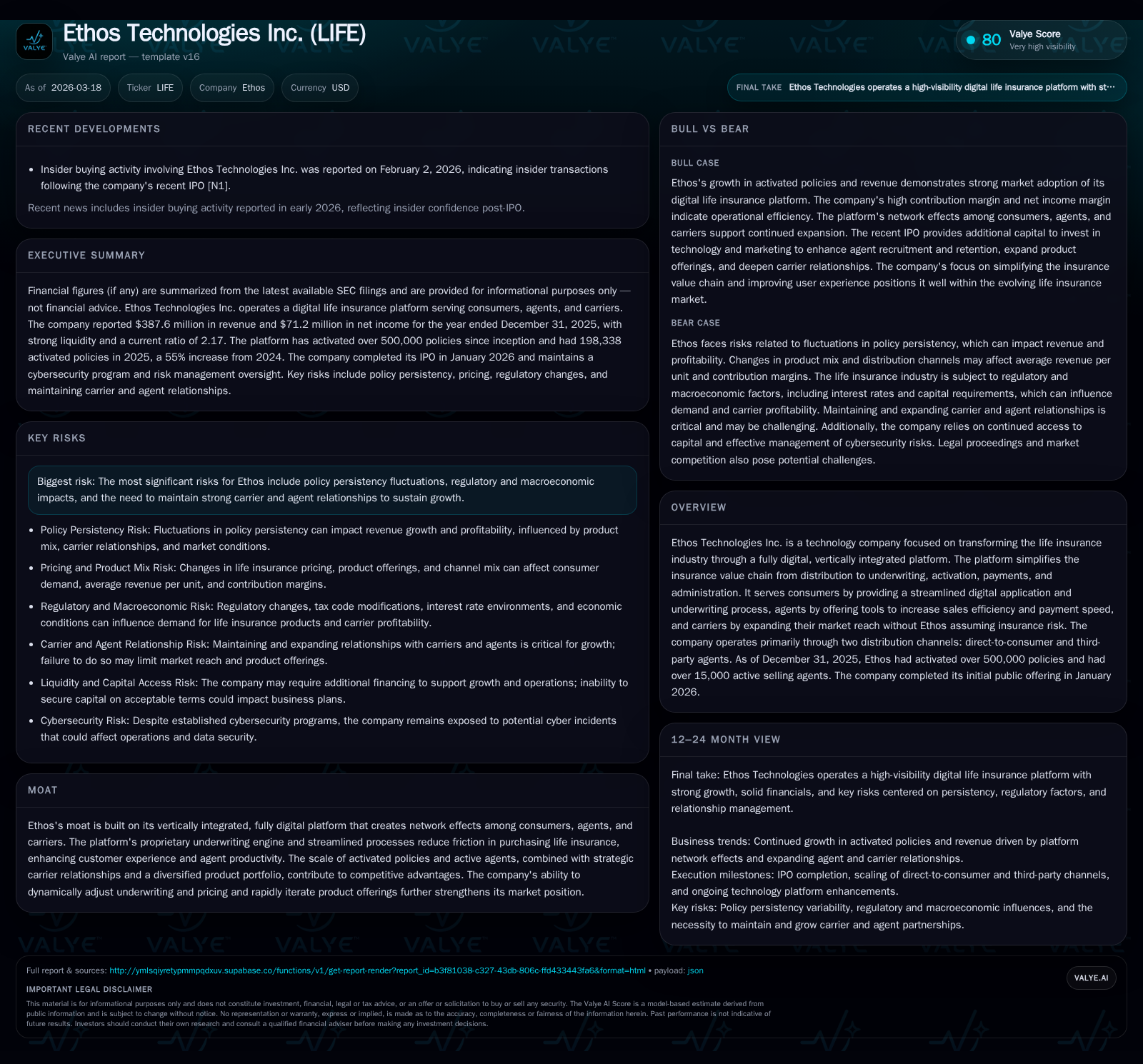
Ethos Technologies has rapidly scaled since inception, activating over 500,000 policies and growing its active selling agent base to over 15,000 as of end-2025. The company’s vertically integrated digital platform reduces friction in underwriting and administration, generating strong network effects across consumers, agents, and carriers. While contribution margins improved slightly from 2024 to 2025, persistency fluctuations and regulatory dynamics remain key growth risks. Cash flow generation is solid with positive free cash flow, supported by a healthy current ratio and ample cash reserves following its January 2026 IPO. Monitoring shifts in channel mix, carrier relationships, and product portfolio diversification will be essential for sustaining momentum and competitive advantage.
Company Overview
Ethos Technologies Inc. (LIFE) operates a fully digital life insurance platform designed to simplify the entire insurance value chain—from consumer application through underwriting, activation, payment collection, and ongoing administration [S14]. This vertical integration fosters network effects among consumers who seek an expedited purchasing experience, agents who gain productivity tools improving sales efficiency and payout speed, and carriers who broaden their market reach without taking balance sheet risk for policies issued on Ethos's platform [S14]. As of December 31, 2025, shortly before their IPO in January 2026 [N1], Ethos had activated over 500,000 policies and maintained more than 15,000 active selling agents [S14].
Historical Growth & Performance Drivers
Since inception, Ethos has demonstrated rapid top-line growth fueled by increasing adoption of its digital underwriting engine that reduces barriers such as lengthy medical exams in favor of proprietary health question algorithms enabling real-time or near-real-time approval for most consumers [S14]. Revenues primarily derive from commissions paid upfront by carriers upon policy activation plus recurring renewal commissions estimated using dynamic persistency assumptions [S24]. Their model avoids insurance risk retention by transferring it entirely to carriers.
Ethos reported substantial improvement in financial metrics from 2024 to 2025. Contribution profit increased from $105 million to $162 million—a margin increase from approximately 41% to 42%. This was driven by improved gross profit margins alongside effective management of sales and marketing expenses including advertising and agent payments [S6]. The company’s consolidated operating income for the full year ending December 31, 2025 was $72.9 million while net income reached $71.2 million up notably from prior periods [F1].
The table below summarizes selected annual financial performance:
Historical performance (annual)
| FY |
|---|
| 2025 |
Source: SEC companyfacts cache [F1].
Operating cash flow (CFO) figures are per SEC filings; free cash flow is estimated by subtracting capital expenditures primarily related to developed software assets critical for platform enhancements [S7][S13][F1]. Dividends or buybacks were not declared or executed during this period [S18].
Business Model & Competitive Advantages
Ethos's strength lies in its proprietary digital platform that enables rapid launching of new products combined with dynamic underwriting/pricing agility that can react to emerging data trends or carrier-specific needs [S14]. The Agent OS streamlines lead generation through self-service microsites plus simplifies quoting/application workflows enhancing agent throughput.
Carrier partnerships are foundational yet Ethos does not underwrite policies themselves or assume resulting balance sheet risks—a distinguishing characteristic reducing capital burden but linking financial results closely to the performance of partner insurers [S14][S29]. This model also generates network effects: expanding policy count attracts more agents seeking efficient payouts while carriers gain access to digitally native distribution channels.
Future Growth Prospects & Risks
Future growth hinges on expanding activated policies via both direct-to-consumer (DTC) and third-party agent channels with strategic carrier additions enabling broader product diversification [S29]. Product mix shifts—for instance between term life insurance versus indexed universal life—which carry different premium sizes and commission structures affect average revenue per user (ARPU) as well as persistency dynamics [S29].
Persistency—the rate at which customers retain policies beyond initial periods—remains a salient risk factor influencing renewal commissions that constitute ongoing revenue streams [S29]. Variability arises from market conditions, regulatory changes (such as tax rules impacting consumer demand), or shifting competitive forces among agents/carriers [S10][S29]. Seasonality effects concentrate policy activations in Q1 aligned with financial planning cycles offering opportunities for cost-effective customer acquisition [S29].
Macroeconomic headwinds like rising interest rates or labor market constraints also impact both customer affordability profiles and carrier profitability metrics which could moderate future growth or require pricing adjustments on Ethos’s dynamic platform [S10]. Maintaining robust carrier relationships while selectively onboarding new partners represents a tactical priority with room to increase market share given currently modest penetration among top carriers’ total premiums via Ethos’s channel [S29].
Capital Structure & Financial Position
Post-IPO proceeds netted about $82.6 million providing balance sheet liquidity supporting operational scaling and technology investment plans [N1][S18][S16]. At December 31, 2025 Ethos held approximately $91 million in cash/equivalents supplemented by short- and long-term investments diversified across government bonds and investment-grade corporate debt with no impairment allowances needed—a sign of conservative investment strategy preserving capital [S21][S22].
Current assets totaled roughly $246 million against current liabilities near $113 million yielding a healthy current ratio above 2x supporting working capital adequacy [F1][S21][S25]. The company generated positive free cash flow estimated near $34.7 million after deducting capital expenditures primarily related to developed software assets critical for maintaining competitive edge via iterative enhancements [F1][S13][S20].
Equity remains modest after conversion of redeemable preferred stock into common shares at IPO along with accumulated deficits partly reflecting prior investments in growth phases rather than dividends or share repurchases which have not been declared historically nor stated as plans currently [F1][S18][S23][S16]. Return on equity is negative reflecting early stage capital structure dynamics poised for improvement as scale grows [F1].
Risks & Governance Considerations
Key risks arise from varying policy lapse rates (“persistency”) which affect recognized revenues beyond initial sales commissions especially since renewal estimates get updated dynamically influencing reported results over time [S10][S29]. Regulatory developments affecting underwriting guidelines or capital requirements may impose new constraints or costs.
Carrier dependency introduces concentration risks as top three carriers accounted for majority share of revenues (38%,36%,14%) with corresponding sizable accounts receivable exposure; prudent diversification efforts are ongoing but partial concentration remains notable [S5][S29]. Cybersecurity remains monitored aggressively at board level given sensitive personal data handled digitally though no material breaches impacting operations have occurred recently [S1].
Operating leverage tied to technology investments requires balancing continual R&D spending with expected margin expansion fueled by scale efficiencies; management reports no impairments on goodwill or intangible assets indicating confidence in sustainable asset values so far [S11][S26]. The company must maintain velocity in digital innovation combined with channel expansion strategies to justify ongoing technology spend amid competitive industry dynamics.
Summary
Ethos Technologies represents a pioneering approach within life insurance distribution transforming traditional friction points through vertically integrated software-enabled workflows generating favorable network externalities across distinct ecosystem participants. Historicals reflect rapid growth coupled with expanding profitability driven by scalable tech infrastructure while carefully monetizing insurance risk via carrier partnerships. Standing at the cusp following its January IPO capital raise, Ethos’s challenges center around maintaining persistency trends for sustained revenue recognition quality plus broadening carrier/product diversity without sacrificing its nimble innovation culture nor risking key relationships. Financially robust with improving free cash flow metrics and strong liquidity buffers combined with judicious capital allocation focused on platform development positions Ethos well amid macroeconomic uncertainties common to financial services firms. Close monitoring of activated policies progression coupled with evolving channel/product mix alongside persistency metrics will provide leading indicators into execution effectiveness moving forward.
This report is prepared solely for informational purposes without providing investment advice or recommendations. Readers should consider this analysis as one perspective within broader due diligence efforts regarding Ethos Technologies Inc., recognizing inherent uncertainties referenced herein.
Disclaimer: This is research-only, informational analysis and not investment advice. It may include AI-generated interpretation and general industry context. Always verify important details using primary sources.

Comments