
Micron Technology's Transformational Earnings Surge Fuels Semiconductor Leadership
Examining Micron’s sharp operating income recovery, capital allocation approach, and competitive dynamics in memory semiconductors.
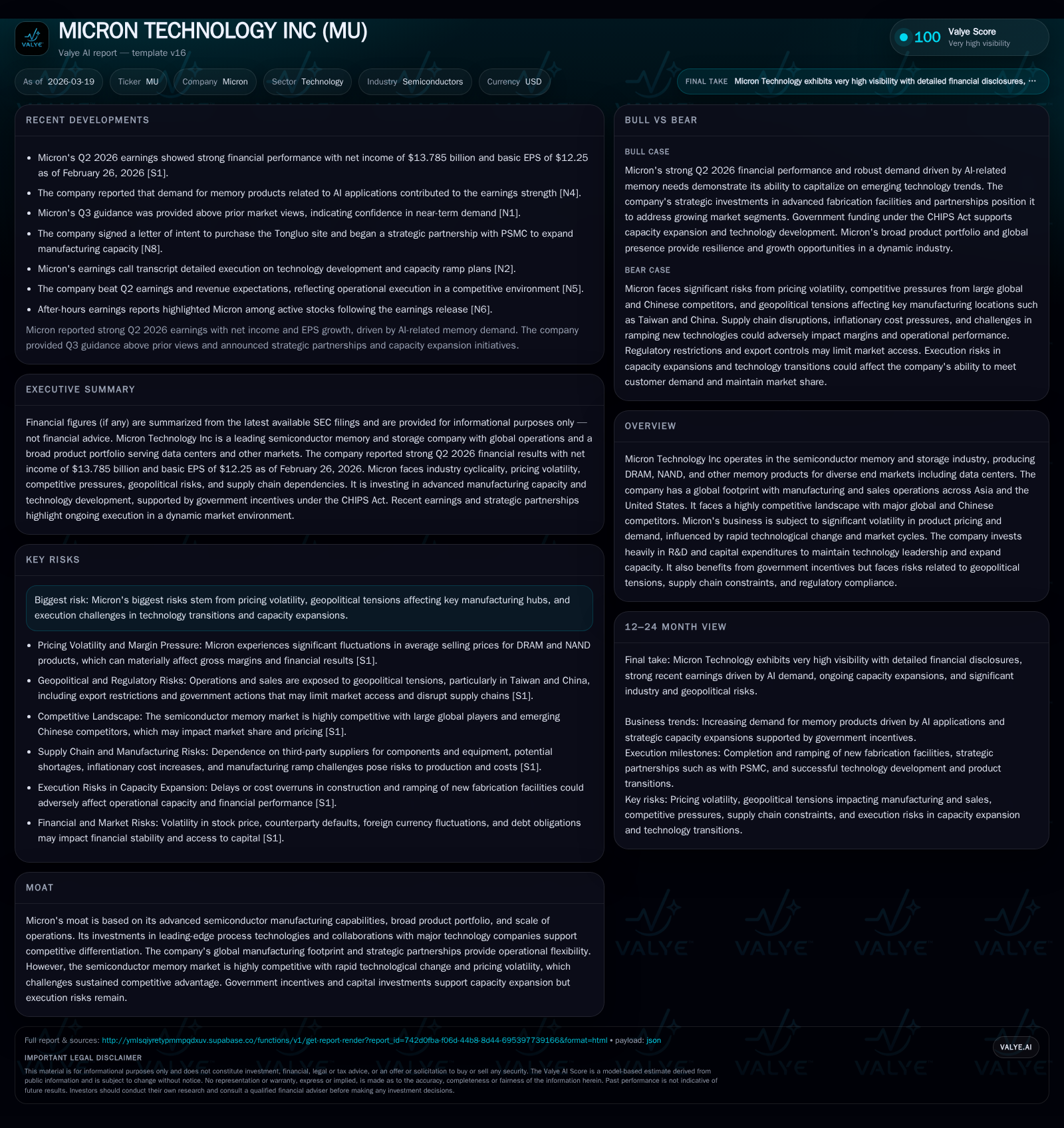
Micron Technology has rebounded dramatically from a significant operating loss in FY2023 to a strong profitability profile by FY2025, with operating income surging over 649% and net income nearly 1000%. This turnaround is underpinned by recovering DRAM pricing cycles, robust data center memory demand, and capacity expansions. The company’s elevated capital expenditures and R&D investments underscore its commitment to advanced process technologies, though it paused share buybacks despite strong cash flow generation. Forward guidance highlights AI-driven memory demand as a key growth vector amid continued market volatility and geopolitical risks.
Resurgence in Operating Income: Examining Growth Drivers Over Recent Years
The trajectory of Micron Technology’s operating performance over the past four years underscores a remarkable turnaround. After posting an operating loss of $5.7 billion in FY2023 amid deep DRAM price troughs and memory market oversupply, Micron reversed course sharply to register operating income of $1.3 billion in FY2024 and then a dramatic surge to $9.8 billion in FY2025 [F1]. This translates into an operating income growth rate of approximately 649% between FY2024 and FY2025 alone—a scale reflective of both cyclical price rebound and operational improvements.
Net income echoed this recovery pattern with an almost ten-fold increase from $778 million in FY2024 to nearly $8.54 billion in FY2025 after a severe loss in FY2023 [F1]. Revenue trends stabilized alongside this profit rebound, with notable concentration of demand in data center end markets which accounted for roughly half of total revenue in 2025 [S6]. Recovery of average selling prices (ASPs) for DRAM products—traditionally volatile given supply-demand imbalances—was a critical driver, coupled with higher wafer fab capacity utilization rates.[S13]
Micron’s ability to improve manufacturing yields, reduce defect density through process refinements (such as lithography node scaling down to advanced process nodes), and expand output enabled them to capture improved pricing without sacrificing gross margins despite intensifying competition.[S13,S6] The company’s large-scale fabs across Asia and the United States provided operational flexibility crucial during this cyclical upswing.
Historical performance (annual)
| FY | Net ($bn) | CFO ($bn) | OpInc ($bn) | Capex ($bn) | Net YoY |
|---|---|---|---|---|---|
| 2025 | 8.5 | 17.5 | 9.8 | 15.9 | +997.6% |
| 2024 | 0.8 | 8.5 | 1.3 | 8.4 | +113.3% |
| 2023 | -5.8 | 1.6 | -5.7 | 7.7 | -167.1% |
| 2022 | 8.7 | 15.2 | 9.7 | 12.1 |
Source: SEC companyfacts cache [F1].
Capital returns and efficiency (annual)
| FY | Div ($mm) | Buybacks ($bn) | FCF ($bn) |
|---|---|---|---|
| 2025 | 522 | 0.0 | 1.7 |
| 2024 | 513 | 0.3 | 0.1 |
| 2023 | 126 | 0.4 | -6.1 |
| 2022 | 461 | 2.4 | 3.1 |
Source: SEC companyfacts cache [F1].
Table: Annual Financial Performance Summary FY2022-FY2025 [F1]
Strategic Capital Deployment: Balancing Capex Investment with Shareholder Returns
Amid this earnings momentum Micron sharply increased capital expenditures (capex), nearly doubling year-over-year from $8.39 billion in FY2024 to $15.86 billion in FY2025 [F1]. This capex ramp reflects investment in advanced node memory manufacturing capabilities designed to maintain competitive differentiation as the firm seeks leadership in DRAM and NAND technologies at smaller lithography nodes incorporating more complex process layers.[S29]
Research & Development also remains a strategic priority with sizable expenditures disclosed tied directly to new memory architectures and memory stacking technologies that improve density and throughput.[S29] Such R&D outlays are essential given industry pressures including increasing complexity from multi-level cell NAND designs and evolving demands for high bandwidth memory products suited for AI workloads.[S6]
Despite strong cash generation that saw operating cash flow exceed $17.5 billion (a doubling compared to prior year), Micron elected not to repurchase any shares during FY2025 contrasted with moderate buybacks previously executed ($300 million repurchased in FY2024).[F1,S4] While dividends rose slightly to $522 million (~modest payout relative to cash flow), management seems focused on preserving liquidity to support ongoing capacity expansions as well as potential regulatory or geopolitical contingencies.[S4]
Market Outlook: Insights from Latest Earnings Reports and Forward Guidance
The Q2 fiscal 2026 earnings report released March 18 reinforced positive momentum with results surpassing Street estimates on both revenue and profitability metrics.[N2,N3,N4] Management highlighted sustained strength originating from AI-related workload demands pushing higher data storage requirements—particularly elevated demand for high-bandwidth DRAM variants.[N3]
Forward guidance remains optimistic yet carefully calibrated given inherent semiconductor cyclicality; margins may face pressure if pricing softens or if inventory corrections occur downstream.[N2,N5] Investors are advised to monitor inventory turns at major customers along with ASP trends for next quarter as early indicators of sustained demand shifts or margin compression risks.
Key Segments and Competitive Positioning in Semiconductor Memory
Micron’s comprehensive product portfolio spans commodity DRAM modules through innovative NAND flash configurations—with system-level solutions such as managed NAND SSDs offering incremental margin potential albeit at higher manufacturing cost intensity.[S6,S8]
The firm continues developing next-gen wafer starts focused on smaller process technology nodes helping address ASP pressures with improved cost per gigabit efficiencies.[S13] However industry rivalry remains fierce particularly from South Korean peers Samsung and SK Hynix as well as emerging Chinese manufacturers leveraging subsidies for capacity ramp-up posing competitive pressures on pricing and market share.[S8]
Strategic partnerships combined with expansive manufacturing footprint provide some moat protection but do not immunize against abrupt shifts driven by tariff regimes or altered customer purchasing patterns especially within hyperscale data center markets where bit content per system is rising due to AI adoption.[S6]
Navigating Risks: Supply Chain, Pricing Volatility, and Geopolitical Challenges
SEC filings outline extensive risk factors including pronounced volatility in average selling prices that materially affect gross margins given memory's commoditized nature.[S2,S13] The firm's international operational footprint spanning Taiwan, Singapore, China poses exposure to geopolitical tensions that might disrupt supply chains or result in trade restrictions complicating material sourcing or equipment procurement.[S5,S7,S18]
Additional execution risk centers on timely ramping of capacity expansions where delays or yield issues could impair supply alignment with forecasted demand risking lost revenue or damaged customer relations.[S9,S21] Tariff investigations launched by U.S authorities could introduce further uncertainty impacting cost structures.[S15]
Legal risks relating to intellectual property infringement claims remain notable given Micron’s reliance on proprietary manufacturing methods; managing talent retention critical to sustaining IP development is also referenced prominently among risk disclosures.[S14,S16]
Financial Health and Return Metrics: A Close Look at ROE, Cash Flows, Dividends, and Buybacks
Micron exhibits healthy return metrics with approximate ROE at about 15.8% calculated using latest annual net income over equity figures [F1], affirming efficient profit generation on shareholder funds.
Operating cash flow more than doubled year-over-year demonstrating robust cash conversion even amid heavy investment cycles [F1]. Free cash flow remains positive around $1.67 billion after subtracting capex indicating sustainable internal financing capacity.
Dividend payments have increased steadily though remain modest relative to free cash flow—signaling a cautious approach balancing stakeholder returns with reinvestment needs [F1,S4]. The halt of share repurchases in the most recent fiscal year contrasts earlier years but likely reflects capital prioritization towards technology investments given ongoing capital intensity requirements.
The current ratio near 2.9 underscores strong liquidity position ensuring coverage of short-term obligations providing financial flexibility amid volatile industry cycles.[F1]
Insights from Management Commentary and Market Reactions
CEO Sanjay Mehrotra has publicly conveyed confidence tied directly to AI-led increases in overall memory content per system driving demand upscaling,[N7] resonating positively with investors as reflected by steady stock price movement following the March earnings release [N1,N9]. Market commentary frequently references AI adoption as a structural shift underpinning medium-term growth prospects but balanced against inherent end-market cyclicality inherent to semiconductor products.
Investor sentiment appears cautiously constructive appreciating operational execution success alongside measured capital discipline despite lingering macro uncertainties tied chiefly to global trade policies.
Disclaimer: This analysis is based strictly on documented financial disclosures ([F1],[S#]) and publicly reported news ([N#]) without speculation beyond cited company statements or regulatory filings. It does not constitute investment advice or recommendations.
Disclaimer: This is research-only, informational analysis and not investment advice. It may include AI-generated interpretation and general industry context. Always verify important details using primary sources.

Comments