
Mount Logan Capital’s Dual-Engine Growth Challenged by Q4 Losses and Competitive Pressures
Mount Logan Capital exhibits rapid asset growth fueled by its integrated private credit and insurance platforms, yet faces earnings volatility and fierce competition risks.
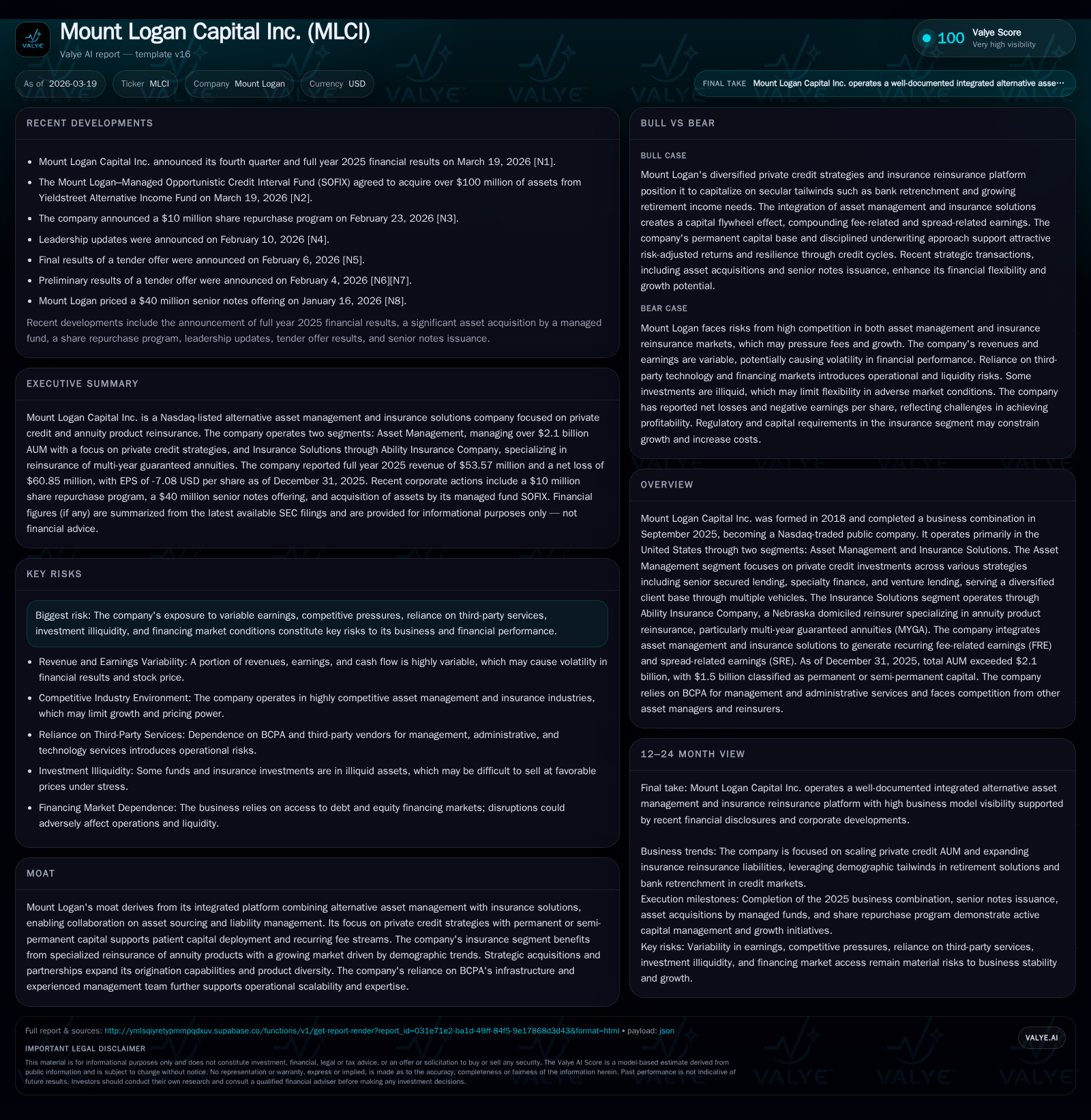
Mount Logan Capital Inc. transitioned to a public company in late 2025, operating two synergistic segments: private credit asset management and MYGA annuity reinsurance through Ability Insurance Company. By year-end 2025, it surpassed $2.1 billion in assets under management but reported a net loss of $60.8 million, underscoring earnings variability tied to insurance spreads and fee-related income. Competitive pressures in both alternative credit and annuity reinsurance markets, along with regulatory and liquidity challenges, frame the company's growth outlook. Capital allocation focuses on fueling insurance platform scale and enhancing recurring earnings streams while managing interest rate and prepayment risks inherent to its business model.
Tracking Mount Logan’s Growth to Public Company Status and Beyond
Mount Logan Capital was formed in 2018 but underwent significant structural transformation culminating in a business combination closing on September 12, 2025 [S1][S3][S19]. This transaction was treated as a reverse acquisition for accounting purposes with Legacy Mount Logan identified as the accounting acquiror despite legally being acquired, resulting in Mount Logan emerging as a Nasdaq-listed entity. The merger effectively repositioned the company to leverage an integrated platform merging alternative asset management capabilities with specialized insurance solutions.
Historically operated primarily through subsidiaries Mount Logan Management LLC (for asset management) and Ability Insurance Company (for insurance solutions), the business combination formalized these units under a publicly traded parent while expanding capital access [S1]. This strategic repositioning is pivotal to understanding both past performance drivers and future growth dependencies.
Profiling the Integrated Platform: Asset Management Meets Insurance Solutions
Mount Logan’s dual-segment operating model integrates:
Asset Management: Focuses on private credit including senior secured loans, specialty finance, venture lending, interval funds like SOFIX and ACIF, BDC platforms (e.g., Logan Ridge Finance), as well as separate accounts [S1][S4][S19]. Its strategy emphasizes deploying patient capital into middle-market companies with risk-adjusted returns while generating recurring fee-related earnings (FRE). FRE reflects recurring fees such as management fees, servicing fees, interest income from investment management activities, less related expenses [S15][S18].
Insurance Solutions: Operated through Ability Insurance Company domiciled in Nebraska; primarily reinsures multi-year guaranteed annuities (MYGA) via quota-share coinsurance treaties with partners like Atlantic Coast Life Insurance Company and Sentinel Security Life Insurance Company [S1][S27]. This segment generates spread-related earnings (SRE), being the net yield spread between investment returns on assets backing liabilities minus guaranteed interest credited to policyholders [S22]. The integrated model facilitates alignment between asset origination (private credit) and liability management (annuity reinsurance), creating operational synergies underpinning recurring fee streams and spread income.
Evaluating Primary Growth Drivers and Year-Over-Year Trajectories
Mount Logan reported FY 2025 revenue of approximately $53.6 million while posting a net loss of $60.8 million [F1][N1]. This [$60.8M] loss equates to an ROE of about -66.9% based on reported equity at year-end [F1]. While revenue growth highlights strong top-line momentum coinciding with exceeding $2.1 billion total AUM — including ~$1.5 billion allocated towards permanent or semi-permanent capital strategies — profitability remains challenged by expenses linked to integration efforts, operating leverage limitations, and volatile insurance segment results [F1][N1][S15].
Historical performance (annual)
| FY |
|---|
| 2025 |
Source: SEC companyfacts cache [F1].
The lack of comparable prior-year public data restricts YOY analysis; however, management commentary notes rapid asset gathering across multiple vehicles while investing heavily in scaling resources post-merger [N1][S15]. The negative net income partly reflects non-recurring costs tied to business combination activities as well as increased provisions related to risk management in both segments.
Dissecting Earnings Variability: Influence of Asset Management Fees and Insurance Spreads
A notable characteristic of Mount Logan’s financials is earnings volatility stemming from revenue mix diversity [S1][S5][S7]. The Asset Management segment produces relatively stable fee-related earnings derived from ongoing management fees calculated on AUM; however, these fees can fluctuate depending on asset performance valuations which can affect performance fees if applicable [S18]. Meanwhile, the Insurance Solutions segment’s earnings vary due to:
- Policyholder behaviors impacting lapse rates or prepayments that affect spread income realization.
- Interest rate fluctuations influencing funding costs and hedging outcomes.
- Competitive pressure constraining profitable blocks or flow treaty pricing.
- Regulatory capital requirements necessitating ongoing capital injections that absorb cash flow.
This interplay makes predicting steady quarterly earnings difficult; consequently, the stock exhibits trading price volatility reflecting these underlying cash flow swings [S1]. Asset illiquidity compounds challenges since some private credit investments cannot be readily sold without discounts affecting portfolio mark-to-market valuations [S20].
Competitive Landscape and Market Position in Specialized Private Credit and MYGA Reinsurance
Mount Logan competes with established alternative asset managers nationally for private credit funds alongside financial entities such as banks and specialist lenders [S6][S11]. Its focus on direct origination into less competitive niches aims to mitigate commoditization but does not fully shield from pricing pressures given expanding investor supply seeking similar risk profiles.
In the annuity reinsurance space via Ability Insurance Company, the firm contends with firms typically holding AM Best ratings offering broader networks and stronger financial strength acknowledgments; Mount Logan currently lacks such ratings which could inhibit scaling or force pricing concessions [S7]. The competitive intensity around quota-share coin transactions affects volume growth potential for MYGA blocks; market participants with deeper balance sheets often secure preferential terms limiting Ability’s ability to increase margins or market share [S7][S11].
Capital Structure, Redeployment Strategy, and Shareholder Returns
Capital allocation post-merger prioritizes reinforcing Ability’s statutory capital base with incremental funding totaling over $37 million since acquisition closure [S22], supporting underwriting capacity for growing MYGA liabilities. Alongside this foundational buildout, Mount Logan announced a $10 million share repurchase program intended to enhance shareholder value amid valuation volatilities [N6][S9].
The company uses BCPA infrastructure extensively under Servicing and Staffing Agreements providing administrative efficiencies but introduces dependency risks regarding vendor service continuity [S14][S16]. While cash flow generation remains constrained by negative net income reported for FY 2025 ([F1]), focused reinvestments aim at compounding Fee Related Earnings (FRE) alongside Spread Related Earnings (SRE) through an expanded integrated platform reach.
Analyzing Regulatory Environment Impacts on Profitability and Expansion Opportunities
Regulatory oversight layers mount across both advisory registrants under the Investment Advisers Act through ML Management as well as state-level insurance regulators overseeing Ability’s operations [S5][S7][S8]. Compliance mandates include minimum risk-based capital ratios (RBC), product approvals for new MYGA treaties prior to execution by states’ insurance authorities, periodic SEC examinations of asset management practices subjecting fiduciary rules adherence [S7][S8].
These regimes generate operational cost burdens while constraining flexibility in product innovation or geographic expansion pending regulatory approvals. Additionally, privacy laws like Gramm-Leach-Bliley imposed recordkeeping obligations with rising scrutiny around consumer data security introduce further compliance complexity [S12]. Potential tightening of solvency frameworks or holding company regulations under NAIC initiatives may limit aggressive growth levers or necessitate higher capital reserves thereby reducing return on equity potential [S25].
What to Watch: Upcoming Milestones, Tender Offer Effects, and Integration Execution
Key near-term developments include:
- The completed tender offer announced February 2026 reducing outstanding shares which may improve per-share metrics though at near-term cash cost liquidity impact [N2][N3][N4].
- Acquisition by Mount Logan-managed SOFIX fund of over $100 million assets transferred from Yieldstreet Alternative Income Fund broadening asset base potentially bolstering fee revenues if integration proceeds smoothly [N5].
- Leadership updates in early February 2026 signaling strategic continuity or shifts essential for successful scaling post-merger completion [N7].
- Ongoing remediation efforts around employee misconduct uncovered impacting certain portfolio companies reflecting reputational risks needing containment [S17].
Absent explicit forward guidance beyond stated strategic priorities, market participants should monitor quarterly operational margins evolution reflecting execution success on integrating diverse credit strategies alongside growing insurance liabilities underwriting efficiently within regulatory confines.
This report is for informational purposes only and does not constitute investment advice.
Disclaimer: This is research-only, informational analysis and not investment advice. It may include AI-generated interpretation and general industry context. Always verify important details using primary sources.

Comments