
DarioHealth’s Persistent Losses and Liquidity Maneuvers Reflect Strained Growth Amid Geopolitical Exposure
Despite revenue growth, DarioHealth wrestles with ongoing net losses and operational challenges tied to geopolitical risk and supply chain issues.
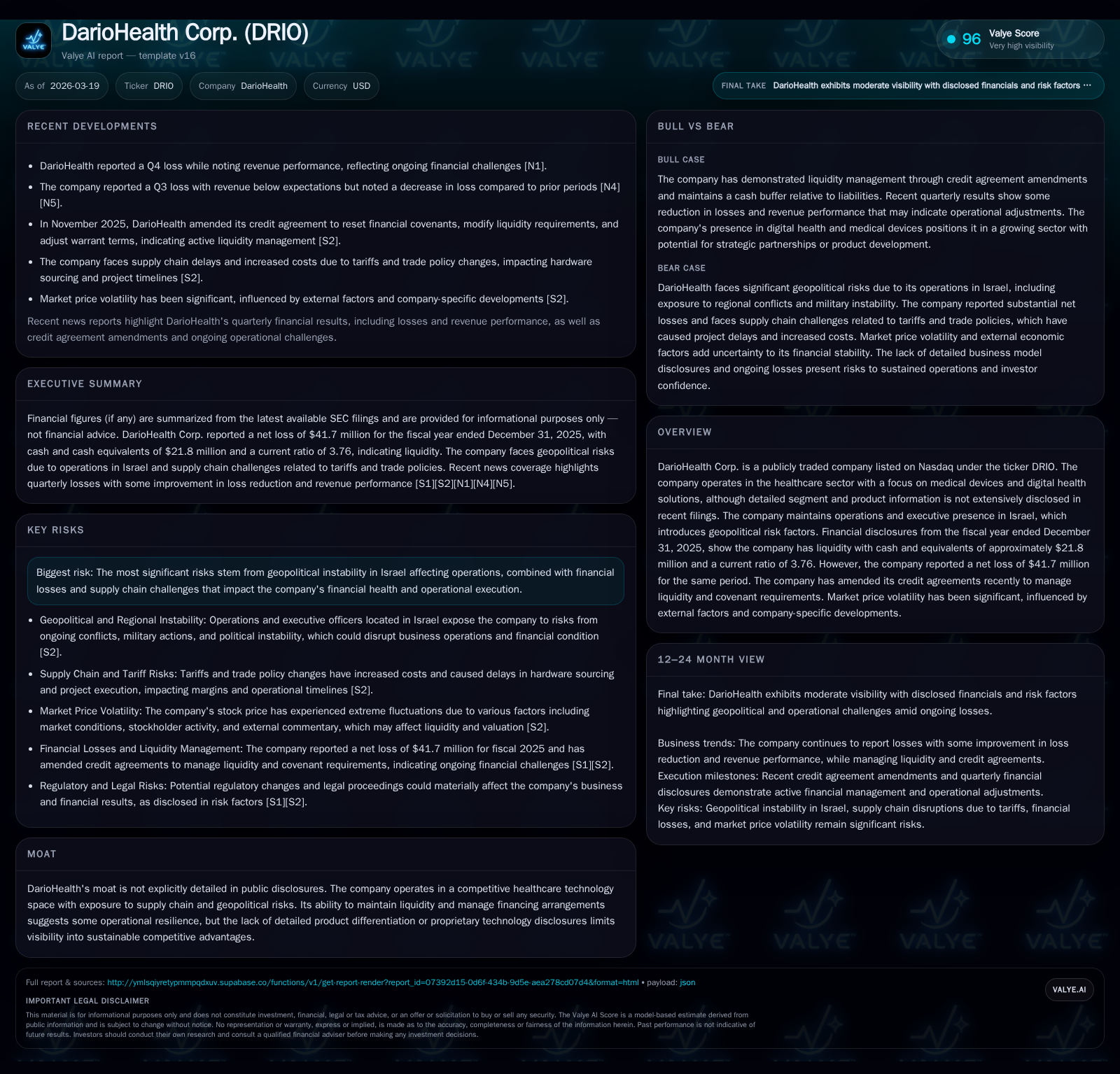
DarioHealth Corp. has experienced steady revenue expansion over recent years but continues to report substantial operating and net losses, with a notable $41.7 million net loss in fiscal 2025 [F1]. The company maintains a strong liquidity position, partly through credit agreement amendments that reset covenants and provide additional discretionary funding [S7]. Geopolitical instability affecting its Israeli operations adds complexity to business continuity and risk management [S2][S4]. Supply chain dynamics, including tariffs and overseas manufacturing pressures, constrain operational efficiency [S8]. While the company’s current ratio indicates short-term financial health, negative cash flow from operations persists [F1]. Future growth depends on navigating these external risks alongside internal execution improvements.
Historical Performance: Incremental Revenue Growth Against Persisting Losses
Historical performance (annual)
| FY | Net ($mm) | CFO ($mm) | OpInc ($mm) | Capex ($) | Net YoY |
|---|---|---|---|---|---|
| 2025 | -42 | -26 | -37 | 142000 | +2.4% |
| 2024 | -43 | -39 | -58 | 138000 | +28.1% |
| 2023 | -59 | -30 | -56 | 584000 | +4.4% |
| 2022 | -62 | -48 | -57 | 442000 |
Source: SEC companyfacts cache [F1].
Capital returns and efficiency (annual)
| FY | Buybacks ($) | FCF ($mm) | ROE% |
|---|---|---|---|
| 2025 | -26 | -61.4 | |
| 2024 | -39 | -59.4 | |
| 2023 | 134000 | -31 | -102.2 |
| 2022 | 134000 | -48 | -77.7 |
Source: SEC companyfacts cache [F1].
DarioHealth demonstrated notable revenue growth from approximately $823K in 2015 to $7.39 million by the end of 2018 [F1]. Post-2018 revenue details are not explicitly disclosed in filings, limiting recent topline visibility. Operating results show persistent significant losses: operating income improved from negative $57.7 million in FY2024 to negative $36.7 million in FY2025, a roughly 36.5% improvement year-over-year [F1]. Net income remained deeply negative at -$41.7 million in FY2025, marginally improved relative to prior years with losses exceeding $40 million annually [F1]. These sustained deficits reflect ongoing investments in product development and market initiatives.
Operating cash flow showed relative improvement as well, moving from -$38.6 million in FY2024 to -$25.9 million in FY2025 (about a 33% improvement) [F1]. Capital expenditures remained low at $142K for FY2025, consistent with the company's focus on digital health solutions which typically require lower fixed asset investment than traditional medical device companies [F1][S27].
Liquidity Position and Financial Structure
As of December 31, 2025, DarioHealth held $21.8 million in cash and equivalents with current assets totaling approximately $35.1 million against current liabilities of around $9.3 million, resulting in a robust current ratio of 3.76x—indicating solid short-term liquidity despite ongoing losses [F1]. This liquidity strength is supported by a November 2025 amendment to its Callodine loan facility that reset financial covenants (including a minimum consolidated unencumbered liquid assets covenant), waived covenant testing for parts of 2025, introduced monthly cash-flow reporting requirements under certain conditions, and provided discretionary funding capacity subject to lender approval ($2.5 million) [S7][S19].
Equity stood near $67.9 million at year-end 2025 after absorbing cumulative net losses; this stability was aided by equity financing activities such as preferred stock conversions that increased share count without immediate cash dilution but add complexity to the capital structure [F1][S20][S25].
Geopolitical Exposure and Operational Risks
The company’s executive leadership presence in Israel exposes it to geopolitical risks stemming from multi-front regional conflicts involving Hamas, Hezbollah, Iran, and related ceasefires during late 2023 through mid-2025. These events pose risks such as workforce disruptions due to mandatory military reserve duties and broader economic instability potentially impacting business continuity and vendor reliability [S2][S4][S6][N1].
Insurance coverage excludes war-related damages; while the Israeli government provides some compensation for direct damages caused by terrorism or acts of war, future coverage sufficiency is uncertain should hostilities escalate again [S2][S4].
These geopolitical challenges compound supply chain difficulties already stressed by U.S.-imposed tariffs affecting components manufactured in China—delays attributed to tariffs have extended project timelines and increased costs adversely affecting margins [S8][N1].
Growth Prospects and Strategic Considerations
While no explicit forward guidance is provided post-March 2026 filings, strategic moves include increasing authorized shares under its equity incentive plan by 500,000 shares and amending corporate governance documents to grant greater board flexibility—actions indicating active capital structure management amid ongoing operational challenges [S10][S20].[N1] Such steps may facilitate future strategic alternatives including partnerships or sales.
Industry tailwinds favoring digital health adoption present growth opportunities; however, competitive intensity remains high without disclosed proprietary advantages.
Returns Profile and Capital Allocation
Due primarily to recurring net losses relative to shareholders’ equity (~$67.9M at FY-end '25), approximate return on equity was deeply negative near -61% for FY2025 (net income divided by equity) reflecting ongoing unprofitability rather than capital efficiency issues [F1]. No dividends were declared nor significant share repurchases undertaken during this period [S10][F1].
Free cash flow remains negative given operating outflows far exceeding minimal capital expenditures (estimated negative ~$26 million), underscoring continued reliance on external financing sources for liquidity maintenance [F1][S16].
What To Watch Next
With no explicit financial targets disclosed after March 2026 filings [N1][S1], investors should monitor:
- Progress on strategic alternatives or restructuring initiatives;
- Developments regarding geopolitical stability impacting Israeli operations;
- Efforts to mitigate supply chain disruptions related to tariffs;
- Future quarterly revenue disclosures for clearer growth trajectory insights;
- Liquidity status vis-à-vis debt covenant compliance or refinancing activities;
- Signs of product innovation or differentiation within competitive digital health markets;
- Stock price response reflecting fundamental business developments.
This analysis synthesizes publicly disclosed regulatory filings alongside relevant news sources as of March 19, 2026. It is intended as an objective overview based solely on documented facts without investment recommendations.
Disclaimer: This is research-only, informational analysis and not investment advice. It may include AI-generated interpretation and general industry context. Always verify important details using primary sources.

Comments