
Whitehawk Therapeutics Elevates ADC Innovation with CPT113 Platform Progress
Whitehawk Therapeutics sharpens its focus on next-gen ADCs leveraging its proprietary CPT113 platform amid advancing clinical trials and evolving financial posture.
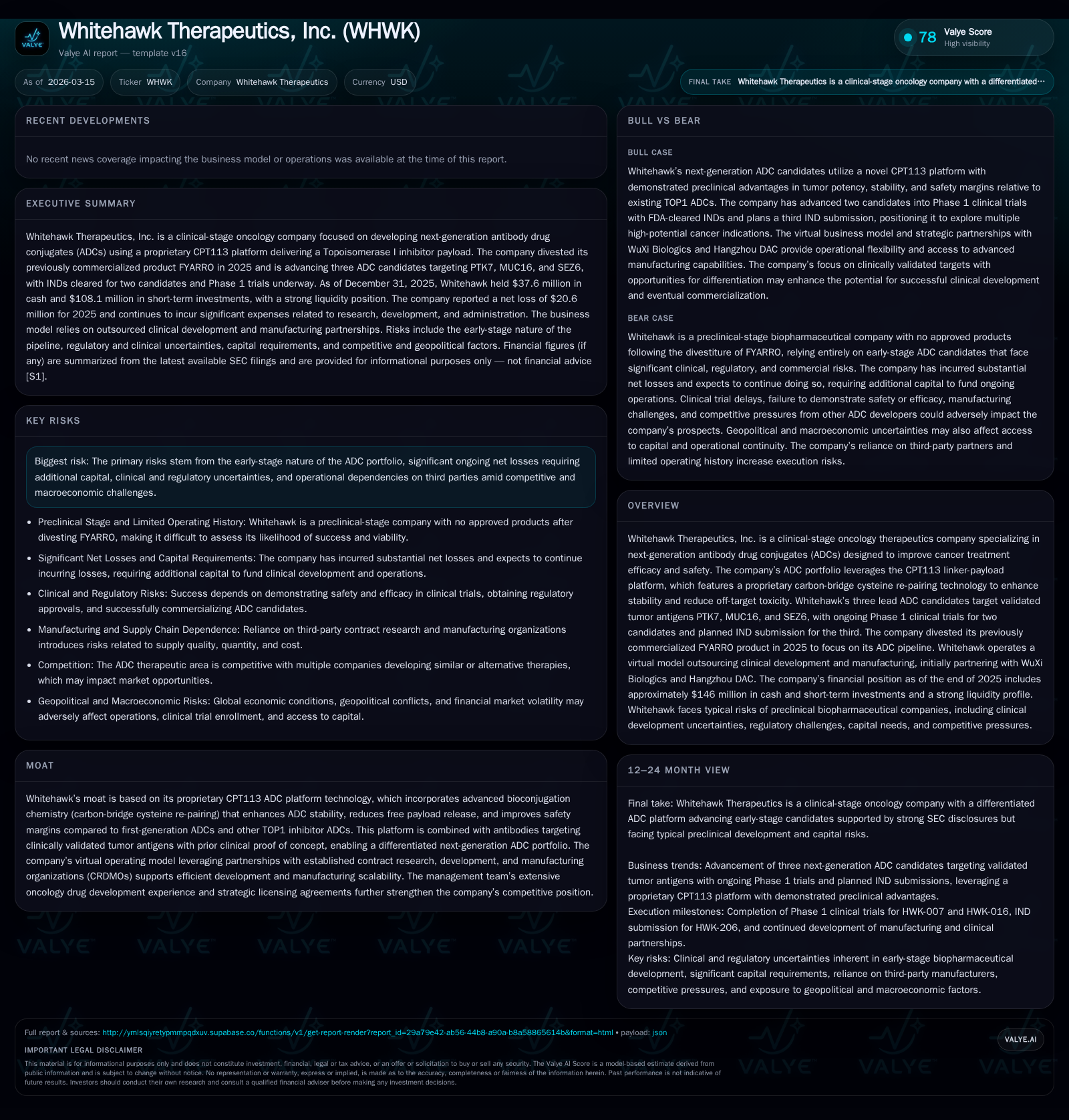
Whitehawk Therapeutics has strategically transformed its portfolio by divesting FYARRO to concentrate on a trio of next-generation antibody drug conjugates built on the CPT113 linker-payload platform. The company’s Phase 1 clinical trials for HWK-007 and HWK-016 are actively recruiting with data anticipated in early 2027, while an IND submission for HWK-206 is planned for mid-2026. Financially, escalating operating losses reflect growing R&D investments characteristic of early-stage biopharma, balanced against a solid liquidity position supported by a high current ratio. Operational reliance on external partners underscores both efficiency and risk as Whitehawk navigates complex development and regulatory pathways.
Transitioning Portfolio: Divestment of FYARRO and Focus on ADC Pipeline
In 2025, Whitehawk Therapeutics divested its commercial product FYARRO to concentrate exclusively on developing a portfolio of three next-generation antibody drug conjugates (ADCs) utilizing its proprietary CPT113 linker-payload platform targeting validated tumor antigens PTK7, MUC16 (membrane-bound), and SEZ6 (biparatopic) [S1][F1]. This strategic refocus aims to leverage advanced drug delivery technologies to address significant unmet needs in oncology while concentrating resources on clinical proof-of-concept milestones.
Proprietary CPT113 Linker-Payload Platform: Technological Edge in ADC Development
The CPT113 platform integrates carbon-bridge cysteine re-pairing chemistry designed to enhance molecular stability in circulation, thereby reducing premature payload release which can cause off-target toxicity [S1]. This platform delivers a potent Topoisomerase I (TOP1) inhibitor payload selectively into tumor cells. The biparatopic antibody approach against SEZ6 exemplifies sophisticated antibody engineering intended to increase tumor specificity and binding avidity.
Together, these innovations aim to improve therapeutic index compared to first-generation ADCs by enhancing safety margins critical for oncology therapeutics.
Clinical Milestones: Phase 1 Trials Progress and Anticipated Data Readouts
Whitehawk’s lead candidates HWK-007 (targeting PTK7 for NSCLC and ovarian cancer) and HWK-016 (targeting MUC16 for ovarian and endometrial cancers) have entered active Phase 1 recruitment following FDA clearance of their IND applications submitted in late 2025 [S1][S3]. These trials are evaluating safety, dosing, pharmacokinetics, and preliminary efficacy across multiple solid tumor indications.
An IND submission for HWK-206 (targeting SCLC and neuroendocrine tumors) is planned for mid-2026 [S3]. Data readouts from the ongoing Phase 1 trials are expected in the first half of 2027. Enrollment challenges typical of early-stage oncology trials—such as competition for patients within narrow indications—remain key operational risks.
Financial Performance: Escalating Operating Losses Amid R&D Investments
Whitehawk’s financial results reveal increasing operating losses aligned with intensified R&D investment: operating loss expanded to $114.4 million in FY2025 compared to $67.5 million in FY2024, a nearly 70% increase year-over-year [F1]. However, net loss narrowed significantly by approximately 67.7% to $20.6 million in FY2025 from $63.7 million previously, reflecting shifts in expense recognition or other accounting factors detailed in filings.
Operating cash flow outflows grew to $97.4 million in FY2025 consistent with scaled development activities. Capital expenditures remained modest at $0.55 million reflecting reliance on outsourced manufacturing [F1].
Historical performance (annual)
| FY | Net ($mm) | CFO ($mm) | OpInc ($mm) | Capex ($mm) | Net YoY |
|---|---|---|---|---|---|
| 2025 | -21 | -97 | -114 | 1 | +67.7% |
| 2024 | -64 | -60 | -67 | 2 | +3.2% |
| 2023 | -66 | -60 | -72 | 4 | -8.7% |
| 2022 | -61 | -50 | -63 | 0 |
Source: SEC companyfacts cache [F1].
Capital returns and efficiency (annual)
| FY | FCF ($mm) | ROE% |
|---|---|---|
| 2025 | -98 | -15.1 |
| 2024 | -61 | -121.4 |
| 2023 | -64 | -62.5 |
| 2022 | -50 | -38.2 |
Source: SEC companyfacts cache [F1].
(Source: [F1])
Capital Allocation and Liquidity Position: Managing Cash Amid Early Development
At December 31, 2025, Whitehawk reported cash and equivalents of approximately $37.6 million supported by total current assets of about $149 million against current liabilities near $14.5 million, yielding a strong current ratio exceeding 10 [F1][S2][S16]. This liquidity base supports ongoing clinical operations but given substantial negative free cash flow estimated near $98 million in FY2025, additional capital raises will likely be necessary to sustain pipeline advancement.
The company has not paid dividends or conducted share repurchases since FY2022 consistent with prioritizing cash conservation during this pre-revenue stage [F1]. Capital deployment focuses primarily on outsourced clinical development through collaborations with WuXi Biologics and Hangzhou DAC Biotechnology enabling scalable operations without heavy fixed asset investment.
Risks and Operational Dependencies: Third-Party Manufacturing and Regulatory Challenges
Whitehawk’s virtual business model relies heavily on third-party collaborators including WuXi Biologics for antibody generation and Hangzhou DAC for CPT113 linker-payload technology [S1][S2]. This dependency introduces risks related to supply chain disruptions, quality control issues, or geopolitical factors that could delay clinical progress.
Regulatory compliance presents multifaceted challenges encompassing FDA review timelines, adherence to healthcare fraud/abuse laws, privacy regulations such as HIPAA, anti-kickback statutes, pricing transparency mandates, among others detailed extensively in SEC filings . Additionally, patient enrollment hurdles within specialized oncology indications present ongoing operational risks.
The company’s growth strategy also depends on successful pipeline expansion potentially via licensing or acquisition opportunities beyond internal development programs [S1][S2].
Outlook: Key Milestones Through Mid-2027
Key upcoming catalysts include the planned IND filing for HWK-206 anticipated mid-2026 followed by data readouts from the Phase 1 trials of HWK-007 and HWK-016 expected during the first half of 2027 [S3]. These milestones will be critical indicators of safety profile acceptability, dosing feasibility, pharmacodynamic activity, and preliminary efficacy.
Investors should also monitor future equity financing activities given the prevailing operating losses and negative free cash flow that underscore the need for capital infusion beyond existing reserves [F1][S16].
Regulatory scrutiny related to manufacturing compliance, healthcare law adherence, environmental liabilities remains material considerations potentially impacting costs or approval timelines .
Successful navigation through these inflection points will shape Whitehawk’s trajectory toward later-stage development investments or eventual commercialization prospects contingent on emerging clinical evidence from these innovative CPT113-enabled ADC therapies.
This analysis is based exclusively on publicly available information sourced from Whitehawk Therapeutics’ SEC filings ([F1], [S#]), supplemented by relevant news releases ([N#]). It is provided as an objective company overview without investment recommendation.
Disclaimer: This is research-only, informational analysis and not investment advice. It may include AI-generated interpretation and general industry context. Always verify important details using primary sources.

Comments