
OnKure Therapeutics Charts Precision Oncology with Mutant-Selective PI3K Alpha Inhibitors
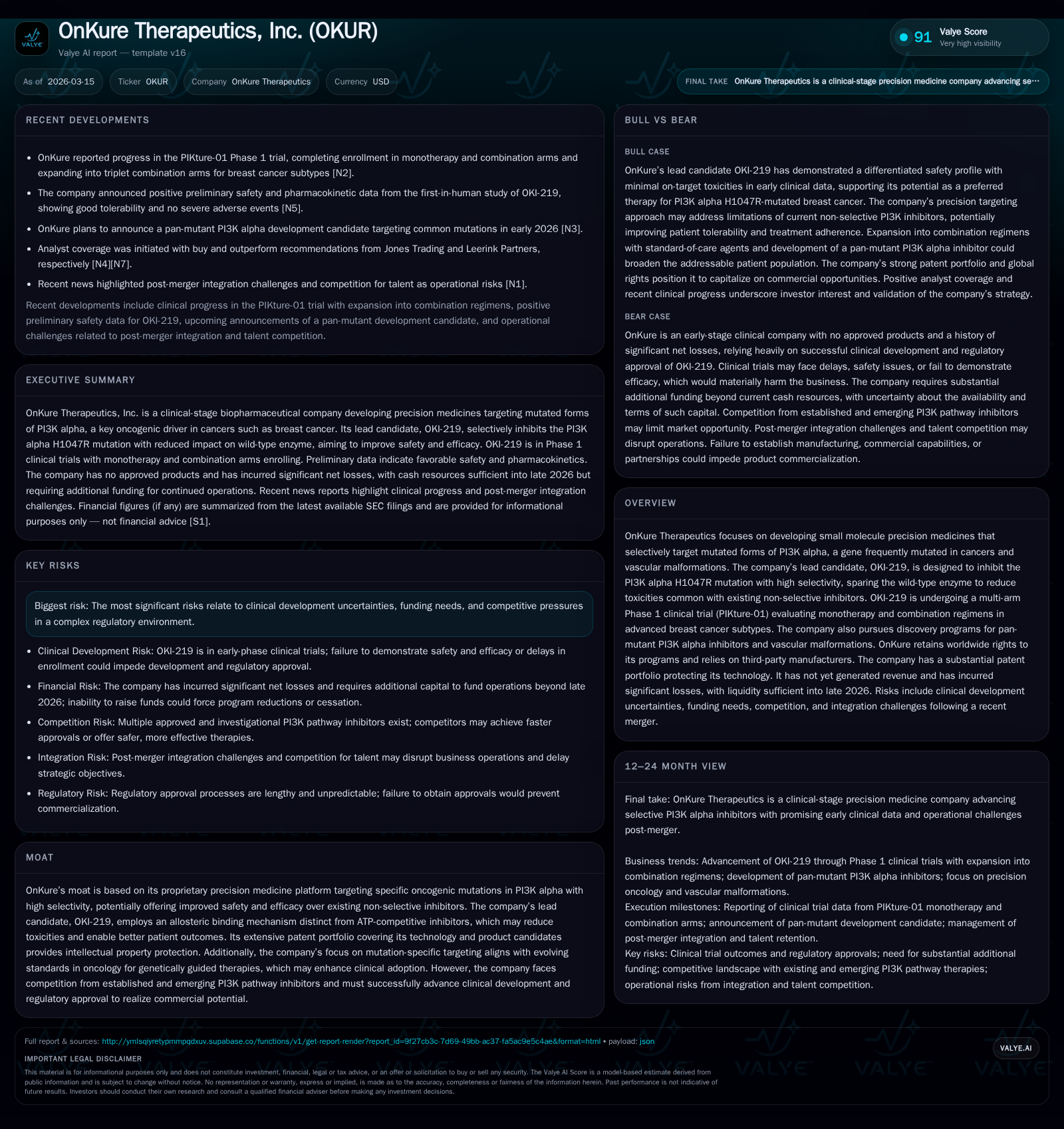
OnKure focuses on precision medicines targeting PI3K alpha mutations with its lead candidate OKI-219, advancing clinical-stage development amid capital constraints and integration challenges.
OnKure Therapeutics employs a proprietary platform to selectively inhibit the PI3K alpha H1047R mutation, differentiating itself from broader non-selective inhibitors currently available. Despite this scientific innovation, the company faces operational headwinds including significant operating losses, a limited cash runway extending into late 2026, and post-merger organizational integration risks. Its Phase 1 PIKture-01 trial encompasses monotherapy and combination regimens in advanced breast cancer subtypes, positioning OKI-219 as a potential backbone therapy within mutation-driven oncology. Regulatory uncertainty and competitive pressures among PI3K inhibitors remain key challenges as OnKure endeavors to transition from clinical development towards commercialization.
Trajectory of Innovation: From Founding to Current Clinical Stage
OnKure Therapeutics has anchored its platform in structure-based drug design aimed at selectively targeting specific mutated forms of phosphoinositide 3-kinase alpha (PI3Kα), particularly the oncogenic H1047R mutation frequently observed across multiple cancers and vascular malformations [S1]. This selective inhibition approach strives for an improved therapeutic window by sparing wild-type PI3Kα activity approximately 80-fold relative to mutant forms. Such refinement anticipates lowering treatment-related toxicities seen with existing non-selective ATP-competitive inhibitors that broadly suppress both mutated and wild-type enzymes.
This scientific foundation has guided the company's progression from early discovery through to clinical evaluation, culminating in the initiation of its first-in-human Phase 1 multi-arm trial — PIKture-01 — which represents a significant milestone in validating OnKure’s paradigm shift towards genetic subtype precision medicines [S1][F1]. Despite this promising trajectory, OnKure remains in a pre-commercial stage, having yet to generate product revenue.
OKI-219: Selectivity Mechanisms and Clinical Development Status
The lead molecule OKI-219 exemplifies OnKure’s precision approach by employing an allosteric binding mechanism that differs sharply from widely used ATP-competitive inhibitors within the PI3K pathway [S1]. This mode facilitates high specificity for the PI3Kα H1047R mutation with diminished engagement of wild-type enzyme signaling — a distinction that may translate clinically into fewer adverse events such as hyperglycemia or gastrointestinal side effects often limiting current PI3K inhibitor dosing.
PIKture-01 encompasses multiple arms testing OKI-219 both as monotherapy and in combination treatments across solid tumors prominently including hormone receptor-positive/human epidermal growth factor receptor 2-negative (HR+/HER2-) and HER2-positive advanced breast cancer patients who harbor the target mutation [S1][N1]. Recent news commentary highlights ongoing data accrual yet notes potential hurdles ahead given competitive therapeutic landscapes and inherent developmental complexities common for novel targeted agents [N1].
Commercial Viability Challenges: From Trial Results to Market Readiness
From an operational standpoint, OnKure faces typical early-stage biopharmaceutical commercialization challenges. With no approved products or sales capabilities established to date [S1][S2], the company depends entirely on successful clinical progression for future revenue generation prospects. Moreover, dependence on third-party manufacturing partners introduces supply chain reliance and scale-up uncertainties reflective of industry norms but necessitates effective coordination — particularly critical given the complex chemistry of selective small molecules like OKI-219.
Further complicating prospects are regulatory pathways that demand both safety/efficacy demonstration under novel indication frameworks shaped by molecular stratification as well as comprehensive risk management strategies implemented post-approval [S4][S5]. The infancy of these systems engenders unpredictability around timeline adherence and requisite evidence thresholds.
Capital Allocation Under Pressure: Reviewing Financial Health and Funding Needs
Financial data captured over the past four fiscal years illustrate persistent losses consistent with intensive R&D-driven expenses ([F1] Table below). Operating income deteriorated further from -$54.39M in FY2024 to -$62.95M in FY2025 representing a worsening of -15.7% year over year — symptomatic of heightened spending likely tied to expanded clinical trial activities.
Net losses tracked similarly (-$52.67M FY2024 vs. -$59.52M FY2025; -13% YoY) while operating cash flow remained negative at approximately -$51.83M for FY2025 (-1.4% decline YoY). Capital expenditures were immaterial (approximate $46k) reflecting limited investment beyond operational necessities.
Cash and cash equivalents totaled $59.05 million at December 31, 2025, providing runway into Q4 2026 based on current spending patterns; however, management expresses "substantial doubt" about going concern status absent successful future capital raises [S1][F1]. No dividends or share repurchases have been declared or executed owing to prevailing financial constraints.
Historical performance (annual)
| FY | Net ($mm) | CFO ($mm) | OpInc ($mm) | Capex ($) | Net YoY |
|---|---|---|---|---|---|
| 2025 | -60 | -52 | -63 | 46000 | -13.0% |
| 2024 | -53 | -51 | -54 | 52000 | +31.9% |
| 2023 | -77 | -64 | -83 | 221000 | -49.0% |
| 2022 | -52 | -47 | -54 | 346000 |
Source: SEC companyfacts cache [F1].
Capital returns and efficiency (annual)
| FY | FCF ($mm) | ROE% |
|---|---|---|
| 2025 | -52 | -105.9 |
| 2024 | -51 | -50.7 |
| 2023 | -64 | -87.3 |
| 2022 | -48 | -52.0 |
Source: SEC companyfacts cache [F1].
Note: All dollar figures are USD.
The approximate return on equity stands near -106%, consistent with pre-revenue biopharma deeply invested in discovery and early trials [F1]. Going forward, capital allocation decisions will need to balance trial acceleration urgency against liquidity preservation amid funding uncertainties.
Competitive Landscape: Proprietary Science Versus Existing PI3K Inhibitors
OnKure’s moat emanates from its selective allosteric mechanism targeting mutant PI3Kα while sparing wild-type kinase—contrasting with incumbent ATP-site-directed pan-PI3K inhibitors that engender dose-limiting toxicities [S1]. The company holds an extensive patent portfolio protecting its technological approach which could facilitate exclusivity if clinical validation succeeds.
Nonetheless, competition is considerable from established drugs addressing PI3K pathway aberrations alongside emerging entrants pursuing various selectivity spectra or combination modalities within oncology [S1]. The ability to demonstrate superior safety-efficacy tradeoffs backed by robust intellectual property coverage will be critical for OnKure's differentiated profile amid crowded landscapes featuring therapies already incorporated into treatment guidelines.
Post-Merger Integration and Talent Competition Impacting Operations
According to recent market commentary [N1], OnKure is contending with notable integration challenges following a corporate merger event compounded by intense competition for experienced biotech talent crucial for sustained research productivity and clinical program momentum.
Such organizational turbulence can cascade into delays or discontinuities in R&D workflows potentially jeopardizing scheduled milestones or diluting strategic clarity during pivotal development inflection points [N1][S2]. Given biotech sector cyclicality tied closely to specialized talent availability, these factors warrant careful monitoring for their operational implications.
Strategic Outlook: Key Milestones and Regulatory Watchpoints Ahead
Upcoming catalysts include interim safety and efficacy readouts from PIKture-01 arms exploring OKI-219 monotherapy plus combinatorial regimens targeting defined breast cancer subpopulations bearing PI3Kα H1047R mutations [S1][N1]. Positive data could pave avenues for expanded indication assessments across earlier treatment settings or alternative solid tumors.
Though explicit approval timelines or registrational plans have yet to be disclosed publicly [S1], close attention should focus on enrollment progression metrics, regulatory feedback loops under evolving oncology guidance frameworks, and emerging payer positioning around mutation-specific therapeutics.
Risks Beyond the Lab: Regulatory, Reimbursement, and Legal Considerations
Beyond scientific hurdles lie multifaceted risks elaborated extensively under risk disclosures [S4–S10]. These encompass:
- The inherently unpredictable FDA regulatory process which may impose additional data demands or delay marketing authorizations;
- Coverage & reimbursement variability driven by shifting third-party payor policies requiring demonstrations of cost-effectiveness beyond safety/efficacy;
- Potential exposure under expansive federal/state healthcare fraud & abuse statutes constraining permissible commercial practices;
- Ongoing obligations tied to post-marketing surveillance including risk evaluation mitigation strategies potentially augmenting long-term costs;
- Intellectual property enforcement risks given litigation complexities around patent validity/enforceability that may threaten exclusivity throughout product lifecycle.
Collectively these external factors reinforce that regulatory approval represents only one waypoint within a highly regulated ecosystem demanding prudent strategic planning well beyond lab-originated innovations.
This analysis synthesizes information publicly disclosed by OnKure Therapeutics through SEC filings and market reports without advocating investment actions. Readers should consider inherent uncertainties associated with early-stage biotechnology ventures focused on novel therapeutic modalities requiring continued capital infusions amidst competitive biopharma dynamics.
Disclaimer: This is research-only, informational analysis and not investment advice. It may include AI-generated interpretation and general industry context. Always verify important details using primary sources.

Comments