
Talkspace’s Turnaround: From Consecutive Losses to Profits and Growth Milestones
Talkspace transitioned from steep losses to profitability in 2025, driven by platform expansion, diversified revenue streams, and disciplined capital management amid complex regulatory challenges.
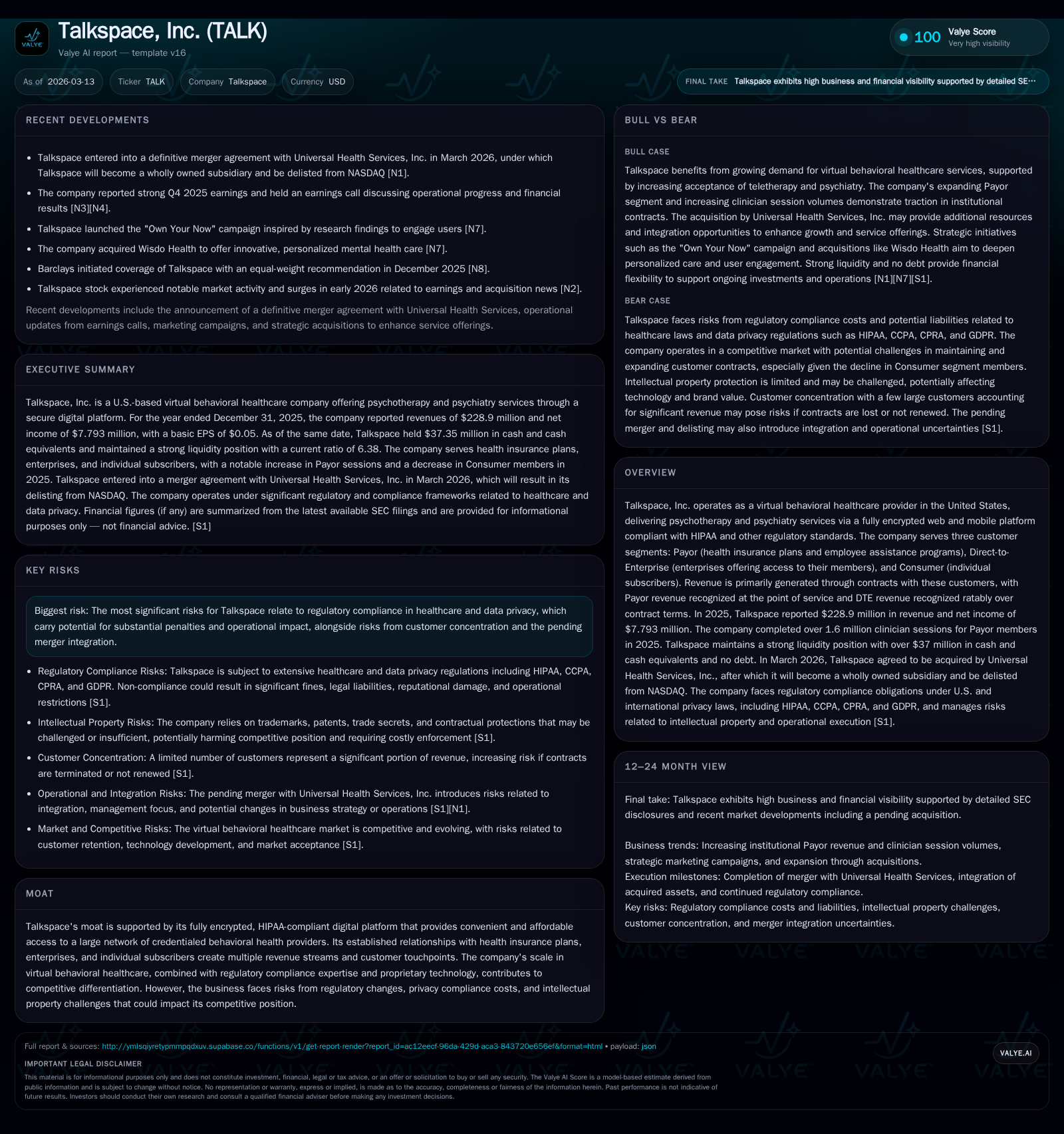
After years of heavy losses driven by aggressive growth investments and scaling challenges, Talkspace, Inc. returned to positive operating income and net profits in 2025. The company’s revenue growth is supported by increasing utilization across key customer segments—Payor, Direct-to-Enterprise, and Consumer—with over 1.6 million clinician sessions delivered in 2025. Looking ahead, a pending merger with Universal Health and ongoing innovations in AI-powered behavioral health services could catalyze growth but also introduce integration risks. Talkspace maintains a strong liquidity position bolstered by active share repurchases and zero debt, while navigating significant compliance demands in healthcare and data privacy.
Historic Financial Trajectory: From Red Ink to Positive Income
Talkspace’s financial journey through the early-to-mid 2020s was marked by substantial operating losses fueled by rapid investment in growth and platform development. For context, its operating income swung from a negative $83.16 million in 2022 down to a negative $23.21 million in 2023 before narrowing further to a negative $4.50 million in 2024—until pivoting sharply into positive territory with $3.15 million operating income in 2025 ([F1]). This represented a remarkable 170.1% year-over-year improvement.
Net income mirrored this transformation: from heavy losses of nearly $79.67 million in 2022 and $19.18 million loss in 2023, the company moved to modest net profit of $1.15 million in 2024 and then surged to $7.79 million net income by year-end 2025 ([F1]). Operating cash flow also recovered from negative $61.08 million in 2022 to positive $11.70 million in 2024 but dipped slightly to $8.53 million in 2025 due primarily to receivable timing variation.
Historical performance (annual)
| FY | Net ($mm) | CFO ($mm) | OpInc ($mm) | Capex ($) | Net YoY |
|---|---|---|---|---|---|
| 2025 | 8 | 9 | 3 | +578.8% | |
| 2024 | 1 | 12 | -4 | +106.0% | |
| 2023 | -19 | -16 | -23 | 151000 | +75.9% |
| 2022 | -80 | -61 | -83 | 350000 |
Source: SEC companyfacts cache [F1].
Capital returns and efficiency (annual)
| FY | Buybacks ($mm) | FCF ($mm) | ROE% |
|---|---|---|---|
| 2025 | 17 | 6.7 | |
| 2024 | 11 | 1.0 | |
| 2023 | -17 | -16.2 | |
| 2022 | -61 | -62.5 |
Source: SEC companyfacts cache [F1].
*Latest full year data; revenue figure not available post-2024 ([F1]).
This shift reflects Talkspace’s structural realignment emphasizing scalable virtual care services aligned with reimbursement models.
Pillars Behind Revenue Growth: Platform Scale, Customer Segments, and Contract Models
Talkspace generates revenue primarily across three segments: Payor (health insurance plans/employer assistance), Direct-to-Enterprise (DTE), which refers to enterprise-level contracts providing member access, and Consumer direct subscriptions ([S22]).
The Payor segment recognizes revenue at point-of-service as clinical sessions occur—a critical factor given that more than 1.6 million clinician sessions were delivered for Payor members during FY2025 alone ([N1]). DTE contracts involve ratable revenue recognition over contract terms reflecting subscription-like arrangements.
This bifurcated accounting under ASC606 aligns revenues closely with ongoing service delivery, sustaining predictability where contracts span multiple months.
Underlying this model is a proprietary fully encrypted virtual behavioral healthcare platform certified HIPAA-compliant ([S1]). This platform ensures security—a non-negotiable moat—and enables patient convenience through mobile/web modalities supporting messaging and live therapies.
Such compliance materially supports retention among institutional clients concerned about data privacy.
Future Outlook: Merger Potential, Market Demand, and Regulatory Boundaries
A watershed moment shaping Talkspace’s horizon is the announced $835 million acquisition agreement with Universal Health ([N3]). Expected to close around Q3-2026 contingent on regulatory approvals including Hart-Scott-Rodino clearance, this deal could unlock enhanced distribution capabilities and operational scale.
Post-pandemic behavioral healthcare demand remains elevated nationally as virtual care adoption solidifies within payor networks ([N3]), providing an expanding addressable market for Talkspace's services.
However, the coming period will require managing integration complexities including system harmonization and client retention—typical risks when combining technology-led healthcare entities ([S10]).
Regulatory landscapes impose further guardrails: the company faces escalating scrutiny around HIPAA compliance enforcement plus international standards like GDPR that impose significant penalties for lapses ([S5],[S10],[S20]). Such evolving laws may increase compliance costs impacting margins or constrain operational flexibility if data handling protocols tighten.
Capital Structure and Returns: Share Repurchases, Cash Position, and ROE Dynamics
Financial discipline punctuates Talkspace’s capital management approach evidenced by its share repurchase activity under an authorized program totaling up to $40 million as of mid-2024 ([S8]). In FY2025 alone, approximately $17.2 million of shares were repurchased for retirement supporting equity value accretion without dividend payments or leverage usage.
Cash plus equivalents stood at approximately $37.35 million at end-2025 indicating robust liquidity buffers with no outstanding debt obligations—a considerable advantage for operational agility ([F1],[S4],[S9]).
Return on equity climbed progressively reaching an estimated ~6.7% given net income relative to equity base near $117 million ([F1]), signifying improving capital efficiency despite historical accumulated deficits.
Operating cash flows remain positive at $8.53 million but declined roughly -27% versus prior year reflecting working capital timing rather than recurring weakness; capital expenditures were low consistent with software-oriented business requiring limited fixed asset investment ([F1],[S26]).
This illustrates a maturing company balancing reinvestment with shareholder return initiatives prudently.
Navigating Compliance Risks: Data Privacy and Healthcare Regulations
Talkspace’s core vulnerability resides within its regulatory environment where noncompliance can generate steep fines or operational curtailments ([S5],[S10]). The Board-level cybersecurity oversight includes quarterly risk reviews by the Audit Committee supplemented with ad hoc management briefings responding dynamically to threat landscapes ([S1]).
Leadership roles such as Chief Information Security Officer (CISO) holding advanced certifications along with seasoned CTO and senior engineering staff underline company commitment toward robust information security architecture designed explicitly for sensitive Protected Health Information (PHI) safeguarding.
Despite comprehensive policies, increased enforcement trends across U.S federal agencies heighten the risk profile—especially considering extensive healthcare interactions fall under ambiguous statutory interpretations liable to costly lawsuits or regulatory actions ([S15],[S20]).
Financial consequences extend beyond fines; reputational damage potentially erodes client trust imperiling renewal prospects critical for sustaining payor-dependent revenue flow.
Operational Excellence and Technology: Security Oversight and Platform Differentiators
Technological leadership forms Talkspace’s competitive anchor through its proprietary Sentia AI platform—the company's bespoke large language model calibrated specifically for behavioral health contexts ([S10]). Sentia extends therapist capacity by engaging users initially while triaging complexity levels warranting human intervention—aligning clinical rigor with scalable automation.
Moreover, the acquisition of Wisdo Health complements traditional therapy with AI-powered social health peer-support modules addressing chronic issues like loneliness—a condition flagged as a public health crisis by U.S Surgeon General—increasing holistic care effectiveness ([S19]).
The hybrid employment model blending salaried clinicians with independent contractors aligns provider cost structures flexibly against fluctuating session volumes that constitute primary cost drivers of goods sold ([S22]).
Most employees continue to operate remotely consistent with broader industry hybrid work trends preserving cultural adaptability while controlling office leasing costs concentrated at its New York City headquarters ([S1]).
Close integration between clinical innovation teams and security governance ensures sustained platform integrity amidst growing cyber-threat sophistication—a cornerstone retaining institutional customers.
Conclusion:
Talkspace has demonstrated a meaningful financial turnaround from persistent losses into profitability by effectively leveraging its secure digital infrastructure intertwined with flexible customer contract models across diverse market segments. While proceeding through transformative events such as the pending Universal Health merger offers potential scale advantages poised for accelerated growth opportunities, vigilant management of regulatory risks related especially to healthcare compliance and data privacy remains crucial.
Capital stewardship shows balanced prudence via active buybacks amid sustainable cash generation though watchfulness toward cash cycle dynamics is warranted given recent CFO softness. Technology-driven enhancements including AI-assisted therapy augmentation reflect a clear innovation blueprint tailored for both customer retention gains and operational scalability. In sum, Talkspace exemplifies how telebehavioral health providers must calibrate technical sophistication alongside exhaustive governance frameworks within an increasingly regulated virtual care environment.
This analysis is based on publicly available financial statements, earnings transcripts, regulatory filings including SEC reports dated up to March 13, 2026, Nasdaq news releases through March 10, 2026, and does not constitute investment advice.
Disclaimer: This is research-only, informational analysis and not investment advice. It may include AI-generated interpretation and general industry context. Always verify important details using primary sources.

Comments