
Finance of America Leverages Reverse Mortgage Leadership Amid Rising Senior Home Equity Market
FOA capitalizes on growing senior demographic and innovative product suite to increase reverse mortgage penetration.
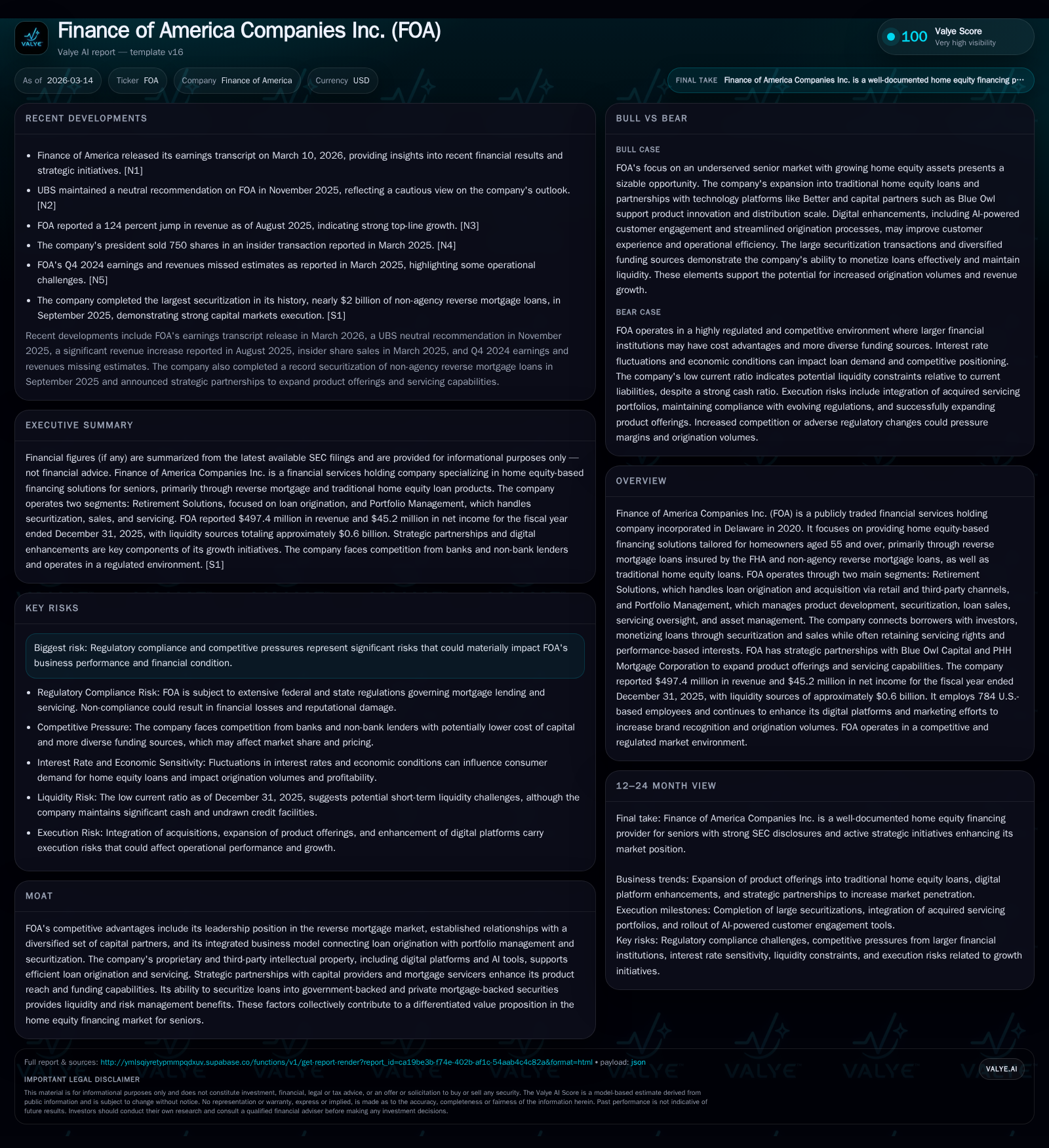
Finance of America Companies Inc. (FOA) has established itself as a leading provider of home equity-based financing solutions for Americans aged 55 and older, primarily through reverse mortgage products. Over recent years, FOA expanded its revenue base significantly from $234 million in 2023 to nearly $497 million in 2025, driven by strategic partnerships, product innovation, and enhanced digital capabilities. Despite robust gross income growth and improving net profitability, the company continues to face challenges including negative operating cash flow and regulatory risks in a competitive market. Going forward, FOA aims to broaden loan origination volumes via AI-driven platforms and new partnerships, focusing on both reverse mortgages and traditional home equity loans for seniors.
Company Overview
Finance of America Companies Inc. (FOA) is a financial services holding company that primarily targets homeowners aged 55 and above with tailored home equity financing products. Incorporated in Delaware in 2020 and publicly listed on NYSE since April 2021 (also trading on NYSE Texas since August 2025), FOA focuses chiefly on reverse mortgage loans—including FHA-insured Home Equity Conversion Mortgages (HECMs) and non-agency variants—and has recently expanded into traditional home equity loans [S1][S6].
The business is organized into two principal segments: Retirement Solutions, which oversees loan origination through retail and third-party origination (TPO) channels; and Portfolio Management, which manages securitization, loan sales, servicing oversight, asset management, and capital markets activities that monetize the originated loans by connecting borrowers with investors directly [S6][S8].
Historical Growth & Financial Performance
FOA has demonstrated substantial revenue growth over the past three years:
Historical performance (annual)
| FY | Rev ($mm) | Net ($mm) | CFO ($mm) | Rev YoY | Net YoY |
|---|---|---|---|---|---|
| 2025 | 497 | 45 | -430 | +47.1% | +192.1% |
| 2024 | 338 | 15 | -424 | +44.4% | +119.3% |
| 2023 | 234 | -80 | -72 | -59.1% | +58.0% |
| 2022 | 573 | -191 | 1408 |
Source: SEC companyfacts cache [F1].
Revenue almost doubled from $234 million in 2023 to nearly $497 million in 2025—an annualized compound growth rate exceeding 40%. Net income improved markedly from losses of approximately $80 million in 2023 to positive earnings of $45 million in 2025 [F1].
Operating cash flow has remained negative throughout this period—around -$430 million as of year-end 2025—reflecting the capital-intensive nature of loan origination requiring significant working capital before monetization through securitizations or sales to investors [F1].
Liquidity is supported by committed warehouse lending facilities totaling approximately $1.7 billion across multiple counterparties as well as cash reserves near $89.5 million at the end of 2025 [S4][F1]. The company’s current ratio remains low due to short-term liabilities associated with these liquidity facilities.
Market Opportunity & Industry Context
FOA operates within an expanding market underpinned by demographic tailwinds—the influx of roughly 11,400 Americans turning age 65 daily between 2024-2026 indicates a growing potential client base [S16]. Seniors hold significant housing wealth with an estimated $14.66 trillion in home equity among those aged 62 or older as of Q3-2025.
Despite this scale, reverse mortgage utilization remains low—only about a 2% penetration rate among eligible seniors—demonstrating a largely untapped opportunity for home-equity based retirement financing solutions [S16].
This dynamic shapes FOA’s long-term strategy to increase reverse mortgage adoption by innovating product offerings such as second lien reverse mortgages that cater to borrowers wishing to maintain existing primary mortgages while unlocking additional flexibility [S5]. The company also launched its first traditional home equity loan products in late-2025 using an AI-driven platform—signaling diversification beyond reverse mortgages toward higher loan-to-value lending solutions for retirees [S5][S20].
Business Model & Competitive Positioning
FOA’s integrated model connects origination through Retirement Solutions with securitization-driven Portfolio Management capabilities that allow efficient risk transfer while often retaining servicing rights or residual interests—a value driver enhancing recurring income streams [S6][S8]. Their ability to package loans into government-backed HMBS or private MBS supports liquidity and risk mitigation.
Competitively, FOA maintains leadership particularly since many banks exited the reverse mortgage space over a decade ago; however, competition remains varied including both bank and non-bank lenders focused on similar products—pricing power can be influenced by interest rates, loan terms, service quality, and distribution reach [S6].
FOA's proprietary technology stack—including digital pre-qualification tools delivering approximately three-minute application experiences—and AI customer ambassador 'Joy' chatbot optimize customer engagement and operational efficiency setting industry benchmarks for borrower convenience [S14][N1].
Strategic partnerships enhance capital access (e.g., Blue Owl Capital committed funding including preferred stock investment) and servicing scale (e.g., acquisition of PHH Mortgage’s HECM servicing portfolio), further strengthening operational competitiveness [S5][S20]. Plans to integrate non-agency second lien reverse mortgages via partner servicer pipelines suggest cross-channel distribution acceleration ahead.
Risks & Regulatory Landscape
As a non-depository institution licensed across all U.S. states where it operates, FOA is subject to a complex regulatory framework encompassing federal statutes such as Truth in Lending Act (TILA), Real Estate Settlement Procedures Act (RESPA), Fair Credit Reporting Act (FCRA), Consumer Financial Protection Bureau (CFPB) oversight under Dodd-Frank legislation plus numerous state consumer protection laws governing licensing, marketing practices, servicing standards, privacy/data protection including GLBA compliance, telemarketing restrictions among others [S9][S11][S12][S25].
Non-compliance risks include monetary penalties or license revocations that could materially impact business operations.
FOA dedicates significant resources toward cybersecurity risk management overseen by an experienced Chief Information Security Officer reporting directly to the board’s audit committee—a critical focus given industry-wide cyber threats targeting sensitive consumer financial information [S26][S23].
Market risks include margin pressure amid competition from lenders benefiting from lower cost capital during rising interest rate cycles or broader economic downturns affecting housing values or credit demand [S6][S10].
Capital Structure & Cash Flow Dynamics
FOA maintains diversified debt funding sources comprising multiple warehouse lending agreements totaling approximately $1.7 billion with over a dozen counterparties providing operational liquidity for loan originations [S4][F1]. Recent debt instruments include issuance of unsecured convertible notes valued at $40 million along with a $50 million Series A Convertible Perpetual Preferred Stock sale tied to Blue Owl partnership enhancing financial flexibility without immediate dilution but introducing conversion rights subject to future adjustments [S4][S28].
Cash balances were approximately $89.5 million at end-2025 augmented by undrawn lines approximating $500 million ensuring ample liquidity buffers despite ongoing negative operating cash flow driven by working capital investment ahead of monetization events like securitizations or sales [F1][S4].
Capital allocation focuses on strategic partnerships facilitating product innovation and scaling while emphasizing servicing efficiency improvements designed to reduce resolution timelines for matured loans thereby lowering losses or operational costs over time [S4][S8]. No public dividend policy or share repurchase program has been indicated recently.
Future Growth Trajectories & Outlook
While explicit forward guidance is not publicly provided beyond recent earnings disclosures [N1], several initiatives point toward sustained originations ramp:
- Expansion into traditional home equity loans via AI-platform partnership with Better aiming at seamless digital experiences complements core reverse mortgage offerings.
- Ongoing product development enabled by Blue Owl alliance targets novel financial solutions addressing seniors’ retirement planning needs.
- Acquisition-driven growth through onboarding PHH Mortgage’s HECM servicing assets should boost scale efficiency.
- Marketing repositioning implemented nationally focuses on messaging resonant with modern seniors underpinning brand recognition improvement.
- Digital automation tools integrated into TPO broker workflows aim to raise productivity further boosting channel volumes.
- Initiatives enhancing borrower outreach post-loan maturity seek to minimize losses via earlier resolutions highlighting operational risk mitigation focus. Collectively these efforts indicate FOA expects growth momentum normalization backed by demographic demand fundamentals.
Conclusion
Finance of America Companies Inc.’s positioning as a leading provider concentrating exclusively on senior homeowner financing through reverse mortgages supported by FHA insurance programs alongside proprietary non-agency products creates differentiated market access amid rising retirement-age population trends. Strategic execution combining technology innovation, capital partner alliances, product evolution into traditional home equity space plus strengthened servicing infrastructure underpin recent strong revenue rebound over three years with profitability restoration.
Nonetheless persistent negative operating cash flows reflect working capital absorption preceding monetization cycles requiring close monitoring alongside regulatory compliance risks inherent in consumer lending sectors demanding vigilance.
Investors should watch upcoming quarterly originations results including new product adoption rates plus any regulatory developments impacting permissible lending or disclosures which could influence competitive dynamics behind surging senior housing wealth unlocking efforts.
This analysis is provided for informational purposes only and does not constitute investment advice.
Disclaimer: This is research-only, informational analysis and not investment advice. It may include AI-generated interpretation and general industry context. Always verify important details using primary sources.

Comments