
RF Acquisition Corp III’s IPO Foundations and Strategic Capital Framework
Examining RF Acquisition Corp III's initial capital structure, operational baseline, and forward framework as a newly formed SPAC.
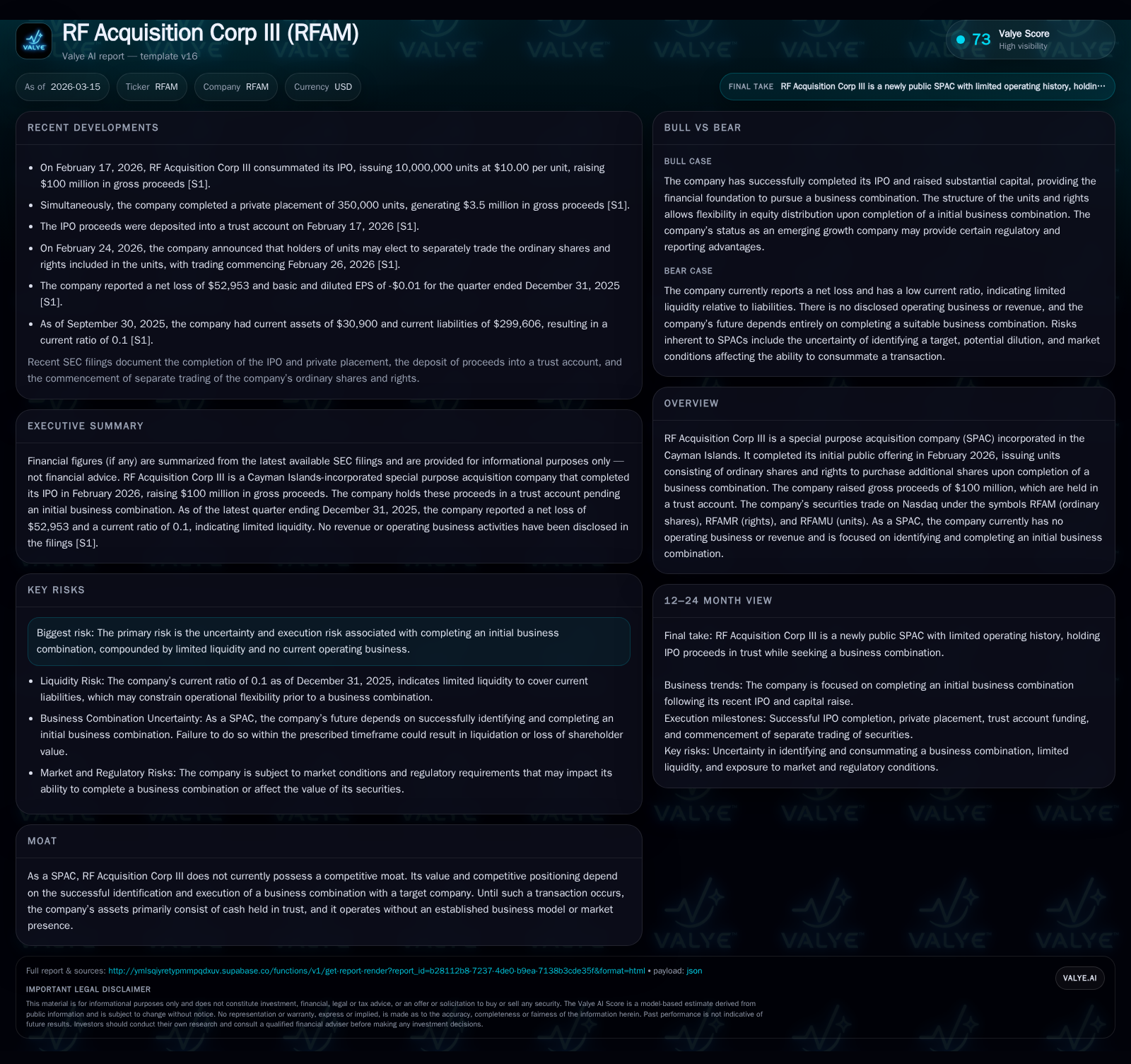
RF Acquisition Corp III (RFAM) launched its public market presence through a $100 million IPO in February 2026, supplemented by a $3.5 million private placement from its sponsor and underwriters. Incorporated in the Cayman Islands, the company holds no operating business or revenue, maintaining proceeds in a trust account pending an initial business combination. Historical financials confirm typical minimal operating losses reflecting initial setup costs, while strategic growth hinges entirely on successful merger execution. Investors currently face standard SPAC risks including deal uncertainty and liquidity constraints until transaction completion.
Establishing the IPO Base: Financial Intake and Initial Setup
RF Acquisition Corp III initiated its capital formation through an initial public offering (IPO) conducted on February 17, 2026. The company issued 10 million units priced at $10 each, collectively raising gross proceeds of $100 million [S4][S6]. Each unit comprises one ordinary share and one right to acquire one-tenth of an additional ordinary share following the closing of the company’s initial business combination. Complementing this public raise was a simultaneous private placement wherein the company’s sponsor Alfa 30 Limited and underwriters purchased 350,000 identical private units at the same price point, resulting in additional proceeds of approximately $3.5 million [S4][S13].
These combined proceeds form the core capital pool underpinning RFAM’s acquisition pursuits. A critical feature embedded in this structure is the rights component attached to each unit which entitles holders to fractional shares post-business combination, aligning with common contractual frameworks seen in SPAC transactions [S3]. This setup sets the financial foundation for identifying and consummating a target merger.
Current Financial Landscape: Assets, Liabilities, and Cash Trusts
As is typical for special purpose acquisition companies (SPACs) in their nascent phase, RFAM's balance sheet composition is dominated by cash and equivalents segregated into a trust account managed by Continental Stock Transfer & Trust Company under strict regulatory oversight [S16]. The full IPO proceeds of $100 million were deposited in this U.S.-based trust account at J.P. Morgan Chase Bank upon closing [S12][S15]. Accrued interest generated may be partially released solely for tax obligations or dissolution expenses up to $100,000 but otherwise remains locked until either consummation of a qualifying business combination or return of funds via shareholder redemptions.
The reported current assets totaled just $30,900 as of September 30, 2025 [F1], reflecting nominal non-trust cash components preceding IPO close. On the liability side, current liabilities were recorded at approximately $299,606 as of December 31, 2025 [F1]. This leads to an anomalously low current ratio around 0.1—a liquidity metric that appears constrained but largely reflects accounting classifications rather than operational distress, given the predominant asset being protected cash in trust.
No outstanding debt has been disclosed; there is effectively no operating leverage or ongoing cash burn beyond initial organizational expenses. Hence, liquidity concerns are muted pending business combination successes.
Historic Performance Snapshot: Minimal Operating Results and Capital Position
Reflecting its foundational stage without operational activities or revenue streams, RFAM reported an operating loss of $52,953 as of December 31, 2025 [F1]. Net income mirrored this loss figure since non-operating income remains negligible after deduction of administrative expenses such as legal fees and underwriting costs.
An indicative proxy for shareholder returns—return on equity (ROE)—was consequently negative at -11.5%, underscoring current value erosion consistent with pre-revenue investment phases common among SPACs [F1]. These financial statistics are symbolic milestones depicting formation rather than performance-based indicators.
Historical performance (annual)
| FY |
|---|
| 2026 |
Source: SEC companyfacts cache [F1].
Key Risks Inherent to Pre-Combination SPACs
Risk disclosures in RFAM's filings reiterate standard SPAC-specific uncertainties identified in their IPO prospectus [S2][S5]. Predominantly present is execution risk—whether RFAM can successfully identify a credible target company suitable for merger within the regulatory deadline (typically 21 months post-IPO).
Additional risks include limited liquidity prior to transaction completion that restrict investors’ ability to realize meaningful returns apart from redemption rights; potential disruptions from adverse shareholder votes on proposed combinations; and dilution risks linked to rights offerings embedded in unit structuring.
No material changes have been reported from prospectus disclosures since IPO filing that would alter these core risk assessments as of March 13, 2026 [S2].
Growth Drivers and Prospective Deal Pipeline
Currently there are no disclosures pertaining to specific acquisition targets or sectors under consideration [N/A]. Growth projections remain contingent on successful deal sourcing and closure—the hallmark characteristic inherent to all SPAC vehicles pre-merger.
This zero-operational footprint scenario means that RFAM's future expansion depends entirely on strategic assessment efficacy by its management team concerning businesses ripe for public market entry via reverse merger pathways. Any appreciation or accretion in value will arise primarily post-announcement or consummation rather than from organic operations.
Capital Allocation Strategy Post-IPO: Raising Stakes Without Revenue
Following completion of its IPO and aligned private placements during February 2026, RFAM placed total gross capital ($103.5 million) into an SEC-governed trust account ensuring preservation for acquisition funding or investor refunds [S4][S7][S12][S14].
The company has elected against deploying any dividends or engaging in share repurchase programs before fulfilling its primary mission—the business combination milestone—which conforms to typical SPAC governance frameworks safeguarding public investors’ capital pending material transactions.
Ongoing expenditures are limited mostly to administrative costs covered from interest earned within permissible limits or nominal operating funds outside the trust account.
Investor Returns Metrics: Contextualizing Performance Indicators
Traditional performance indicators such as ROE bear limited interpretive relevance given RFAM’s preparatory status—where recurring losses reflect expected foundational costs void of revenue production [F1][S5]. Investors commonly evaluate such entities based on structural features like trust fund protection levels, unit rights mechanics enabling fractional share allocations post-deal closure, and sponsor commitments secured via private placement participation.
Value realization awaits transaction announcements that could catalyze re-rating based on perceived quality or growth outlooks concerning acquired businesses rather than conventional profitability metrics at this juncture.
Critical Milestones Ahead: Triggers for Value Realization
Looking forward over the next two years—the typical lifespan for SPACs before forced liquidation if no deal closes—the critical event path includes announcement of a target acquisition candidate followed by shareholder approval processes culminating in consummation within prescribed deadlines (generally up to 24 months post-IPO) [N/A].
These events will materially alter capital structures through issuance exchanges or redemptions while setting groundwork for commencement of fully operational financial reporting post-business combination. Failure to complete such transactions may prompt liquidations returning capital minus permitted expenses.
Monitoring emergence of press releases concerning deal pipeline activations or SEC proxy filings related to vote solicitations provide vital signal points on progress toward these milestones.
Disclaimer: This analysis is based solely on information extracted from public SEC filings dated through March 15, 2026. No forward-looking statements have been projected beyond documented company disclosures.
Disclaimer: This is research-only, informational analysis and not investment advice. It may include AI-generated interpretation and general industry context. Always verify important details using primary sources.

Comments