
IN8BIO’s Quest for Breakthroughs in Gamma-Delta T Cell Therapies and Financial Stability
IN8BIO pursues innovation in gamma-delta T cell immunotherapy while contending with substantial financial losses and operational risks.
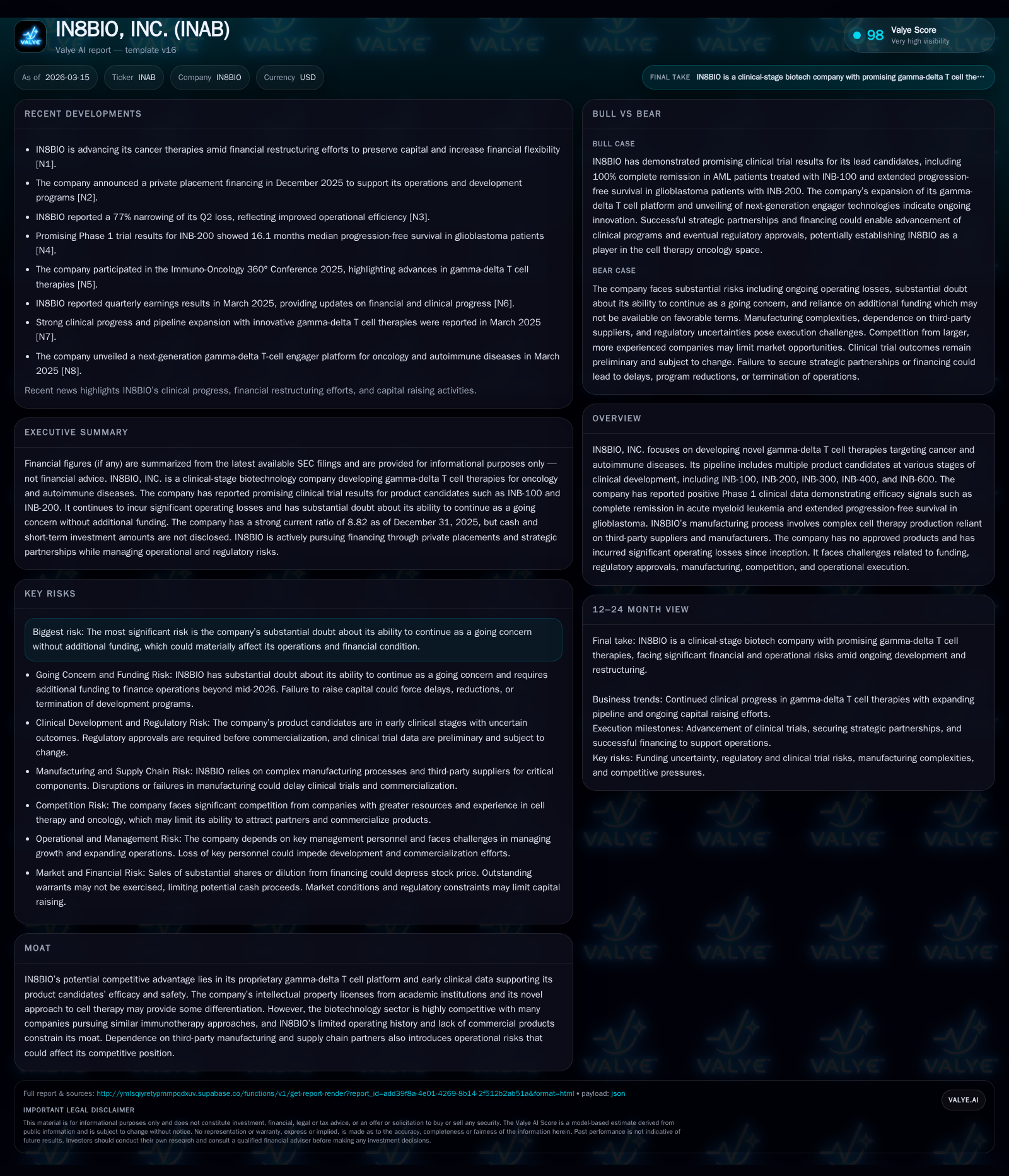
IN8BIO, INC. leverages its proprietary DeltEx gamma-delta T cell platform to develop multiple cell therapy candidates targeting cancer and autoimmune diseases, with early clinical data suggesting promising efficacy signals. Despite progress in clinical trials, the company continues to operate at significant losses, though operating income improved by over 36% in FY2025 versus prior years. Liquidity remains a key concern with a high current ratio counterbalanced by going concern disclosures and dependency on third-party manufacturing. Regulatory and commercial hurdles compound operational risks in this complex biotech space. Key milestones to watch include advanced clinical trial readouts and successful scale-up of bio-manufacturing.
Innovative Clinical Advances in Gamma-Delta T Cell Therapy Pipeline
IN8BIO, INC. operates at the cutting edge of cellular immunotherapy through its proprietary DeltEx platform, which exploits gamma-delta (γδ) T cells rather than conventional alpha-beta (αβ) T cells typically employed in oncology. Gamma-delta T cells represent a biologically distinct subset with innate-like properties enabling recognition of stressed or malignant cells without major histocompatibility complex restriction. This mechanistic differentiation offers potential advantages such as broader tumor targeting and reduced risk of graft-versus-host disease, positioning IN8BIO's product candidates uniquely within the crowded immunotherapy space [S1][N1].
The company's lead assets include multiple candidates—INB-100 series through INB-600—at various stages of clinical development targeting diverse oncology indications including acute myeloid leukemia (AML) and glioblastoma multiforme (GBM). Notably, Phase 1 clinical trials have demonstrated encouraging efficacy signals: complete remission cases documented in AML cohorts and extended progression-free survival markers in GBM suggest translational promise for this novel approach [S1][N1]. While these early-stage data serve as important proof points validating the platform's therapeutic rationale, pivotal studies remain necessary to confirm durability and safety.
Financial Performance Trends Highlight Improving but Negative Operating Income
IN8BIO continues to operate under significant operating losses typical for pre-commercial biotechnology firms [F1][S3]. However, fiscal year 2025 exhibited marked improvement relative to preceding years:
Historical performance (annual)
| FY | Net ($mm) | CFO ($mm) | OpInc ($mm) | Capex ($) | Net YoY |
|---|---|---|---|---|---|
| 2025 | -19 | -13 | -19 | 0 | +36.1% |
| 2024 | -30 | -24 | -30 | 71000 | -1.4% |
| 2023 | -30 | -23 | -30 | 407000 | -5.2% |
| 2022 | -29 | -24 | -29 |
Source: SEC companyfacts cache [F1].
Capital returns and efficiency (annual)
| FY | FCF ($mm) | ROE% |
|---|---|---|
| 2025 | -13 | -70.5 |
| 2024 | -24 | -210.2 |
| 2023 | -24 | -120.3 |
| 2022 | -125.5 |
Source: SEC companyfacts cache [F1].
Operating income improved by roughly $11 million in FY2025 from FY2024 levels—a positive trajectory indicating tighter expense control or incremental operational efficiencies amid sustained R&D investments. Net income mirrors this pattern as no material non-operating entries appear disclosed [F1]. Operating cash flow also improved substantially by nearly half compared to the prior year; however it remains negative at $12.7 million reflecting ongoing cash burn associated with early-stage development activities.
Capital expenditures contracted sharply to zero by Q3 FY2025 after nominal spend the year before—a pattern consistent with biotech firms focusing resources predominantly on clinical programs rather than fixed assets. Equity nearly doubled from $14.5 million at end-FY2024 to $27.6 million end-FY2025 suggesting recent capital injections or retained deficit changes [F1][S3]. This financial snapshot underscores a difficult but narrowing loss profile characteristic of firms at the cusp of clinical inflection points.
Capital Structure and Liquidity Position
As of December 31, 2025 IN8BIO reported current assets of $27.9 million against current liabilities of $3.16 million yielding an enviable current ratio over 8.8x—a sign of liquidity cushion among peers in early stage biotherapeutics [F1][S2]. Nonetheless this balance sheet strength is juxtaposed against formal disclosures expressing "substantial doubt" over continuing as a going concern absent additional financing [S2].
The company's reliance on recurring capital raises introduces dilution risk for shareholders while strategically constraining program continuity if funding delays occur. Recent restructuring activities referenced in news releases highlight ongoing efforts to optimize capital structure amid challenging cash flow dynamics [N1]. These acknowledgments reflect the high capital intensity inherent to cell therapy R&D alongside marketplace uncertainties common across disruptive biotech enterprises.
Operational Dependencies: Manufacturing and Third-Party Supply Risks
IN8BIO’s model dictates reliance on third-party contract manufacturing organizations (CMOs) for its intricate gamma-delta T cell production processes—a prerequisite given technical complexity and regulatory quality standards involved [S1][S4][N1]. This dependence carries pronounced risks including supply chain bottlenecks impacting dose availability for clinical trials or future commercial supply.
Manufacturing scalability challenges typical within autologous or allogeneic cell therapies—such as reproducibility issues or lot-to-lot variability—compound timing risks that could delay clinical milestones or inflate costs beyond budgeted projections [S4]. Given that tight coordination between suppliers and internal teams is critical for seamless GMP-compliant manufacture-lined workflows this axis remains a potential bottleneck threatening operational execution [N1].
Regulatory Pathways and Market Risks in Biotech Innovation
Beyond manufacturing complexities lie formidable regulatory hurdles characterized by FDA’s exhaustive approval procedures governing cellular biologics [S4][S5][S7]. The company must satisfy rigorous efficacy and safety endpoints through multi-phase clinical testing before marketing authorization can be obtained.
Post-approval obligations carry ongoing compliance demands including pharmacovigilance and manufacturing inspections under cGMP which can expose IN8BIO to potential sanctions or product recalls if violations emerge [S15]. Additionally evolving U.S. healthcare regulations centered around fraud prevention impose costly monitoring for physician engagements or marketing practices that could inadvertently contravene anti-kickback statutes [S4][S5].
Pricing uncertainties arising from new Medicare Drug Price Negotiation Programs add further complexity with downward pressures on reimbursements potentially undermining long-term commercial economics [S11][S14][S21]. Such policy developments heighten market risk especially for pioneering therapies where payor acceptance remains untested.
Outlook and Key Milestones to Monitor in Clinical Development
While explicit earnings guidance is not provided by IN8BIO recent public statements highlight advancing pivotal pipelines toward later-stage Phase 2 studies whose results will critically influence growth trajectory prospects [N1][S3]. Key catalysts likely include top-line readouts from multiple INB candidates revealing durability signals beyond initial Phase 1 successes.
Strategic partnerships or licensing deals could supplement funding needs or de-risk scale-up challenges especially around bio-manufacturing infrastructure noted as an ongoing priority [N1]. Investors tracking INAB should focus on crucial inflection points such as pivotal trial enrollments completion dates alongside any regulatory submissions communicated publicly.
Capital Allocation Focused on R&D Amid Negative Cash Flow and Returns
IN8BIO’s capital allocation prioritizes research and development investments over asset expansion; capital expenditure has dwindled to negligible levels consistent with outsourced manufacturing strategy—a cost-conscious approach given limited internal scale capability [F1]. No dividends have been declared reflecting reinvestment priorities.
Return metrics illustrate steeply negative performance reflective of life-science startups heavily investing pre-commercially: approximate return on equity stood near negative 70% at fiscal year-end 2025 illustrating continued shareholder value erosion amid steep losses [F1]. Free cash flow remains negative ($-12.7 million), underscoring persistent dependence on external financing despite operating improvements.
This financial stance typifies early cell therapy companies balancing high development risk against transformative medicine aspirations.
Disclaimer: This analysis is based solely on information publicly available through SEC filings and reputable news sources as of mid-March 2026. It does not constitute investment advice or recommendations but aims to synthesize IN8BIO’s business fundamentals within the context of advanced cell therapy innovation and financial realities inherent to emerging biotech firms.
Disclaimer: This is research-only, informational analysis and not investment advice. It may include AI-generated interpretation and general industry context. Always verify important details using primary sources.

Comments