
Mountain Crest Acquisition Corp. V’s Transition from SPAC Formation to Business Combination Challenges
MCAG, a blank check company, faces critical liquidity and execution risks as it pursues a transformative business combination with an early cancer detection diagnostics firm.
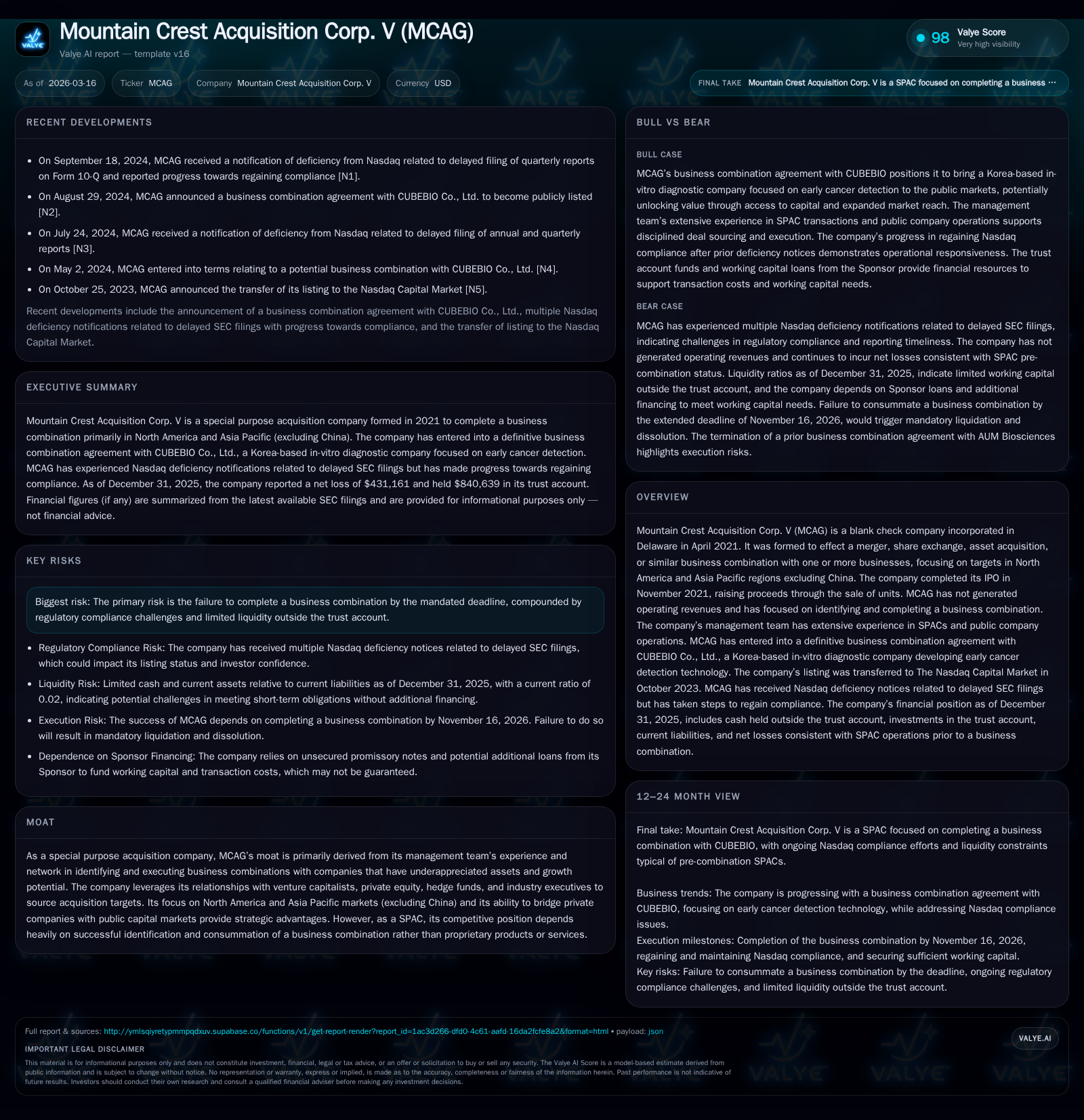
Mountain Crest Acquisition Corp. V (MCAG) was established in April 2021 as a special purpose acquisition company (SPAC) targeting North America and Asia Pacific (excluding China). Since its November 2021 IPO, the firm has incurred consistent operational losses and has yet to generate revenue, focusing instead on identifying a suitable merger partner. Efforts to merge with AUM Biosciences dissolved in mid-2023, while a definitive agreement with Korea’s CUBEBIO offers a pathway forward amid tight liquidity, ongoing working capital loans from the Sponsor, and a looming November 2026 deadline for consummating a business combination or facing liquidation. The company’s financial trajectory underscores the typical SPAC lifecycle tension between capital deployment, management expertise, and market timing.
Historical Performance and Financial Trends
Mountain Crest Acquisition Corp. V (MCAG) was incorporated under Delaware law on April 8, 2021, functioning as a Special Purpose Acquisition Company (SPAC). As expected for SPACs pre-business combination, MCAG has not generated operating revenues but has incurred operating expenses primarily related to legal, administrative, and organizational costs.
The company completed its Initial Public Offering (IPO) in November 2021 by selling units consisting of common stock and warrants to raise capital for an eventual business combination.
Key financial metrics over the fiscal years ending December 31 reveal persistent net losses alongside gradual improvement in operating income:
Historical performance (annual)
| FY | Net ($mm) | CFO ($) | OpInc ($mm) | Net YoY |
|---|---|---|---|---|
| 2025 | 0 | -741998 | 0 | -15.1% |
| 2024 | 0 | -921200 | -1 | +83.4% |
| 2023 | -2 | -470675 | -3 | -50449.3% |
| 2022 | 0 | -446350 | -1 |
Source: SEC companyfacts cache [F1].
Capital returns and efficiency (annual)
| FY | ROE% |
|---|---|
| 2025 | 11.7 |
| 2024 | 10.9 |
| 2023 | 68.3 |
| 2022 | -0.2 |
Source: SEC companyfacts cache [F1].
Operating income improved approximately 23.7% year-over-year from fiscal 2024 to fiscal 2025 [F1]. However, net income deteriorated by about 15.1% over the same period reflecting ongoing expenses exceeding revenues. Operating cash flow remains negative but showed a moderate improvement of approximately 19.5% year-over-year [F1]. The equity position remains negative due to accumulated losses exceeding contributed capital.
Business Combination Initiatives and Strategic Focus
MCAG’s pursuit of an initial business combination targets companies primarily located in North America and Asia Pacific regions excluding China and its territories [S1].
The first significant transaction was the Business Combination Agreement with AUM Biosciences Pte. Ltd., a Singapore-based life sciences firm. Despite multiple amendments and submission of proxy statements for shareholder approval during late 2022 and early-to-mid 2023 periods, this agreement was terminated by AUM on June 8, 2023 [S1][S11]. Subsequently, MCAG canceled the scheduled special meeting for stockholder voting.
Following this termination, MCAG entered into a definitive agreement with CUBEBIO Co., Ltd., a Korean company specializing in advanced in-vitro diagnostic platforms focused on early cancer detection technologies. This proposed transaction aligns with MCAG’s strategic focus on high-growth sectors exhibiting underexploited expansion opportunities within their geographic remit.
Liquidity Profile and Capital Structure Analysis
At December 31, 2025, MCAG held approximately $840K in its trust account invested primarily in level one mutual funds—down from about $1.16 million at year-end 2024—reflecting use of funds for operations and transaction-related expenses [S3]. Cash held outside the trust account was limited to roughly $11.9K at that date [S9], underscoring constrained liquid resources readily available without accessing sponsor loans.
To finance working capital needs and cover transaction costs ahead of consummation of an initial business combination:
- The Sponsor issued several unsecured promissory notes totaling up to $2.2 million across multiple issuances between February 15, 2023 and December 11, 2025 .
- These notes bear no interest and are repayable upon consummation of the business combination or upon liquidation if no transaction closes before the deadline.
- The Sponsor may convert these loans into private units at $10 per unit upon closing.
- Some earlier notes were converted into common stock shares following agreements approved by the audit committee [S6][S8].
Accounts payable and accrued liabilities were recorded at approximately $271K as of year-end [F1], consistent with ongoing operational expenditures.
A significant liquidity risk arises from the low current ratio estimated around 0.02 given limited current assets relative to liabilities [F1], emphasizing dependence on trust account funds and sponsor financing.
Key Risks Impacting Execution Outcome
Failure to complete an initial business combination before November 16, 2026 triggers mandatory liquidation procedures per SEC-mandated timelines tied to IPO proceeds usage restrictions [S9]. This includes dissolution of the company and redemption rights for public shareholders at set prices.
Additional risks include regulatory compliance obligations post-business-combination approval as well as uncertainty regarding availability of additional financing if needed prior to deal closure [S27][S23][S28].
Competitive pressures from other SPACs targeting similar healthcare diagnostics sectors heighten execution challenges. Success will depend largely on MCAG's management team's ability to source proprietary deals leveraging their experience within targeted industries.
Capital Allocation and Return Considerations
Pre-business-combination MCAG does not distribute dividends or repurchase shares due to lack of positive free cash flow or earnings generation [F1][S7].
Return on equity calculations are complicated by negative equity balances but approximate an effective figure near negative territory aligned with sustained net losses [F1].
Sponsor-related note conversions dilute existing shareholders but provide necessary liquidity without incurring interest expenses upfront—a common practice among SPAC sponsors managing working capital bridging loans prior to transaction completion [S6][S8].
No other material debt or capital return programs are currently disclosed given transitional corporate stage pending consummation of primary objective.
Forward-Looking Considerations and Milestones To Monitor
While explicit timeline guidance on closing the CUBEBIO transaction is not publicly detailed yet [S1], key upcoming milestones include:
- Progress updates or potential amendments regarding the definitive agreement with CUBEBIO including regulatory approvals,
- Monitoring utilization rates against sponsor loan facilities indicating runway availability,
- Any requests or approvals for extensions beyond the mandatory liquidation deadline,
- Variations in administrative expenses suggesting increased diligence activity,
- Changes in trust account balances reflecting fund deployment levels,
- Disclosures clarifying strategic sector focus beyond current acquisition candidate(s).
Conclusion Summary
Mountain Crest Acquisition Corp. V exemplifies an emerging stage SPAC designed as a public vehicle facilitating growth through acquisition within selective geographies and sectors. Its financial history reflects foundational expense absorption absent revenue until merger completion occurs. Execution risk is underscored by previous aborted transactions and tight liquidity conditions mitigated only through related-party loans.
Management’s expertise is central to unlocking value through targeted acquisitions such as CUBEBIO; however timely consummation before November 16th deadline remains critical for survival beyond forced wind-down scenarios inherent in this SPAC lifecycle phase.
Disclaimer: This is research-only, informational analysis and not investment advice. It may include AI-generated interpretation and general industry context. Always verify important details using primary sources.

Comments