
Rallybio Corp’s Strategic Pivot: Clinical Milestones and Merger Ambitions
Rallybio transitions with promising Phase 1 results and a transformative merger, aiming to strengthen its stance in rare disease therapeutics.
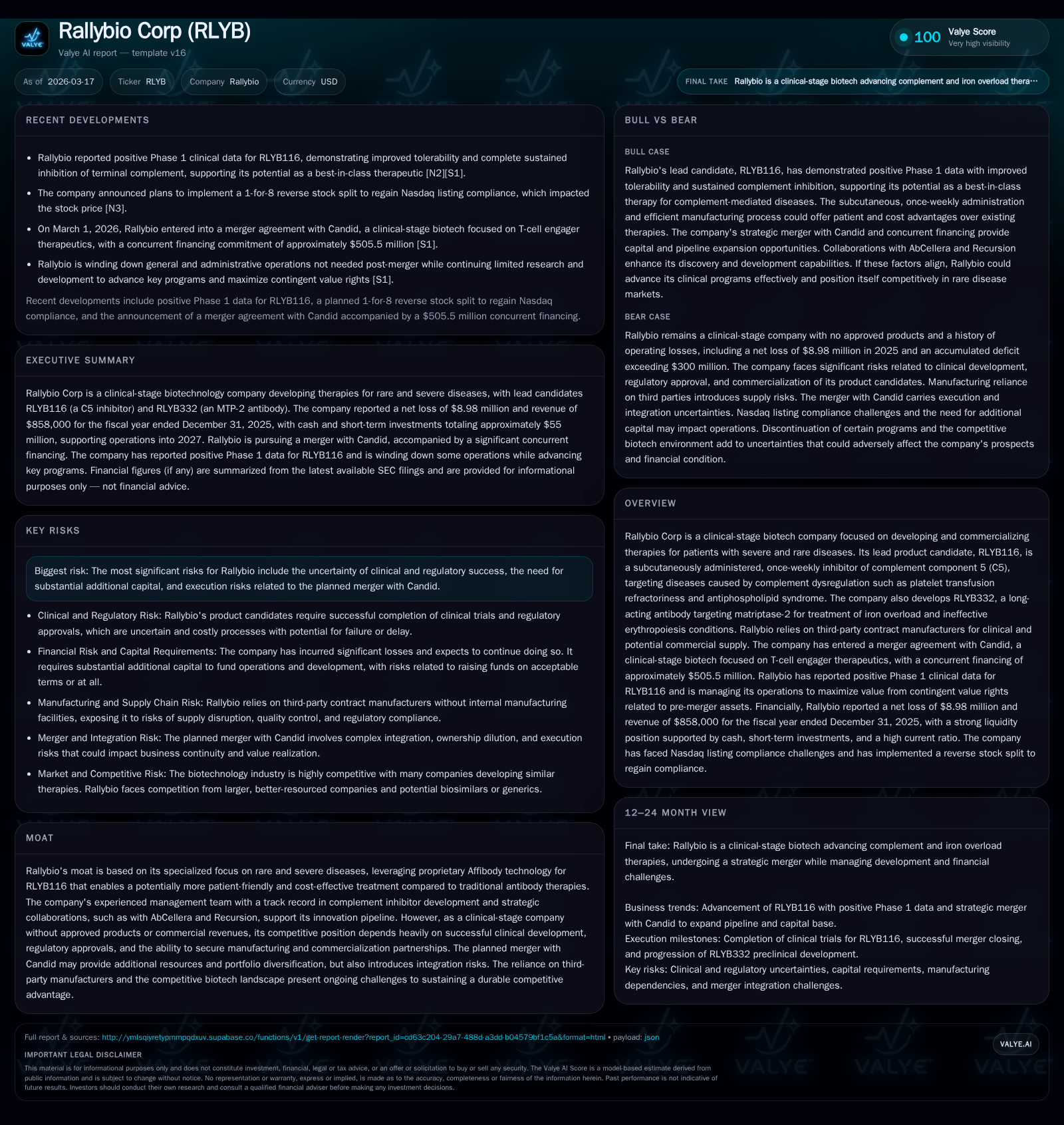
Rallybio Corp, a clinical-stage biotech focused on rare and severe diseases, showed improved financial metrics in 2025 alongside encouraging Phase 1 data for its lead candidate RLYB116 targeting complement dysregulation. The company's recent merger agreement with Candid introduces a substantial capital injection of $505.5 million and diversifies its pipeline with T-cell engager therapies for autoimmune disorders. Despite operational losses and regulatory challenges typical of early-stage biotechs, Rallybio’s strategic moves position it for potential expansion pending successful clinical and regulatory milestones.
Tracing Rallybio’s Growth Trajectory and Financial Pattern Since Inception
Rallybio remains in the throes of typical clinical-stage biotech financial dynamics—persistent operating losses paired with minimal revenues but underpinned by intensive R&D investments aimed at addressing rare and severe disease niches. Annual revenues advanced from approximately $600K in 2024 to $858K in 2025, marking an encouraging +43% year-over-year uptick [F1]. This modest top-line growth originates principally from collaborations or milestone-based income streams rather than product sales given absence of approved therapies.
Operating income mirrored a positive shift toward reduced losses: the deficit narrowed by roughly 45%, from about -$60.5M in 2024 to -$33.1M in 2025 [F1]. Though sizable negative margins prevail, this halving signals incremental operational efficiencies or possibly controlled development expenditures. Net income improvement was even more pronounced—shifting from a -$57.8M net loss in 2024 to -$8.98M in 2025—largely attributable to one-time gains reported earlier in the year around sale transactions as noted in SEC filings [S2]. Nonetheless, the cash flow profile remains challenged: operating cash outflows contracted from -$49.3M in 2024 to -$29.8M in 2025 but underscore continued reliance on external funding to fuel trials and administrative costs [F1].
Liquidity stands robust relative to immediate obligations; a current ratio exceeding 14 underscores substantial short-term asset cushions versus liabilities at fiscal year-end [F1]. Capital expenditures remain negligible—typical of companies outsourcing manufacturing and infrastructure needs [F1]. This financial snapshot bears hallmarks of an innovation-driven firm navigating early commercial inflection points.
Historical performance (annual)
| FY | Rev ($) | Net ($mm) | CFO ($mm) | OpInc ($mm) | Rev YoY | Net YoY |
|---|---|---|---|---|---|---|
| 2025 | 858000 | -9 | -30 | -33 | +43.0% | +84.5% |
| 2024 | 600000 | -58 | -49 | -60 | +22.5% | |
| 2023 | -75 | -60 | -79 | -11.9% | ||
| 2022 | -67 | -57 | -68 |
Source: SEC companyfacts cache [F1].
Capital returns and efficiency (annual)
| FY | FCF ($mm) | ROE% |
|---|---|---|
| 2025 | -15.5 | |
| 2024 | -49 | -93.7 |
| 2023 | -60 | -70.2 |
| 2022 | -57 | -39.4 |
Source: SEC companyfacts cache [F1].
Operating income and net income show sequential improvement albeit still deeply negative given pre-commercial status.
RLYB116 Phase 1 Data Signals Therapeutic Potential in Complement-Mediated Diseases
The recently reported positive Phase 1 results for RLYB116 represent a strategic inflection highlighting Rallybio's utilization of Affibody technology—a proprietary platform enabling compact protein therapeutics engineered for superior delivery—which sets it apart from traditional monoclonal antibody inhibitors targeting complement component C5 [N2]. The subcutaneous route administered once weekly stands as an advantage offering enhanced patient convenience potentially conducive to adherence over intravenous infusions frequent with marketed complement inhibitors.
Targeting indications such as platelet transfusion refractoriness and antiphospholipid syndrome addresses underserved patient populations plagued by complement dysregulation pathophysiology where limited therapies exist . The favorable safety and pharmacological profile demonstrated so far lays groundwork for proceeding into pivotal stages that may leverage expedited regulatory pathways common to rare diseases.
Merger with Candid: Diversifying Pipeline with T-Cell Engager Therapeutics
In March 2026, Rallybio consummated an agreement to merge with Candid Therapeutics—another clinical-stage biotech specializing in T-cell engager (TCE) biologics designed for autoimmune diseases—thus broadening its therapeutic reach beyond complement-centric approaches [S3][N3]. Accompanying this deal is a hefty concurrent financing commitment approximating $505.5 million, underscoring investor appetite for portfolio diversification coupled with innovative immunotherapeutic modalities.
Structurally, upon closing anticipated within the foreseeable future pending customary conditions, Candid will operate as a wholly owned subsidiary under the Rallybio umbrella [S3]. This leap into TCE platforms offers potential synergies but equally ushers integration risks including cultural alignment, consolidation of scientific programs, and management bandwidth strain—a high-wire act common when mid-stage biotechs transform via mergers.
While creating optionality against single program reliance—and expanding into autoimmune disease space complementary to rare diseases—the transaction presages near-term operating complexity intensified by merger-associated transaction costs detailed within risk disclosures [S4][S6]. Nevertheless, such inorganic growth moves illustrate Rallybio’s pivot toward becoming a multi-platform biotech entity.
Capital Structure, Cash Position, and Planned Reverse Stock Split
At fiscal year-end 2025, Rallybio posted cash and equivalents totaling approximately $31.4 million against current liabilities under $4.3 million yielding an impressive current ratio near 14.5x—indicative of strong short-term liquidity buffers [F1]. Yet significant operating cash burn at close to $30 million annually delineates runway constraints absent further capital inflows or revenue generation.
To address Nasdaq continued listing compliance issues stemming from persistently depressed share price levels, Rallybio announced execution of a one-for-eight reverse stock split effective early February 2026 aimed at elevating per-share trading metrics above minimum standards [N3][S1]. While intended as a technical measure supporting market stature stability, reverse splits typically compress shareholder counts proportionately and often trigger heightened share price volatility shortly thereafter.
Overall leverage remains low; equity sits near $58 million after contraction linked partially to earnings deficits [F1], underscoring capital structure focused on equity financing rather than debt burden.
Evaluating Key Risks: Clinical, Regulatory, and Execution Hurdles
As articulated comprehensively across regulatory filings [S1][S4][S5][S6], Rallybio faces multifold risks inherent to clinical-stage biopharma ventures: uncertain clinical trial outcomes jeopardizing lead candidates like RLYB116; stringent FDA scrutiny including pre-approval pharmacovigilance requirements; post-marketing surveillance exposures; plus complex pricing negotiation landscapes intensified by third-party payor frameworks demanding rigorous pharmacoeconomic validation prior to reimbursement acceptance.
Furthermore, the merger introduces execution uncertainties encompassing transaction closure contingencies; potential dilution events; integration costs; talent retention threats considering Rallybio’s small workforce (~14 full-time employees post-2025); and operational constraints imposed during deal pendency restricting business maneuverability [S1].
Beyond U.S., European Medicines Agency regulations along with updated International Recognition Procedure rules demand precise compliance strategies given territorial variations affecting trial conduct and product marketing authorization timing [S11][S26]. Moreover, data privacy standards such as GDPR add layered obligations particularly relevant as trials increasingly globalize [S16].
Failure or delay across any of these domains could precipitate adverse impacts on financial performance or market capitalization.
Outlook for Clinical Readouts, Regulatory Milestones, and Market Entry Timing
Explicit forward guidance remains limited within public documentation; however investors should monitor several definitive catalysts including initiation/completion of later-phase studies for RLYB116 validating efficacy/safety endpoints pivotal for FDA accelerated approval pathways typical in rare disease spaces [N2][S3]. Additionally, progress advancing RLYB332 targeting iron overload disorders presents complementary pipeline maturation potential although currently preclinical per company disclosures.
Crucially, merger closing progress plus securing commercial partnerships or manufacturing scale-up agreements will inform operational scalability post regulatory clearance steps—signaling when potential launch preparation activity might intensify.
Regulatory interactions such as Fast Track or Breakthrough Therapy designations awarded could materially expedite timelines although are not assured [S13]. Thus a compound watchlist involving clinical data releases combined with official notices regarding merger completion will define Rallybio’s trajectory into commercial relevance.
Capital Allocation, Returns Profile, and Shareholder Value Considerations
Reflective of developmental stage biotech norms without revenue-generating products yet, Rallybio posted negative approximate return on equity near -15.5% calculated using net income relative to equity capital at end-2025—a reflection of heavy reinvestment into clinical programs over immediate profitability pursuits [F1].
No dividends or share repurchase programs exist due to lack of operational free cash flow availability coupled with continued resource prioritization toward advancing pipeline assets through costly trial phases typical for novel biologics discovery-to-market lifecycle.
Investor patience thus remains paramount while capital is allocated predominantly toward R&D efforts augmented now by increased war chest following the merger financing commitment—supporting runway extension beyond the immediacies of current burn rates.
—— This analysis reflects data cut-off as of March 17, 2026 referencing publicly filed SEC documents (10-K/10-Q), company announcements reported via Nasdaq sources alongside proprietary Valye report excerpts assessing Rallybio Corp’s evolving business fundamentals within the clinical-stage biotech domain targeting niche rare disease proteins leveraging advanced biologics technologies.
The inherent uncertainty accompanying clinical development compounded by integration complexities warrants cautious scrutiny while recognizing that demonstrating robust proof-of-concept signals alongside strategic financial maneuvers typify early-stage biopharma innovation narratives preparing for potential market entry inflection points ahead.
Disclaimer: This is research-only, informational analysis and not investment advice. It may include AI-generated interpretation and general industry context. Always verify important details using primary sources.

Comments