
Pangaea Logistics: Balancing Legacy Strengths and Emerging Financial Pressures
Pangaea Logistics leverages its niche ice-class drybulk fleet and logistics integration to sustain profit amid margin pressures and capital constraints in 2025.
Pangaea Logistics Solutions Ltd. expanded its operational scale materially in 2025, growing revenue by over 54% driven by increased vessel utilization, especially via its specialized Ice-Class fleet supporting harsh climate routes. However, this top-line surge coincided with decreases in operating income and net income, impacted by elevated drydock costs, depreciation from recent vessel acquisitions, and lower financing inflows compared to 2024. The company’s well-developed strategies targeting backhaul cargoes and logistics services in niche markets underpin future growth, yet rising fuel prices, freight rate cyclicality, and customer concentration remain significant risks. Capital structure constraints and covenant requirements intensify the challenge of balancing shareholder returns with necessary maintenance capital expenditures.
Historical Revenue Surge and Profitability Dynamics
Pangaea Logistics Solutions Ltd.’s financial trajectory over recent years reveals a notable paradox: a robust surge in revenue accompanied by declining profitability margins. Specifically, for the fiscal year ended December 31, 2025, revenue rose sharply by approximately 54.1% year-over-year to reach about $102.2 million [F1]. This significant boost largely stems from expanded fleet operations and higher voyage activity.
Counterintuitively, operating income contracted by 15.5% despite top-line growth, coming in at approximately $40.9 million for the same period [F1]. Net income followed suit, shrinking by roughly one-third (-33%) to $19.4 million [F1]. This divergence highlights mounting cost pressures that accompany fleet expansion—mainly related to depreciation, drydock expenses, and operational overhead associated with recent vessel acquisitions.
Historical performance (annual)
| FY | Net ($mm) | CFO ($mm) | OpInc ($mm) | Net YoY |
|---|---|---|---|---|
| 2025 | 19 | 54 | 41 | -33.0% |
| 2024 | 29 | 66 | 48 | +2527.6% |
| 2023 | 1 | 54 | 11 | -92.9% |
| 2022 | 16 | 135 | 19 |
Source: SEC companyfacts cache [F1].
Capital returns and efficiency (annual)
| FY | Div ($mm) | ROE% |
|---|---|---|
| 2025 | 16 | 4.5 |
| 2024 | 19 | 6.8 |
| 2023 | 18 | 0.3 |
| 2022 | 13 | 4.9 |
Source: SEC companyfacts cache [F1].
Dollar figures rounded; YoY percentages calculated based on provided annual data.
Drivers Behind Fleet Expansion and Operational Expertise
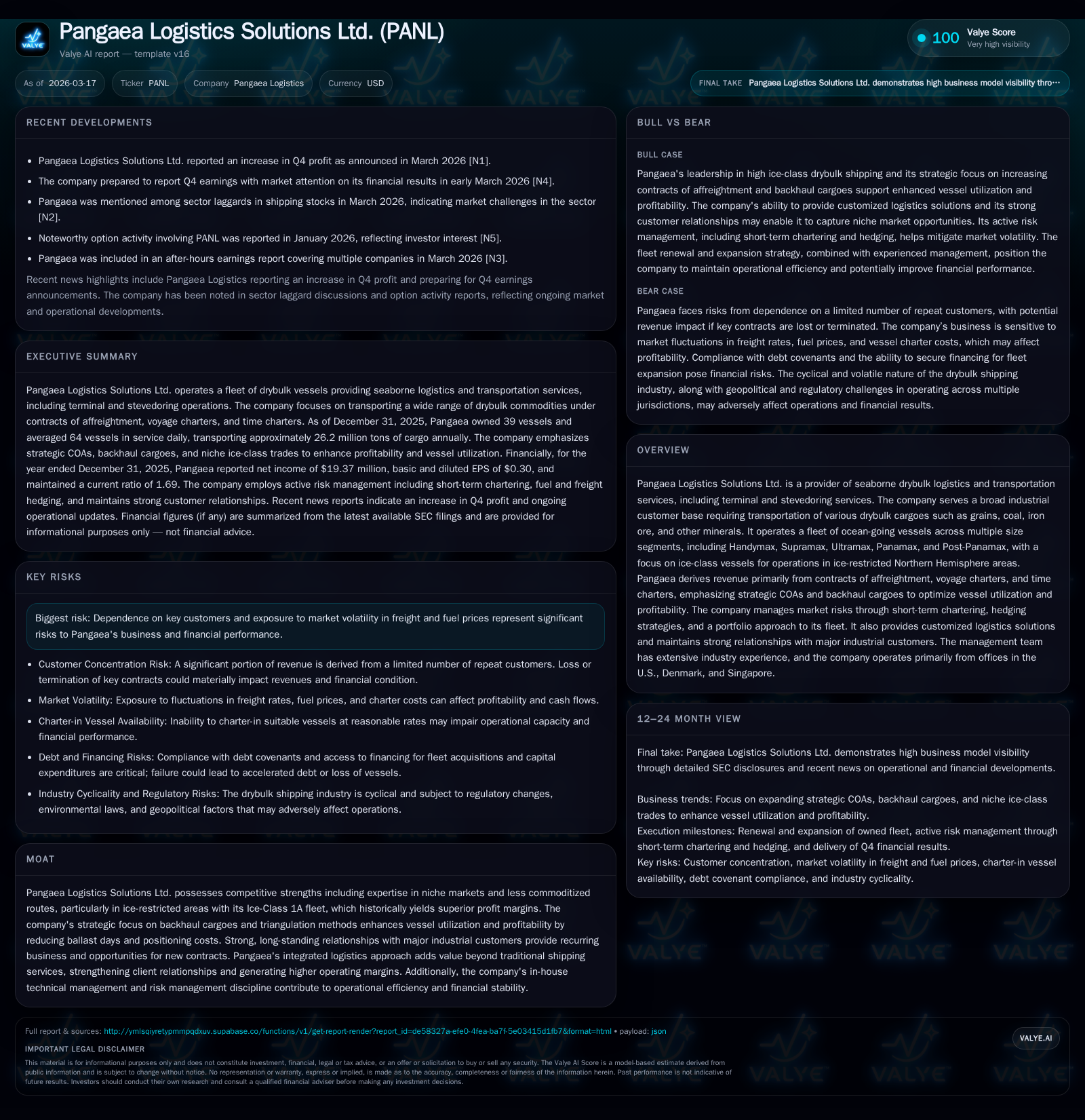
The company's expansion reflects strategic deployment of a mixed fleet spanning Handymax, Supramax, Ultramax, Panamax and Post-Panamax size classes tailored for varied trade routes [S17]. As of December 31, 2025, Pangaea owned a consolidated fleet of 39 dry bulk vessels including nine Panamax vessels (six Ice Class 1A), eight Supramax vessels, four Ultramax vessels (two Ice Class 1C), four Post-Panamax Ice Class 1A vessels and fourteen Handysize vessels.
This niche positioning enables Pangaea not only to command superior charter rates but also to earn incremental margins uncommon among commoditized bulk shipping sectors. The company’s approach integrates terminal services like stevedoring which further solidify client relationships as they function effectively as an extension of their customers’ ocean logistics operations.
Fleet utilization jumped impressively from an average of about 48 vessels deployed daily in calendar year 2024 to approximately 64 per day in the subsequent year—a near one-third increase indicating successfully scaling operational capacity supported by both owned vessels and short-term charter-ins averaging less than nine months tenure [S17].
Current Financial Performance: Margins, Cashflows, and Profitability Challenges
Operating cash flow landed at $53.7 million for the full year ending December 31, 2025, down around 18.2% compared with $65.7 million recorded in fiscal year prior [F1][S1]. This deterioration owes partly to larger non-cash depreciation charges ($42.5 million vs $30.4 million prior year) linked notably to the Strategic Shipping Inc acquisition completed late in prior year expanding vessel count but increasing amortization burdens.
Drydock expenses also rose commensurate with heightened maintenance activity necessary for fleet upkeep given the specialized nature of vessels required under stringent international maritime safety and environmental regulations [S11]. Investing activities swung positive versus a heavy outflow previously—reaching net cash inflow of $11.4 million mainly driven by proceeds of vessel sales totaling $17.2 million while deferring new vessel acquisitions for the year; this shift signals focus on preserving liquidity amid challenging capital markets conditions [S1][S11].
In financing activities, outflows widened steeply from $10.2 million in FY24 to $48.6 million primarily due to far fewer debt financings undertaken compared to previous vessel-related funding efforts paired against ongoing principal repayments [S1]. A disciplined approach toward deleveraging is evident despite availability pressures caused by tighter credit market conditions worldwide [S6].
Core Growth Opportunities in Niche Ice-Class and Backhaul Logistics
Pangaea's leadership position within the high ice-class drybulk shipping niche remains a primary competitive advantage setting it apart from many peers focused on mainstream bulk trades or lower specification vessels lacking ice-class notation required for severe Arctic or sub-Arctic environments [S17]. This sector demands vessels built or retrofitted with strengthened hulls certified at Ice-Class levels such as Polar Class Rules for navigating northern sea lanes safely even under extreme ice conditions.
Moreover, Pangaea pursues contracts emphasizing backhaul routes—segments where ships typically operate ballast days sailing empty returning between ports but through strategic contracting shifts these legs carry cargo instead enhancing revenue earned per voyage cycle while cutting ballast time that incurs costs without offsetting revenue streams [S15][S17].
Such triangulation logistics serve as an operational lever improving economic load factors and timely positioning encouraging repeat business particularly among industrial customers requiring dependable supply chain solutions including mining corporations importing iron ore or alumina producers shipping refined minerals.
Expanding complete logistics offerings involving customized loading/discharge facility design plus extended port services offers differentiated high-margin tailwinds enabling Pangaea to deepen client stickiness beyond mere transport carriage functions [N2][S17].
Constraints: Market Cyclicality, Fuel Prices, and Customer Concentration Risks
The shipping industry’s inherent cyclicality—with freight rates heavily swayed by global demand-supply dynamics—is manifest among Pangaea’s risk considerations [S7][S20]. Fuel price inflation materially compresses margins given bunker fuel often representing upwards of a third of voyage operating expenses; recent geopolitical tension such as conflicts affecting oil supply chains exacerbate volatility risks.
Additionally, dependence on a concentrated core group of repeat customers (top ten accounting for roughly one-third of total revenues) introduces revenue stability vulnerability should any major customer default or reduce charter commitments unexpectedly [S26]. Regulatory sanctions regimes targeting certain jurisdictions further complicate route planning potentially affecting scheduling certainty.
Capital Structure, Covenants, and Liquidity Considerations
As of December end-2025, Pangaea carried total outstanding indebtedness approximating $375.6 million spread across secured credit facilities, finance leases and obligations [F1][S5]. These facilities impose tight financial covenants including a consolidated leverage ratio ceiling at no more than twice equity value (<=200%), minimum liquidity maintained above $18 million and mandated debt service coverage not falling below stipulated ratios ensuring prudent financial stewardship [S4][S6].
These restrictions prevent unfettered asset disposal or dividend payments without lender consent creating structural pressure especially under markets with tight refinancing access or depressed collateral values potentially triggering defaults risking asset forfeiture.
Financing cash outflow growth from scheduled loan amortizations combined with limited fresh drawdowns underscores management’s cautious navigation balancing deleveraging versus capital expenditure demands predominantly related to specialized drydock surveys essential for maintaining class certifications as per maritime law requirements impacting fleet availability temporarily but critical long term asset preservation channels [F1][S11][S13].
Shareholder Returns: Dividends, Buybacks, and Capital Allocation Decisions
Despite margin pressures amid elevated costs associated with expanded operations management maintained shareholder return programs albeit at moderated levels—with dividends paid totaling around $16.3 million during FY25 down from roughly $18.7 million previously reflecting lowered payout rates consistent with conservative liquidity postures adopted under sector headwinds while still signaling commitment toward rewarding equity holders responsibly given earnings traction volatility noted earlier [F1][S1].
On share repurchases meanwhile approximately $3 million was expended chiefly aimed at offsetting dilution effects without overly constraining operational cash reserves.
Return on Equity calculated near mid-single digits (~4.5% for FY25) conveys improving but cautiously modest profitability relative to invested capital base still absorbing acquisition-related amortization effects alongside incremental drydock expenditures emphasizing phase timing impacts typical within asset-heavy shipping enterprises undergoing fleet renewal cycles [F1].
Outlook: Key Milestones and Strategic Risks to Monitor
Looking into early-to-mid-2026 timeframe planned operational milestones center around maintenance-intensive activities with thirteen planned special surveys complemented by two intermediate drydocks estimated to cost close to $18.7 million collectively causing anticipated offhire periods ranging between ten to twenty days per vessel thereby slightly constraining available vessel days impacting immediate revenue generation capacity yet vital given regulatory compliance mandates involving environmental rules tightening globally affecting fuel usage patterns onboard vessels too [S1][S11].
Monitoring macro-drivers inclusive of bunker fuel price trajectories alongside charter market rate developments will be paramount—as will scrutiny surrounding geopolitical developments playing out around Northern Hemisphere trading areas serviced by Pangaea’s ice-class assets possibly influencing route viability or insurance premium adjustments adding cost layers [N2][N4].
Strategic emphasis on expanding contract portfolios anchored by long-term COAs especially adapted toward backhaul traffic leveraging integrated port servicing capabilities alongside selective fleet renewals targeting ice-class specialization underpin expected resilience despite headwinds afflicting broader commodity shipping markets.
Disclaimer: This is research-only, informational analysis and not investment advice. It may include AI-generated interpretation and general industry context. Always verify important details using primary sources.

Comments