
Investors Title Co Faces Growth Constraints from Cyclical Real Estate and Regulatory Pressures
ITIC’s financials reflect steady premiums amid cyclical housing markets and intensive state insurance regulation.
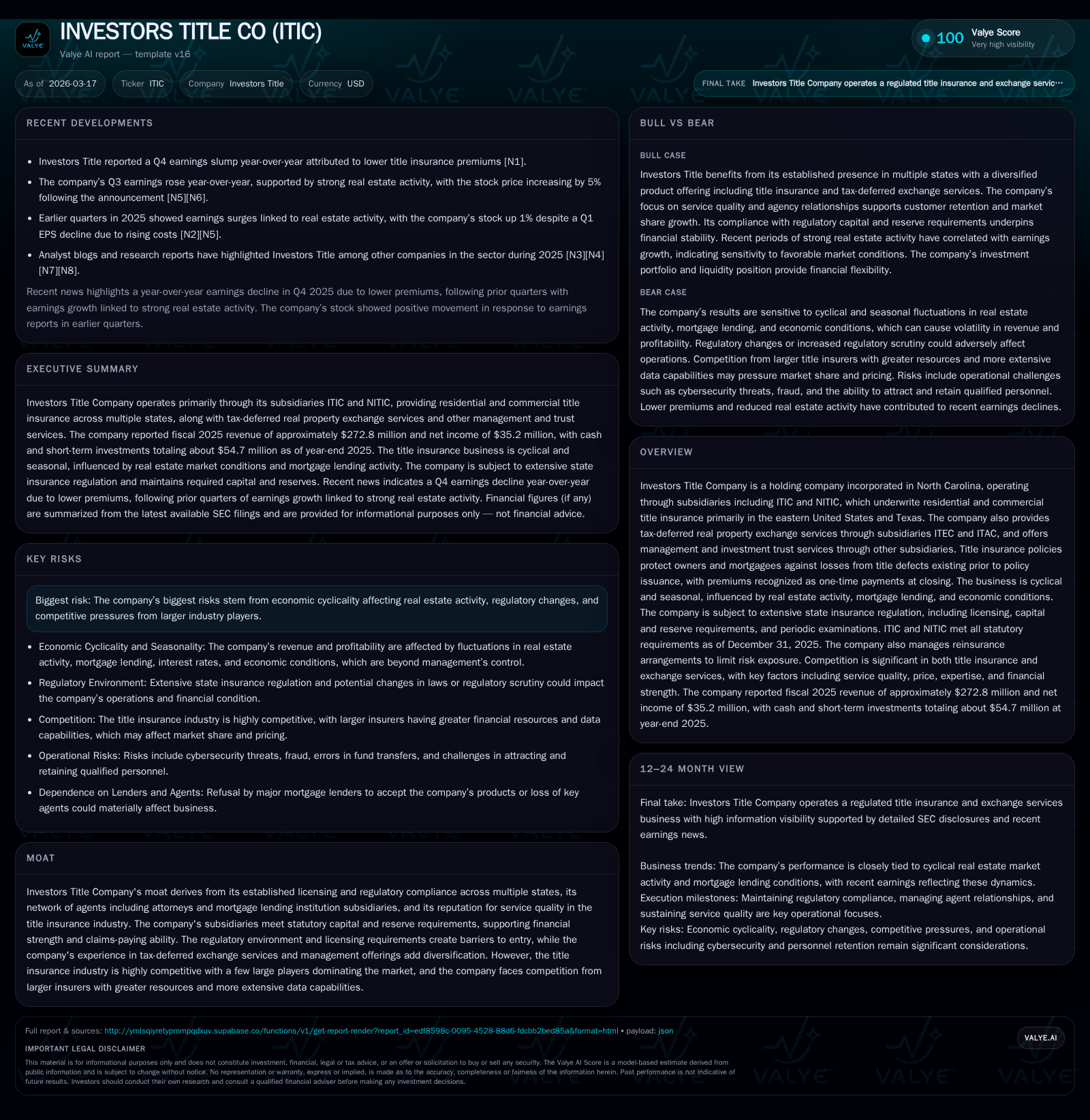
Investors Title Company (ITIC) operates predominantly in title insurance and tax-deferred exchange services across multiple eastern U.S. states and Texas. Historically, its revenue has grown modestly with fluctuations tied to real estate market cycles and mortgage activity, reflected in its 2025 revenue of $273 million, up 5.6% year-over-year. Risks include economic cyclicality, regulatory oversight, and competition from larger title insurers with more extensive resources. ITIC maintains solid capital adequacy and dividend payouts but faces restrictions on capital deployment due to insurance regulations. Future growth is capped by industry cyclicality and regulatory environment, with no explicit guidance provided for upcoming milestones.
Company Overview
Investors Title Company (ITIC) is a North Carolina-based holding entity specializing in title insurance underwriting through subsidiaries ITIC and NITIC. Founded operationally since the mid-1970s, the company principally serves residential and commercial real estate transactions largely across the eastern U.S. states plus Texas [S1][S25]. Its two main segments are title insurance issuance and tax-deferred real property exchanges facilitated via subsidiaries ITEC and ITAC; other service lines include agency management (ITMS) and investment trust services (Investors Trust), which collectively fall under "All Other" segments without separate financial disclosure [S24][S25].
Title insurance policies protect mortgagees and owners against historical title defects that could undermine ownership or encumber properties transferred during real estate closings. The industry operates under strong state-level regulatory frameworks mandating licensing, capital thresholds, and reserve adequacy—all of which ITIC subsidiaries satisfy as of year-end 2025 [S1][S6][S7][S10].
Historical Performance and Drivers
The company’s revenues correlate closely with cyclical real estate activity influenced by home sales volume, mortgage financing availability, interest rates, housing inventory supply-demand dynamics, consumer confidence, employment levels, and general economic conditions [S20]. Title insurance generates primarily one-time premium premiums recognized at transaction closing, causing revenue recognition to fluctuate alongside transaction volumes.
ITIC reported full-year revenues of approximately $272.8 million for fiscal 2025, marking a moderate increase of 5.6% compared to $258.3 million in 2024 per company filings [F1]. Net income improved by over 13% to $35.18 million from $31.07 million year-over-year reflecting controlled expenses or underwriting outcomes that outpaced top-line growth.
Operating cash flows remained robust at around $30.9 million while capital expenditures saw a sharp decline of over 25% compared to the prior year—an indication of potentially reduced investment spending or optimization initiatives within existing operations [F1]. The balance sheet remains strong with equity growing steadily to roughly $268 million.
Dividend distributions rebounded substantially after a dip in 2024, paying out nearly $20 million in dividends during 2025 versus almost $29.9 million the previous year—reflecting management’s return of capital priorities despite no reported share repurchases this cycle following minimal buybacks historically [F1].
Historical performance (annual)
| FY | Rev ($mm) | Net ($mm) | CFO ($mm) | Capex ($mm) | Rev YoY | Net YoY |
|---|---|---|---|---|---|---|
| 2025 | 273 | 35 | 31 | 6 | +5.6% | +13.2% |
| 2024 | 258 | 31 | 30 | 7 | +14.9% | +43.3% |
| 2023 | 225 | 22 | 7 | 9 | -20.7% | -9.3% |
| 2022 | 283 | 24 | 36 | 6 |
Source: SEC companyfacts cache [F1].
Capital returns and efficiency (annual)
| FY | Div ($mm) | Buybacks ($) | FCF ($mm) |
|---|---|---|---|
| 2025 | 20 | 0 | 25 |
| 2024 | 30 | 1099000 | 22 |
| 2023 | 11 | 959000 | -2 |
| 2022 | 9 | 133000 | 31 |
Source: SEC companyfacts cache [F1].
Note: Revenue growth slowed in recent years due to cyclical downturns particularly evident in the oscillation between FY22-23.
Segmental Business Characteristics
Title insurance underwritten by ITIC and NITIC commands the bulk of consolidated revenue with principal focus across five states accounting for the largest premiums: North Carolina, Texas, South Carolina, Georgia, and Florida [S10]. These subsidiaries write primary title policies directly or through independent attorneys or affiliated agents depending on local customs—a channel mix critical for market penetration.
Tax-deferred exchange services offered by ITEC & ITAC represent a smaller but strategically complementary segment engaging qualified intermediary functions for §1031 property exchanges providing fee income plus partially dependent on interest income from escrowed deposits held during transaction intervals [S24]. This segment's performance is sensitive both to demand for like-kind exchanges typically tied to commercial real estate activity trends as well as interest rate environments.
Management service offerings via ITMS enable support for agency startups while Investors Trust delivers fiduciary trust responsibilities mainly localized within North Carolina regulatory jurisdiction.
Regulatory Environment & Competitive Moat
Industry regulation is extensive: licensing renewal annually is mandatory across numerous states where underwriting occurs; capital reserves must continually meet statutory minimums monitored closely by state insurance authorities; premium rates undergo scrutiny requiring prior approval thereby limiting pricing flexibility; consumer protection statutes including RESPA enforced by CFPB add layers of compliance burden; additional cybersecurity rules target protection of personal data handled throughout processing pipelines [S6][S7][S9][S11][S12][S22]. ITIC’s subsidiaries maintain requisite ratings by independent agencies that underpin policyholder confidence though these remain subject to downward revision if adverse operational factors arise.
The competitive landscape comprises few dominant players controlling over eighty percent of the U.S title market share nationally—larger firms benefit from scale economies including extensive digital property record databases supporting efficient title searching that regional players like ITIC cannot fully match [S13]. ITIC’s differential advantages reside more in its stable multi-state regulatory licenses covering eastern jurisdictions where it has longstanding local agent networks composed mainly of attorneys and community banks that serve as distribution conduits along with reputation for service reliability within niche markets.
New entrants face high barriers given licensing complexity plus necessity for capital backing reserves sufficient for underwriting risks; however any regulatory relaxation might increase competition intensifying margin pressures.
Key Risks Affecting Performance
Principal risks arise primarily from macroeconomic fluctuations depressant effects on housing markets such as reduced transaction volumes due to tightening mortgage availability or rising interest rates which diminish affordability leading to lower policy premiums collected; also risks tied to potential regulatory reforms impacting CFPB enforcement scope or government-sponsored enterprise reforms affecting mortgage securitization requirements could materially alter demand patterns [S1][S20][S19]. Fraud exposures exist stemming from reliance on independent agents managing escrowed funds with potential misappropriation risks leading to claim liabilities or reputational harm [S14]. Cybersecurity threats increasingly sophisticated necessitate ongoing investments into defenses possibly increasing operating expenses.
Acquisition strategies aimed at geographical footprint expansions or deeper penetration may strain integration capabilities resulting in operational or employee retention challenges potentially offsetting anticipated synergy gains [S15]. Changes in insurer rating assessments can influence lender acceptance of ITIC products thus affecting new business acquisition chances.
Environmental regulations currently exclude pollution-related title risks unless specifically endorsed voluntarily protecting the firm from related claim burdens but climate change induced weather events could adversely impact regional real estate markets indirectly affecting volumes processed over time [S8][S16][S26].
Future Outlook: Opportunities & Constraints
While specific forward guidance remains undisclosed publicly recently, monitoring real estate transaction velocities—particularly single-family home sales coupled with refinancing activities—and mortgage rate trends are key metrics for prospective revenues given their direct correlation with premium intake [N1][N2]. Further diversification via enhancing technology platforms aligning with agents' operational efficiency could bolster competitiveness but will require capital allocation balancing against dividend expectations.
Regulatory uncertainties—such as potential CFPB policy shifts or changes in state insurance mandates—may constrain pricing freedom or administrative cost structures influencing underwriting margins. Geographic expansion offers growth avenues albeit with integration execution risk.
Capital deployment remains conservative; no buybacks were executed during fiscal year ending December 31, 2025 while dividend payouts remain substantial reflecting shareholder return priorities constrained by subsidiary dividend restrictions dictated by surplus levels enforced under state law limiting extraordinary dividends requiring regulator pre-approval [F1][S23].
Capital Allocation & Returns Analysis
With equity of nearly $268 million against net income of approximately $35 million for the latest fiscal year results in an approximate ROE near 13%, indicating reasonably efficient utilization within an insurance model framework confronted by regulatory reserve requirements limiting leverage opportunities.[F1]
Operating cash flow generation remains positive and consistent allowing funding of capex requirements which declined notably in recent periods suggesting efficiency gains or strategic deferrals.[F1] Free cash flow approximates $25 million supporting ongoing dividend distributions primarily since no share repurchases occurred this term.[F1]
Insurance subsidiary regulations impose dividend caps based on surplus balances constraining free movement of cash upstream which affects corporate liquidity planning.[S23] This dynamic necessitates cautious balancing between reinvestment needs, regulatory compliance and shareholder returns.
Conclusion
Investors Title Company operates a sector-exposed business embedded within cyclical real estate markets governed tightly by multi-state regulatory regimes that form both moat barriers protecting licensing but simultaneously limit operational agility especially concerning pricing adjustments and capital distribution flexibility.
over recent years it has posted steady revenue gains moderated by market volatility trends coupled with diversified ancillary service offerings helping stabilize fee income streams related to tax deferrals and trust management. However its medium-term growth potential remains conditioned on external macro factors including mortgage rates accessibility alongside competitive pressures exerted from larger national insurers leveraging superior data assets. Strategic expansion initiatives present opportunities albeit accompanied by integration risks impacting margins if not executed carefully. The company’s conservative capital allocation prioritizes dividends over buybacks aligned with maintaining strong balance sheet metrics required by regulators ensuring resilience though capping financial engineering levers. Overall Investors Title exemplifies a niche regional player adapting within a complex highly regulated environment where sustained competitive relevance demands prudent risk management coupled with targeted growth execution amidst prevailing cyclical constraints.
This report bases its analysis strictly on publicly available documents including SEC filings dated March 16, 2026 (10-K), Nasdaq news releases dated February 17 & 23 2026 (N1, N2), and numeric data from validated SEC XBRL datasets (F1). No speculative assumptions beyond disclosed facts were made.
Disclaimer: This is research-only, informational analysis and not investment advice. It may include AI-generated interpretation and general industry context. Always verify important details using primary sources.

Comments