
Agenus Inc.'s Journey from Pipeline Innovation to Operational Realities
Agenus blends pioneering immuno-oncology technology with mounting operational and financial challenges shaping its near-term horizon.
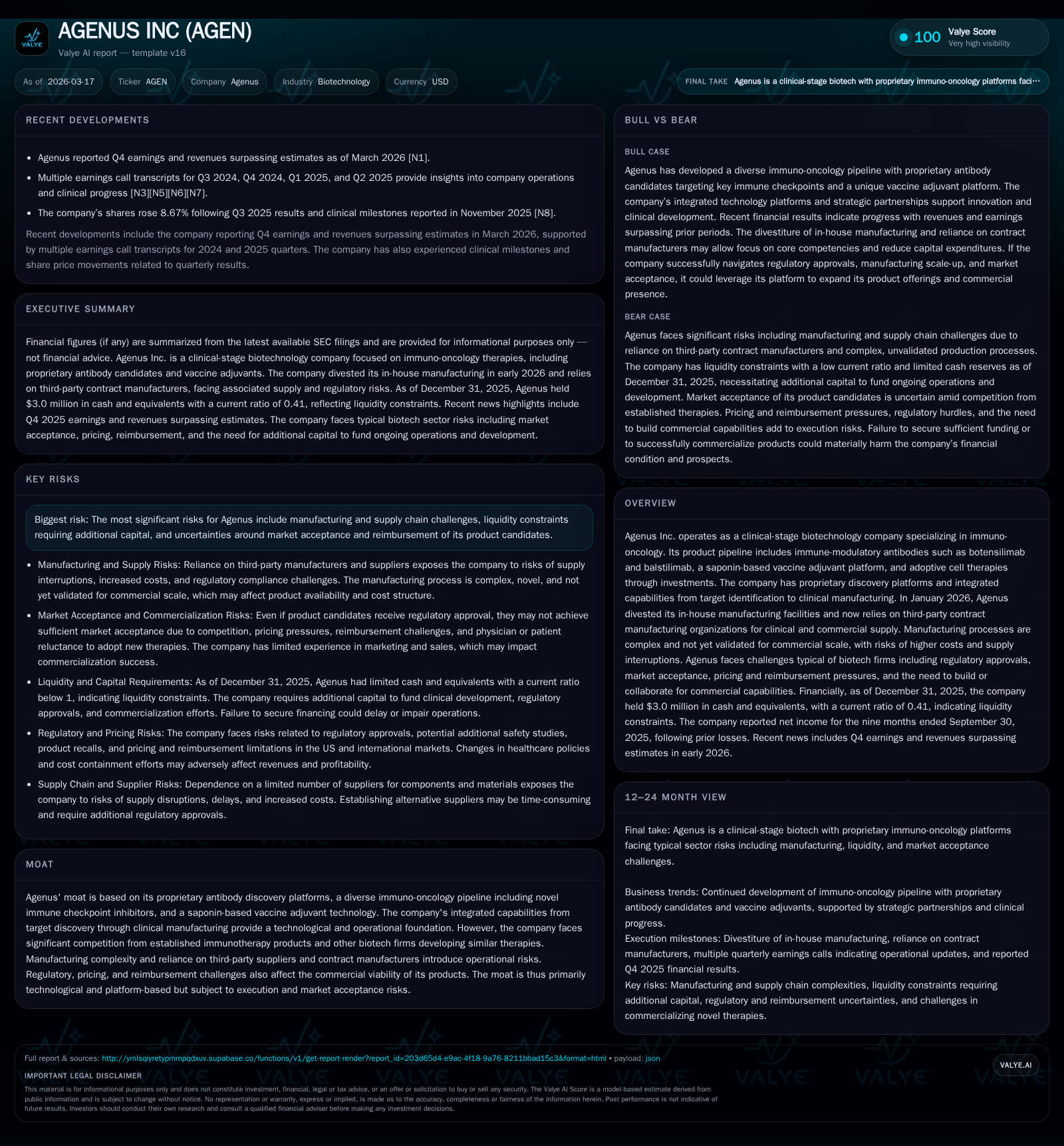
Agenus Inc. positions itself as an innovative clinical-stage biotech in immuno-oncology, anchored by proprietary antibody platforms and a saponin-based vaccine adjuvant technology. Despite a near 50% revenue upswing in fiscal 2025, persistent operating losses and substantial cash burn underscore ongoing financial pressures exacerbated by the recent divestment of in-house manufacturing facilities. The company faces significant execution risks from reliance on third-party contract manufacturing alongside regulatory and market acceptance uncertainties typical in novel oncology treatments. Pending securities litigation adds an additional layer of risk amid pivotal late-stage development milestones. Investors should monitor clinical trial readouts, regulatory filings, capital-raising, and partnership activities as critical inflection points.
Historical Growth Performance and Revenue Drivers
Agenus has exhibited incremental topline growth over recent years reflective of intensified clinical development activity characteristic of emerging immuno-oncology biotechs. Fiscal 2025 revenue climbed to approximately $8.35 million—up nearly 50% year-over-year from around $5.58 million in 2016—driven by advancing product candidates and associated licensing or collaboration income streams [F1]. However, despite top-line growth momentum, the company continues to incur significant operating losses: operating income improved substantially from -$120 million in 2024 to -$20 million in 2025 but remains negative at scale typical for clinical-stage biotechs investing heavily in R&D.
This narrowing operating loss trend aligns with increased R&D productivity or cost efficiencies but corresponds with persistent cash burn dynamics given ongoing trial costs and infrastructure investments. Capital expenditures decreased dramatically to $6,000 in fiscal 2025 from prior years’ millions indicating strategic shifts including divestiture of fixed assets such as manufacturing facilities.
Historical performance (annual)
| FY | CFO ($mm) | OpInc ($mm) | Capex ($mm) |
|---|---|---|---|
| 2025 | -77 | -20 | 0 |
| 2024 | -158 | -120 | 1 |
| 2023 | -224 | -160 | 10 |
| 2022 | -175 | -179 | 53 |
Source: SEC companyfacts cache [F1].
Capital returns and efficiency (annual)
| FY | FCF ($mm) |
|---|---|
| 2025 | -77 |
| 2024 | -159 |
| 2023 | -234 |
| 2022 | -228 |
Source: SEC companyfacts cache [F1].
Table includes selected financials; some revenue figures unavailable for recent years.
Proprietary Technology and Product Pipeline: Core Strengths
Central to Agenus’s competitive position is its proprietary platform technology suite developed for immune checkpoint inhibition applied to oncology therapeutics. Botensilimab and balstilimab form the backbone of its late-stage pipeline as novel checkpoint inhibitors aimed at reinvigorating anti-tumor immune responses where current therapies may be insufficient.
Complementing these antibodies is a unique saponin-based vaccine adjuvant platform designed to enhance vaccine efficacy across indications including infectious diseases and oncology vaccines—representing differentiated technological assets within the crowded immunotherapy space [S1].
The integration of target discovery platforms through to clinical manufacturing capabilities historically supported operational efficiency and pipeline agility but recent divestment of manufacturing changes this dynamic materially.
While these technologies offer promising therapeutic potential with mechanistic differentiation, reliance on core antibodies elevates concentration risk should clinical endpoints fail or competition prevail post-approval.
Manufacturing Transition and Supply Chain Implications
In early 2026 Agenus strategically exited ownership of internal manufacturing facilities, pivoting exclusively to third-party contract manufacturing organizations (CMOs) for supply chain needs supporting both clinical trials and anticipated commercial launch preparations [S1].
This transition aligns with sector trends favoring asset-light models but introduces considerable execution risk given that complex biologic manufacturing processes require rigorous validation for consistency at commercial scales—a step not yet fully realized by Agenus.
Potential consequences include increased unit costs due to outsourcing premiums, logistics vulnerabilities leading to supply interruptions impacting clinical trial continuity or market launch reliability, and reduced direct operational control challenging immediate response capabilities.
Such risks are accentuated by their status as an emerging biotech without established commercial product revenues or diversified supply relationships commonly seen in larger peers.
Navigating Regulatory and Commercial Viability Risks
Agenus’s experience with regulatory approvals underscores inherent uncertainties facing new molecular entities in immuno-oncology where FDA approval pathways remain lengthy with unpredictable hurdles [S1]. Specific concerns include:
- Possible adverse events or insufficient therapeutic efficacy emerging in late-stage trials delaying or derailing approval;
- Price competition from dominant existing PD-1/PD-L1 inhibitors limiting reimbursement attractiveness;
- Physician adoption inertia favoring proven therapies over newly approved agents lacking real-world outcome data;
- Stringent pricing regulation pressures in U.S./international markets compressing commercial margins.
Moreover, comprehensive healthcare compliance burdens encompassing federal anti-kickback statutes, False Claims Act constraints, privacy regulations (HIPAA/GDPR), and evolving artificial intelligence governance compound operational challenges once marketing commences [S4–S10].
Collectively these combine into a high barrier landscape requiring adept regulatory strategy management alongside robust payer engagement programs.
Financial Health, Capital Allocation, and Cash Flow Analysis
Financial data reveals Agenus faces acute liquidity stress reflective of heavy R&D investment amid unprofitable operations. The latest fiscal year closed with a negative operating cash flow approximating -$77 million contrasted against minimal capital expenditures roughly $6,000 indicating tightening capex discipline amidst preservation efforts [F1].
With cash & equivalents under $3 million set against over $323 million current liabilities at year-end results in a challenging working capital deficit environment underscored by a low current ratio (~0.41) [F1]. This signals pressing financing needs likely requiring equity raises or debt structuring that historically risk diluting existing shareholders or imposing restrictive covenants.
The reported approximate ROE of about -13.9% reflects ongoing net losses amid large negative equity (-$271 million), highlighting balance sheet strain rather than return generation strength [F1].
Capital allocation decisions must continue prioritizing core development expenditures while navigating cost structures compressed by outsourced manufacturing dependencies.
Legal Proceedings and Impact on Corporate Governance
Agenus currently contends with securities class action litigation initiated in September 2024 alleging violations related to misleading statements about botensilimab’s efficacy and commercial prospects alongside derivative suits targeting executive governance practices [S1].
These unsettled legal proceedings pose potential reputational damage risks that could negatively influence investor sentiment at sensitive junctures of late-stage clinical advancement.
No contingent liabilities have been recognized thus far; however ongoing defense costs as well as possible material settlements remain considerations that could divert management bandwidth from strategic imperatives.
Future Milestones to Watch in Clinical Development and Market Entry
Absent explicit forward-looking guidance from current disclosures ([N1], [S2]), investors should monitor several pivotal near-term catalysts including:
- Key clinical trial data readouts evaluating efficacy/safety profiles of botensilimab/balstilimab—particularly combination therapy regimens that support differentiated positioning;
- Regulatory submission advancements including Investigational New Drug (IND) applications transitioning into pivotal Phase III studies;
- Strategic partnership announcements potentially mitigating capital risks through licensing or co-development agreements;
- Subsequent capital raising activities necessitated by existing cash runway limitations.
Each event represents potential inflection points capable of reshaping Agenus's valuation baseline contingent on demonstration of platform validation or enhanced commercial feasibility.
This analysis integrates publicly available SEC filings up through March 2026 combined with recent earnings disclosures covering fiscal performance through year-end 2025 to provide a comprehensive view of Agenus Inc.'s evolving landscape as it balances innovation-driven promise against operational realities typical of clinical-stage biopharmaceutical enterprises. Readers should interpret these findings without deriving investment recommendations but rather as an informed foundation for deeper engagement on company-specific risk/reward interplay within the immuno-oncology domain.
Disclaimer: This is research-only, informational analysis and not investment advice. It may include AI-generated interpretation and general industry context. Always verify important details using primary sources.

Comments