
How Green Dot Corp’s Key Partnerships Shape Its Financial Trajectory and Challenges
Green Dot’s financial results reveal strong revenue growth driven by concentrated partnerships, yet profitability and regulatory risks persist.
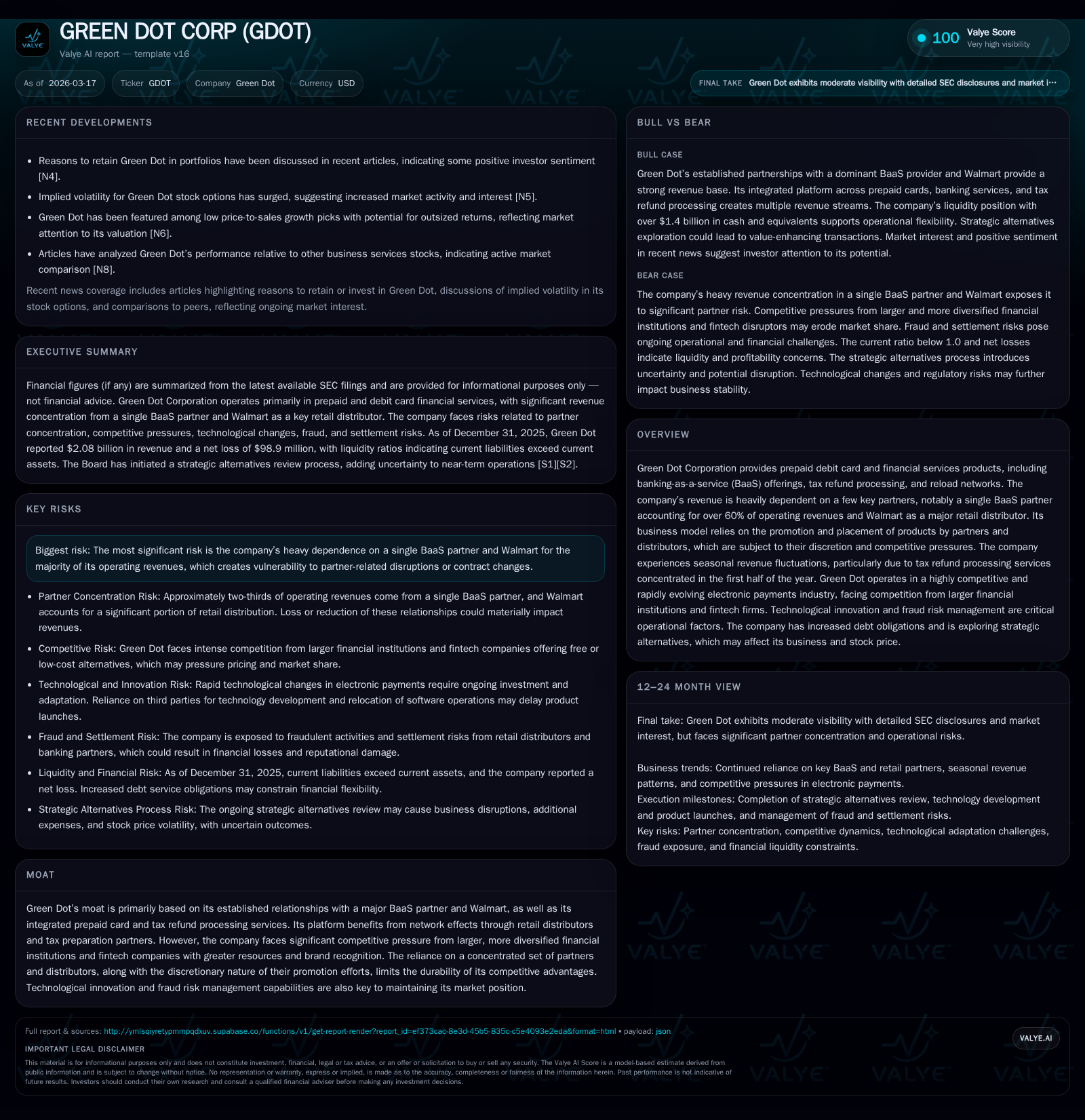
Green Dot Corporation experienced robust revenue expansion in fiscal 2025, fueled primarily by its dominant BaaS partner and Walmart distribution. However, this reliance on a few large partners introduces notable revenue concentration risks that may affect future stability and negotiated terms. Despite increased operating income compared to the prior year, the company continued to report significant net losses. Cash flow generation remains solid, supporting ongoing investments even as regulatory scrutiny and competitive pressures mount in the prepaid payments sector.
Strong Revenue Growth Masks Profitability Headwinds in FY2025
Historical performance (annual)
| FY | Rev ($bn) | Net ($mm) | CFO ($mm) | OpInc ($mm) | Rev YoY | Net YoY |
|---|---|---|---|---|---|---|
| 2025 | 2.1 | -99 | 139 | 14 | +20.7% | -270.3% |
| 2024 | 1.7 | -27 | 81 | -2 | +14.8% | -497.2% |
| 2023 | 1.5 | 7 | 98 | 23 | +3.6% | -89.5% |
| 2022 | 1.4 | 64 | 278 | 94 |
Source: SEC companyfacts cache [F1].
Capital returns and efficiency (annual)
| FY | Buybacks ($mm) | FCF ($mm) | ROE% |
|---|---|---|---|
| 2025 | 66 | -11.1 | |
| 2024 | 0 | 7 | -3.1 |
| 2023 | 0 | 22 | 0.8 |
| 2022 | 96 | 193 | 8.2 |
Source: SEC companyfacts cache [F1].
Green Dot Corp reported fiscal year 2025 revenue of approximately $2.08 billion, marking a robust 20.7% increase from the prior year's $1.72 billion [F1]. This top-line growth reflects successful execution with key partners and growing prepaid card usage alongside tax refund services—with seasonal drivers contributing significantly during the first half of the year [S6][S9]. Despite this expansion, operational leverage remains constrained; operating income improved markedly from a slight loss (-$1.7 million in FY2024) to a positive $13.7 million in FY2025 [F1], representing a near tenfold percentage increase.
However, net profitability deteriorated substantially as net losses widened from -$26.7 million to -$98.9 million [F1]. This divergence suggests elevated expenses or non-recurring charges offsetting improved core operations.
| FY | Revenue (USD) | Rev YoY % | Operating Income (USD) | OpInc YoY % | Net Income (USD) | Net YoY % | Operating Cash Flow (USD) | CFO YoY % | Capital Expenditures (USD) | Capex YoY % |
|---|---|---|---|---|---|---|---|---|---|---|
| 2025 | 2,080M | 20.7% | 13.7M | 918.9% | -98.9M | -270.3% | 138.6M | 70.3% | 72.5M | -2.4% |
| 2024 | 1,724M | -1.7M | -26.7M | 81.4M | 74.3M |
Reliance on Major Partners Sets a Double-Edged Sword for Future Prospects
Green Dot's business model hinges heavily on two principal partnerships: a single banking-as-a-service (BaaS) partner generating over 60% of operating revenues and Walmart accounting for about 7–8% via its retail distribution footprint [S2][S6][S9]. While these relationships validate product-market fit and drive scale through trusted distribution channels, they simultaneously expose Green Dot to acute counterparty concentration risk.
Contractual renewal terms are sensitive; Walmart's MoneyCard agreement extends through January 2033 with automatic renewals but includes termination clauses tied to service levels and pricing disagreements [S2][S9]. The BaaS partnership similarly lacks long-term exclusivity protections, heightening potential volatility if market shifts or competitive offers entice these entities elsewhere.
This structural dependency constrains Green Dot’s bargaining leverage and makes its revenue streams susceptible to partner strategy alterations or macroeconomic factors impacting consumer spending patterns across retail channels [S6][S9]. Publicity surrounding any disruption could further dampen customer acquisition or retention across multiple networks.
Potential Impact of Strategic Transactions on Company Structure and Value
In November 2025, Green Dot announced an ambitious strategic restructuring involving merger agreements with CommerceOne Financial Corporation and an asset sale of its Payments Business segment valued at $690 million [S1][S3]. Under this plan, Green Dot would convert into a limited liability company post-merger while divesting its non-bank fintech assets to Smith Ventures LLC affiliate “Payments Buyer.”
Proceeds from the Payments Sale are earmarked to fund per-share cash consideration to shareholders as part of the merger transaction as well as debt reduction initiatives [S1]. This move targets capital redeployment efficiency, focusing on core competencies while potentially unlocking shareholder value through streamlined operations.
For investors analyzing Green Dot's evolving capital structure, this separation represents both an opportunity for clearer asset valuation and a risk factor associated with integration execution complexities and potential shifts in revenue composition.
Operational Cash Flow Supports Investments Despite Earnings Pressure
Operational cash flow advanced strongly alongside revenue gains—growing 70% year-over-year from $81.4 million in FY2024 to $138.6 million in FY2025 [F1]. After considering capital expenditures of approximately $72.5 million (slightly reduced from prior year), Green Dot’s free cash flow remains healthy near $66 million.
Positive free cash flow amid accounting losses illustrates effective working capital management likely supported by collection terms from retail distributors and timely remittance from payment networks [S1]. Such cash generation capacity is critical given ongoing investments required in technology platforms and fraud prevention capabilities within financial services.
Capital Management: No Buybacks, Steady Equity, but Negative ROE
The company ceased share repurchases after distributing close to $95 million in buybacks as recently as FY2022; no buybacks have occurred during FY2024 or FY2025 [F1]. Concurrently, total shareholders’ equity has grown moderately from roughly $874 million to $890 million indicating retention of earnings or other comprehensive items despite net losses [F1].
Return on equity is negative around -11% based on last twelve months’ net loss relative to book equity value—a signal that profitability challenges persist even amidst top-line growth acceleration [F1]. The absence of buybacks aligns with management’s apparent focus on capital preservation over returning funds when earnings remain volatile.
Seasonality and Competitive Pressures in Prepaid Card & Payments Landscape
Green Dot’s earnings exhibit pronounced seasonality tied largely to tax refund processing services that generate the bulk of their income during the first half of each calendar year—prompting material quarterly fluctuations in revenues and cash flow [S6][S9].
Competitive forces intensify as larger incumbent banks and nimble fintech disruptors vie for market share with differentiated products offering lower fees or enhanced digital experiences [S14]. Many competitors possess scale advantages allowing them greater brand recognition and pricing flexibility.
To preserve relevance, Green Dot must continue investing in scalable technology infrastructure for real-time payments and embed stringent fraud risk mitigation tactics amid rising sophisticated attack vectors exploiting AI-powered social engineering schemes [S15][S18]. Failure to keep pace could erode network effects derived from retail distributor partnerships.
Monitoring Regulatory Developments and Fraud Risk Frameworks
Green Dot operates under intense regulatory scrutiny across banking and consumer finance domains necessitating compliance with complex federal statutes including Anti-Money Laundering rules and interchange fee regulations [S4][S5]. Notably, it paid a significant civil money penalty totaling $44 million in mid-2024 related to supervisory breaches involving its subsidiary bank [S4].
Ongoing regulatory developments threaten interchange fee income—a material portion (~9%) of overall revenues—and may compel fee restructuring that could impair customer acquisition economics or result in product discontinuations if cost increases reduce competitiveness [S5].
Simultaneously, litigation risks from data security incidents or failure to protect consumer information add financial burdens including settlement costs or fines plus reputational damage potentially curtailing acceptance by key retail partners [S10][S12]. Thus Green Dot's compliance function is pivotal not just for legal adherence but sustaining business continuity.
Summary
Green Dot Corporation navigates a delicate balance: benefitting from powerful partnerships driving impressive revenue growth yet exposed to concentrated counterparty risk shaping its financial trajectory dramatically. Operational improvements lifted segment profit margins temporarily but did not prevent substantial net losses amid competitive investments and regulatory costs.
Strategic corporate maneuvers—including divestitures aligning focus on core fintech assets—signal attempts at recalibrating value propositions against industry headwinds involving rapid technological innovation needs along with compliance intensification.
With stable yet negative returns on equity, solid cash flow execution remains vital for funding advances in product offerings while managing seasonally volatile revenue cycles affected by tax-related service timing.
The company’s continued evolution will require deft partnership management combined with agile adaptations in fraud risk frameworks aligned with emerging payment system norms within an increasingly competitive landscape dominated by larger diversified players.
Disclaimer: This is research-only, informational analysis and not investment advice. It may include AI-generated interpretation and general industry context. Always verify important details using primary sources.

Comments