
Blend Labs Drives Financial Services Transformation Through AI-Powered Origination
Blend Labs leverages its integrated AI-driven SaaS platform to recover from deep operating losses and position for scalable growth in mortgage and consumer lending markets.
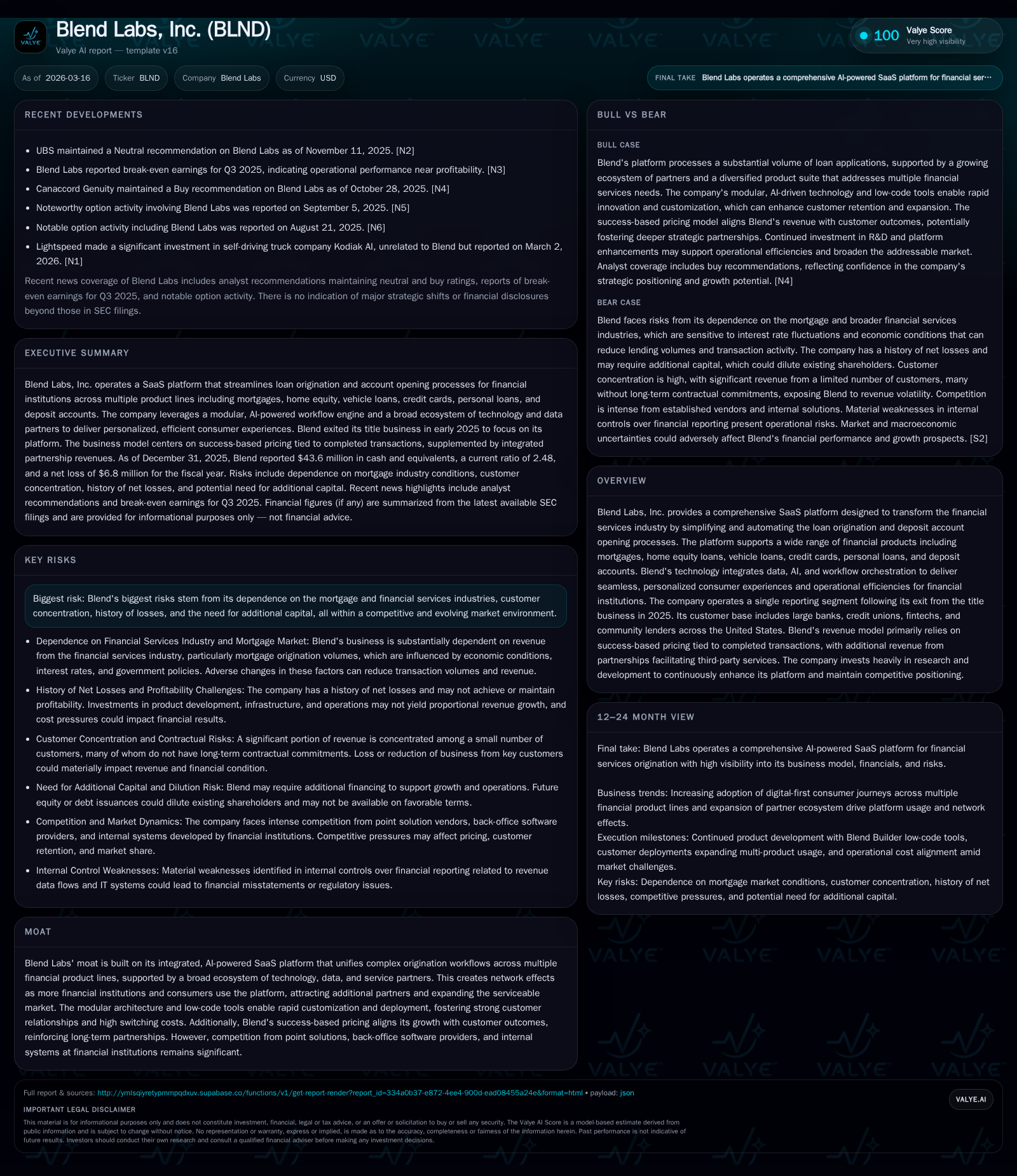
Blend Labs, a fintech SaaS provider specializing in loan origination and deposit account opening, has transitioned away from its title business to focus on an integrated AI-powered platform. Over the past four years, the company has notably reduced its operating losses and achieved positive operating cash flow by streamlining workflows and deepening customer relationships. Blend’s success-based pricing aligns its revenue with transaction completions, but growth remains subject to mortgage market dynamics and customer concentration risks. Looking ahead, expansion into new consumer banking products and ecosystem partnerships underpin growth potential, while regulatory, competitive, and macroeconomic headwinds present ongoing challenges.
Historical Performance: Recovering from Operating Losses
Blend Labs' financial trajectory over the last four fiscal years reveals a significant recovery from historically large losses that threaten sustainability. Operating income improved dramatically from a staggering -$746 million in FY2022 to -$21.7 million by FY2025, a decrease in losses year-over-year of approximately 56.2% [F1]. Net income mirrored this trend with an 84.3% narrowing of net loss from -$720 million to -$6.8 million during the same period. Moreover, after persistent negative cash flow from operations (CFO) earlier in the decade — for example dropping as low as -$190 million in FY2022 — the firm generated positive operating cash flow of $11.5 million in FY2025, signaling progress toward operational break-even on a cash basis [F1].
This turnaround coincides with Blend's strategic exit from its Title segment business during Q1 2025, consolidating its focus on core SaaS offerings for financial services firms and eliminating earnings volatility associated with ancillary lines [S4][S5]. Such refocusing likely trimmed complexity and enhanced margin profiles as resources targeted higher-growth digital origination workflows.
Historical performance (annual)
| FY | Net ($mm) | CFO ($mm) | OpInc ($mm) | Net YoY |
|---|---|---|---|---|
| 2025 | -7 | 12 | -22 | +84.3% |
| 2024 | -43 | -13 | -50 | +75.7% |
| 2023 | -179 | -128 | -156 | +75.2% |
| 2022 | -720 | -190 | -746 |
Source: SEC companyfacts cache [F1].
Capital returns and efficiency (annual)
| FY | ROE% |
|---|---|
| 2025 | 22.3 |
| 2024 | 76.9 |
| 2023 | 928.6 |
| 2022 | -584.7 |
Source: SEC companyfacts cache [F1].
Table: Blend Labs Historical Financial Performance (FY2022-FY2025) shows substantial reduction in losses alongside return to positive cash flow.
Despite these improvements, equity remains negative since FY2023 reflecting accumulated deficits amid prior rapid investment cycles. While indicative of an improving trajectory, Blend is not yet profitable on a GAAP basis.
Technology Edge: AI and Workflow Orchestration in the Blend Platform
Blend Labs’ platform distinguishes itself through an AI-infused workflow orchestration engine that harmonizes numerous complex tasks inherent in loan origination across multiple product lines. The company’s blend of modular microservices architecture with extensive pre-defined rules—covering data collection, verification checks, pricing algorithms, disclosures handling, stipulation management through closing—enables rapid configuration tailored to diverse financial institutions’ needs [S4][S5][S9].
The centerpiece is Blend Builder: a low-code design environment empowering institutions to create bespoke workflows and consumer-facing application journeys that can be quickly adapted without heavy engineering overhead [S9][S17]. This flexibility suits both national banks seeking scale and community lenders requiring customized compliance.
In addition to internal modules, the Blend Ecosystem integrates technology partners including CRM platforms, core banking systems, third-party data vendors like credit bureaus and fraud detection providers, as well as marketplace alliances—such as insurance integrations—providing consumers expanded options seamlessly embedded within loan processes [S6][S12]. This comprehensive ecosystem generates network effects where more customers attract additional service providers enhancing value for all stakeholders.
Development practices embrace Agile methodologies with weekly code deployments bolstered by automated testing frameworks assuring high reliability amid rapid innovation cycles [S20]. Such technological foundations underpin Blend’s ability to deliver modernized digital-first experiences surpassing legacy loan origination systems (LOS).
Customer Base and Market Position Post-Title Business Exit
With the divestiture of its Title business early in 2025—classified as discontinued operations—Blend consolidated reporting into a single segment focused exclusively on SaaS solutions powering loan origination and deposit accounts for financial services firms nationwide [S4][S5]. Customers encompass a broad spectrum including top-tier banks, fintechs licensed as non-bank lenders, credit unions of various sizes, independent mortgage banks, and community financial institutions managing under $1 billion AUM [S6][S18].
However, revenue concentration is notable: approximately 75% derives from just 25 customers generating more than $1 million each annually [S6][S18]. This concentration underscores dependence risks but also reflects deep integration where switching costs have grown due to embedded workflows extending beyond standalone applications.
Blend employs a “land-and-expand” sales strategy wherein initial deployments usually encompass one or two products targeting immediate pain points followed by gradual cross-sell of adjoining product suites building toward seamless multi-product consumer journeys under one unified platform brand [S4][S6][S18]. Dedicated account teams support deployment success through technical integrations often completed within three to four months—including back-office system linkages—and ongoing client enablement efforts encompassing training and best practice dissemination tailor-made per institution scale and sophistication level [S4][S20].
Revenue Model and Success-Based Pricing Dynamics
Blend’s commercial arrangements emphasize "Success-Based Pricing" where fees correlate directly with completed transactions—such as funded loans or newly opened deposit accounts—rather than mere applications submitted or abandoned dishes that still consume resources internally [S15][S24]. This approach aligns incentives closely between Blend Labs' growth objectives and end-customer business outcomes.
Such a transaction-tied revenue model inherently introduces volatility linked to fluctuations in loan volumes driven by external factors like mortgage demand cycles or regulatory shifts affecting credit availability. Moreover, forecasting difficulty arises because revenue realization hinges on self-reporting by institution clients regarding transaction counts—a limitation acknowledged by management adding complexity to precise revenue prediction models [S1][S15][S24].
To supplement transactional fees blending into more predictable streams during sustained usage phases or varied product adoption patterns some fixed-fee deals provide unlimited access to Consumer Banking solutions within defined scopes fostering longer-term stability where applicable [S15]. Additionally, Blend monetizes its extensive ecosystem by earning commissions or shares of revenue when facilitating third-party verifications or ancillary insurance services integrated directly into workflows creating incremental revenues through partner collaborations without full exposure to related operational costs [S15][S12].
Growth Prospects: Expanding Product Lines and Ecosystem Partners
Looking forward, Blend targets multiple avenues to augment top-line expansion anchored principally around broadening product sets beyond core mortgages into wider consumer banking verticals. Notable advances include launch of Rapid Home Lending—a streamlined journey optimizing refinance processes along with home equity line/loan originations designed to enhance conversion rates while optimizing unit economics underpinned by deeply modular workflow design principles [N1][S4][S17].
Further diversification incorporates vehicle loans financing solutions powering faster approval experiences plus credit card originations featuring configurable selection engines enhancing application completions plus personal loans offerings accelerating unsecured credit access stages providing velocity advantages within highly competitive markets [S17]. Also gaining traction are deposit account opening features helping institutions combat fraud risks while ensuring compliance through embedded Bank Secrecy Act (BSA) adherence functionality bolstering trustworthiness for new client onboarding workflows [S17].
The expanding marketplace partner roster reflects growing network effects attracting technology vendors incorporating complementary modules such as CRM providers or specialized document generation tools which reduce clients’ internal integration burdens while driving incremental platform engagement metrics serving as further lock-in mechanisms defining longer term relationships benefitting both Blend Labs and their clientele bases alike [S12][S19]. Cross-selling opportunities flourish due to shared backend APIs enabling easier bundling across multiple products within tailored consumer journeys increasing wallet share per customer institution.
Risks to Growth: Interest Rate Sensitivity and Customer Concentration
As management candidly emphasizes in SEC filings [S1][S7], principal risks stem significantly from reliance on mortgage market dynamics vulnerable to interest rate hikes impacting borrowing activity negatively thereby throttling loan origination volumes critical for revenue generation given success-based pricing structures.
Customer concentration risk exacerbates this vulnerability; terminations or material reductions by key clients could induce disproportionate revenue declines given few top contributors dominate sales mix currently comprising three-quarters of total revenues via just two dozen customers generating over $1 million apiece annually [S6][S18]. Additionally incumbent competition intensifies amidst proliferation of internal LOS enhancements executed by large financial institutions alongside specialized point vendors offering niche capabilities challenging Blend’s broader integrated suite positioning requiring continual innovation investment sustaining competitive moats derived from flexibility scalability breadth integrated ecosystems proprietary workflow libraries backed by sizable client bases which impose switching costs constituting partial deterrents but not insurmountable barriers for replacement alternatives emerging rapidly particularly if pricing disputes or performance issues arise.
Regulatory complexities loom large; legislative changes concerning consumer protections data privacy cybersecurity or arbitration waiver enforceability could affect contractual terms clientele willingness or legal exposures resulting potentially costly litigation claims underscoring heightened compliance costs weighing against bottom-line improvements despite efficiency advancements recorded recently which remain fragile given ongoing shifting macroeconomic conditions influencing technology spending appetite across financial firms broadly .[F1]
Capital Allocation: Improving Cash Flow and Return Metrics
Following years marked by steep operating cash flow deficits peaking at nearly -$190 million in FY2022 declining somewhat but still negative through FY2024 (-$13 million), Blend demonstrated encouraging signs culminating with positive operational cash generation totaling approximately $11.5 million in FY2025 marking a pivotal inflection toward financial self-sufficiency spotlighting prudent capital stewardship alongside strategic portfolio rationalization via title business exit that streamlined cost centers supporting returns optimization efforts underway now visible at income statement level too albeit still negative operating income near $-21.7M highlights residual pressures lingering reflecting reinvestment initiatives ongoing even as cost containment tightens arrayed against competitive necessity maintaining R&D intensity sustaining proprietary software advantage within fast-evolving fintech landscape crucial for mid-term viability.
Equity balances swung from positive $123 million at start of period (FY22) dipping into negative territories thereafter (-$19M in ‘23; -$56M ‘24; -$30M ’25), indicating persistent accumulated deficits absorbed predominantly through capital raises or convertible issuances rather than retained earnings improvable only upon consistent profitability establishment once sustained effective business scale realized.[F1]
Approximate return on equity calculations based on latest year produce about +22% ROE when considering net loss relative negative equity figure caution warranted interpreting magnitude due to capital structure distortions rather than pure operational performance gains but nevertheless underscores trajectory progress toward normalized profitability contours if current momentum persists paired with cautious financing discipline.[F1]
No reported dividends nor material ongoing share buyback programs were disclosed though board retains repurchase authorizations permitting opportunistic capital return should surplus liquidity beyond reinvestment needs materialize warranting continued observer attention for policy shifts aligned with corporate lifecycle phases.[S16]
What to Watch: Indicators Shaping Blend’s Financial Trajectory
Absent explicit forward guidance disclosures blend’s evolving story can be tracked through key leading indicators revealing business health elsewhere: total dollar volume of completed loans processed provides real-time proxy mirroring sector-wide mortgage market cycles filtered through Blend’s expanding footprint potentially uncovering higher wallet share gains under multi-product adoption strategies deployed among top customers originating majority transactions serviced; velocity adoption metrics quantifying how fast newly acquired customers ramp usage across diverse product portfolios indicate cross-selling success factoring directly into near-term recurring revenue quality enhancement; renewal patterns coupled with contract terms renewal negotiations reflect pricing power positioning amid intensifying competition constrained budgeting environments risk aversion postmortgage cycle corrections inducing discount concessions impacting ARR predictability; lastly regulatory environment shifts including CFPB enforcement trends around consumer finance laws arbitrations class action validity may heighten compliance burdens indirectly pressuring margins or negotiating leverage conditions shaping cost structures hence profitability outlook overall.[N1][S3]
Monitoring these operational vectors alongside general macroeconomic interest rate trajectories affecting housing affordability credit demand will provide investors nuanced context deciphering how well Blend Labs capitalizes on its digital transformation promise maintaining gains demonstrated recently while mitigating structural headwinds ubiquitous across fintech lending arenas.
This analysis synthesizes publicly filed SEC reports alongside recent news references without projecting investment advice or price expectations. All numeric figures stem solely from documented sources denoted throughout except contextual sector analysis which represents informed editorial perspective consistent with buy-side financial research standards.
Disclaimer: This is research-only, informational analysis and not investment advice. It may include AI-generated interpretation and general industry context. Always verify important details using primary sources.

Comments