
Small-Market Strength: PCB Bancorp’s Financial Performance and Outlook
PCB Bancorp leverages a focused niche lending strategy and conservative credit practices to drive robust earnings growth while navigating regulatory and operational challenges.
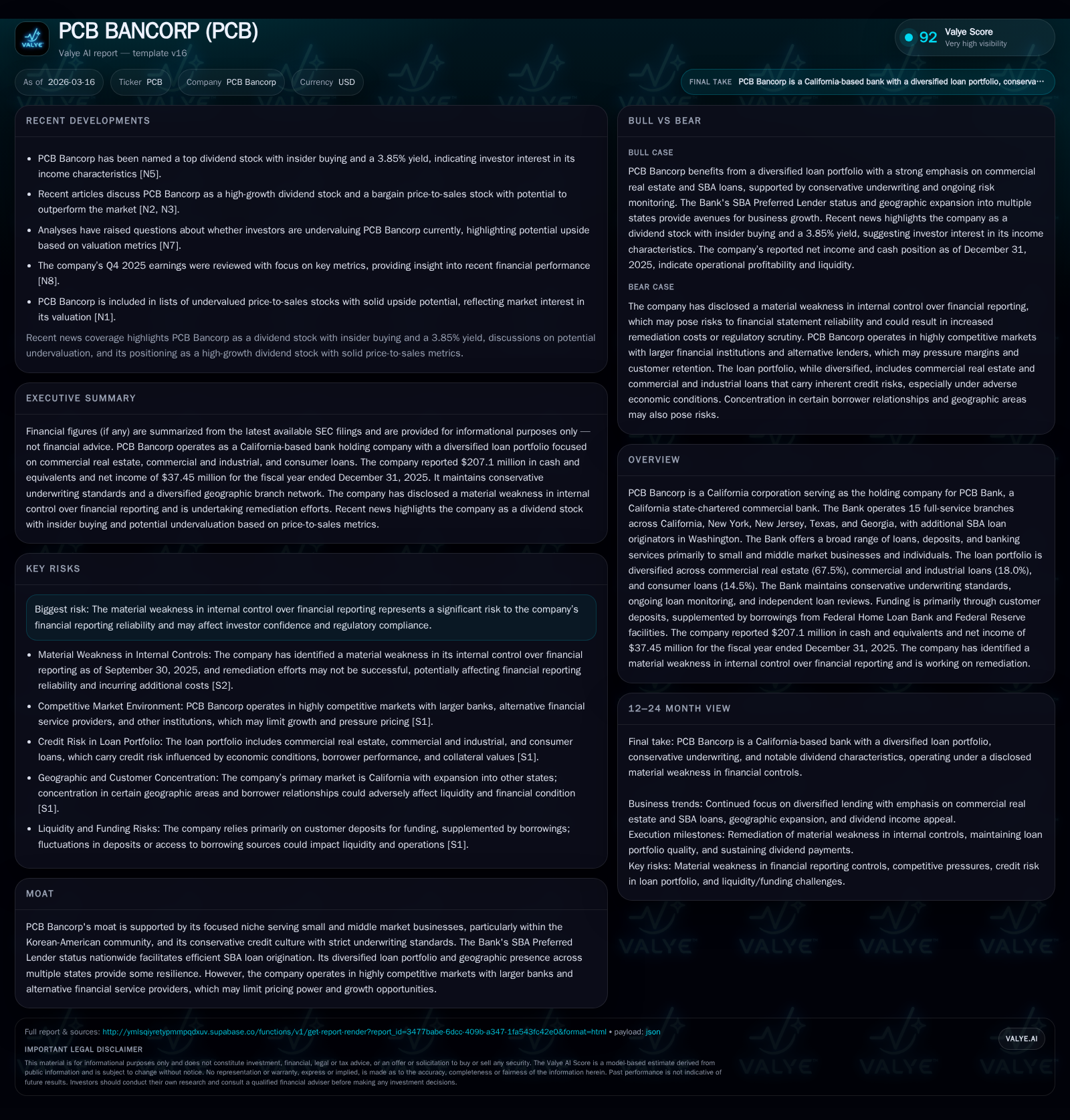
PCB Bancorp, operating through its state-chartered bank with 15 branches primarily serving small and middle market businesses including a significant Korean-American clientele, reported a 45.1% jump in net income for fiscal 2025, reflecting disciplined credit management and strategic loan diversification. Despite softer operating cash flows, the company reduced capital expenditures significantly and increased share repurchases, underscoring a commitment to shareholder returns amid solid regulatory capital levels. Material weaknesses in financial reporting controls remain a notable risk requiring close monitoring as the bank balances growth ambitions with regulatory compliance and market competition.
Earnings Acceleration Driven by Strategic Niche Lending
Historical performance (annual)
| FY | Net ($mm) | CFO ($mm) | Capex ($mm) | Net YoY |
|---|---|---|---|---|
| 2025 | 37 | 27 | 2 | +45.1% |
| 2024 | 26 | 39 | 4 | -15.9% |
| 2023 | 31 | 63 | 1 | -12.2% |
| 2022 | 35 | 57 | 5 |
Source: SEC companyfacts cache [F1].
Capital returns and efficiency (annual)
| FY | Buybacks ($mm) | FCF ($mm) | ROE% |
|---|---|---|---|
| 2025 | 7 | 24 | 9.6 |
| 2024 | 0 | 35 | 7.1 |
| 2023 | 9 | 62 | 8.8 |
| 2022 | 7 | 52 | 10.4 |
Source: SEC companyfacts cache [F1].
PCB Bancorp's financial results for fiscal year 2025 highlight a pronounced acceleration in profitability within its targeted small- to middle-market banking niche. Net income leapt by 45.1% to $37.45 million compared to $25.81 million in FY2024 [F1]. This surge unfolded despite a notable contraction of nearly one-third (-31.8%) in operating cash flows to $26.59 million, signaling some working capital challenges or changes in non-cash items [F1]. Capital expenditures halved year-over-year from $4.08 million to $2.19 million—a reduction possibly signaling operational efficiency gains or maturity in branch infrastructure investment [F1]. Equity at year-end rose moderately to $390 million, reflecting retained earnings accretion alongside modest share repurchases increasing sharply to $7.1 million from just $0.22 million the prior year [F1]. This constellation suggests that the company’s earnings leverage is deeply linked to its credit risk discipline and the composition of its lending portfolio rather than aggressive top-line expansion.
Loan Portfolio Composition and Risk Management Practices
A defining feature of PCB Bancorp’s business model is its diversified yet concentrated loan portfolio dominated by commercial real estate (CRE) exposures, which constituted roughly 67.5% of loans at end-2025 [S1][S4]. Within CRE are segments spanning commercial properties, owner-occupied business real estate, multifamily residential units, and construction loans—all subject to conservative underwriting limits such as maximum loan-to-value ratios (e.g., 70% for construction) [S6][S12][S25]. The next largest component comprises commercial & industrial (C&I) loans at approximately 18%, including SBA-backed facilities supporting equipment purchases and working capital needs [S16][S10]. Consumer loans account for about 14.5%, consisting mainly of residential mortgages and auto loans extended predominantly to higher net worth individuals within the target demographics [S16].
The bank maintains rigorous credit risk governance including centralized policies, uniform underwriting standards across product lines, independent semi-annual third-party loan reviews validating internal risk ratings, and ongoing borrower monitoring conducted by dedicated relationship officers [S6][S16]. The company’s SBA Preferred Lender status nationwide facilitates efficient SBA loan origination processes that are vital for addressing the financing needs of small businesses especially within Korean-American communities [S10]. Despite facing industry-wide CRE concentration scrutiny—the company discloses CRE loans exceeding 300% of total risk-based capital—it actively manages this exposure through strict collateral valuations, portfolio diversification efforts, and discussions with regulators [S19].
Geographic and Customer Diversification as Growth Foundations
While headquartered principally in Southern California—operating nine full-service branches across Los Angeles and Orange Counties—the bank extends its presence strategically with three full-service branches on the East Coast (New York and New Jersey), two in Texas (Carrollton and Dallas), one in Georgia (Suwanee), alongside loan originator presence in Washington state focused on SBA lending [S8]. This multi-regional footprint supplements reliance on local economic conditions through geographic diversification aligned with communities sharing common demographic profiles.
PCB Bancorp notably targets the Korean-American community within these locales—a niche characterized by distinct banking needs not always met by larger institutions—establishing robust customer relationships leveraged for organic lending growth [S1][N4]. This focus insulates the bank somewhat against generic competitive pressures yet imposes concentration risks tied to economic conditions both domestically within those regions and externally related to Korea’s economic environment [S23][S18]. The overlapping demographic lending emphasis combined with broad regulatory compliance requirements creates execution challenges but also acts as a moat through specialized service offerings.
Capital Allocation Priorities: Dividends, Buybacks, and Cash Flows
Capital deployment by PCB Bancorp balances shareholder returns with conservative liquidity management. The company maintained dividends yielding approximately 3.85% as noted recently [N5][N6], grounded on consistent net income generation despite elevated market uncertainties.
Share repurchases surged dramatically to $7.1 million in FY2025 from minimal activity previously (approximately $222k in FY2024), underscoring management’s confidence in intrinsic valuation and commitment to returning capital efficiently [F1]. With total equity around $390 million at year-end FY2025 and an approximated return on equity of about 9.6%, the firm exhibits moderate profitability suitable for measured capital recycling without compromising regulatory buffers [F1].
Liquidity remains strong with cash & equivalents totaling over $207 million—supporting ongoing lending activities amid fluctuating deposit costs—and borrowings primarily sourced from Federal Home Loan Bank advances acting as supplemental funding [F1][S5]. Core deposits constitute nearly two-thirds of total deposits ($2.8 billion total), supplemented by wholesale deposits totaling over $340 million providing stable low-cost funding critical given competitive deposit markets [S14].
Addressing Internal Control Challenges Amid Expansion
Among highlighted risk factors is the identification of a material weakness in internal control over financial reporting disclosed during Q3 of 2025 that rendered the disclosure controls ineffective as of September 30th, necessitating ongoing remediation efforts [S2][S1]. The potential implications include diminished investor confidence, regulatory scrutiny, possible misstatements, delays or inaccuracies in filings—all material risks given increasing complexity associated with geographic expansion and product diversification.
Management is actively working towards remediation without assurance of success—a typical scenario for banks scaling operations while attempting process upgrades under regulatory frameworks such as Sarbanes-Oxley compliance requirements applicable here [S2]. While this represents a near-term risk warranting attention from stakeholders, prompt corrective steps may mitigate long-term reputational damage if executed effectively.
Forward-Looking Considerations for Growth and Regulatory Landscape
Looking ahead, PCB Bancorp’s growth trajectory hinges chiefly on executing prudent credit policies amid evolving interest rate environments impacting net interest margin dynamics—the core driver of earnings volatility common across regional banks [N4][S13]. Expanding SBA-backed lending remains an important avenue leveraging preferred lender status nationwide while managing legal lending limits thoughtfully avoids excessive borrower concentration risks which could impair portfolio quality [N7][S4].
Competitive pressure from both larger banks targeting identical customer segments as well as fintech entrants underscores the importance of technology investments alongside relationship-based banking—though smaller institutions like PCB frequently emphasize personal service over scale efficiencies alone [S15][S8]. Regulatory adherence relating both to capital adequacy under Basel III rules plus community development programs linked to current ECIP participation will continue framing strategic choices especially concerning preferred stock repurchase options potentially exercisable post mid-2026 conditional upon meeting "qualified lending" thresholds—a significant milestone investors should watch closely [S22][S23][N7].
What Investors Should Monitor Next
Continuous surveillance is recommended on several fronts:
- Progress remediation status regarding reported material internal control weakness impacting quarterly reporting reliability.
- Trends within the CRE segment loan quality given its outsized contribution relative to capital base along with external real estate market signals.
- Stability or growth trajectory of deposits encompassing core vs wholesale composition impacting liquidity buffers.
- Dividend sustainability vis-à-vis net income consistency amidst potential margin compression.
- Developments around repurchase eligibility under ECIP agreements providing potential for discounted preferred stock buyback juxtaposed against execution risks.
- Macroeconomic factors including regional economic health affecting key demographic demand drivers alongside interest rate movement influencing asset-liability management.
Such factors collectively frame PCB Bancorp’s nuanced opportunity set defined by niche expertise yet balanced against traditional banking sector headwinds enlivened by contemporary regulatory complexities.
This analysis relies solely on publicly available information drawn from the company's recent SEC filings including Form 10-K (filed March 16, 2026) along with corroborated data snapshots as per companyfacts XBRL disclosures ending December 31, 2025 ([F1]), augmented by reputable financial news sources cited explicitly herein ([N#]). No forward-looking projections are offered beyond documented guidance where referenced; all conclusions avoid speculative inference respecting compliance mandates governing internal Valye News research memos.
Disclaimer: This is research-only, informational analysis and not investment advice. It may include AI-generated interpretation and general industry context. Always verify important details using primary sources.

Comments