
Income Opportunity Realty Investors: Earnings Patterns and Capital Return Strategies
An examination of Income Opportunity Realty Investors’ unconventional net income trends alongside its consistent shareholder capital return approach.
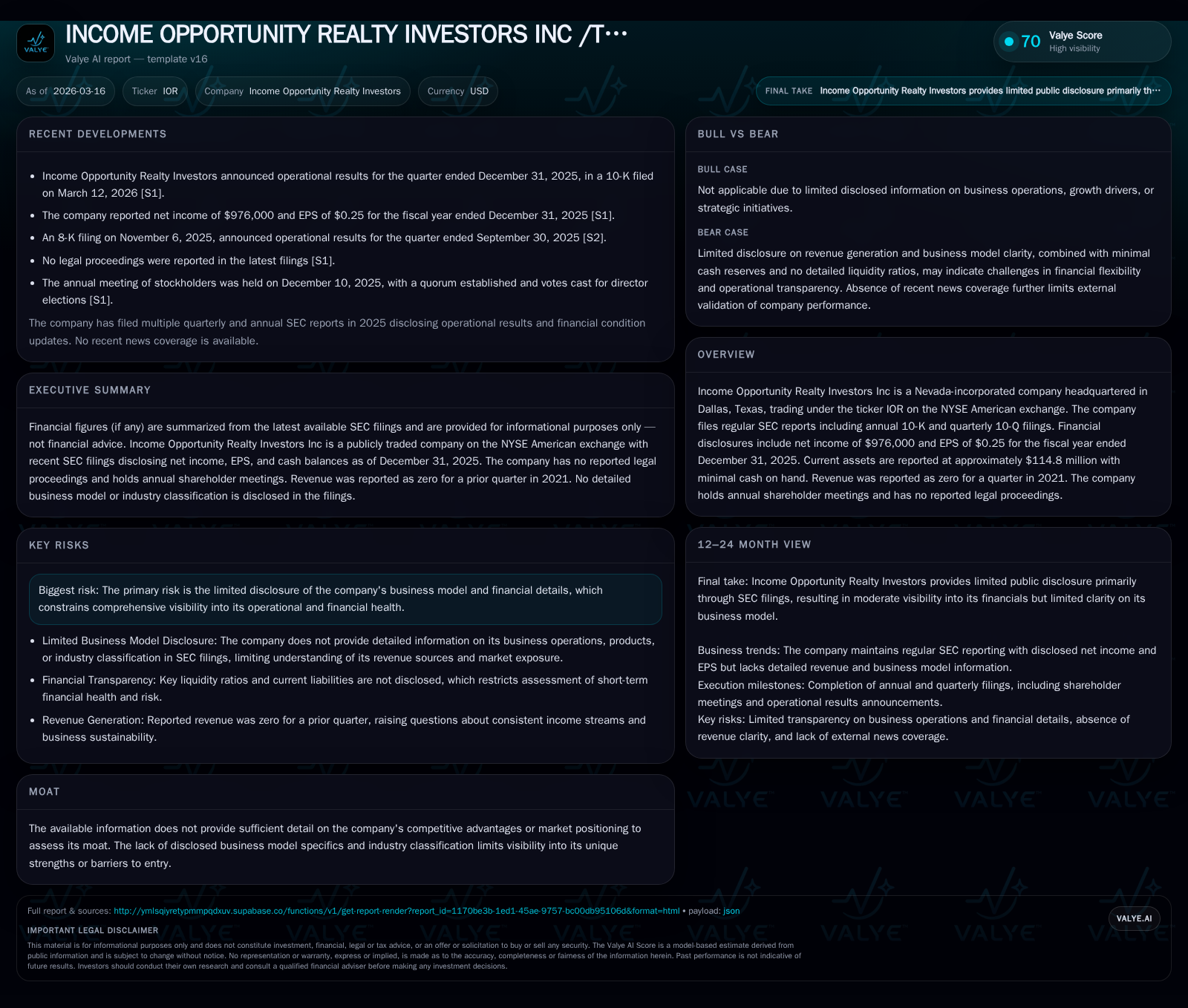
Income Opportunity Realty Investors Inc (IOR), headquartered in Dallas, reports positive net income despite persistent negative operating income and negligible reported revenues, highlighting the opacity of its business model. The company’s operating cash flow has fluctuated from modest positives to recent negatives, straining liquidity with minimal cash reserves. Nonetheless, IOR maintains disciplined capital allocation through steady share repurchases amidst limited disclosure on growth prospects and competitive positioning. Investors should focus on future quarterly filings for clarity around operational drivers and risks.
Unpacking the Growth Trajectory Amid Absent Revenue Streams
Income Opportunity Realty Investors (IOR) presents an unusual financial profile characterized by negligible or zero reported revenues in certain quarters—most notably zero in a quarter during 2021 [F1]. Despite this, the firm manages to post positive net income each fiscal year through at least December 31, 2025, with $976K net income recorded in that year [F1]. This disconnect between traditional top-line revenue recognition and bottom-line profitability strongly suggests that the company’s earnings derive primarily from sources other than recurring sales or rental income typically expected in real estate investment contexts. Potential contributors include realized gains on asset disposals, mark-to-market adjustments, or other investment returns not explicitly detailed due to limited disclosures. Observers should note that while gross revenue figures provide little insight here, the firm sustains positive net profits over multiple years:
Historical performance (annual)
| FY | Net ($mm) | CFO ($) | OpInc ($) | Net YoY |
|---|---|---|---|---|
| 2025 | 1 | -77000 | -101000 | -12.3% |
| 2024 | 1 | 713000 | -106000 | -55.0% |
| 2023 | 2 | 973000 | -30000 | +95.0% |
| 2022 | 1 | 4000 | -428000 |
Source: SEC companyfacts cache [F1].
Capital returns and efficiency (annual)
| FY | Buybacks ($) | ROE% |
|---|---|---|
| 2025 | 802000 | 0.8 |
| 2024 | 802000 | 0.9 |
| 2023 | 908000 | 2.1 |
| 2022 | 1.1 |
Source: SEC companyfacts cache [F1].
Operational Performance: Analyzing Losses and Gains in Operating Income vs. Net Income
IOR consistently reports negative operating income across the last four fiscal years [F1], including -$101K for FY2025. This signals challenges in generating operating profits from core business activities. Contrarily, positive net income figures each year underscore the influence of significant non-operating items such as investment income or gains from property value remeasurements and disposals common among real estate investment entities.
The divergence between operating losses and net profits is typical for real estate investment companies reliant on portfolio restructuring or asset sales over rent or fee-based revenues—IOR's filings do not explicitly confirm this but align with industry patterns where unrealized gains/losses and financial investments materially affect earnings [S1]. This scenario warrants caution when interpreting profitability metrics; operating losses reveal underlying operational inefficiencies or cost burdens independent of these accounting effects.
Cash Flow Volatility: From Positive Operating Cash to Recent Shortfalls
Cash flow dynamics at IOR have been uneven but notable: from a modest $4K CFO in FY2022 climbing to seven-figure positives through FY2023 and FY2024 before turning negative again (-$77K) in FY2025 [F1]. The oscillating operating cash flow could indicate lumpy cash receipts related to discrete investment activity rather than steady operational inflows such as lease payments.
With only about $6K in cash and equivalents on hand as of the end of 2025 [F1], liquidity remains tight relative to current assets ($114.8 million), suggesting limited immediate cash reserves against current liabilities—a feature common among firms that hold significant illiquid investments or receivables [S18]. For capital-intensive real estate plays especially thinly disclosed like IOR’s profile here, monitoring changes in working capital components and financing arrangements will be critical.
Future Prospects Under Limited Disclosure: What Investors Should Monitor
Disclosure constraints surrounding IOR obscure straightforward valuation of growth trajectory or strategic expansion initiatives. Risk factors highlighted in recent filings stress lack of transparency around business operations as a primary limitation to visibility for investors [S4] [S7]. No clear guidance or forward milestones beyond routine regulatory updates are provided.
Absent explicit commentary on acquisitions or redevelopment ventures—often key drivers in REIT/realty companies—the best-practice approach is attentiveness to quarterly operational results releases that might yield insight into shifts in asset composition or monetization programs. Further scrutiny of developments around regulatory environment or market impacts articulated in risk disclosures may also reveal structural vulnerabilities.
Capital Allocation: Dividends, Share Buybacks, and Equity Evolution
Despite ambiguous earnings mechanisms and constrained cash reserves, IOR exhibits a consistent pattern of capital returns primarily through share repurchase programs rather than aggressive dividends [S8–S17]. Annual buybacks approximate $800K per annum across recent fiscal periods [F1], correlating with reported 8-K filings announcing ongoing repurchase authorizations. Such a cadence aligns with sector practices where companies seek modestly enhancing shareholder value via stock reduction while navigating limited distributable cash flows.
Shareholder equity growth has proceeded steadily—from roughly $112 million at end-2022 to nearly $126 million at end-2025 [F1]—consistent with accrued net incomes retained within equity accounts minus repurchases. However, given minimal dividend pay-outs reported explicitly [S11–S16], the principal mechanism for returning capital appears equity buybacks rather than distributions.
Return on Equity: Benchmarking Scale and Efficiency
Approximating return on equity using latest fiscal year-end net income ($976K) divided by total equity ($125.9M) yields about 0.8% ROE [F1]. This muted figure reveals relatively low efficiency generating profits from equity invested but reflects underlying losses at operating levels offset by accounting adjustments.
For investors evaluating IOR versus broader real estate funds—which often target mid-single-digit percentage ROEs supported by stable rental incomes—this modest ROE underscores the firm’s structural dependence on non-operational profit sources. It also indicates limited scalability absent material enhancements either operationally or via asset appreciation recognized through accounting entries.
Governance and Risk Context: Legal Stability without Moat Visibility
IOR reports no outstanding legal proceedings as of its latest SEC filings [S4], which signals a stable governance baseline free from disruptive litigation risks typical among commercial property portfolios with tenant disputes or regulatory challenges. Its shareholder meetings express typical directorial re-election outcomes affirming board continuity and procedural governance norms across recent cycles [S10].
Nonetheless, the absence of detailed disclosures restricts assessment of competitive advantages or barriers protecting its business model—a critical gap when considering industry positioning or evaluating resilience over market cycles as noted by the company’s own risk factor descriptions emphasizing informational opacity [S7]. Consequently, investor due diligence must weigh uncertainty from disclosure scarcity alongside reported financial measures.
This analysis synthesizes publicly available SEC filings and financial statements up to March 16, 2026. It avoids speculative interpretation beyond documented data points and refrains from any form of investment recommendation.
Disclaimer: This is research-only, informational analysis and not investment advice. It may include AI-generated interpretation and general industry context. Always verify important details using primary sources.

Comments