
Cantor Equity Partners III Pursues Business Combination with AIR Under Tight 24-Month Deadline
Cantor Equity Partners III, a Cayman Islands-based SPAC linked to Cantor’s financial services platform, focuses on closing a targeted deal by mid-2027.
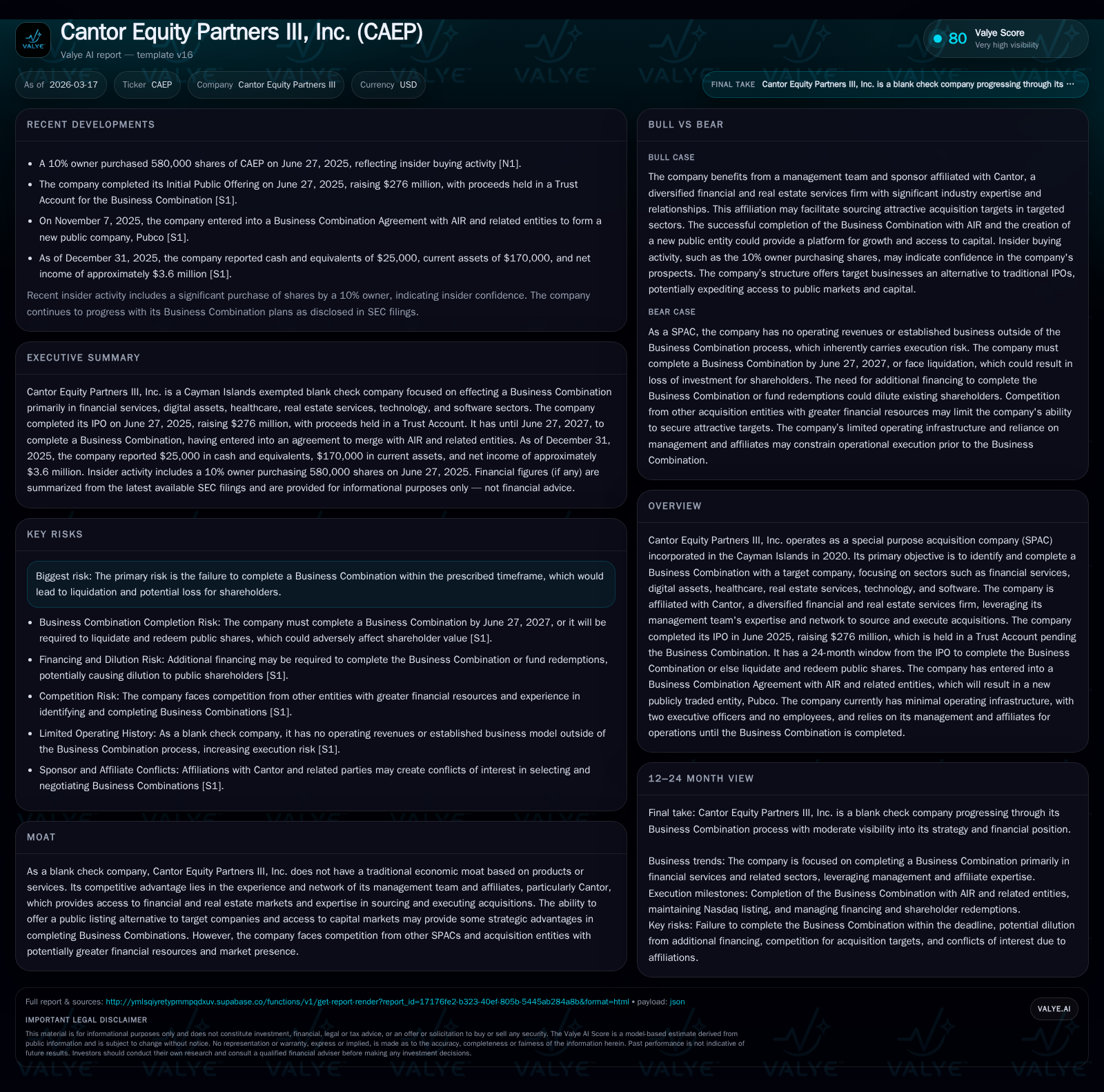
Incorporated in 2020, Cantor Equity Partners III, Inc. (CAEP) operates as a special purpose acquisition company (SPAC) leveraging the expertise and network of its affiliate Cantor to seek acquisitions primarily in financial services, digital assets, healthcare, real estate services, technology, and software. The company raised $276 million in its IPO in June 2025, held in trust pending a business combination. CAEP has entered into an agreement with AIR and related entities to complete a business combination but must finalize the transaction by June 27, 2027 or liquidate. Its competitive advantage stems from the management team’s industry experience and capital market access rather than traditional operational moats. Shareholder redemption rights and potential dilution remain key considerations for the upcoming merger.
Company Overview and Structure
Cantor Equity Partners III, Inc. (CAEP) was incorporated as a Cayman Islands exempted company on November 11, 2020 to serve as a special purpose acquisition company (SPAC). Its mission: identify and consummate one or more business combinations within sectors including financial services, digital assets, healthcare, real estate services, technology, and software. The company's executive leadership consists of Brandon G. Lutnick—Chairman and CEO—and Jane Novak—Chief Financial Officer—with both executives affiliated with Cantor’s diversified financial ecosystem.
Cantor itself is a multifaceted financial services firm with controlling interests in entities such as BGC Group (Nasdaq: BGC), a global brokerage and technology provider servicing financial markets; Newmark Group (Nasdaq: NMRK), specializing in commercial real estate services; and CF&Co., an independent middle market investment bank [S1]. These relationships imbue CAEP with considerable industry insight and access to capital markets essential for executing transactions.
Past Growth & Historical Performance
As a blank check company without operating revenues prior to any business combination, CAEP’s historical financials reflect only administrative expenses associated with maintaining the publicly-listed entity.
Historical performance (annual)
| FY |
|---|
| 2025 |
Source: SEC companyfacts cache [F1].
Operating losses primarily arose from ongoing SPAC-related costs including legal fees and general administrative expenses. The positive net income figure predominantly originates from non-operational sources such as interest income accrued on funds held in the Trust Account established post-IPO [F1].
Future Growth Prospects
CAEP's growth trajectory depends entirely on its ability to consummate an initial business combination within its designated timeframe. The company has executed an agreement to merge with AIR and associated entities—a transaction anticipated to unlock value via the combined entity’s operations post-merger while expanding shareholder base.
Potential growth drivers include leveraging Cantor's deep sector knowledge for target identification ranging from fintech innovation in digital assets to expansion within healthcare technology solutions. Additionally, the company’s capability to utilize different financing tools—including cash from the trust account combined with shares or debt issuance—provides flexibility in tailoring acquisition deal structures that suit target needs while preserving shareholder value [S7], [S18].
However, numerous constraints persist: failure to close by June 27, 2027 mandates liquidation; competitive pressures from other SPACs backed by larger pools of capital remain significant hurdles; dilution risk accompanies potential additional financing rounds; lastly target execution risks regarding management integration could impair combined entity prospects given limited pre-combination operational history among sponsors beyond SPAC activities [S25], [S27].
Forecasts / Milestones / Expectations
The critical milestone remains completion of the Business Combination by mid-2027 unless extended with shareholder approval—extending beyond this period triggers mandatory liquidation procedures involving redemption payments approximating $10.36 per public share based on Trust Account values minus taxes accrued since IPO [S7], [S14], [S22].
Given their November 2025 agreement with AIR — a related but unaffiliated business — progress towards closing compliance steps (regulatory filings/Public Shareholder approvals) will be keenly observed. Proxy materials disclosures will elucidate structure details related to redemptions limits tied to shareholder vote mechanisms per Nasdaq rules.
Investors should monitor updates on:
- Completion timetable adherence,
- Redemption election levels impacting cash availability for transaction,
- Whether additional financing is required beyond Trust Account proceeds,
- Lock-up releases affecting share float post-merger,
- Strategic shifts driven by target company operational performance insights once announced.
Returns / Capital Allocation
Prior to a business combination closing, CAEP holds nearly all investor proceeds ($~281.9 million at Dec 31, 2025) in an SEC-regulated Trust Account earning interest held specifically for funding transactions or redemptions. Outside of this trust funding is minimal: unrestricted cash totals $25k emphasizing tight operational cash reserves reserved solely for SPAC management activities [F1].
Key capital allocation provisions specify that public shareholders may redeem shares regardless of voting preference at approximately the pro-rata Trust Account per-share value (recently estimated $10.36 including accrued interest), constrained by certain limitations if shareholder vote is conducted alongside the proposed merger approval process [S6], [S15], [S26]. This feature protects liquidity but caps downside exposure.
Additionally:
- The Sponsor extended loan facilities intended to cover redemption attendant costs funded outside the Trust Account; such amounts convert into ordinary shares or repayable at Closing depending on outcomes [S13],
- Founder Shares (~6+ million shares) owned by Cantor-affiliated Sponsor entities are subject to forfeiture/vesting arrangements based on five-year earn-out criteria stipulated under Sponsor Support Agreement following merger closing; these terms align long term incentives but substantially limit immediate insider liquidity while guarding against premature selling pressure post-combination [S8].
Return metrics like ROE offer limited insight given no revenues or operating businesses exist pre-deal; latest approximate ROE was -60.5%, reflecting accounting losses against equity base largely consisting of invested IPO proceeds prefunded for acquisitions rather than operational return generation yet observed net income includes mostly accounting entries unrelated to operating profitability [F1].
Competitive Positioning & Risks
While lacking product-driven economic moats typical in operating companies, CAEP’s strategic advantage emerges from:
- The extensive network and market execution capability supplied via Cantor’s diversified finance and real estate platform,
- Flexibility afforded through multi-instrument deal structures (cash/debt/equity combinations),
- Public listing providing target candidates liquidity events that may compete favorably relative to private alternatives.
Nonetheless competition is fierce among SPACs often sponsored or supported by institutions with deeper capital pools or more sector-specific track records. Deal flow quality remains uncertain despite management’s expertise. Further factors placing downward pressure include risks related to failing to close deals on time causing automatic redemption/liquidation events resulting in loss of potential upside for shareholders.
Uncertainties also surround future management roles post-merger given none of CAEP’s current directors/officers are expected to stay following Business Combination completion unless otherwise indicated at closing evaluation phase; this creates governance transition risk impacting continuity of strategy execution amid integration phases [S25], [S27].
Summary
Cantor Equity Partners III stands at its defining crossroads—charged with deploying roughly $282 million raised just nine months ago into its first major acquisition underpinned by Cantor's extensive expertise umbrella across intertwined financial markets and real estate sectors plus strategic tech verticals including fintech innovation areas like digital assets. Success hinges tightly on completing its merger pact with AIR before mid-2027 or face orderly dissolution paying back investors near par principal plus modest trust account interest.
Investor focus will center not only on timing but structural mechanics of redemptions alongside shareholder voting thresholds influencing deal feasibility amid broader competitive landscapes saturated with well-capitalized peers pursuing similar industry vertical targets.
Disclaimer: This analysis is provided for informational purposes reflecting data available as of March 17, 2026. It does not constitute investment advice nor an endorsement of any securities mentioned herein.
Disclaimer: This is research-only, informational analysis and not investment advice. It may include AI-generated interpretation and general industry context. Always verify important details using primary sources.

Comments