
Centurion Acquisition Corp. Faces Clock on Business Combination with $287.5M IPO Trust
Operating as a blank check company, Centurion Acquisition Corp. has raised substantial capital but must secure a qualifying acquisition within its 24-month window.
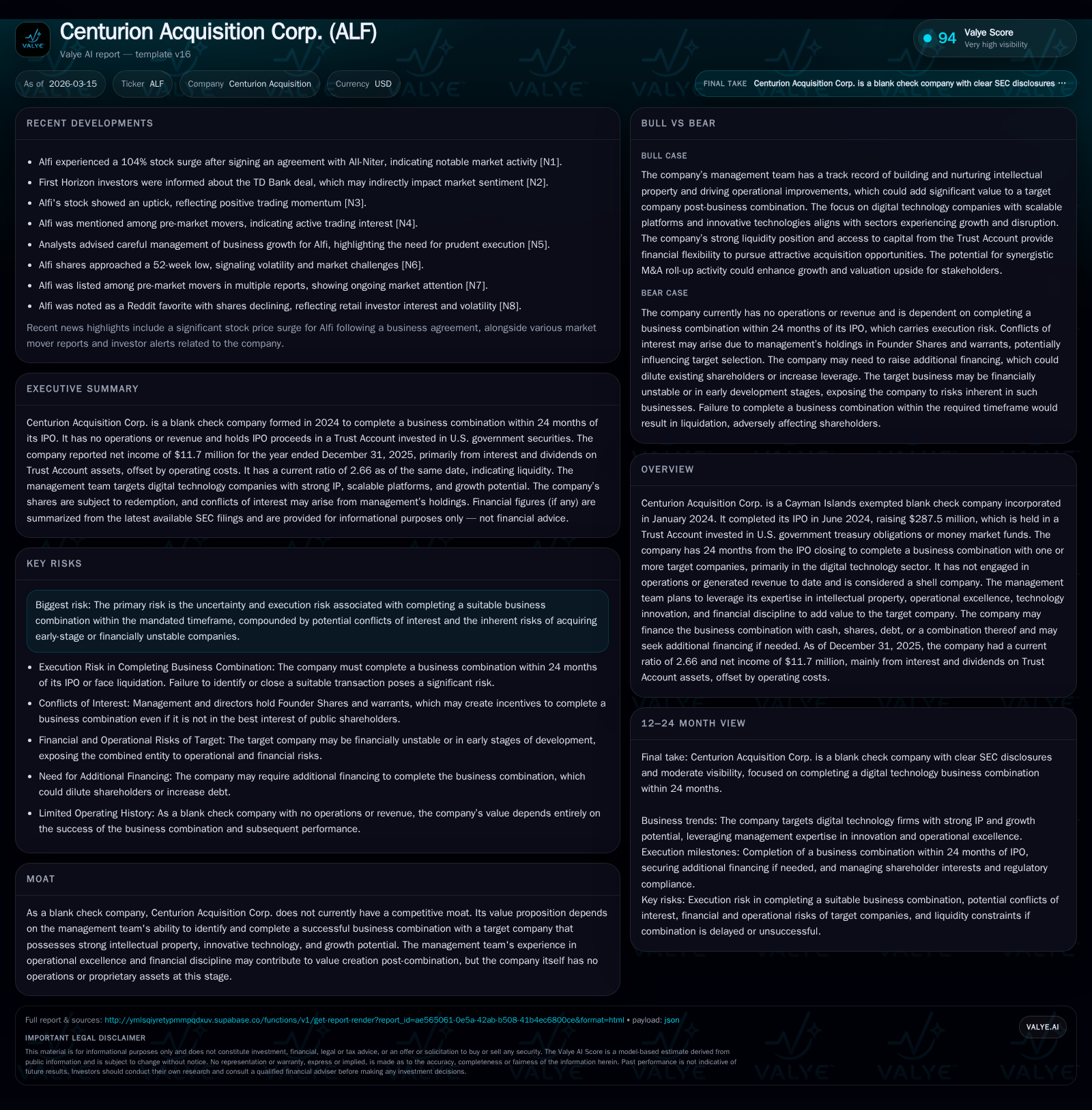
Centurion Acquisition Corp. launched in January 2024 and raised $287.5 million through an IPO held in trust to facilitate a business combination primarily in digital technology. As a newly formed blank check company without operational revenue, it carries inherent execution risks tied to successfully identifying and closing a target deal before its June 2026 deadline. Financial results reflect net income predominantly from interest earned on trust assets, offset by operating costs related to public company compliance and due diligence. The company’s capital structure and liquidity are strong yet highly dependent on successful transaction execution within the allotted timeframe.
Company Overview and History
Centurion Acquisition Corp. (ALF) was incorporated in the Cayman Islands on January 18, 2024 as a special purpose acquisition company (SPAC) focused on consummating a business combination predominantly in the digital technology sector [S1]. It completed its initial public offering (IPO) on June 12, 2024, issuing 28.75 million units at $10 each and raising gross proceeds of $287.5 million [S1]. These funds were placed into an interest-bearing Trust Account invested primarily in U.S. government treasury securities with short maturities or money market funds complying with SEC rules [S1][S7][S19].
As a blank check entity, Centurion Acquisition Corp has no operations or revenue-generating activities before completing its Business Combination. Its current activities revolve around incurring formation and operational costs related to seeking and negotiating that transaction [S1]. The company operates as a shell under Exchange Act definitions owing to its nominal non-cash assets comprised almost entirely of trust funds [S1].
Historical Financial Performance
Centurion's financials are characteristic of early-stage SPACs: operating losses accompany interest income earned by investing IPO proceeds conservatively.
Historical performance (annual)
| FY | Net ($mm) | CFO ($) | OpInc ($) | Net YoY |
|---|---|---|---|---|
| 2025 | 12 | -564445 | -626249 | +49.8% |
| 2024 | 8 | -165249 | -467492 |
Source: SEC companyfacts cache [F1].
Capital returns and efficiency (annual)
| FY | ROE% |
|---|---|
| 2025 | -86.4 |
| 2024 | -60.5 |
Source: SEC companyfacts cache [F1].
The company reported no operating revenues since inception [F1]. Operating losses increased by approximately 34% year-over-year from $467K in 2024 to $626K in 2025 [F1], reflecting ongoing legal, accounting, auditing fees, and due diligence expenses associated with business combination planning [S1].
Net income rose by nearly 50% YoY from about $7.8 million in 2024 to $11.7 million in 2025 driven by higher dividends and interest income earned on marketable securities held in the Trust Account [F1][S1]. This non-operating income substantially offsets operating expenses.
Operating cash flow trends mirror the loss profile with cash used increasing materially year over year (-$165K to -$564K) as spending on acquisition planning intensified [F1]. At December 31, 2025, the trust held approximately $308 million while cash outside the trust totaled just over $100K [S7][F1].
The equity section shows a deficit reflecting that Class A ordinary shares subject to redemption liabilities are accounted for outside permanent equity; thus shareholders’ deficit stood near -$13.6 million at end-2025 [F1][S19]. This negative equity position is typical for SPACs given redemption rights embedded in IPO shares.
Business Model and Moat
Centurion Acquisition Corp’s value proposition lies not in proprietary operations but rather in its management team’s expertise targeting businesses with strong intellectual property within digital technology—aiming to combine operational excellence and financial discipline post-acquisition for value creation . As of today, it lacks any competitive moat or unique operational assets beyond its sponsor's network and financial war chest.
Risks and Execution Challenges
The primary risk facing ALF is the uncertainty inherent to sourcing and executing a suitable business combination within the mandated two-year window from IPO closing (deadline: June 12, 2026) [S1][S4][S16]. Failure results in mandatory liquidation and dissolution of the company with proceeds returned to shareholders minus expenses [S16]. While extensions are possible under certain conditions, none have been confirmed.
Additional risks pertain to conflicts of interest due to Sponsor relationships with potential targets or competing ventures as well as challenges typical for SPAC mergers such as price negotiations amid volatile markets or regulatory hurdles [S13][S20].
Capital Structure and Liquidity
The company's capital structure comprises:
- Founder Shares held by Sponsor representing approximately 20% post-IPO equity but without redemption rights [S21][S22]
- Public Shares issued via IPO with embedded redemption rights exercisable upon shareholder vote or tender offer at roughly $10 per share plus accrued interest [S21][S26][S27]
- Private Placement Warrants purchased by Sponsor and underwriters amounting to seven million warrants at $1 each [S21][S22]
Trust Account cash totals approximately $308 million securing investor principal for use solely toward business combination financing or redemptions at close [S19]. Cash outside the trust remains minimal and primarily finances corporate overhead while working capital stands positive albeit very modest ($100K+ at balance sheet date) [F1][S7].
No long-term debt has been reported; transaction-related deferred underwriting fees totaling about $13.7 million are accrued liabilities payable upon business combination completion [S19][F1]. Promissory notes extended from Sponsor during pre-IPO organization phase were extinguished pre-IPO close; no outstanding borrowings currently exist under working capital arrangements [S5][S12].
Capital Allocation & Returns
No dividends or share repurchase programs have been declared or executed given SPAC status pending transaction success [S10][S15][S22]. The one significant use of capital remains directed toward identifying and closing acquisitions that meet investment criteria.
Return metrics such as ROE appear negative (-86.4% approx.) based purely on net income versus negative book equity after redeemable shares classification adjustments—reflective mostly of SPAC accounting peculiarities rather than operational performance failure [F1].
Outlook & Milestones To Watch
Centurion Acquisition Corp’s future hinges entirely on consummating an initial Business Combination prior to June 12, 2026—a non-negotiable milestone given mandatory liquidation if missed [S16]. The company's management continues active evaluation of acquisition targets but no definitive agreements have been announced as of March 15, 2026 . Recent news cited surges in related entities after signing agreements hint at industry activity but do not indicate ALF's direct transactions yet (N1).
Potential growth drivers post-combination would depend on acquiring companies with scalable technology platforms capable of leveraging intellectual property advantages in digital innovation sectors cited by management guidance . Conversely, failure to identify attractive candidates promptly caps upside entirely.
Investors should closely monitor filings for:
- Announcements regarding target identification or letter(s) of intent signing
- Proxy materials issued for shareholder votes surrounding business combinations
- Voting outcomes respecting redemption rights exercised
- Possible extensions requested for the statutory deadline
- Post-merger financial performance updates following transactioin completion
The absence of explicit earnings guidance until after the merger precludes conventional forecasting beyond these event-driven milestones.
Conclusion
Centurion Acquisition Corp exemplifies a conventional SPAC model: funded conservatively through IPO proceeds stashed in secure Treasury instruments while incurring predictable operating expenses focused on deal sourcing activities. Its intrinsic value lies presently solely in its capacity to identify and consummate an appropriate business combination within the rigid two-year timeline enforced by its governing documents.
While net income metrics look positive thanks mainly to interest income from invested IPO funds, ongoing losses represent legitimate costs associated with maintaining public company compliance ahead of proposed mergers without traditional revenue streams at this stage.
Absent execution risk mitigation and alignment with appropriately innovative target companies offering technological moats post-merger, ALF’s investors remain exposed primarily to timing risk that culminates either in transformative growth via acquisition or complete dissolution should no deal materialize.
This report is prepared solely for informational purposes based on available documentation including SEC filings and public domain information as of March 15, 2026. It does not constitute an investment recommendation nor does it provide advice regarding securities purchases or sales.
Disclaimer: This is research-only, informational analysis and not investment advice. It may include AI-generated interpretation and general industry context. Always verify important details using primary sources.

Comments