
DUKE Robotics Faces Capital Constraints While Expanding Military and Civilian Drone Operations
A small robotics firm with patented stabilization technology, DUKE Robotics operates at the intersection of defense and infrastructure maintenance with mixed financial results.
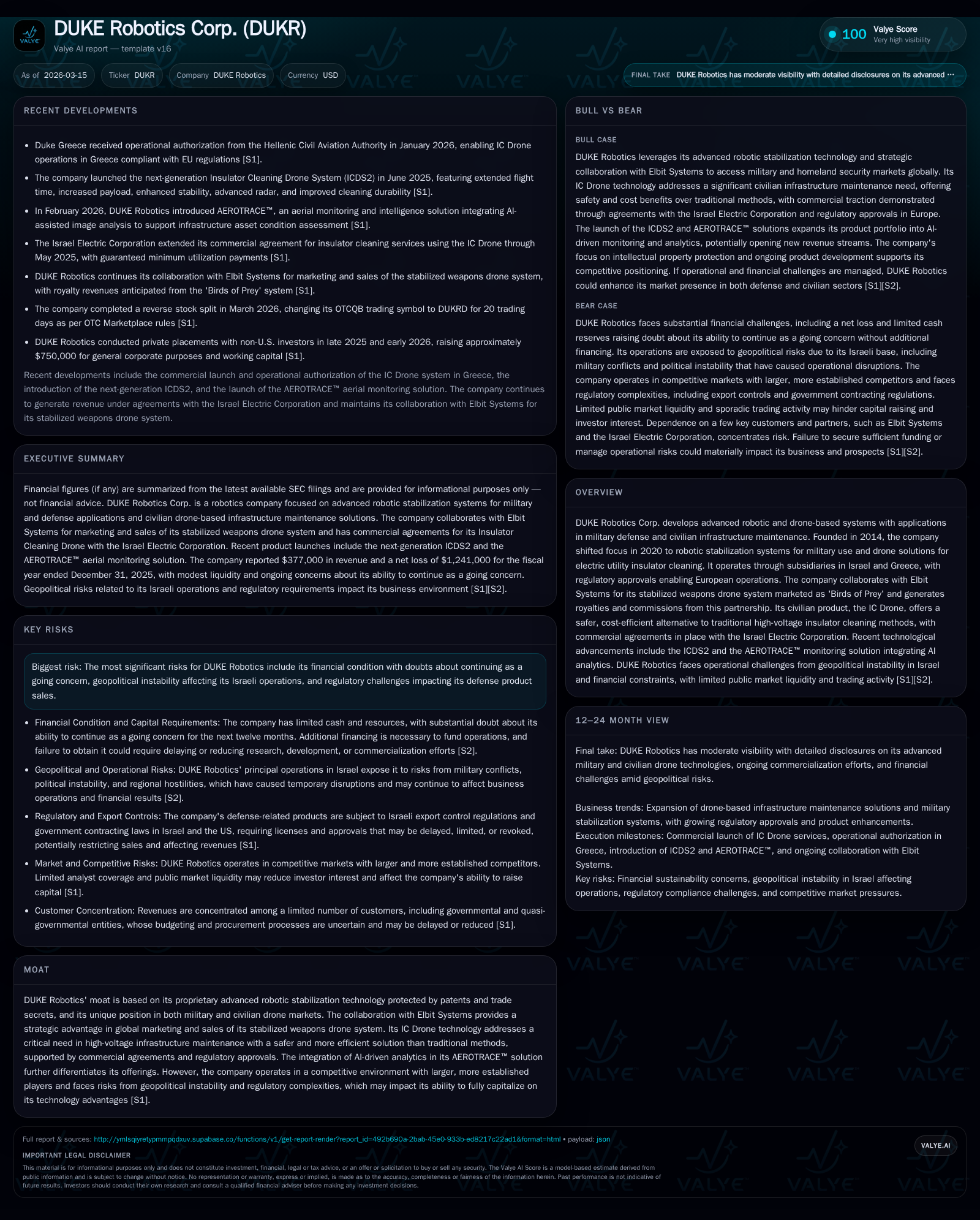
DUKE Robotics Corp., established in 2014, specializes in advanced robotic stabilization technology and drone solutions for military and civilian clients. Despite revenue growth from $108K in 2024 to $377K in 2025 driven by partnerships and new product launches like the IC Drone and AEROTRACE™, the company remains unprofitable with a net loss exceeding $1.2 million and substantial cash flow deficits. Collaboration with Elbit Systems enables exposure to military markets but financial sustainability is uncertain given limited liquidity, recurring losses, and geopolitical risks tied to its Israeli base. Future growth depends on broader adoption of civilian drone services in Europe, expanded U.S. defense sales, and capital funding, with watch points on regulatory challenges and commercialization execution.
Company Background and Business Model
Founded in 2014 initially as Unlimited Aerial Systems LLP, DUKE Robotics Corp. pivoted in 2020 towards developing advanced stabilized robotic systems designed for military applications alongside civilian drone solutions targeted at infrastructure maintenance [S1]. Central to its technology suite is a proprietary robotic stabilization system protected by patents granted notably in the U.S. [S15]. Commercially, DUKE leverages a collaboration agreement with Elbit Systems Land Ltd., an Israeli defense electronics company. This alliance has produced the 'Birds of Prey' stabilized weapons drone system; Elbit leads marketing while DUKE receives royalties ranging from low to mid-double digit percentages plus mid-single digit commissions on sales introduced by DUKE's activities [S7].
On the civilian front, DUKE's IC Drone addresses the challenge of high voltage electric insulator cleaning—a critical yet hazardous routine usually conducted via helicopters or crane trucks. The drone offers a safer and more cost-effective alternative capable of operating near live lines without human risk [S15]. The company is expanding internationally with subsidiaries in Israel (Duke Israel) and Greece (Duke Greece), the latter having obtained regulated operational approval within the European Union after completing the SORA process mandated by EU Regulation 2019/947 [S24][S23].
Historical Financial Performance
DUKE Robotics remains a small-cap entity showing volatile but upward-trending revenue growth from a low base. Annual revenues increased from approximately $108K in 2024 to $377K in 2025—a rise of about 249% year-over-year. However, this top-line expansion has not offset persistent operating losses that increased from -$1.03 million in 2024 to -$1.21 million in 2025 (a roughly -18% decline). Correspondingly, net income losses widened from about -$985K to -$1.24 million (-26%) over the same period. Operating cash flows remain negative but improved by nearly +12%, moving from -$918K to -$811K between 2024 and 2025 [F1].
Capital expenditures grew sharply—more than doubling year-over-year—to support product development and commercialization initiatives: rising from $77K in 2024 to $205K in 2025 (+166%). This contributes to significant free cash flow deficits estimated near -$1 million annually [F1]. Equity declined substantially—from $851K at end-2024 down to about $100K as of December 31, 2025—reflecting accumulated losses eroding shareholder value [F1]. The balance sheet shows moderate liquidity with cash & equivalents at $750K against current liabilities of $756K (current ratio approximately 1.2), indicating tight working capital conditions [F1].
### Historical performance (annual)

| FY | Rev ($) | Net ($) | CFO ($) | OpInc ($) | Rev YoY | Net YoY |
| --- | :---: | :---: | :---: | :---: | :---: | :---: |
| 2025 | 377000 | -1241000 | -811000 | -1206000 | +249.1% | -26.0% |
| 2024 | 108000 | -985000 | -918000 | -1025000 | -64.0% | -35.7% |
| 2023 | 300000 | -726000 | -548000 | -802000 | -40.0% | +34.1% |
| 2022 | 500000 | -1101000 | -672000 | -1124000 |  |  |

*Source: SEC companyfacts cache [F1].*

### Capital returns and efficiency (annual)

| FY | FCF ($) | ROE% |
| --- | :---: | :---: |
| 2025 | -1016000 | -1241.0 |
| 2024 | -995000 | -115.7 |
| 2023 | -566000 | -40.2 |
| 2022 | -707000 | -45.4 |

*Source: SEC companyfacts cache [F1].*
Table summarizes key annual financial performance figures
Growth Drivers and Future Prospects
DUKE’s future growth potential rests on three pillars:
Military Market Expansion: The collaboration agreement with Elbit positions DUKE for penetration into U.S. special operations forces and NATO allies’ defense budgets, particularly for remotely operated weapon systems mounted on drones or other platforms including all-terrain vehicles [S23]. The U.S. military’s diverse use cases could serve as early large-scale adopters.
Civilian Infrastructure Services: The IC Drone targets a multi-million unit global market addressing high voltage insulator cleaning—a vital component whose routine maintenance prevents outages and reduces accident risks [S15]. Drones offer safer, more cost-efficient alternatives compared to helicopters.
Technology Innovation: Recent additions include AEROTRACE™, an AI-powered aerial monitoring solution integrating data-driven analytics for asset condition assessment [S15]. This may enable upselling opportunities while strengthening competitive differentiation.
Challenges include evolving business model risks amid civilian market entry requiring internal expertise development [S1], geopolitical tensions related to Israeli operations potentially affecting contracts [S8][S22], regulatory complexity, and supply chain disruptions due to tariffs or export controls [S20][S14].
Milestones and Upcoming Developments
No explicit quantitative guidance was provided recently; key watch points include:
- Expansion of IC Drone contracts beyond initial customers following European SORA certification.
- Increased sales momentum through Elbit-led marketing targeting U.S. defense agencies.
- Progress on AI analytics integration via AEROTRACE™.
- Resolution developments on litigation involving Duke Israel [S25].
- Announcements regarding funding rounds critical given liquidity concerns.
Capital Structure and Returns Analysis
DUKE Robotics does not currently pay dividends or repurchase shares; capital deployment favors R&D investments supporting product innovation [S24]. Shareholder equity has contracted significantly due to cumulative losses—equity stood at just $100K at the end of 2025 down from nearly $851K one year prior [F1].
Operating cash flows are negative annually reflecting burn rates well beyond current revenues; combined with rising capex results in negative free cash flow near ($1M) annually [F1]. Financing details suggest reliance on equity or debt raises remains necessary given limited liquidity and going concern disclosures [S11][S19].
Return on equity is deeply negative (~-1240%), highlighting unprofitability and limited return generation capacity presently [F1]. Substantial doubt exists regarding continuing as a going concern absent additional financing given cash runway constraints from operating losses [S1][S2][S12][S13].
Risks Summary
Key risks include:
- Financial Uncertainty: Cash reserves insufficient for projected twelve-month operations without new funding posing existential risk [S1][S2].
- Geopolitical Exposure: Israeli geopolitical volatility could disrupt headquarters or constrain defense-related sales subject to export licensing [S22][S25].
- Regulatory Complexity: Compliance demands across U.S., Israeli, EU regulations impose operational burdens risking contract termination or penalties if unmet [S6][S8][S10].
- Litigation: Claims against Duke Israel alleging breaches related to IEC services pose potential reputational or financial exposure though initial dismissal occurred without prejudice [S25].
- Competitive Landscape: Larger players with greater resources may limit market share gains if DUKE cannot scale manufacturing or innovate rapidly enough [S7][S16][S22].
- Intellectual Property Challenges: Patents offer some protection but rapid AI innovation may erode advantages or lead to costly disputes [S16][S9][S29].
- Supply Chain Risks: Tariff impositions on components increase input cost uncertainty alongside supplier concentration risks potentially disrupting production schedules [S14][S20].
Industry Context (Analysis)
DUKE operates where advanced robotics for defense applications intersect with industrial inspection drones—sectors marked by intense innovation pressure alongside heightened global regulatory scrutiny. Military unmanned systems face rigorous certification processes influenced by shifting allied policy priorities; civilian infrastructure drones confront evolving safety certifications plus privacy/data compliance regimes complicating rapid market expansion.
Success hinges not only on technological edge but also regulatory navigation given government budget constraints require proof of reliability before broader adoption.
Summary Outlook
DUKE Robotics presents differentiated stabilized robotic technologies serving niches within military unmanned weapon platforms via strategic partnerships alongside pioneering high-voltage power grid maintenance drones supported by regional regulatory approvals.
Financially constrained yet technologically promising, DUKE shows sharp revenue growth counterbalanced by deepening cumulative losses; ongoing external capital raises will be critical absent near-term profitability gains.
Future focus should track contract wins linked to Elbit’s marketing efforts in NATO markets, civilian utility sector expansions post-European endorsements, and any new financing easing going concern pressures.
Disclaimer: This report is provided for informational purposes only without any recommendation regarding securities transactions.
Disclaimer: This is research-only, informational analysis and not investment advice. It may include AI-generated interpretation and general industry context. Always verify important details using primary sources.

Comments