
AC Immune SA Navigates Strategic Collaboration Shifts Amid Continued Investment in Neurodegenerative Therapies
Swiss biotech AC Immune balances regaining key program rights with sustained net losses and a liquidity runway extending into late 2027.
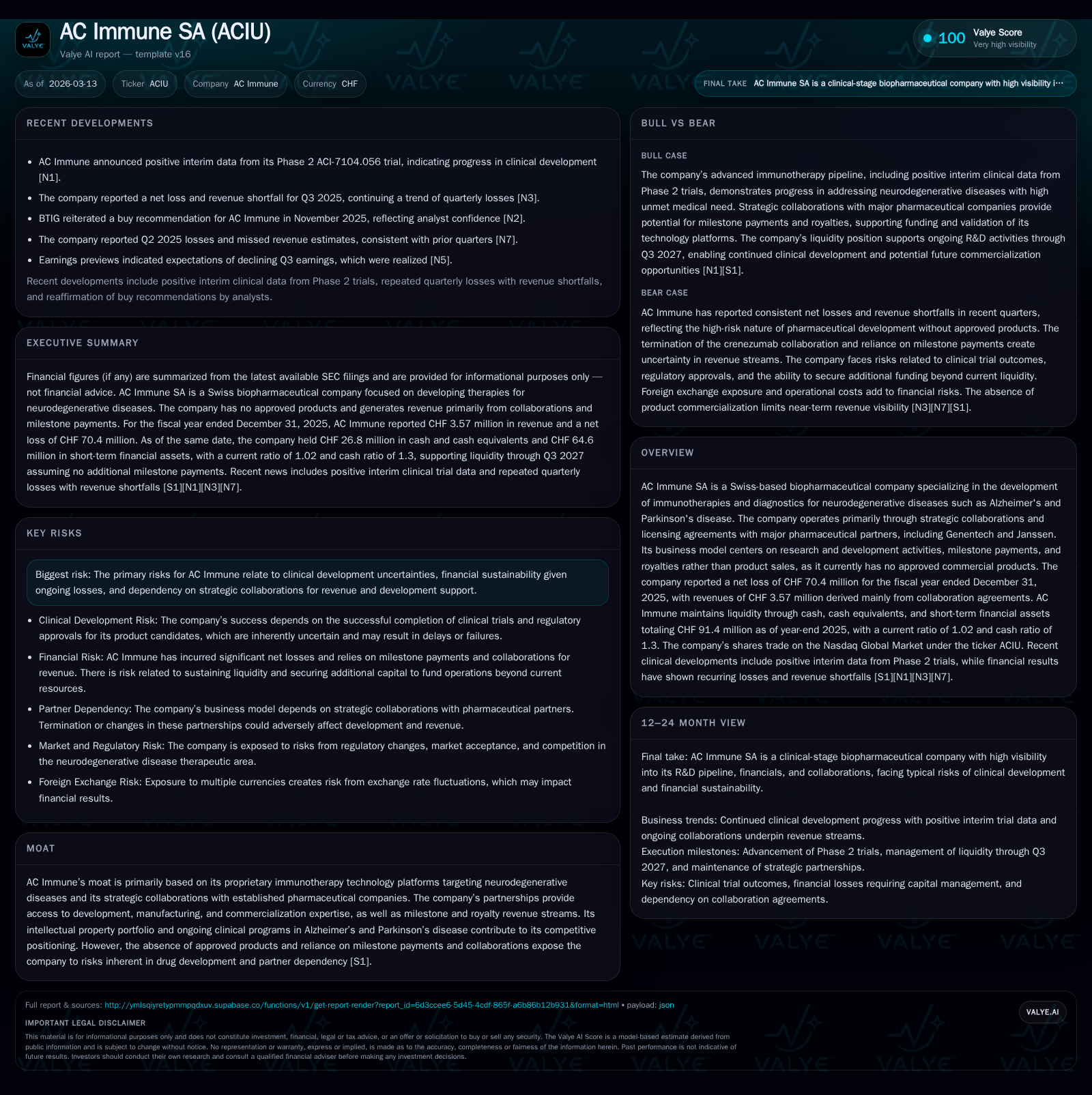
AC Immune SA remains focused on advancing immunotherapies for neurodegenerative diseases, operating without approved products or commercial sales. The company’s 2025 revenue declined sharply to CHF 3.6 million due to the termination of key collaborations and reacquisition of development rights. Despite a net loss of CHF 70.4 million, strong cash management sustains operations through Q3 2027. Ongoing partnerships with Janssen, Takeda, and Lilly complement internal development efforts as AC Immune progresses clinical pipelines independently amid typical biotech risks.
Historical Performance
Founded in 2003, AC Immune SA focuses on immunotherapies targeting neurodegenerative diseases including Alzheimer's and Parkinson's. The company has not generated revenues from product sales but relies on milestone payments and upfront fees from licensing agreements with pharmaceutical partners.
Revenues have been volatile due to the timing of milestones tied to collaborations. Revenue peaked at CHF 27.3 million in FY2024 but declined sharply by nearly 87% to CHF 3.57 million in FY2025 following the termination of key Genentech development agreements and reacquisition of global rights to certain programs [F1][S1].
Net losses persisted, widening from CHF 50.9 million in FY2024 to CHF 70.4 million in FY2025, reflecting substantial R&D investments as the company advances clinical programs without commercial product sales [F1].
Historical performance (annual)
| FY | Rev ($mm) | Net ($mm) | Rev YoY | Net YoY |
|---|---|---|---|---|
| 2025 | 4 | -70 | -86.9% | -38.4% |
| 2024 | 27 | -51 | +84.5% | +6.1% |
| 2023 | 15 | -54 | +276.1% | +23.3% |
| 2022 | 4 | -71 |
Source: SEC companyfacts cache [F1].
Capital returns and efficiency (annual)
| FY | ROE% |
|---|---|
| 2025 | -157.0 |
| 2024 | -45.4 |
| 2023 | -33.8 |
| 2022 | -41.9 |
Source: SEC companyfacts cache [F1].
*Note: Significant step changes linked to milestone timing effects [F1].
Growth Outlook
Key strategic developments shape AC Immune's near-term outlook:
Following the April 2024 termination of crenezumab and semorinemab collaborations with Genentech, AC Immune regained full global rights by February 2025, increasing internal development scope [S1].
The company continues collaboration with Janssen on ACI-35.030 (anti-Tau active immunotherapy) and has an option-license agreement with Takeda covering Abeta-targeting active immunotherapies such as ACI-24.060; AC Immune is responsible for completing the ABATE trial prior to Takeda potentially assuming further development [S1].
Lilly retains global commercialization rights for Morphomer Tau small molecules after phase 1 completion led by AC Immune [S1].
ACI-19764, an orally administered NLRP3 inflammasome inhibitor, entered Phase 1 trials in early 2026, reflecting diversification into neuroinflammation pathways [S3].
The proprietary SupraAntigen and Morphomer platforms underpin technology differentiation supporting candidate generation beyond amyloid and tau targets [S1]. Progression through costly late-stage trials remains critical for value realization.
Milestones and Expectations
While explicit financial guidance is not provided beyond reported results, important upcoming milestones include:
- Completion of the ABATE Phase trial under AC Immune’s responsibility before Takeda exercises its license option.
- Independent advancement of crenezumab and semorinemab programs following rights reacquisition.
- Clinical data readouts from Janssen collaborations will inform pipeline validation.
- Early-stage program outcomes like ACI-19764 will expand therapeutic focus within neurodegeneration.
Revenue generation remains contingent upon milestone achievements triggering license payments; product sales revenues are not expected imminently.
Capital Allocation and Returns
The company’s return on equity was approximately -157% in FY2025 due to continued net losses relative to shareholders’ equity [F1].
Cash management is conservative:
- At December 31, 2025, cash and cash equivalents were CHF 26.8 million with short-term financial assets of CHF 64.6 million, totaling CHF 91.4 million liquidity available [F1][S8].
- Current assets slightly exceed current liabilities resulting in a current ratio near unity at roughly 1.02 [F1], consistent with controlled working capital management.
- Management expects existing capital resources sufficient to fund operations until at least the end of Q3 2027 absent new milestone receipts or unexpected expenses [S5][S8].
No dividends have been declared or are planned given ongoing losses and Swiss law requirements; share repurchases have not been conducted recently as capital preservation takes priority [S4][S7]. Equity compensation programs exist but have not materially affected dilution recently [S23].
Business Model Insights
AC Immune leverages proprietary platforms focusing on immunotherapies against pathological proteins implicated in chronic neurodegeneration including amyloid beta, tau protein aggregation, alpha-synucleinopathies, and neuroinflammation via NLRP3 inflammasome inhibition.
Collaborations with major pharmaceutical companies provide critical funding and expertise but introduce revenue volatility tied to milestone timing and partnership adjustments.
The regained rights over key antibody programs increase potential upside but also operational risk exposure previously managed by partners such as Roche/Genentech.
Diagnostic tracer licensing complements therapeutic pipelines enabling biomarker-driven patient selection strategies increasingly important in Alzheimer’s disease trials.
Risks
Key risks identified include:
- Heavy reliance on collaboration milestone payments exposes revenues to partner decisions and program terminations [S14].
- Substantial ongoing funding needs may require future capital raises that could dilute shareholders or pressure valuations if market conditions deteriorate [S16].
- Clinical trial uncertainties inherent in CNS drug development may materially affect timelines and costs.
- Intellectual property protection demands continuous vigilance amid competitive neuroscience research landscapes [S18].
- Currency exposure exists but is mitigated through treasury policies prioritizing Swiss Franc holdings and short-duration instruments minimizing interest rate sensitivity [S9][S10].
Leadership Stability
Andrea Pfeifer Ph.D., co-founder since inception and CEO since IPO leadership commencement in 2016, provides continuity combining scientific expertise with business leadership experience pivotal during this transitional phase marked by expanded internal development responsibilities post-partner rights reversion [S1].
The executive team includes seasoned finance leadership under CFO Christopher Roberts and technical operations expertise ensuring robust governance during clinical pipeline expansion.
Conclusion: Key Developments Ahead
Investors should monitor:
- Progression through ABATE trial leading up to Takeda’s option decision.
- Independent advancement of crenezumab and semorinemab programs signaling capacity for full internal development execution.
- Clinical updates from Janssen partnership validating active immunotherapy approaches.
- Early-stage program results such as ACI-19764 expanding therapeutic modalities beyond classical amyloid/tau targets.
- Operating cash burn trends relative to liquidity reserves informing potential future financing needs.
AC Immune stands at a strategic inflection balancing proprietary platform promise against typical biopharmaceutical developmental risks within challenging CNS indications where commercialization remains years away without approved products.
This report synthesizes information solely from SEC filings dated March 13, 2026 ([S1]-[S29]) combined with financial data from SEC Companyfacts ([F1]) without extrapolation or speculative commentary.
Disclaimer: This is research-only, informational analysis and not investment advice. It may include AI-generated interpretation and general industry context. Always verify important details using primary sources.

Comments