
HomeTrust Bancshares Strengthens Regional Banking with Steady Growth and Capital Discipline
A regional bank focused on southeastern U.S. markets, HomeTrust Bancshares balances organic growth and acquisitions while maintaining capital adequacy and disciplined credit practices.
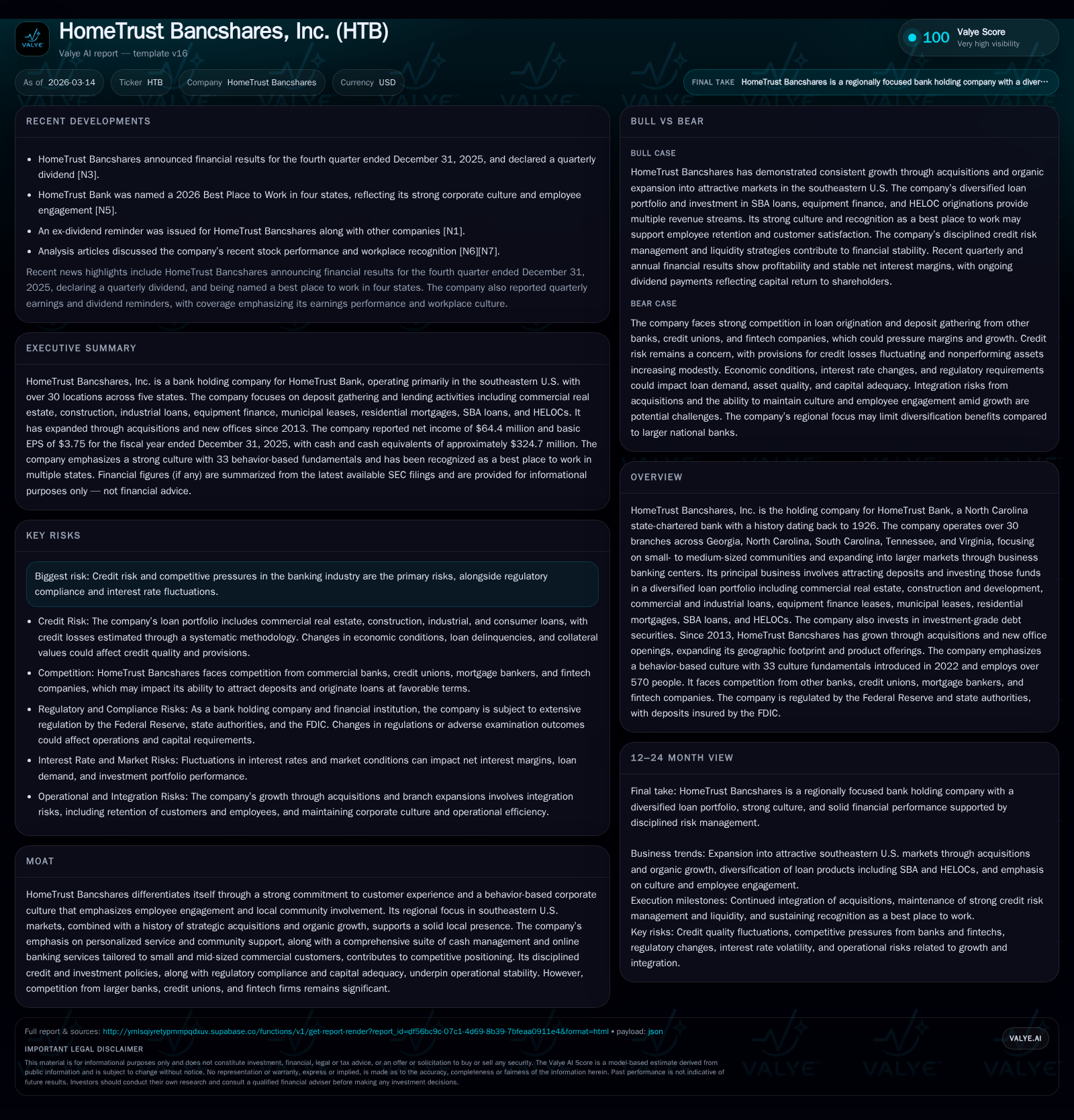
HomeTrust Bancshares, Inc., the holding company for HomeTrust Bank, operates over 30 branches in growing southeastern markets, emphasizing community banking and personalized service. Since its transition to a stock company in 2012, it has expanded through acquisitions and organic growth. The company reported $64.4 million in net income for FY 2024 with strong year-over-year improvement and maintains solid capital adequacy and liquidity positions. Future growth depends on moderate loan portfolio expansion across commercial real estate, SBA lending, and new business banking centers amid competitive and regulatory challenges.
Company Background and Historical Growth
HomeTrust Bancshares was established as the holding company for HomeTrust Bank's conversion from mutual to stock form in July 2012 [S1]. Since then, it has expanded through strategic acquisitions and organic growth across southeastern U.S. markets including North Carolina, South Carolina, Tennessee, Georgia, and Virginia. Notable acquisitions include BankGreenville Financial (2013), Jefferson Bancshares (2014), multiple Bank of America branches (2014), United Financial’s municipal lease business (2016), TriSummit Bancorp (2017), Quantum Capital Corp. (2023), among others [S1][S12].
Founded originally in Asheville in 1926, the bank evolved from a local community institution into a regional player targeting small- to mid-sized cities while entering larger urban markets primarily via business banking centers rather than traditional retail branches. This approach broadened its geographic footprint without sacrificing core community banking principles [S1][S12].
Financial Performance Overview
At December 31, 2025, consolidated total assets were approximately $4.5 billion with total deposits around $3.7 billion; stockholders' equity was about $601 million [S1][F1].
Income Statement Highlights
Historical performance (annual)
| FY | Net ($mm) | CFO ($mm) | Capex ($mm) | Net YoY |
|---|---|---|---|---|
| 2024 | 64 | 49 | 4 | +127.5% |
| 2023 | 28 | -11 | 0 | +369.7% |
| 2022 | 6 | 35 | 7 | +181.3% |
| 2021 | -7 | 3 | 16 |
Source: SEC companyfacts cache [F1].
Capital returns and efficiency (annual)
| FY | Div ($mm) | Buybacks ($mm) | FCF ($mm) |
|---|---|---|---|
| 2024 | 8 | 14 | 45 |
| 2023 | 4 | 0 | -12 |
| 2022 | 5 | 43 | 28 |
| 2021 | 5 | 16 | -13 |
Source: SEC companyfacts cache [F1].
Net income more than doubled from FY 2023 to FY 2024 driven by stronger core operations supported by controlled credit expenses amid improving economic conditions affecting the loan portfolio [F1]. Operating cash flow improved markedly from negative $11.4 million in FY 2023 to positive $49.5 million in FY 2024.
Capital expenditures increased significantly year-over-year as investments were made in technology platforms and branch infrastructure to support growth initiatives.
Capital Metrics
The bank maintained capital ratios comfortably above regulatory minima: CET1 ratio exceeding 7%, Tier 1 capital ratio above 8.5%, total capital ratio greater than 10.5%, and leverage ratio well above the required thresholds as of December 31, 2025 [S10][S22]. These strong capital levels provide flexibility for dividend payments and share repurchases while supporting conservative asset quality management.
Asset Composition and Credit Risk
The loan portfolio remains diversified:
- Commercial real estate loans constitute a significant portion including construction/land development (
7%), owner-occupied CRE (15%), non-owner occupied CRE (24%), multifamily (3%) - Commercial loans including industrial lending have grown notably (~26% increase year-over-year) reflecting focus on business banking customers [S25]
- Residential mortgage loans including HELOCs represent roughly one-quarter of total loans with HELOC originations aimed at secondary market sales [S7][S12]
- SBA loans have grown since their introduction post-2017 offering government-guaranteed lending solutions for small businesses
Credit quality remains stable though nonperforming loans rose slightly to approximately 0.89% of total loans as of September 30, 2025; SBA loans form the largest classified asset portion but are substantially guaranteed mitigating credit risk impact [S19]. The allowance for credit losses held steady near historical norms at about 1.18% of total loans; provisions are adjusted based on evolving economic forecasts including considerations related to natural disasters such as Hurricane Helene with declining outstanding deferrals noted over recent quarters [S9][S16][S19].
Competitive Positioning and Corporate Culture
HomeTrust faces intense competition typical for regional banks: other commercial banks, credit unions, mortgage bankers, life insurance companies offering financing options, finance companies competing for consumer lending alongside fintech entrants challenging legacy models especially in deposits and payments innovation [S6].
Differentiation is achieved through a behavior-based corporate culture emphasizing employee engagement via "culture fundamentals," comprehensive digital banking tools tailored to small-to-medium businesses, and strong community involvement supporting affordable housing and financial education programs within its markets [S6][S12]. This culture fosters productivity, talent retention, and customer loyalty grounded in personalized service rather than commoditized offerings.
Liquidity Management & Funding Structure
The deposit base consists mostly of core deposits supplemented by brokered deposits representing about 8-9% of total deposits providing funding flexibility to manage interest rate risk and liquidity needs especially during periods of market stress [S4][S5]. Certificates of deposit maturing within one year totaled approximately $930 million posing rollover risk; however management expects retention due to competitive rates combined with strong customer relationships.
Borrowings include Federal Home Loan Bank advances secured by collateralized assets such as commercial real estate loans; additional borrowing capacity is maintained through unused lines of credit enhancing liquidity buffers further [S5][S10]. The investment securities portfolio emphasizes high-quality short-duration instruments that are readily marketable as needed.
Dividend Policy & Capital Allocation Strategy
The company adheres to a prudent dividend policy consistent with Federal Reserve guidance requiring adequate capital before paying dividends or repurchasing shares [S13][S18]. In FY 2024 dividends paid totaled approximately $8.38 million while share repurchases resumed after a pause deploying about $13.6 million reflecting confidence in financial strength backed by regulatory surplus capital.
Regulatory oversight requires maintaining capital conservation buffers above minimums prior to discretionary capital actions; ongoing monitoring of these buffers will be critical when considering future payout expansions or opportunistic buybacks.
Risks & Considerations for Watchfulness
Key risks include:
- Credit risk concentrated in sectors like SBA lending or commercial real estate which could be adversely affected by economic downturns or sector-specific stresses including real estate valuation shifts or borrower defaults.
- Intense competition from peers and fintech firms pressuring margins particularly on deposit pricing.
- Evolving regulatory environment imposing cybersecurity incident reporting mandates impacting operational risk costs; compliance burdens related to AML/BSA regulations; heightened consumer protection requirements affecting mortgage lending; potential impacts from Basel III or similar capital framework changes [S15][S17][S21].
- Macroeconomic factors such as interest rate volatility influencing net interest margins through repricing mismatches between assets/liabilities; economic slowdowns potentially reducing loan demand; inflationary pressures affecting operating expenses.
Outlook & Key Indicators to Monitor (Analysis)
No explicit forward guidance was provided recently beyond internal incentive targets set for executives through end-2026 [N3]. Growth prospects rest on:
- Continued penetration into existing markets via selective de novo branches aimed at business clients rather than retail segments where competition is fiercer.
- Expansion or cross-selling within SBA loan offerings leveraging government-backed guarantees providing steady fee income subject to economic cycles.
- Modest growth or stabilization in commercial real estate portfolios focused on owner-occupied properties historically more resilient than speculative developments.
Investors should monitor:
- Quarterly loan originations across different segments,
- Trends in allowance for credit losses amid changing economic outlooks,
- Shifts in deposit composition signaling competition intensity,
- Regulatory developments impacting dividend/distribution capacity,
- Effectiveness of cultural initiatives reflected through employee retention metrics influencing long-term competitive positioning.
Conclusion
HomeTrust Bancshares exemplifies a regional bank blending traditional community relationship banking with modern risk management practices and expansion strategies targeting complementary southeastern U.S. markets through acquisitions and organic growth initiatives. Strong earnings momentum combined with conservative credit policies underpin financial stability supported by ample regulatory capital buffers facilitating shareholder returns via dividends and buybacks. Challenges remain from intensifying competition—both traditional financial institutions and fintech disruptors—credit concentration risks under macroeconomic headwinds alongside increasing regulatory demands which will shape the sustainability of growth beyond near-term fundamentals.
This analysis is intended solely for informational purposes without investment recommendations or opinion on security valuation.
Disclaimer: This is research-only, informational analysis and not investment advice. It may include AI-generated interpretation and general industry context. Always verify important details using primary sources.

Comments