
Jefferson Capital’s Strategic Levers and Growth Trajectory Post-IPO
Jefferson Capital leverages proprietary analytics, broad geography, and capital management to sustain growth while confronting financial leverage and regulatory complexities.
Since its June 2025 IPO, Jefferson Capital has built on a solid foundation of disciplined portfolio acquisitions and deep data analytics to generate robust revenue and cash flow growth. Its diversified operations across the U.S., Canada, the U.K., and Latin America, combined with a sophisticated underwriting process, underpin its competitive advantages. However, significant financial leverage and evolving regulatory demands remain key challenges that could limit flexibility and growth. Monitoring debt refinancing, regulatory developments, and client concentration will be critical to assessing future performance trajectories.
From Inception to IPO: Drivers Behind Jefferson Capital’s Historical Growth
Jefferson Capital Inc. completed its initial public offering (IPO) in June 2025, marking a pivotal milestone after more than two decades of building expertise in nonperforming consumer loan portfolios. Historically, the firm’s financial performance has been underpinned by high-volume purchases of charged-off receivables across multiple asset types such as credit cards, automotive loans, utilities, telecommunication services, and other consumer debts.
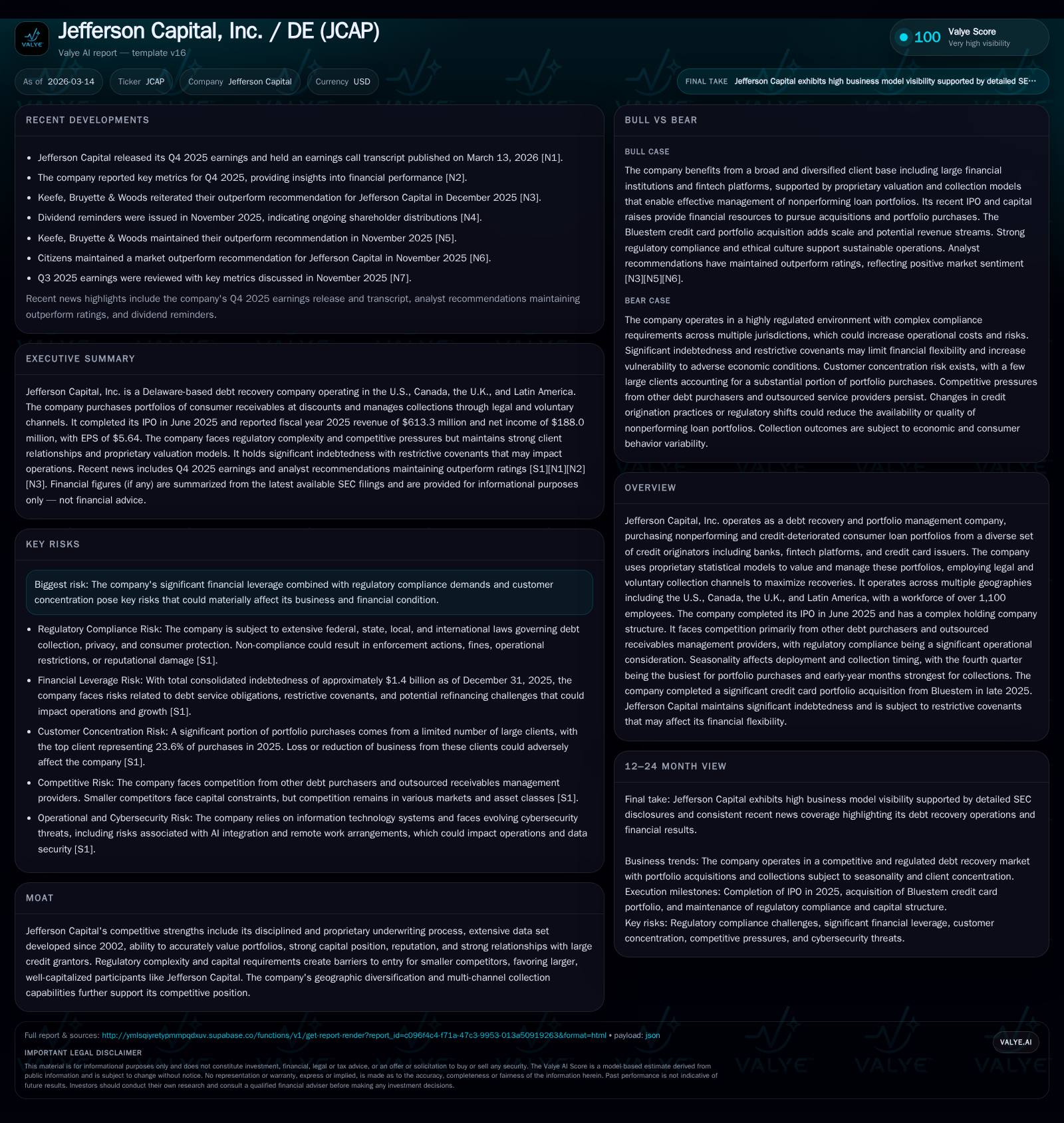
By the end of fiscal year 2025, Jefferson Capital reported revenues of approximately $613 million, reflecting disciplined expansion through portfolio acquisitions purchased at deep discounts to face value [F1]. Operating income stood at roughly $316 million with net income near $188 million for the same period [F1], yielding a return on equity (ROE) approximating 39.5%, indicative of effective capital deployment relative to shareholder equity.
The company’s cash flow from operations also reinforced its financial stability with robust free cash flow generation of about $268 million after capital expenditures [F1]. This strong cash position facilitated strategic capital returns post-IPO without compromising liquidity.
Historical performance (annual)
| FY |
|---|
| 2025 |
Source: SEC companyfacts cache [F1].
Table: Jefferson Capital Selected Financial Performance Metrics (FY2024–FY2025) sourced from [F1]. Exact CFO and Capex values not detailed in provided data.
Growth drivers include sizable portfolio purchases enabled by strong creditor relationships spanning Fortune 500 banks, fintech platforms, credit card issuers, and telecom providers [S1], leveraging proprietary behavioral data analytics that have evolved since founding in 2002.
Portfolio Acquisition and Recovery Expertise: The Company’s Core Competitive Advantages
Central to Jefferson Capital’s performance is its rigorous underwriting framework powered by proprietary statistical models. These models harness vintage analysis — assessing loan cohorts based on origination dates and performance trends — coupled with valuation discount rates reflective of expected cash flow timing and curtailment rates reflecting early repayments or modifications.
This analytical precision reduces risk of overpaying for portfolios while ensuring alignment between purchased asset profiles and specific collection channels employed — legal proceedings for harder-to-collect accounts versus voluntary recovery approaches optimized through customer outreach strategies [S1][S28].
Notably, Jefferson Capital combines traditional collection agencies’ methods with internal legal capabilities such as those deployed by its UK subsidiary Moriarty Solicitors Ltd., allowing escalated recoveries within regulated frameworks [S28]. This holistic approach supports sustainable earnings persistence by maximizing net recoveries over loan lifecycles.
Moreover, the company’s technology infrastructure integrates ongoing vintage performance monitoring permitting refined forecasts and dynamic bid pricing for each portfolio acquisition opportunity.
Geographic Diversification and Customer Concentration: Balancing Opportunity with Risk
Jefferson Capital operates extensively across the United States, Canada, the United Kingdom, and multiple Latin American countries including Colombia and Peru [S20]. This regional diversification mitigates localized economic downturn risk but introduces complex layers of regulation requiring tailored compliance efforts across jurisdictions.
In the U.S., federal regulations such as the Consumer Financial Protection Bureau’s enforcement mandate impose strict guidelines on debt collection practices. Internationally, adherence to the UK Financial Conduct Authority’s Consumer Duty rules exemplifies growing regulatory scrutiny; for instance, credit purchase legislation reforms highlight a shift towards outcome-focused consumer protection frameworks .
Despite geographic breadth, customer concentration remains an operational consideration. The top five clients accounted for over 45% of purchase volume in fiscal year 2025; notably, the largest single client represented roughly one-quarter of acquisitions that year—down slightly from prior periods but still materially significant [S1][S20]. This concentration amplifies potential revenue volatility if any large seller reduces sales or changes contractual terms.
Thus while diversification provides opportunity matrices across asset classes and regions enhancing portfolio mix resilience, client concentration injects countervailing risk warranting close attention from management.
Capital Structure, Leverage, and Liquidity: Navigating Financial Flexibility Constraints
At December 31, 2025 Jefferson Capital managed consolidated indebtedness totaling approximately $1.41 billion comprising three tranches of senior notes due between 2026–2030 ($300M due in 2026; $400M due in 2029; $500M due in 2030) alongside a revolving credit facility sourced principally through its operating subsidiaries [F1][S10]. The revolver capacity totaled just under $770 million but usage is governed by borrowing base restrictions aligned with collateralized assets.
This debt structure incorporates restrictive covenants limiting dividends payable to stockholders or potential acquisition financing activities without lender consent. Covenants also constrain business flexibility by imposing minimum financial ratios—breach risks include acceleration of debt obligations or forced asset divestitures thereby elevating refinancing dependencies [S5][S7][S9].
Floating rate interest exposure linked to revolver borrowings further adds vulnerability to rising interest rate regimes potentially eroding earnings via increased interest expense burden [S16].
Liquidity management hence requires balancing aggressive portfolio deployments with rigorous covenant testing plus contingency planning for potential macroeconomic or credit market disruptions impacting refinancing avenues.
Regulatory Landscape: Compliance as a Competitive Moat and an Operational Challenge
Jefferson Capital faces an intricate regulatory environment shaped by domestic laws such as the Dodd-Frank Act—the CFPB’s sanctioning authority—and analogous regimes abroad including FCA regulations in the UK along with evolving privacy statutes like U.K./EU GDPR standards ,[S19],[S23],[S26].
The Company dedicates considerable resources to compliance frameworks overseen directly by board-level committees focused on cybersecurity governance employing ISO/IEC 27001-aligned information security management systems integrating industry-leading controls per NIST Cybersecurity Framework criteria [S1]. This oversight encompasses quarterly risk reporting from management on cyber threats alongside continuous technical monitoring.
Regulatory requirements extend beyond collection practices to encompass licensing mandates in several states/countries restricting operational footprints while heightening compliance costs—thus deterring smaller market entrants lacking requisite governance sophistication—thereby reinforcing barriers to entry supporting JCAP's moat [S11],[S13],[S17],[S21],[S22].[N19]
However these regulations also elevate operational complexity necessitating constant adaptation especially as recent UK Consumer Duty rollouts signify deeper supervision emphasizing ethical collection standards.
Earnings Analysis and Quality of Cash Flows: Metrics Driving Investor Confidence
The fiscal year ending December 31, 2025 saw Jefferson Capital report operating income around $316 million alongside net income near $188 million reflecting both scale advantages achieved post-IPO plus efficient portfolio management post acquisition [F1]. Adjusted ROE hovering near a robust ~39.5% evidences strong capital efficiency relative to equity base post-IPO transition highlighting experiential underwriting benefits married with effective cost controls [F1].[N1]
Cash flows demonstrate high quality earnings sustainability: free cash flow generation was approximately $268 million driven by predictable collection patterns offsetting capital expenditures primarily invested into IT infrastructure supporting analytics modeling effectiveness [F1].[N1]
Quarterly earnings commentary articulates ongoing vigilance surrounding vintages’ performance dynamics benchmarking cure rates consistent with expectations supporting forward income visibility but flagging potential seasonality particularly impacting deployment cadence ahead of year-end quarterly closes [N1].[N2]
Thus earnings metrics illustrate robust profit conversion while sustained free cash flow enables flexible operational funding.
Capital Allocation Strategy: Stock Repurchases, Dividends, and Shareholder Alignment
Post-IPO capital allocation reflects prudent balancing between shareholder returns and covenant-bound liquidity preservation. Since mid-2025 Jefferson Capital initiated quarterly dividend payments aligned with earnings generation yet mindful of debt covenants limiting excess distributions without lender approvals [S4],[S6]&[N2].
Moreover large-scale share repurchases totaling approximately $58.9 million were executed strategically around follow-on equity offerings aimed at stabilizing stock prices thereby enhancing shareholder value indirectly via market support mechanisms [S6].[N2]
The company is classified as a "controlled company" under Nasdaq governance rules due to majority voting ownership retained by founding investors—the JCF Stockholders—currently holding around half of outstanding voting shares post-follow-on transactions granting them substantial influence over corporate decisions including director elections without independent control mandates typical for most public firms [S4],[S6].[N2]
This ownership concentration introduces governance tradeoffs balancing continuity against reduced minority shareholder protections potentially influencing long-term strategic choices more heavily weighted toward major stakeholders' interests.
Looking Ahead: Growth Prospects, Market Dynamics, and Key Milestones to Monitor
Forward growth prospects hinge on continued deepening of proprietary data-driven underwriting techniques refined since inception enabling selective portfolio purchase discipline preserving yield amid tighter market competition for nonperforming loans [N1],[S28].
While expanding fintech platform client bases offer additional origination channels bolstering deal pipelines,[N2] ongoing regulatory intensification notably within U.S. CFPB jurisdiction ties growth opportunities closely to adherence investments consuming incremental resources.
Leverage remains a constraining factor as upcoming maturities particularly the February 2026 notes demand possible refinancing or re-negotiation requiring adequate free cash flow cushion or market receptivity amidst volatile debt markets influencing cost structures going forward.[F1][S7][N2]
Key milestones warrant close observation including:
- Quarterly updates disclosing credit environment changes affecting acquisition pricing dynamics;
- Compliance audit outcomes particularly relating to new consumer protection frameworks across principal geographies;
- Announcements regarding credit facility expansions or refinancing initiatives;
- Changes in top customer purchase volumes impacting revenue diversification.
Stakeholders should track these indicators closely given their direct bearing on sustained operating momentum tempered by structural industry risks.
This analysis is intended solely for informational purposes based on publicly available data without investment advice or recommendation.
Disclaimer: This is research-only, informational analysis and not investment advice. It may include AI-generated interpretation and general industry context. Always verify important details using primary sources.

Comments