
Legacy Housing Corp’s Financial Flexibility Supports Growth Amid Housing Market Headwinds
Legacy Housing leverages vertical integration and diversified financing to sustain margins despite top-line pressure.
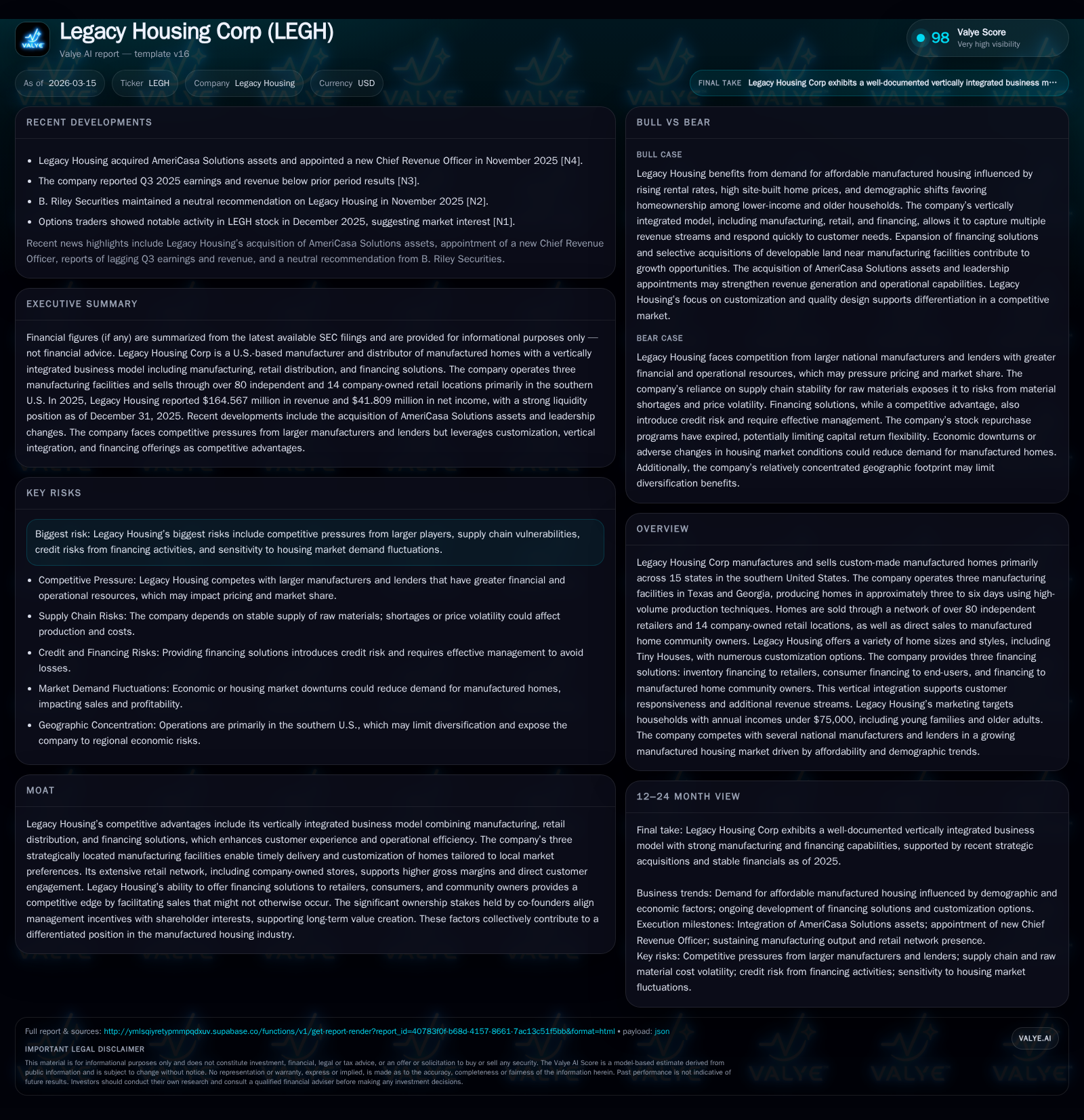
Legacy Housing Corporation demonstrates operational strength through its integrated manufacturing, retail, and financing business model. Despite a notable 10.7% revenue decline in 2025 driven by housing market challenges, the company maintained solid operating cash flow and executed disciplined capital allocation, including increased share repurchases. Its expansion into financing solutions and targeted product customization underpin prospects for margin resilience and future growth amid competitive and credit risks.
From Rapid Manufacturing to Retail Network: A History of Growth and Efficiency
Legacy Housing maintains a robust vertical integration model combining manufacturing, distribution, and financing that supports both operational efficiency and margin stability [S19][S16]. The company operates three manufacturing facilities — in Fort Worth and Commerce, Texas, and Eatonton, Georgia — with a combined capacity to produce approximately 60 fully completed homes weekly through high-volume production techniques [S12][S16]. Factory production times average between three to six days per home, leveraging an assembly-line approach employing between 100 and 199 employees per site [S20].
These manufacturing hubs are located near key southern U.S. markets spanning approximately 15 states where Legacy distributes primarily through a wide network of over 80 independent retailers complemented by 14 company-owned retail stores [S12][S15]. The owned stores enable higher gross margins owing to focused local market selection and direct customer engagement supported by well-trained sales personnel [S15]. Vertical integration leverage provides Legacy with enhanced agility to meet diverse consumer demands across various home types including residential units and Tiny Houses with customizable modular designs [S19][S20].
Unpacking 2025 Performance: What Driven Revenue and Earnings Trends Reveal
In the fiscal year ended December 31, 2025, Legacy Housing reported revenues of $164.6 million, marking a significant decrease of approximately 10.7% compared to $184.2 million in FY2024 [F1]. This contraction mirrors broader industry headwinds during tightened housing demand and inflationary pressures impacting material costs [S10]. Operating income declined by nearly 24% to $48.4 million from $63.6 million in the prior year, indicating margin compression partially attributable to rising input costs for raw materials such as wood products and steel [F1][S10][S16].
Net income dropped more steeply by 32.2% to $41.8 million from $61.6 million in FY2024 [F1], reflecting amplified cost pressures offset only partly by stable operational efficiencies. Notably, operating cash flow demonstrated resilience increasing modestly by ~3.2% year-over-year to $37.2 million [F1], reflecting effective working capital management and underlying business stability despite revenue erosion.
Historical performance (annual)
| FY | Rev ($mm) | Net ($mm) | CFO ($mm) | OpInc ($mm) | Rev YoY | Net YoY |
|---|---|---|---|---|---|---|
| 2025 | 165 | 42 | 37 | 48 | -10.7% | -32.2% |
| 2024 | 184 | 62 | 36 | 64 | -2.6% | +13.2% |
| 2023 | 189 | 54 | -14 | 65 | -26.4% | -19.6% |
| 2022 | 257 | 68 | -2 | 78 |
Source: SEC companyfacts cache [F1].
Capital returns and efficiency (annual)
| FY | Buybacks ($mm) | FCF ($mm) | ROE% |
|---|---|---|---|
| 2025 | 8 | 28 | 7.9 |
| 2024 | 5 | 27 | 12.5 |
| 2023 | -21 | 12.5 | |
| 2022 | -5 | 17.7 |
Source: SEC companyfacts cache [F1].
Operating figures reflect consistent investment in capacity and shareholder returns despite cyclicality.
Expanding Financing Solutions: Unlocking Customer Accessibility and Margin Opportunities
A key pillar of Legacy's growth strategy involves expanding its portfolio of financing products targeting consumers, dealers, and manufactured housing community owners [S5][S7][S8]. The company extends inventory financing to over 80 independent retailers facilitating stocking flexibility; ongoing dealer incentive programs align retailer margins with Legacy's economics [S19][S8]. Consumer financing primarily consists of chattel loan offerings—a non-land-backed personal property loan suited for manufactured homes—with over 4,300 customers financed through this channel as of end-2025 [S7][S18].
Commercial lending activities involve providing loans or structured financing solutions directly to manufactured home community owners purchasing multiple homes for rental use or site development projects [S7][S18][S15]. This commercial portfolio earns attractive returns combining interest income with gross product margins on targeted home sales.
Loan servicing fees contribute incremental operating income streams via administering ongoing consumer installment agreements under preferred return arrangements shared with dealers [S8]. These ancillary revenues deepen margin opportunities while reinforcing vertical integration leverage.
Customization at Scale: How Product Innovation Shapes Market Positioning
Legacy prioritizes continuous innovation through design customization enabled by direct sourcing of materials supporting varied customer preferences—ranging from fireplaces and advanced HVAC features to decorative finishes like stipple ceilings or wood grain vinyl flooring [S5][F1]. Modular factory-built housing methods underpin these capabilities permitting swift reconfiguration during production cycles without sacrificing quality or throughput rates.
This level of customization addresses differentiated market segments including families requiring diverse floor plans up to Tiny Houses catering to younger buyers or retirees seeking compact living solutions [S19][S20]. Such product flexibility distinguishes Legacy against competitors who often rely heavily on standard models lacking these pronounced customization allowances.
Capital expenditures dedicated approximately $9 million annually towards maintaining manufacturing capacity alongside new tooling investments supporting emerging product variations ensures sustained innovation momentum [F1][S10].
Land Holdings and Commercial Partnerships: Strategic Foundations for Future Growth
The company holds a significant land bank exceeding 1,000 acres primarily centered in Texas near existing manufacturing hubs enabling eventual subdivision development or third-party project financing partnerships [S15][S26]. This real estate base complements Legacy’s manufactured home sales by fostering growth avenues beyond pure product manufacturing—offering both recurring revenue potential from land leasing/sale and enhanced control over community development processes.
Additionally, strategic alliances cultivating cooperative agreements with owners of manufactured home communities stimulate bulk sales from projects ranging broadly in size (30–300+ homes) while reinforcing commercial financing portfolios aligned with long-term rental housing needs [S5][S7]. This dual focus integrates site availability improvements feeding back into product demand dynamics.
Capital Allocation Priorities: Returns, Buybacks, and Investment Discipline
Legacy’s capital allocation reflects prudent balancing between reinvestment in capacity, maintaining liquidity buffers, and returning capital to shareholders via share repurchases [F1][S9][S14]. Annual capital expenditures consistently approximate $9 million—a level sufficient for sustaining current manufacturing throughput without aggressive expansion commitments [F1][S10].
In parallel, the company executed accelerated share repurchases increasing total open market buybacks by roughly 41% year-over-year—$7.6 million in FY2025 versus $5.4 million in FY2024—to moderate dilution effects post-IPO phases while enhancing per-share economic value where market conditions permit [F1][S14].
Return on equity approximates a moderate yet stable near-8% figure driven primarily by controlled leverage levels combined with functional operational efficiency amid challenging sales conditions [F1]. Legacy presently eschews dividend payments prioritizing earnings retention for growth initiatives alongside debt servicing flexibility [S9][S14].
Balance Sheet Strength and Liquidity: Navigating Credit Risk and Funding Flexibility
As of December 31, 2025, the company maintained a strong liquidity profile highlighted by a current ratio of approximately 3.51x supported by nearly $8.5 million in cash equivalents alongside current assets totaling $164.7 million against liabilities near $46.9 million [F1][S3][S6].
Credit risk is principally concentrated within dealer finance receivables and consumer loan portfolios including notes receivable secured against mobile home parks under commercial lending operations [S13][S18]. Rigorous risk management practices emphasize diversification among approximately 54 dealer loans post AmeriCasa acquisition plus over 3,800 consumer contracts averaging contractual rates around 13% for consumer loans coupled with structured terms averaging over eight years [S18].
Funding flexibility is bolstered via access to credit facilities ensuring operational resilience during cyclicality-induced cash flow variability—the crucial factor given sensitivity inherent in chattel-based consumer loan underwriting accompanied by tighter borrowing environments affecting potential homebuyers’ affordability horizons [S3][S6].[F1]
Key Risks in Competitive and Financing Environments: What Investors Should Watch
Legacy faces intensified competition from larger national manufacturers benefiting from scale economies potentially exerting pricing pressure alongside increasing supply chain volatility elevating raw material input risks particularly steel and lumber pricing fluctuations noted during the past year’s inflationary cycles [S2][S23].[S10]
Consumer financing limitations persist since current offerings exclusively include chattel loans which inherently carry higher interest rates than conforming mortgage alternatives restricting buyer pools compared to competitors offering FHA or GSE-backed mortgage products (non-conforming mortgages remain unoffered), thus exposing Legacy’s sales volumes to constrained credit accessibility for lower-income buyers despite growing urban site developments being pursued for commercial loan opportunities [S8].[S23]
Moreover, macroeconomic downside scenarios leading to demand contraction or sustained interest rate hikes could further curtail order flows impacting plant utilization rates reducing operational gearing benefits underpinning recent margin trends noted above.[S10]
Continued vigilance towards credit losses within the finance receivables portfolios remains critical given the inherent risk profile of chattel loans absent substantial collateral beyond the manufactured homes themselves.[S18]
This analysis relies exclusively on publicly available SEC filings as of March 2026 data points complemented by disclosed corporate narratives without speculative assertions on future performance or valuation advice.
Disclaimer: This is research-only, informational analysis and not investment advice. It may include AI-generated interpretation and general industry context. Always verify important details using primary sources.

Comments