
How Costco Leverages Membership and Operational Scale for Financial Success
Costco Wholesale's membership-driven model combined with disciplined capital deployment underpins its consistent growth and robust profitability.
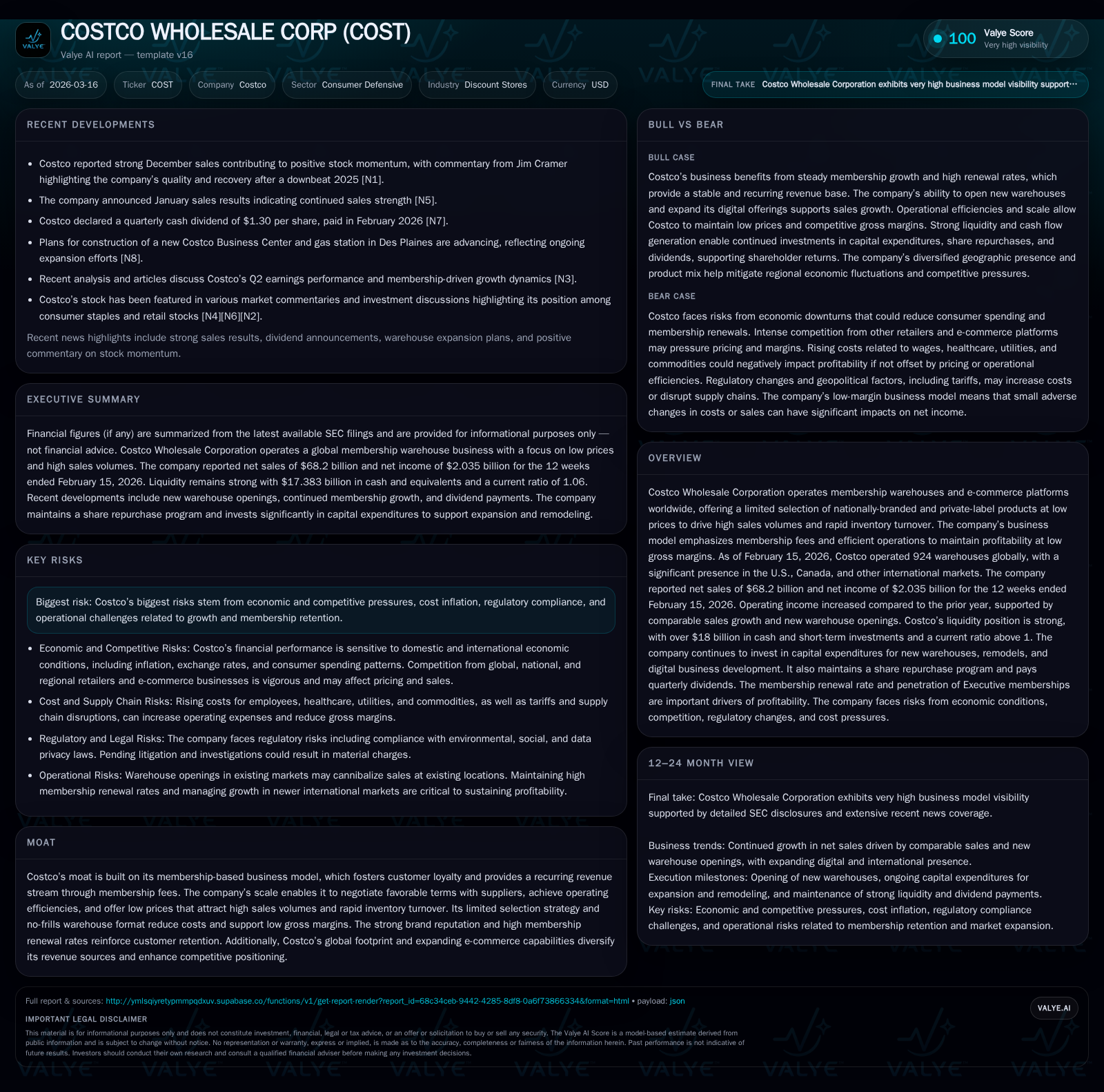
Costco Wholesale operates a low-margin, high-volume business model fueled by recurring membership fees that create customer loyalty and stable revenue streams. Over the past four fiscal years, the company has steadily expanded top-line revenue by 8.2% year-over-year in FY2025, alongside improving operating income (+11.8%) and net income (+9.9%) supported by new warehouse openings and solid comparable sales growth. Its capital allocation framework balances reinvestment in warehouse expansion with dividends and increasing share repurchases, generating strong free cash flow (~$7.8 billion in FY2025) and a healthy approximate ROE of 27.8%. Inflationary pressures present margin challenges, but Costco’s operational scale and prudent cost control remain key to navigating these headwinds while maintaining membership retention.
Rising Revenue and Operating Income: Tracking Costco’s Recent Performance
Costco Wholesale has demonstrated sustained financial growth through FY2025, with revenue reaching $275.2 billion, marking an 8.2% increase over FY2024's $254.5 billion level [F1]. This top-line expansion reflects both an increase in warehouse numbers and favorable comparable sales trends within existing locations. Operating income outpaced revenue growth at an 11.8% rise to $10.38 billion up from $9.29 billion the prior year, indicative of improved operating leverage achieved through scale efficiencies and disciplined cost management amidst inflationary pressures [F1]. Net income followed suit, growing 9.9% year-over-year to $8.10 billion.
Operating cash flow surged notably by 17.6%, reaching $13.33 billion for FY2025 from $11.34 billion in FY2024, supporting reinvestment activities as capital expenditure grew 16.7% to $5.50 billion, primarily targeting new warehouse development and facility upgrades [F1]. This balance between strong cash generation and elevated capex underscores Costco’s commitment to long-term sustainable growth leveraging its capital base.
Historical performance (annual)
| FY | Rev ($bn) | Net ($bn) | CFO ($bn) | OpInc ($bn) | Rev YoY | Net YoY |
|---|---|---|---|---|---|---|
| 2025 | 275.2 | 8.1 | 13.3 | 10.4 | +8.2% | +9.9% |
| 2024 | 254.5 | 7.4 | 11.3 | 9.3 | +5.0% | +17.1% |
| 2023 | 242.3 | 6.3 | 11.1 | 8.1 | +6.8% | +7.7% |
| 2022 | 227.0 | 5.8 | 7.4 | 7.8 |
Source: SEC companyfacts cache [F1].
Capital returns and efficiency (annual)
| FY | Buybacks ($mm) | FCF ($bn) | ROE% |
|---|---|---|---|
| 2025 | 903 | 7.8 | 27.8 |
| 2024 | 700 | 6.6 | 31.2 |
| 2023 | 676 | 6.7 | 25.1 |
| 2022 | 439 | 3.5 | 28.3 |
Source: SEC companyfacts cache [F1].
Financial data per SEC filings with YoY percentages calculated based on adjacent years [F1].
Membership Model: Core Driver of Recurring Revenue and Customer Retention
A cornerstone of Costco’s defensive moat lies in its membership-based warehouses model that delivers stable recurring revenue streams via annual membership fees which supplement thin product gross margins [S1]. This model fosters elevated customer loyalty characterized by strong renewal rates that enable predictable cash flows even during fluctuating economic environments.
By cultivating member affinity through consistently low prices facilitated by high inventory turnover, Costco benefits from a dual advantage: steadier fee revenue underpinning profitability while sustaining high foot traffic driving merchandise sales volume [S1][N2]. The limited SKU assortment strategy combined with the no-frills warehouse format reduces operational complexity and expense.
Such membership economics establish meaningful pricing power despite competitive discount retail settings as members typically perceive enhanced value from exclusive access alongside savings incentives.
Warehouse Expansion and Comparable Sales: Key Operational Growth Engines
Warehouse expansion remains central to Costco’s organic volume growth strategy with a notable increase in global store count supporting incremental sales throughput [N1][N2]. Adding new locations across established markets like the U.S., Canada, alongside international footprints enhances geographic penetration while leveraging existing supply chain advantages.
Comparable store sales consistently grow driven by product assortment efficiency paired with membership engagement improvements — signaling robust underlying consumer demand resiliency even when macroeconomic conditions tighten [N2]. Operational scale engenders improved purchasing leverage with suppliers enabling Costco to maintain low prices that attract volume-driven economies of scale.
Scale benefits cascade into better fixed-cost absorption improving operating leverage that is reflected in positive operating profit trajectory relative to revenue gains amidst pressure on raw material costs.
Navigating Inflation and Economic Pressures: Challenges Facing Costco
Costco faces tangible risks from input cost inflation notably labor, fuel, freight expenses along with potential regulatory compliance challenges detailed among risk factors documented by the company [S1][N1]. Persistent inflationary environment increases pressure on narrow product gross margins characteristic of its business model demanding stringent cost containment efforts.
The tradeoff lies in managing pass-through pricing adjustments cautiously so as not to degrade membership renewal rates or shopper frequency amid intensified price sensitivity among consumers during economic uncertainty.
Operational excellence remains key; incremental efficiency improvements such as tighter inventory management or logistics optimization become critical levers mitigating margin erosion without sacrificing service levels or product availability which underpin consumer satisfaction.
Capital Allocation Priorities: Dividends, Buybacks, and Investment Efficiency
Costco operates a balanced capital allocation framework prioritizing reinvestment for growth while progressively returning capital to shareholders chiefly via share repurchases supported by modest dividend payments historically reported prior to FY2024 data limits [F1].
In FY2025, capital expenditures expanded by nearly +16.7%, consistent with ongoing investment into new warehouses and enhancements reflecting confidence in long-term organic expansion prospects [F1]. Concurrently, share repurchases rose materially to around $903 million from $700 million the prior year indicating an emphasis on leveraging free cash flow to bolster shareholder returns alongside controlled dividend deployment earlier years.
This capital discipline embodies a prudent approach balancing returns today against capacity fueling future profitable growth avenues.
Evaluating Free Cash Flow Generation and ROE Stability
Robust cash flow generation underlines Costco’s financial strength; operating cash flow jumped +17.6% YoY reaching $13.33 billion in FY2025 against elevated capex yielding free cash flow near $7.84 billion — a substantial liquidity cushion supporting investments plus buybacks [F1].
Equity levels increased moderately from about $23.6 billion in FY2024 to roughly $29.2 billion in FY2025 reflecting retained earnings growth alongside steady share count dynamics contributing to an approximate ROE of about ~27.8%, signaling efficient use of shareholder capital amid expanding profitability metrics [F1].
This ROE stability offers insight into effective capital stewardship reinforcing trustworthiness for stakeholders focused on sustainable returns beyond immediate earnings performance.
E-Commerce Growth Prospects Amid Traditional Warehouse Footprint
While Costco maintains a dominant bricks-and-mortar warehouse presence globally, its expanding e-commerce platform introduces incremental growth avenues complementing traditional channels though official explicit data quantifying online revenues remain sparse [N12].
Given sector peers such as Walmart report digital sales surges exceeding +20-25%, Costco’s cautious digital expansion likely aims at preserving core value propositions without diluting its no-frills operational ethos or cannibalizing store traffic unnecessarily.
Growth opportunities may hinge on digitally-enabled member experiences including click-and-collect services optimizing convenience while leveraging physical assets rather than full-scale omni-channel transformations common among broader retailers.
What Investors Should Monitor: Upcoming Milestones and External Risks
Future developments warrant close observation including cadence of new warehouse openings which materially impact volume growth trajectory alongside evolving membership trends critical for maintaining defensive revenue predictability plotted quarterly updates highlight these dynamics notably Q3 progress on renewals and fee policy implications [N3][S2].
Macroeconomic indicators related to inflation trends remain pivotal given their influence on wholesale procurement costs, pricing strategy elasticity, and consumer spending behavior shaping margin profiles substantially.
Additionally, regulatory scrutiny or changes encompassing trade policies along with compliance cost escalations form relevant external risk vectors detailed within company disclosures underscoring ongoing operational vigilance necessity [S1].
Disclaimer: This analysis is informational only and reflects data available as of March 16, 2026, sourced explicitly from SEC filings ([F1]) and cited news articles ([N#],[S#]). It eschews investment advice or forecasts beyond documented disclosures.
Disclaimer: This is research-only, informational analysis and not investment advice. It may include AI-generated interpretation and general industry context. Always verify important details using primary sources.

Comments