
Artesian Resources Drives Growth Through Diversified Water and Wastewater Services
Artesian Resources capitalizes on its exclusive franchise territories to expand water and wastewater services while managing regulatory and inflationary pressures.
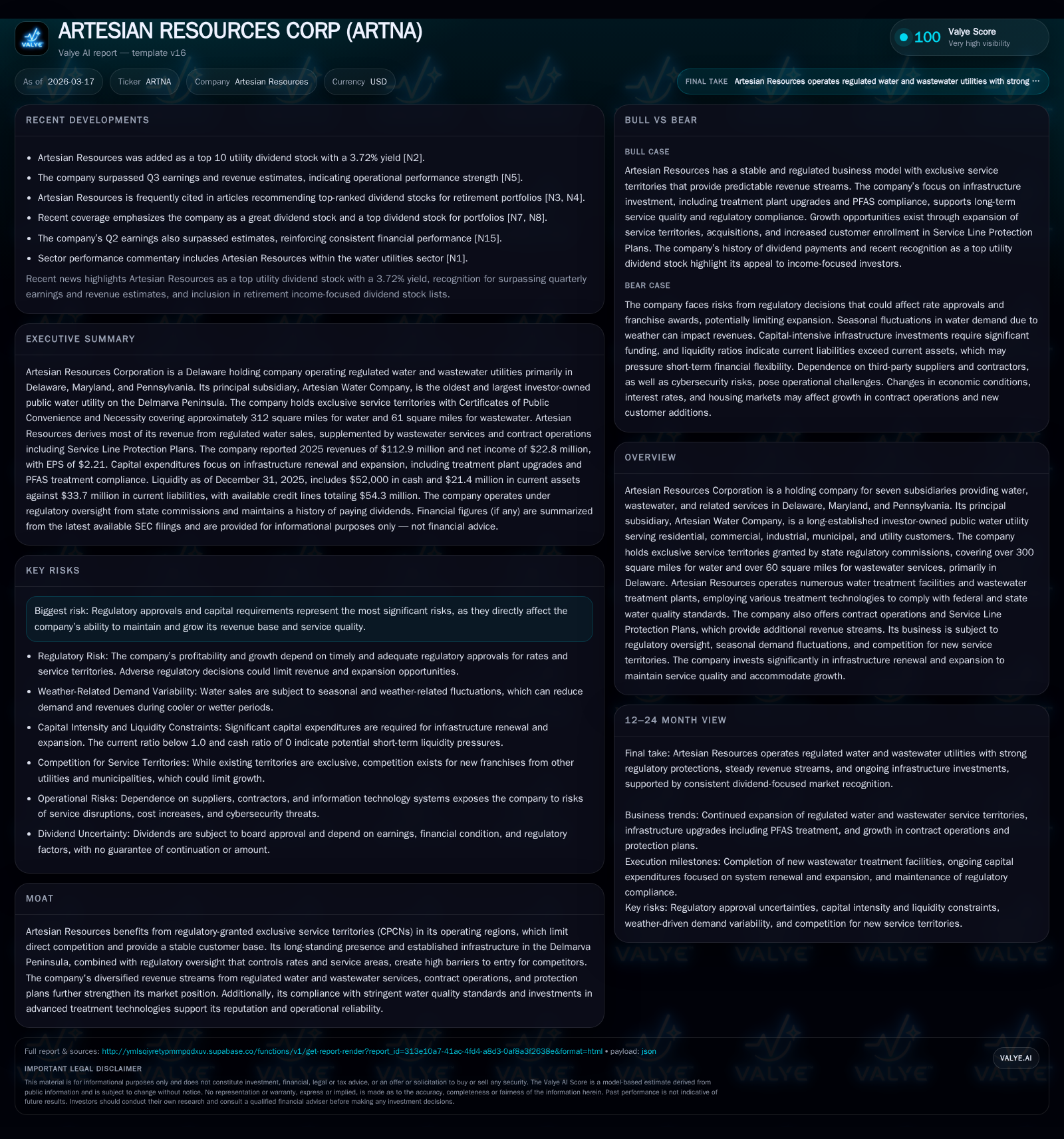
Artesian Resources Corporation has demonstrated consistent top-line and profitability growth supported by its regulated water and wastewater utilities operating primarily in Delaware, Maryland, and Pennsylvania. The company's revenue stability is bolstered by weather-resilient wastewater and service line protection plan offerings, which complement the more variable water sales. Capital expenditures rose sharply in FY2025 as Artesian invested heavily in infrastructure upgrades amid inflationary cost challenges, necessitating ongoing rate case filings subject to regulatory approval. Despite a tight current ratio reflecting working capital constraints, the company maintains liquidity through available credit lines and developer contributions, enabling future expansions. Dividend payments reflect management’s commitment to shareholder returns within a rate-regulated environment, though free cash flow swings highlight the tradeoff with heavy capex requirements.
Steady Growth Fueled by Core Water and Wastewater Services
Historical performance (annual)
| FY | Net ($mm) | CFO ($mm) | OpInc ($mm) | Capex ($mm) | Net YoY |
|---|---|---|---|---|---|
| 2025 | 23 | 40 | 28 | 59 | +11.9% |
| 2024 | 20 | 37 | 26 | 46 | +22.1% |
| 2023 | 17 | 32 | 22 | 62 | -7.2% |
| 2022 | 18 | 24 | 24 | 48 |
Source: SEC companyfacts cache [F1].
Capital returns and efficiency (annual)
| FY | Div ($mm) | FCF ($mm) | ROE% |
|---|---|---|---|
| 2025 | 13 | -18 | 9.1 |
| 2024 | 12 | -9 | 8.5 |
| 2023 | 11 | -30 | 7.2 |
| 2022 | 10 | -24 | 9.6 |
Source: SEC companyfacts cache [F1].
Artesian Resources has sustained positive momentum in its regulated utility operations, attributed primarily to water sales complemented by steadily growing wastewater service demand. For fiscal year ending 2025 (FY2025), operating income reached $27.8 million, marking a year-over-year (YoY) increase of 6.2% from $26.2 million in FY2024 [F1]. Net income grew even more robustly by 11.9%, rising from $20.4 million to $22.8 million [F1]. This profitability trend is underpinned by expansion of customer bases—metered water customers increased approximately 1.8% both in Delaware and Maryland, with Pennsylvania’s count stable [S1]. The Delaware wastewater segment experienced a stronger lift with a 6.5% customer increase year-over-year [S1].
Water sales inherently exhibit seasonal volatility due to weather influences—higher consumption typically aligns with warmer months; cooler or wetter conditions can suppress volume temporarily [S1]. In contrast, wastewater revenues derive mainly from fixed monthly fees billed to residential and commercial customers, making them resilient against such fluctuations [S1]. This dynamic supports revenue stability over annual cycles despite weather variability.
The company’s established presence serving over 300 square miles in its regulated territories offers substantial scale benefits alongside covenant protections from direct competition via Certificates of Public Convenience and Necessity (CPCNs). The largest regional system covers roughly 145 square miles centered around northern New Castle County with about 81,000 metered customers [S18].
Expanding Contract Operations and Service Line Protection Plans
Beyond core utility services, Artesian Resources diversifies revenue streams through contract operations—managing water and wastewater systems for municipalities and developers—and service line protection plans (SLPs) that provide customers coverage for potential repairs.
By end-2025, eligible customers enrolled in the various SLP plans had grown: Water Service Line Protection (WSLP) Plan up 4.1%, Sewer Service Line Protection (SSLP) Plan up 2%, and Internal Service Line Protection (ISLP) Plan up 5.7% compared to prior year figures [S1]. Notably, new enrollments for the ISLP Plan were discontinued effective January 2026 as part of the strategic adjustment [S1]. These insurance-like products generate recurring fee income insulated from weather impacts that affect water consumption volumes.
Contract operations form a complementary business leveraging the company’s engineering and operational expertise to serve external clients beyond franchised areas [S1]. This growth area is sensitive to broader construction activity influenced by economic factors such as interest rates and housing market conditions but remains a stable counterbalance to core utility demand fluctuations.
Capital Expenditures and Infrastructure Investments Amid Inflation Pressures
In response to aging infrastructure demands, regulatory compliance upgrades including PFAS treatment installations, and system expansion projects like new wastewater treatment plants completed or underway, Artesian Resources significantly ramped capital expenditures (capex) during FY2025.
Capex totaled $58.8 million—a strong jump of 28.1% versus $45.9 million the prior year—and was directed across supply/treatment facilities ($15.8M), transmission/distribution mains ($40.6M), and general plant assets ($7.3M) [F1][S8][S9]. Planned capex for calendar year 2026 is expected around $64.3 million underscoring ongoing capital-intensiveness.
These investments embody operating leverage concepts common in regulated utilities where upfront expenditures grow the rate base—the asset valuation on which regulators allow returns—enabling future revenue recovery through rate cases subject to regulatory approvals . However, increasing inflation on materials and labor costs raises risks if regulatory lag delays pass-through of these expenses or if approval rates are insufficient.
Navigating Regulatory Rate Approvals and Competitive Moats
Regulatory constraints shape Artesian Resources’ financial trajectory since all rate increases must be authorized by respective state commissions: Delaware Public Service Commission (DEPSC), Maryland PSC (MDPSC), or Pennsylvania Public Utility Commission (PAPUC) depending on jurisdiction [S17]. Rate cases involve detailed filings followed by sometimes protracted administrative hearings.
The exclusive franchise rights granted through CPCNs—covering approximately 312 square miles of water service territory mostly in Delaware plus over 60 square miles for wastewater—fortify market position against direct competitors but simultaneously expose the company to 'regulatory lag,' where inflation-driven cost hikes outpace timely resultant rate adjustments [S1][S12][N2].
On a positive note, Artesian’s status as the sole regional regulated wastewater provider in Sussex County further shields it from competitive incursions enhancing long-term stability [S19]. The recent inclusion of ARTNA among top utility dividend stocks carrying an estimated yield of around 3.72% attests to investor confidence in consistent earnings backed by regulatory protections [N2].
Balance Sheet, Liquidity Sources, and Capital Allocation Trends
As of December 31, 2025, Artesian Resources maintains liquidity via two primary revolving credit lines totaling $60 million—$40 million from Citizens Bank (with $34.3 million available) and $20 million from CoBank fully undrawn at period end—with terms linked to SOFR plus margins [S4][S7]. Additionally, developer contributions representing advances toward system expansions reached $26.1 million during FY2025 providing significant off-balance-sheet financing support for capital projects [F1][S4][S6].
Despite these liquidity sources, current liabilities exceeded current assets resulting in a current ratio of approximately 0.64 indicating a relatively tight working capital environment typical for capital-intensive utilities requiring vigilant cash flow management [F1]. Cash flow from operations grew nearly 10% YoY reaching $40.3 million supporting investment needs alongside financing activities though free cash flow remained negative due to heavy capex totaling nearly $18.5 million shortfall (operating CFO minus capex) for FY2025 alone [F1].
Long-term debt includes first mortgage bonds with staggered maturities aggregating over $250 million alongside state revolving fund loans subject to customary covenants; management expects refinancing actions as needed well before maturities while maintaining compliance with all loan terms as confirmed at year-end [S10][S23].
Dividend Policy and Shareholder Returns Under Rate-Regulated Conditions
Dividends paid out reached approximately $12.7 million during FY2025 reflecting steady increases over several years alongside earnings growth demonstrating management’s commitment to shareholder returns balanced against heavy reinvestment needs [F1]. Calculated return on equity approximates near a healthy 9.1%, aligning with regulated utility norms that balance capital recovery requirements with investor yield expectations [F1].
The company’s recognition as a top dividend stock within the utilities sector further validates its steady dividend policy albeit investors should monitor cash flow dynamics given elevated capex schedules which may pressure free cash flow availability for dividends absent sufficiently timely rate adjustments [N2].
Monitoring Upcoming Catalysts and Strategic Opportunities
Looking forward – although explicit financial forecasts or milestone timelines are not provided – several strategic developments merit attention: Artesian is advancing expansion of wastewater treatment capacity including permits granted for a new regional facility enhancing service area reach; ongoing discussions about obtaining new franchised territories within Delaware hold potential for customer base growth; planned rate case filings will be essential to offset escalating operating costs amid inflation; non-utility contract operations development remains an additional avenue for diversification; finally, evolving environmental regulations may trigger further capital requirements impacting investment pacing and cost recovery dynamics [S11][S18]. Monitoring regulatory decisions especially around rate approval timing will remain critical given their material impact on near-term cash flow sufficiency.
This analysis synthesizes information exclusively derived from publicly filed SEC reports and associated verified news sources without speculation beyond provided disclosures or numerical data sets ([F1], [S#], [N#]). It aims to provide an informed perspective tailored for internal deliberation without rendering investment recommendations or price judgments.
Disclaimer: This is research-only, informational analysis and not investment advice. It may include AI-generated interpretation and general industry context. Always verify important details using primary sources.

Comments