
Broadcom’s Surge in Profitability: Analyzing Its Accelerated Growth and Capital Strategy
Broadcom’s operating income nearly doubled in FY2025, powered by AI-driven semiconductor demand and disciplined capital deployment.
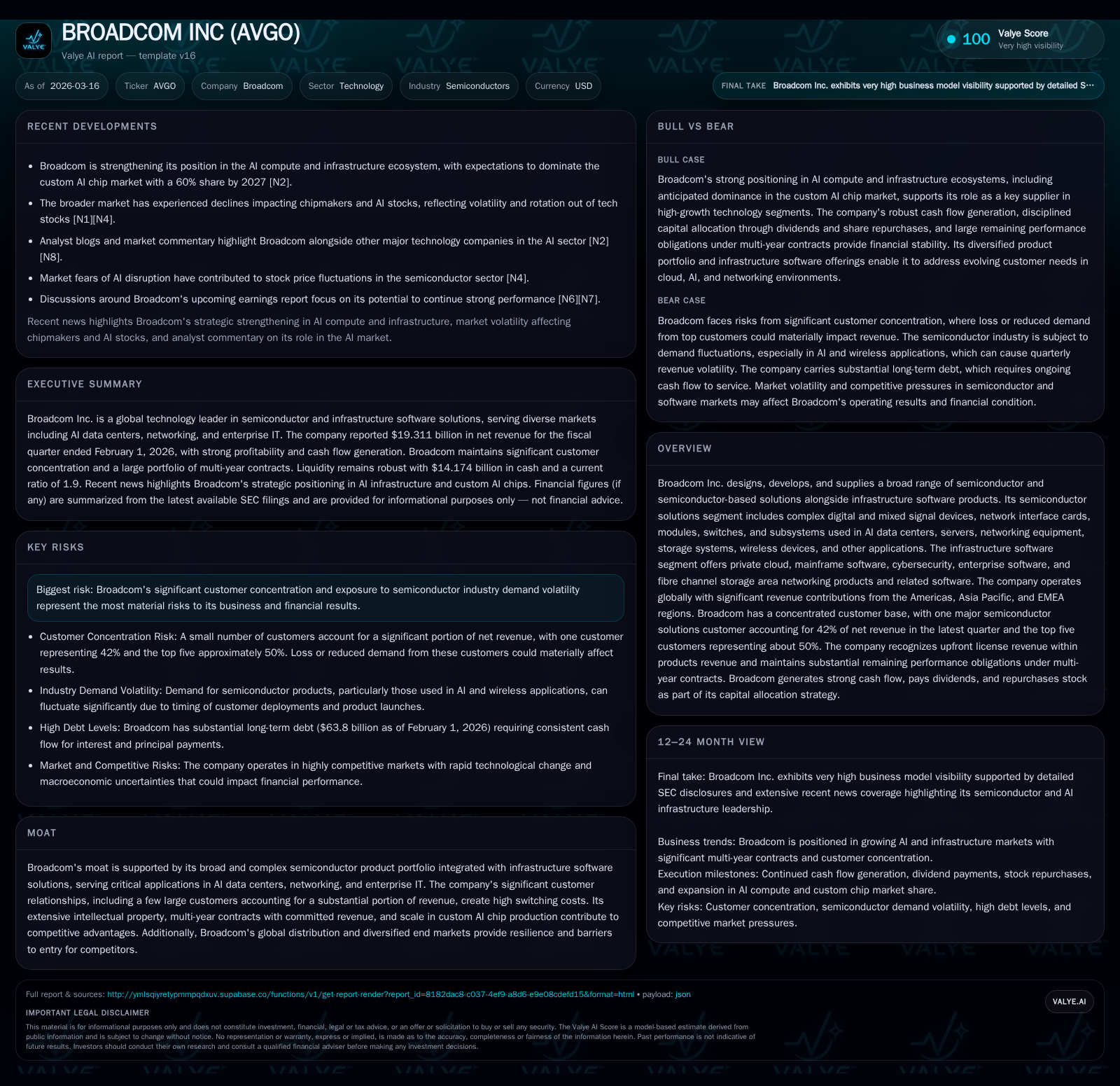
Broadcom Inc. has demonstrated an exceptional profitability surge with operating income growth of 89.3% in fiscal year 2025, largely fueled by accelerated demand in AI infrastructure semiconductors and steady performance in its infrastructure software segment. The company maintains a strong capital allocation discipline, returning over $11 billion to shareholders via dividends and buybacks while preserving robust free cash flows exceeding $26.9 billion. Although customer concentration remains a material risk, Broadcom’s integrated semiconductor and software offerings position it competitively amid evolving data center trends.
Profitability Transformation: Historical Performance and Key Drivers
Broadcom Inc.'s fiscal year 2025 marked a pronounced inflection point with operating income soaring to approximately $25.48 billion, up an impressive 89.3% from the prior year’s $13.46 billion [F1]. This near doubling was accompanied by net income escalating more than fourfold compared to fiscal 2024's $5.90 billion benchmark—indicative of pronounced operating leverage amid evolving demand dynamics [F1]. Operating cash flows surged 37.9% year-over-year to nearly $27.54 billion, comfortably funding concurrent capex increases of 13.7%, which rose modestly to $623 million [F1].
This robust financial momentum reflects a strategic pivot towards products tailored for AI-intensive workloads, precise management of costs, and the benefits of scale in custom chip manufacturing despite the semiconductor sector's overall volatility.
Historical performance (annual)
| FY | CFO ($bn) | OpInc ($bn) | Capex ($mm) |
|---|---|---|---|
| 2025 | 27.5 | 25.5 | 623 |
| 2024 | 20.0 | 13.5 | 548 |
| 2023 | 18.1 | 16.2 | 452 |
| 2022 | 16.7 | 14.2 | 424 |
Source: SEC companyfacts cache [F1].
Capital returns and efficiency (annual)
| FY | Div ($bn) | Buybacks ($bn) | FCF ($bn) |
|---|---|---|---|
| 2025 | 11.1 | 2.5 | 26.9 |
| 2024 | 9.8 | 7.2 | 19.4 |
| 2023 | 7.6 | 5.8 | 17.6 |
| 2022 | 7.0 | 7.0 | 16.3 |
Source: SEC companyfacts cache [F1].
Table: Broadcom’s historical annual financial performance illustrates accelerating profitability paired with disciplined capital reinvestment and returns.
AI Demand as a Catalyst: Management Insights and Market Position
The CEO’s recent commentary underscores robust demand linked to artificial intelligence infrastructure as a pivotal catalyst shaping Broadcom’s trajectory [N9]. The company’s portfolio—ranging from complex digital semiconductor devices to mixed-signal components integral for hyperscale AI data centers—has aligned well with surging needs for specialized network interface cards, switches, and custom AI chips vital for high-throughput workloads.
Broadcom benefits from multi-year committed contracts with hyperscale cloud providers, enhancing revenue visibility amidst technology evolution [S2]. The semiconductor solutions segment's top customer relationship—representing close to half the revenue stream—reflects not only concentration but also deep integration into critical AI deployments [S5]. These bespoke chips embody advanced integration of mixed-signal design, offering low latency and high bandwidth essential for modern AI systems.
The company's infrastructure software segment complements this hardware base by delivering private cloud orchestration, cybersecurity solutions, and enterprise-class FC SAN storage networking products that mesh seamlessly within leading AI-focused enterprise IT environments [S13]. This symbiosis solidifies Broadcom's position in growing segments while extending technical entry barriers against competitors.
Revenue Mix and Customer Concentration: Opportunities and Risks
Segmentation data reveals that semiconductor solutions topped $12.5 billion in revenue during recent quarters—a growth spike compared with approximately $8.2 billion the prior year—underscoring how AI-driven product demand has accelerated the segment [S13]. Meanwhile, infrastructure software retained steady revenues near $6.8 billion with conservative margin expansion due to increasingly subscription-based licensing models [S13].
Geographically, Asia Pacific dominates product shipments (~$10.95 billion), followed by significant contributions from Americas ($2.16 billion) and Europe/EMEA ($1 billion+), reflecting global end-market penetration [S10]. Revenue recognition adjustments incorporating upfront license fees demonstrate evolving monetization sophistication within infrastructure software contracts [S14].
However, Broadcom’s revenue is tightly concentrated, with one semiconductor customer comprising about 42% of total net revenue in the latest quarter—a significant elevation from roughly 29% one year earlier [S5]. The top five customers collectively account for approximately half of sales, concentrated further due to channel distribution relationships linked to hyperscalers [S5]. While such concentration embeds switching costs and contract longevity advantages through licensing agreements and embedded system integration, it simultaneously concentrates exposure to procurement fluctuations or shifts in customer strategies.
Broadcom remains transparent about this risk emphasizing robust long-term contracts complemented by recurrent service revenues that mitigate abrupt revenue swings tied to single customer dynamics [S10,S5]. Nonetheless, potential risks arising from large order timing variability and industry cyclicality merit ongoing scrutiny.
Capital Allocation Priorities: Dividends, Buybacks, and Cash Flow Generation
Capital discipline stands out as a hallmark of Broadcom's financial stewardship strategy as evidenced by sizeable shareholder returns alongside investments for innovation.
During FY2025, Broadcom distributed approximately $11.14 billion through dividends—continuing a sequential increase—and executed share repurchases totaling around $2.45 billion [F1,S9]. This contrasts with prior year buybacks amounting to roughly triple this figure at $7.18 billion suggesting a calibrated approach balancing market conditions against capital needs.
Operating cash flow generation strongly supports this strategy; with $27.54 billion generated last fiscal year against minimal capex need ($623 million), free cash flow approximations reach nearly $26.9 billion—highlighting exceptional conversion efficiency given scale [F1]. Return on equity is estimated near 23.6%, reflecting significant earnings leverage against shareholders’ equity base last recorded circa $25-26 billion albeit older snapshots suggest stability rather than rapid growth here [F1].
The extended unvested restricted stock compensation obligations totaling roughly $22 billion spread over multiple years hint at continued talent retention incentives aligned with shareholder value creation without immediate dilution pressure [S9]. Overall liquidity remains strong with over $14 billion readily available supported by revolver capacity and cash equivalents [S4], fortifying both operational flexibility and return continuity.
Technology and Product Synergies Fueling Long-Term Growth
Broadcom’s moat derives substantially from its sophisticated semiconductor architecture integration combined with complementary infrastructure software stacks geared toward contemporary enterprise IT ecosystems dominated by cloud-scale computing requirements.
Its product lineup covers complex digital ICs alongside mixed-signal products featured in modules, switches, network subsystems tailored explicitly for scalable AI data centers—segments that require tight integration between silicon design prowess and firmware control layers typical in hyperscaler environments [S13].
Additionally, infrastructure software offerings enhance overarching value propositions through private cloud orchestration tools, cybersecurity platforms meshing within hybrid clouds, alongside mission-critical Fibre Channel SAN products incorporating proprietary modules aimed at secure high-performance storage networks favored by large enterprises [S13]. Such vertical integration across hardware-software planes creates sizable technology lock-in while allowing Broadcom to command pricing premia unattainable by commoditized players lacking similar breadth.
Financial Health: Balance Sheet Resilience and Liquidity Metrics
Assessing liquidity metrics reveals a current ratio near approximately 1.9x supported by current assets around $32 billion against current liabilities near $16.86 billion at February 2026-quarter end [F1,S4]. Cash and equivalents hold firm at roughly $14.17 billion providing ample cushion for working capital requirements alongside upcoming debt maturities.
Total outstanding debt approximates $66 billion across senior notes issued through diversified maturities extending well beyond the medium term; principal repayments scheduled are spread evenly ensuring no acute refinancing burdens imminently [S6,S4,S7]. Recent senior note issuances totaling $4.5 billion coupled with redemptions indicate proactive capital structure optimization balancing interest cost management against liquidity maintenance.
The undrawn revolving credit facility valued at $7.5 billion further enhances short-term financing flexibility while compliance adherence confirms covenant maintenance without restrictions hindering ongoing operations or strategic initiatives .
What to Monitor: Upcoming Milestones and Forecast Considerations
In absence of explicit forward guidance disclosed recently or detailed forecasts beyond routine reporting cadence, market participants should track quarterly earnings reports slated soon post-February quarter end as key barometers for sustaining momentum amid volatile macroeconomic backdrops [N3].
Particular emphasis should be placed on updates regarding AI chip demand trajectories given their outsized impact on substantive portions of Broadcom’s semiconductor solutions revenues as well as any changes detected among dominant customer order patterns or contract renewals signaling either extension or potential attrition risks [N13,S5].
Additionally, advancements within R&D pipelines related to emerging mixed-signal integration technologies or enhancements within their infrastructure software portfolios supporting private/hybrid cloud evolutions will also offer directional cues on sustaining competitive positioning over medium-to-long term horizons.
-- This report is provided for informational purposes only without any recommendations or investment advice.
Disclaimer: This is research-only, informational analysis and not investment advice. It may include AI-generated interpretation and general industry context. Always verify important details using primary sources.

Comments