
loanDepot’s Revenue Surge Masks Persisting Profitability and Liquidity Challenges
loanDepot shows notable revenue growth through FY2025, yet ongoing net losses and heavy indebtedness challenge its operational and financial resilience.
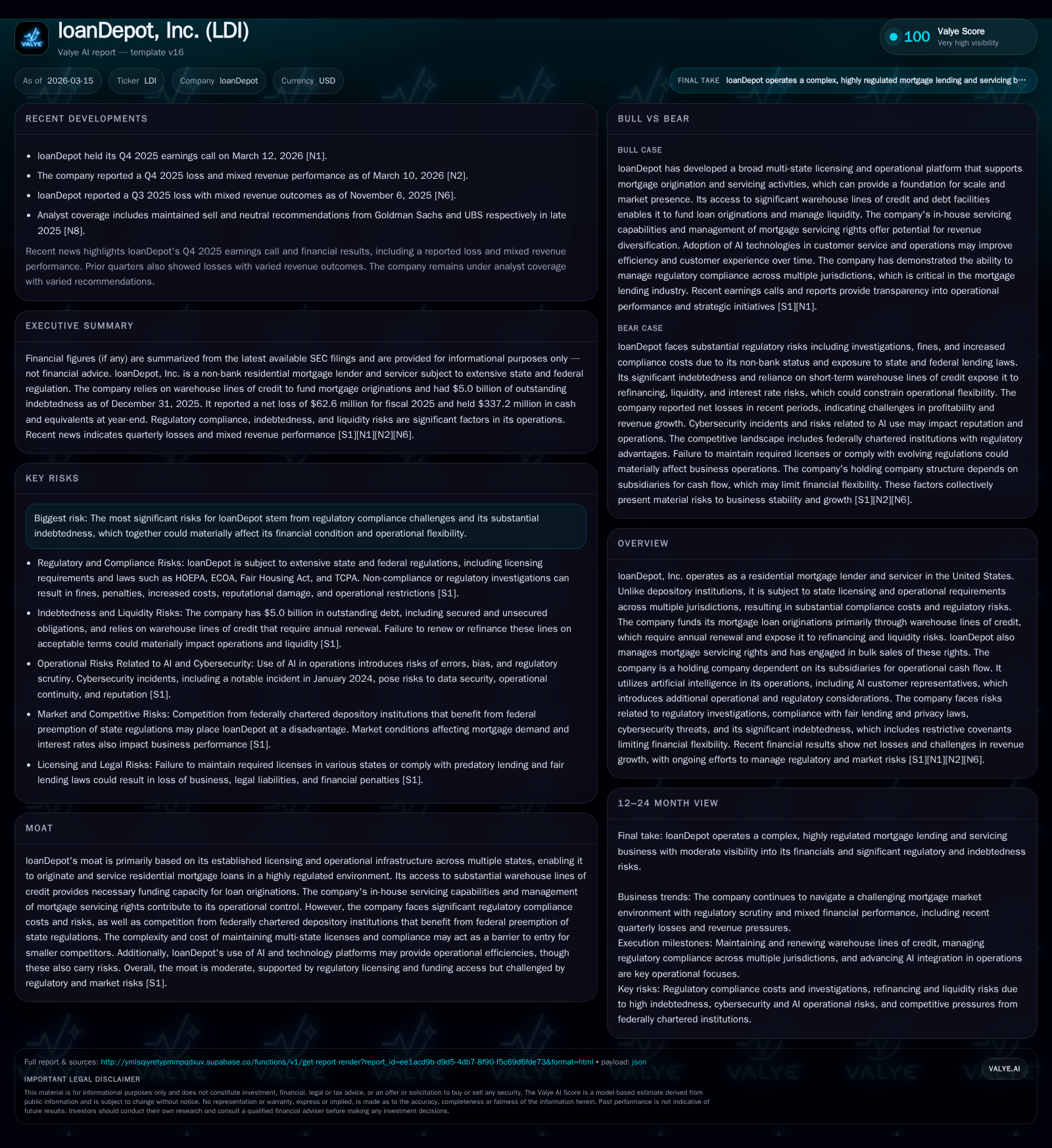
Over the past three years, loanDepot has achieved consistent revenue growth driven by strategic expansion and product innovation. However, this growth contrasts sharply with persistent net losses and deteriorating operating cash flows, highlighting underlying profitability issues. The company’s reliance on short-term warehouse lines and significant debt obligations amplifies liquidity risks amid tightening credit conditions and stringent regulatory requirements. As loanDepot continues deploying AI-driven efficiencies, it faces balancing operational innovation against escalating compliance costs in a fragmented mortgage market.
Momentum in Revenue Growth: Analyzing loanDepot’s Trajectory Through FY2023 to FY2025
loanDepot has registered steady revenue expansion over recent years despite challenges in the broader mortgage lending environment. From $974 million reported at the end of fiscal year 2023, revenues rose to approximately $1.06 billion in FY2024 and reached nearly $1.19 billion by the close of FY2025—a robust 12.2% increase year-over-year for the latest period [F1]. This upward trend reflects strategic initiatives such as deepening penetration in existing markets and enhancements to product offerings including second-lien loans and home equity products as described during recent earnings discussions [N1]. Additionally, platform investments have supported sustained origination volume even amid fluctuating interest rate pressures.
The Profitability Puzzle: Tracking Persistent Net Losses and Cash Flow Pressures
Although top-line growth signals operational scale benefits, loanDepot's bottom line reveals a persisting profitability gap. The net loss narrowed from -$110 million in FY2023 to -$62.6 million (approximately -$63M) by FY2025, representing a positive earnings trajectory with a 36.3% year-over-year improvement [F1]. Yet this progress is overshadowed by deeply negative operating cash flows which stood at -$707 million for FY2025 versus -$865 million the prior year—a slight cash burn improvement but indicative of entrenched cash consumption given rising Capex levels that totaled $27.1 million last fiscal year [F1]. Negative free cash flow remains a critical concern; with substantial cash used for operations minus capital expenses totaling roughly -$735 million annually, sustainability hinges on managing both cost structure and external financing sources.
Regulatory Headwinds and Licensing Burdens in a Fragmented Mortgage Market
Unlike federally chartered banks, loanDepot confronts the costly complexity of adhering to varied licensing mandates across multiple states without benefiting from federal preemption privileges [S1][S11]. This fractured regulatory patchwork exposes loanDepot to heightened compliance expenditures involving fair lending laws (including the Equal Credit Opportunity Act), state consumer protection statutes, privacy regulations like GLBA and CCPA, as well as emerging state-level Community Reinvestment Acts aimed at nonbank lenders [S15][S22]. Recent years have seen amplified regulatory attention on alleged redlining practices and servicing compliance under military relief statutes (SCRA), necessitating greater administrative oversight with direct impact on operational margins and legal risk exposure [S20][S21]. The company's ongoing engagement with such regulatory investigations underscores continuing vulnerability.
Funding Reliance on Warehouse Lines: Credit Risks and Capital Raise Challenges
The company’s operational model heavily relies on roughly $2.9 billion of secured short-term warehouse lines of credit that fund mortgage originations—a critical liquidity source requiring annual renewal [S4][S7][S8]. These facilities feature restrictive covenants contingent upon maintaining minimum pre-tax income levels (often just one dollar positive), tangible net worth thresholds, borrowing ratios, and liquidity reserves—all under threat given persistent net losses [S9][S10]. Cross-default terms linking these warehouse agreements compound refinancing risk; failure under any one could cascade into broader defaults affecting all credit lines simultaneously. LoanDepot must continuously navigate lender sentiment fluctuations driven by macroeconomic uncertainties and mortgage market volatility to secure cost-effective renewals or replacements [S6][S13]. The resultant funding fragility is compounded by market competition from federally chartered entities enjoying deeper deposit bases that offer more stable liquidity access.
Strategic Deployment of AI and Platform Innovations Amid Industry Compliance Needs
In pursuit of efficiency gains within this complex environment, loanDepot has integrated artificial intelligence into customer-facing operations including AI-powered representatives that streamline borrower interactions and underwriting processes [N1][S1]. While these technological enhancements promise scalability advantages reducing reliance on human-intensive functions, they simultaneously invite fresh regulatory oversight regarding algorithmic fairness and data security compliance obligations [S16]. Balancing tech-driven cost reductions against emerging rules around AI use is thus pivotal for mitigating potential enforcement actions or reputational damage.
Capital Allocation Review: Debt Profile, Dividend Policy, and Enterprise Liquidity
From a capital structure standpoint, loanDepot’s equity base contracted steeply from approximately $921 million at the end of FY2022 down to around $386 million by FY2025 amid recurring losses absorbing retained earnings—driving an approximate negative return on equity near -16% for the latest fiscal year [F1]. Total liabilities remain elevated with a combined debt load exceeding $5 billion that includes not only warehouse debts but also secured notes ($1.3B) and unsecured senior notes ($807M) due within the next few years [S4][S12]. These leverage levels restrict discretionary capital returns; consistent with this constraint dividend distributions have dwindled to roughly $2.47 million reported last fiscal year from an order of magnitude higher payments recorded earlier in 2022 [F1]. Capital preservation appears prioritized given precarious liquidity positioning where available cash balances hover around $337 million—insufficient to offset shortfalls without external financing or asset sales such as bulk MSR transactions routinely employed to bolster cash flow [S14][F1].
Historical performance (annual)
| FY | Rev ($mm) | Net ($mm) | CFO ($bn) | Capex ($mm) | Rev YoY | Net YoY |
|---|---|---|---|---|---|---|
| 2025 | 1190 | -63 | -0.7 | 27 | +12.2% | +36.3% |
| 2024 | 1060 | -98 | -0.9 | 26 | +8.9% | +10.7% |
| 2023 | 974 | -110 | -0.2 | 21 | -22.4% | +59.7% |
| 2022 | 1256 | -273 | 4.5 | 43 |
Source: SEC companyfacts cache [F1].
Capital returns and efficiency (annual)
| FY | Div ($mm) | FCF ($bn) | ROE% |
|---|---|---|---|
| 2025 | 2 | -0.7 | -16.2 |
| 2024 | 3 | -0.9 | -19.4 |
| 2023 | 3 | -0.2 | -15.6 |
| 2022 | 119 | 4.4 | -29.6 |
Source: SEC companyfacts cache [F1]. *Note: Calculated YoY % reflect changes between successive fiscal years where data permits; operating cash flow YoY % data partially constrained.
Forward Outlook: Key Milestones, Market Risks, and Indicators to Monitor
loanDepot has not issued explicit forward financial guidance but outlined key sensitivities during its Q4 earnings call relating to warehouse line renewals scheduled annually throughout coming quarters—a critical liquidity event warranting surveillance given current credit market tightness [N1][N2]. Additional scrutiny will focus on any shifts within regulatory landscapes governing fair lending enforcement activity or expanded state-level licensing reforms potentially elevating compliance costs further beyond current expectations [S24][S26]. Progress or setbacks in diversification efforts such as uptake of HELOCs or real estate ancillary services will also serve as barometers for sustainable revenue growth beyond core mortgage origination volumes currently powering top-line increases.
Conclusion
loanDepot exemplifies a high-growth nonbank mortgage lender wrestling with entrenched profitability challenges amid systemic financing dependencies. Its expanding revenues attest to commercial momentum leveraged through proprietary technology platforms but remain counterweighted by structural headwinds from tighter regulatory regimes and intensely cyclical funding conditions tied to short-term warehouse facilities vulnerable to market disruption. Addressing these challenges hinges on successfully balancing innovative product deployment against mounting compliance burdens while prudently managing liquidity risk embedded within a heavily geared capital structure. This complex mix defines loanDepot’s near-term operating environment.
This analysis is based exclusively on publicly available filings including SEC reports up to March 12, 2026 ([F1], [S#]) and recent industry news transcripts ([N#]). It does not constitute investment advice or recommendations.
Disclaimer: This is research-only, informational analysis and not investment advice. It may include AI-generated interpretation and general industry context. Always verify important details using primary sources.

Comments