
Volato Group’s Shift from Ownership to AI-Driven Aviation Solutions
Volato Group transitioned from capital-intensive fractional jet ownership to proprietary AI-powered software platforms, achieving profitability amid liquidity constraints.
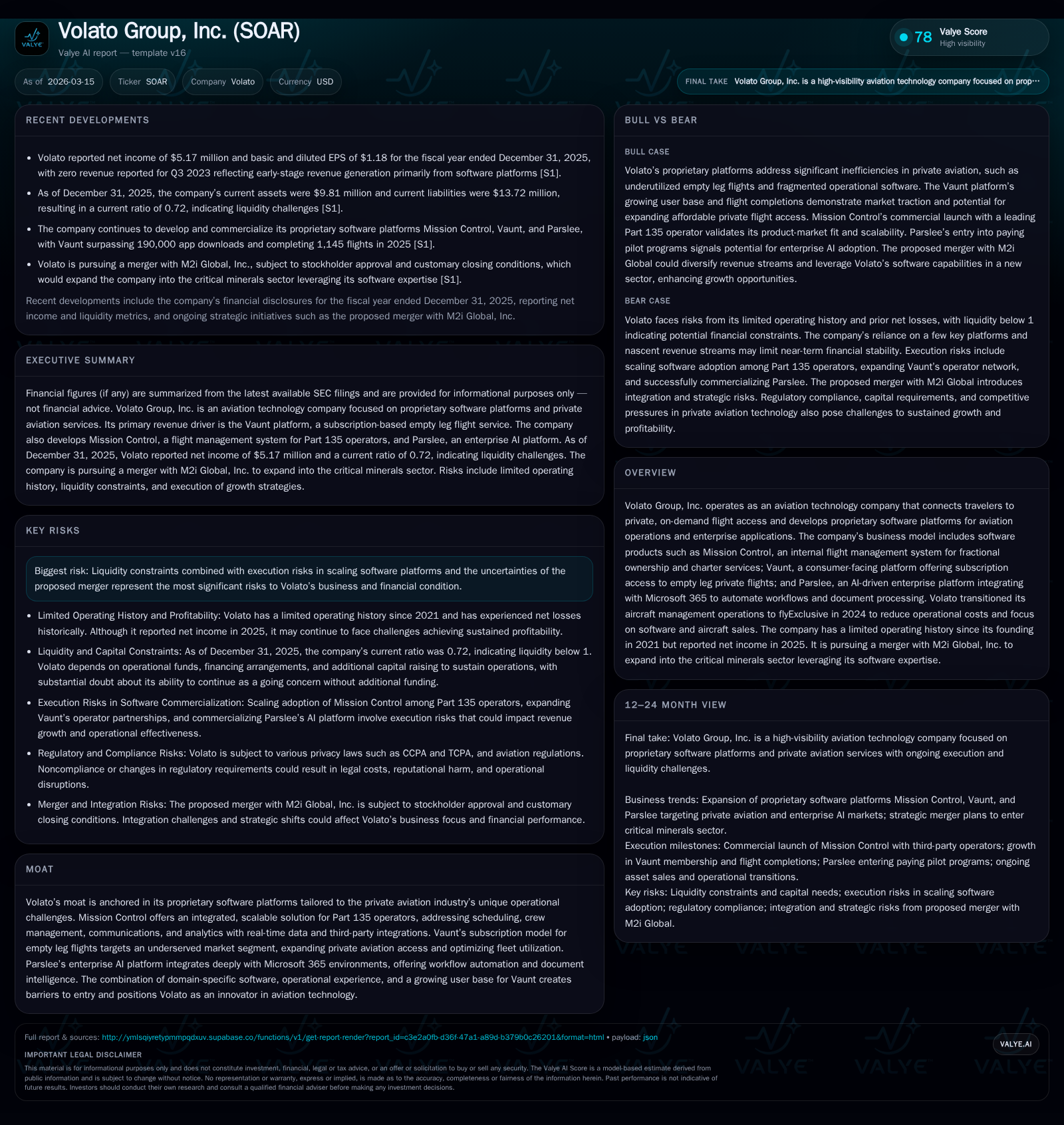
Founded in 2021 as a private aviation operator focused on fractional jet ownership and charter services, Volato Group faced steep losses due to the capital-intensive nature of aircraft management. Pivoting in 2024-2025, the company strategically exited asset-heavy functions by outsourcing flight operations to flyExclusive while doubling down on three proprietary software platforms—Mission Control, Vaunt, and Parslee—that leverage technology to optimize private aviation efficiency and extend into enterprise AI. This shift underpinned a sharp profitability turnaround with operating income swinging from -$9.37 million in 2024 to +$3.96 million in 2025, and net income following a similar trend. Despite this progress, substantial liquidity risks and tight working capital remain pressing concerns. The planned merger with M2i Global signals an expansion into critical minerals supply chains by applying Volato’s software expertise beyond aviation. Near-term performance hinges on scaling these software offerings, managing vendor dependencies, and securing capital to sustain growth.
From Fractional Ownership to Tech Platform: Tracing Volato's Early Growth
Volato Group was founded in January 2021 primarily as an operator of private jets via a fractional ownership model grounded in Part 135 FAA-certified operations [S1]. It began delivering its first HondaJet in August 2021 and started commercial charter flights shortly thereafter. In March 2022, the company expanded by acquiring Gulf Coast Aviation (a Texas-based Part 135 operator) and placing orders for four Gulfstream G280 jets slated for delivery in later years.
However, this initial capital-intensive phase was marked by significant operating losses driven by high fixed costs associated with aircraft ownership, maintenance, and flight operations—as typical for fractional ownership programs constrained by narrow margin levers [F1]. Revenues were minimal or nonexistent until the company transitioned attention to software-led models.
Recognizing these limits, Volato started internal software development efforts mid-2022 targeting operational efficiency improvements via Mission Control, an integrated flight management platform tailored specifically for Part 135 operators’ complex scheduling and crew coordination needs [S14]. Eventually commercialized externally with flyExclusive as the first third-party client, Mission Control embodies Volato's move away from asset-heavy models toward scalable SaaS offerings addressing aviation industry pain points such as disparate legacy systems and lack of real-time analytics.
Parallelly, Volato launched Vaunt in late 2023—a consumer-facing platform designed around subscription access to monetize the underutilized "empty leg" flights prevalent in private aviation fleets where repositioning flights have historically represented wasted capacity [S14][S24]. This innovative approach mirrors subscription economy trends adapted for luxury travel.
Dissecting the 2024-2025 Turnaround: Drivers Behind Profitability and Operating Rebound
Between fiscal years ending December 31 of 2022 through 2024, Volato reported mounting operating losses worsening from approximately -$1.74 million in 2022 to -$37.51 million by end-2023 before improving to -$9.37 million in 2024 [F1]. Net income followed an even more pronounced dip peaking at -$52.82 million in FY23 with partial recovery to -$40.65 million FY24 [F1].
The inflection point occurred in 2025 when Volato swung to an operating profit of $3.96 million accompanied by positive net income of $5.17 million—highlighting substantive operational restructuring and revenue diversification into software services rather than pure aircraft operations [F1].
Key drivers included:
- Transitioning aircraft management services to flyExclusive reduced overhead burdens allowing focus on higher margin tech products [S14][S26].
- Generating software revenue through Vaunt’s subscription model which grew rapidly with cumulative app downloads exceeding 190,000 and over 1,145 flights completed by year-end – Vaunt became the primary revenue contributor [S14][S24].
- Early commercial pilots of Parslee enterprise AI indicated nascent but promising use cases complementing core aviation products with automation tools targeting Microsoft-centric workflows [S14].
Cash flow from operations shifted from large negative values (-$16.92M FY24) into positive territory at +$3.49M FY25 while maintaining low capital expenditure near $211k signaling disciplined spending aligned with strategic priorities [F1][S26].
Historical performance (annual)
| FY | Net ($mm) | CFO ($mm) | OpInc ($mm) | Capex ($) | Net YoY |
|---|---|---|---|---|---|
| 2025 | 5 | 3 | 4 | 211000 | +112.7% |
| 2024 | -41 | -17 | -9 | 145000 | +23.1% |
| 2023 | -53 | -30 | -38 | 637000 | -3506.3% |
| 2022 | 2 | -1 | -2 |
Source: SEC companyfacts cache [F1].
Capital returns and efficiency (annual)
| FY | FCF ($mm) | ROE% |
|---|---|---|
| 2025 | 3 | -279.8 |
| 2024 | -17 | 248.8 |
| 2023 | -31 | -358.1 |
| 2022 | 76.1 |
Source: SEC companyfacts cache [F1].
Note: Revenue reported as zero or not applicable due to business transition phase; all figures USD millions/k except CapEx.
Mission Control, Vaunt, and Parslee: Software Platforms Shaping Future Trajectory
Volato has developed domain-specific technology platforms addressing distinct industry segments within private aviation and enterprise automation.
Mission Control
Mission Control is bespoke flight management software designed explicitly for Part 135 operators who face complex logistics challenges including crew scheduling, trip optimization, compliance tracking, customer communications, and real-time analytics integration across platforms such as Schedaero and ForeFlight [S14]. Its deployment beyond Volato's own operations through flyExclusive marks early validation as a scalable SaaS offering creating operational efficiencies traditionally underserved by legacy tools.
Vaunt
Vaunt innovates on the longstanding private aviation inefficiency of empty leg flights—repositioning trips without passengers that constitute roughly one-third of fleet activity but yield no revenue [S14][S24]. By aggregating these inventory pieces into a consumer subscription platform leveraging transparent waitlists and priority upgrades, Vaunt taps latent demand among affluent users seeking cost-effective private flying experiences without full ownership commitments [S24]. This experiential subscription model addresses pain points both for operators needing better fleet utilization and consumers craving flexible private air access — unlocking new market segments.
Parslee
Parslee represents Volato’s bet on enterprise AI integration outside traditional aviation verticals by embedding autonomous workflow agents within Microsoft 365 ecosystems including Outlook, Teams, SharePoint [S14]. Its layered architecture combining knowledge-base contextualization with deterministic document processing aims at mission-critical applications such as contract analysis where auditability is paramount—an essential differentiator over generic LLM solutions prone to hallucinations or data leakage risks.
While still early-stage—entering pilot paying programs only mid-2025—the platform leverages advancements in large language models mediated through Azure OpenAI APIs [S6], indicating both opportunity and risk linked to dependency on third-party AI infrastructure providers.
Liquidity Challenges and Capital Structure: Risks Restricting Expansion Potential
Despite improved earnings results in FY25,[F1] Volato faces significant liquidity constraints threatening near-term stability.
The current ratio stood at approximately 0.72 as of FY25’s close reflecting negative working capital where current liabilities notably exceed current assets ($13.7M vs $9.8M) [F1][S4]. Recurring cash burn had previously strained finances culminating in auditors issuing a ‘substantial doubt’ paragraph over going concern viability despite recent profits signifying lingering fragility [S7].
Debt instruments largely comprise convertible promissory notes aggregating up to $36 million potentially convertible into common stock at discounts creating dilution pressure for existing holders [S19]. The complex web of interlinked debt covenants imparts risk that any covenant breach could trigger acceleration clauses endangering asset repossession such as remaining aircraft or intellectual property collateral—heightening refinancing urgency amidst volatile market conditions [S4][S19].
Proactive cost discipline visible via markedly low capital expenditure spending near $211k despite growth ambitions showcases lean operations but underscores constrained resource availability propelling reliance on external financing or strategic transactions such as mergers.
Near-Term Milestones and Merger Ambitions with M2i Global
Volato filed an agreement dated July 28, 2025 with M2i Global Inc., envisaging a merger transaction whereby M2i would become a subsidiary post-merger holding approximately ~85% ownership stake subject to approvals [S3].
This strategic maneuver intends to diversify Volato's scope beyond private aviation technology into critical minerals supply chains crucial for national security—leveraging existing expertise in developing operational intelligence platforms toward transparency and traceability solutions across global resource value chains.
While precise terms remain pending finalization, this shift signals management's intent to broaden technological horizons amid intense liquidity pressures warranting close monitoring of execution risks alongside ongoing core business scaling efforts.
Capital Allocation Insights: Cash Flows and CapEx Discipline
Analyzing cash flow dynamics reveals encouraging signs tempered by cautionary constraints:
- Operating cash flow turned positive at approximately $3.49 million for FY25 after multi-year deficits underscoring operational restructuring success [F1].
- Capital expenditures were tightly controlled at $211k—less than prior peak year spend—reflecting deliberate capex austerity aligned with product focus rather than asset accumulation [F1][S26].
- No dividends or share repurchases have been reported evidencing prioritization of internal liquidity preservation over shareholder returns amid growth uncertainties [F1][S26].
- Free cash flow approximated $3.28 million (CFO minus CapEx), supportive but within tight margins requiring additional funds likely ahead.
This measured allocation aligns with typical emerging growth tech firms balancing investment needs against investor appetite amidst structural financial risks.
Risks from Third-Party Dependence and Regulatory Environment on AI Products
Parslee’s reliance on third-party LLM APIs such as Microsoft Azure OpenAI exposes Volato to vendor-specific risks including potential API pricing hikes, usage limitations, service outages or discontinuations threatening core product delivery continuity [S6].
Moreover, customer data transmitted via these external platforms entail cybersecurity exposure given limited control over vendor data handling; breaches may invite regulatory actions under frameworks like California Consumer Privacy Act (CCPA), federal guidelines plus sector-specific privacy laws increasing compliance costs if mishandled [S10][S22].
From an AI product standpoint:
- Large language models may produce inaccurate outputs detrimental in contexts involving contracts or regulatory filings raising liability concerns even if errors originate from third-party AI versus Volato’s platform logic itself—a known challenge termed "hallucination risk" within NLP circles [S6][S10].
- U.S federal agencies continue deliberation on automated decision-making transparency mandates potentially imposing disclosure or auditing requirements impacting design flexibility.
Cybersecurity threats targeting information infrastructure including Microsoft cloud environments further elevate operational risk requiring ongoing mitigation consistent with industry norms.
Investor Considerations: What To Watch Next in Volato’s Path Forward
Key factors include:
- Successful consummation of the M2i merger could materially alter business scope unlocking new markets but carrying integration complexity risks.
- Ability of Vaunt platform not only to sustain rapid user growth but expand inventory supply via onboarding additional Part135 operators will be pivotal for recurring revenue stability.
- Commercial traction gains by Parslee beyond pilot stage will indicate genuine market adoption prospects crucial for diversifying revenue base outside aviation vertical.
- Management’s capacity to secure additional capital under acceptable terms given tight liquidity alongside managing convertible note dilution consequences remains central risk dimension.
- Effective navigation of emerging AI regulatory landscapes paired with safeguarding customer data integrity will influence reputation and compliance cost structures.
- Observation warranted whether internal control remediation efforts outlined due material weaknesses can restore confidence per Sarbanes-Oxley Section404 expectations [S25].
Early indicators suggest Volato is poised at an inflection between overcoming legacy asset-heavy models toward innovative tech-led growth yet contingent upon judicious execution amid persistent financial uncertainties.
This analysis reflects facts disclosed by Volato Group through SEC filings as of March 15, 2026 ([F1], [S#]) without speculative forecasts or investment recommendations.
Disclaimer: This is research-only, informational analysis and not investment advice. It may include AI-generated interpretation and general industry context. Always verify important details using primary sources.

Comments