
BRT Apartments Corp.'s Expansion and Financial Strains in 2025
BRT Apartments Corp. expanded its multi-family portfolio significantly in 2025 but faced increasing operating losses and refinancing challenges.
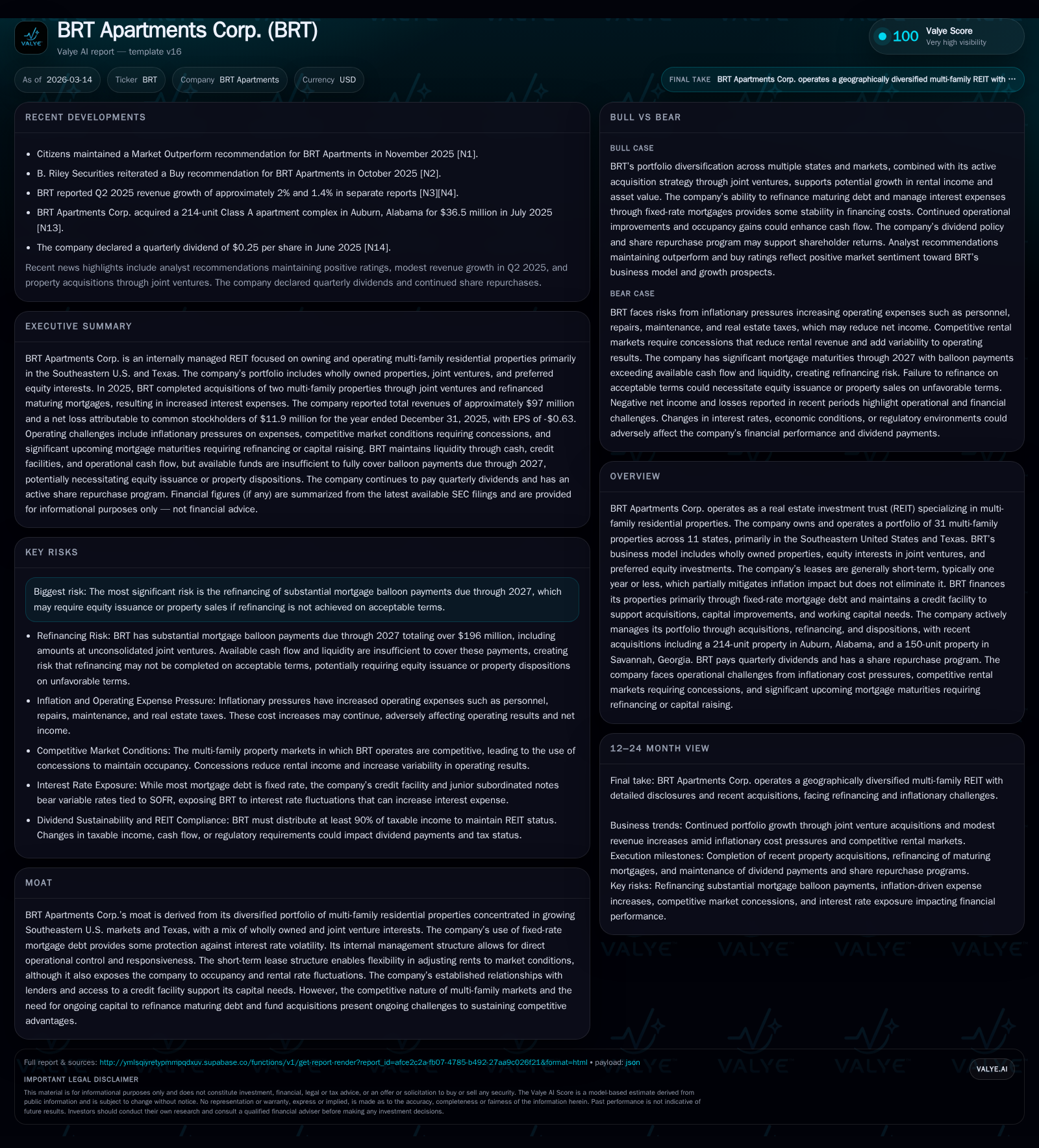
BRT Apartments Corp. pursued aggressive growth through acquisitions in the Southeastern U.S. and Texas, tripling revenues in 2025. Despite this surge, the company experienced deeper operating and net losses amid inflationary pressures and higher expenses. Substantial mortgage balloon maturities through 2027 create refinancing risks that necessitate careful liquidity management. Maintaining dividend distributions while managing cash flows and debt obligations will be critical for sustaining financial stability.
Rapid Growth Through Strategic Acquisitions in Southeastern and Texas Markets
In 2025, BRT Apartments Corp. expanded its portfolio significantly within the multi-family residential sector by acquiring additional properties primarily located in Alabama and Georgia. Joint ventures acquired a 214-unit complex in Auburn, Alabama, for $36.5 million with an associated $24.4 million mortgage at a fixed 5.38% interest rate maturing in 2032, and a 150-unit property in Savannah, Georgia, for $23 million with a $15.7 million mortgage bearing a fixed rate of 2.71%, maturing in 2031 [S1][S2]. These acquisitions contributed to growing the portfolio to 31 properties across 11 states, mainly concentrated in the Southeastern United States and Texas.
The use of joint ventures allows BRT to deploy capital efficiently while sharing risk exposure; typically holding an 80% equity stake with planned improvements accounted for alongside acquisition costs. Borrowings increased with approximately $15 million drawn on its credit facility to support these purchases [S2]. This expansion diversifies BRT’s asset base geographically while maintaining regional concentration risks.
Financial Performance: Revenue Growth Amid Operating Losses
BRT reported revenue of approximately $97 million for fiscal year 2025, more than triple the roughly $24 million recorded the prior year [F1]. This increase largely reflects contributions from newly acquired properties within wholly owned portfolios and joint ventures.
Despite strong revenue growth, operating income declined sharply to nearly -$12.5 million in 2025 versus prior losses near -$3.4 million, indicating significant margin compression driven by rising operating expenses including personnel costs, maintenance, real estate taxes, and inflationary pressures [F1][S1]. Net income followed this trend with losses increasing to about -$11.9 million from -$2.1 million prior year [F1].
Historical performance (annual)
| FY | Rev ($mm) | Net ($mm) | CFO ($mm) | OpInc ($mm) | Rev YoY | Net YoY |
|---|---|---|---|---|---|---|
| 2025 | 97 | -12 | 14 | -12 | +304.8% | -477.1% |
| 2024 | 24 | -2 | 24 | -3 | +2.0% | -19.2% |
| 2023 | 24 | -2 | 20 | -2 | +3.5% | +58.8% |
| 2022 | 23 | -4 | 15 | -5 |
Source: SEC companyfacts cache [F1].
Capital returns and efficiency (annual)
| FY | Div ($mm) | Buybacks ($mm) | ROE% |
|---|---|---|---|
| 2025 | 19 | 5 | -6.7 |
| 2024 | 19 | 3 | -1.0 |
| 2023 | 19 | 14 | -0.8 |
| 2022 | 18 | -1.7 |
Source: SEC companyfacts cache [F1].
Source: Company financial statements [F1]
Cash Flow Management and Capital Allocation
Operating cash flow decreased approximately 42% to $14 million in fiscal year ending December 2025 despite revenue gains [F1]. This reflects higher working capital needs and increased maintenance expenditures amid inflationary cost pressures [S1][S2]. Positive cash flow despite net losses suggests non-cash charges like depreciation partially offset earnings declines.
Dividend payments remained steady near $19 million annually consistent with REIT distribution requirements mandating at least a 90% payout of taxable income [S1]. However, management cautions that without significant property sales, dividends may increasingly be treated as return of capital.
Share repurchases moderated to about $5 million in FY2025 compared to higher levels previously [F1]. Capital allocation balanced acquisitions funded through borrowings on a $40 million credit facility secured by unencumbered property collateral with liquidity preservation amid refinancing challenges [S4][S13].
Debt Maturity Profile and Refinancing Risks Through 2027
As of December 31, 2025, consolidated mortgage debt totaled approximately $738 million including $290 million related to unconsolidated joint ventures with weighted average interest rates around mid-4% range [F1][S7][S12]. Fixed-rate mortgages provide some protection against interest rate volatility.
However, balloon maturities aggregate about $130 million due between late-2026 and end-2027 across consolidated portfolios plus an estimated additional $60+ million from joint ventures [S4][S7]. This concentration creates refinancing risk requiring either new debt issuance or asset sales under potentially unfavorable conditions.
The company's revolving credit facility permits borrowing up to $40 million at variable rates tied to SOFR plus ~250 basis points with a floor currently above six percent; it matures in September 2027 coinciding with significant balloon maturities [S9][S13]. Junior subordinated notes totaling approximately $37 million mature in April 2036 and carry floating coupons tied to SOFR plus spreads [S10].
Overall leverage appears manageable but refinancing execution will require disciplined balance sheet management given macroeconomic uncertainties affecting capitalization rates and credit spreads.
Competitive Landscape and Market Positioning
BRT competes within crowded acquisition markets featuring large publicly traded REITs alongside private equity investors deploying capital into value-add multi-family assets [S1]. Competition affects acquisition pricing—pressuring capitalization rates—and leasing dynamics where tenant retention depends on location attractiveness and amenities.
Short-term lease structures averaging one year provide flexibility for rent adjustments but resident sensitivities during inflationary periods limit aggressive rent increases [S1].
Inflation Impact on Operations and Borrowing Costs
Inflationary pressures increased personnel costs, maintenance expenses, real estate taxes, and insurance premiums during fiscal year 2025 eroding net operating income margins despite efforts at rental rate resets post-lease expirations [S1]. While fixed-rate mortgage debt reduces exposure to borrowing cost increases, floating-rate components on credit facilities and junior subordinated notes increase interest expense sensitivity.
Outlook: Growth Constraints Amid Refinancing Needs
Management acknowledges constraints stemming from limited acquisition opportunities due to competitive pressures and geographic concentration risks focused on Southeastern U.S states plus Texas [S2]. Selective value-add projects continue but pipeline volume is subdued reflecting macroeconomic headwinds.
Liquidity demands from upcoming debt maturities combined with ongoing dividend requirements will critically influence new investments [S13]. Opportunistic acquisitions may arise from market dislocations but involve tradeoffs between risk profiles.
Key Milestones to Monitor
Near-term focus centers on refinancing sizable mortgage maturities totaling over $190 million through late-2027 including unconsolidated joint venture shares [S7][S13]. Asset disposition or equity issuance may be necessary if refinancing terms are unfavorable.
Monitoring occupancy trends remains essential as they underpin cash flow stability amid rising operating costs . Dividend coverage ratios will indicate sustainability given possible growth in return-of-capital distributions.
Access to credit facility liquidity provides a buffer but requires covenant compliance including minimum tangible net worth thresholds above $140 million as confirmed at early-2026 reporting dates [S9][S20].
Disclaimer: This report is for informational purposes only; it does not constitute investment advice or recommendations regarding securities or financial instruments.
Disclaimer: This is research-only, informational analysis and not investment advice. It may include AI-generated interpretation and general industry context. Always verify important details using primary sources.

Comments