
Nektar Therapeutics' Clinical Advances and Financial Dynamics in 2025
Nektar advances its immunomodulatory pipeline with heightened R&D investment while managing sharp operating losses and complex capital needs in 2025.
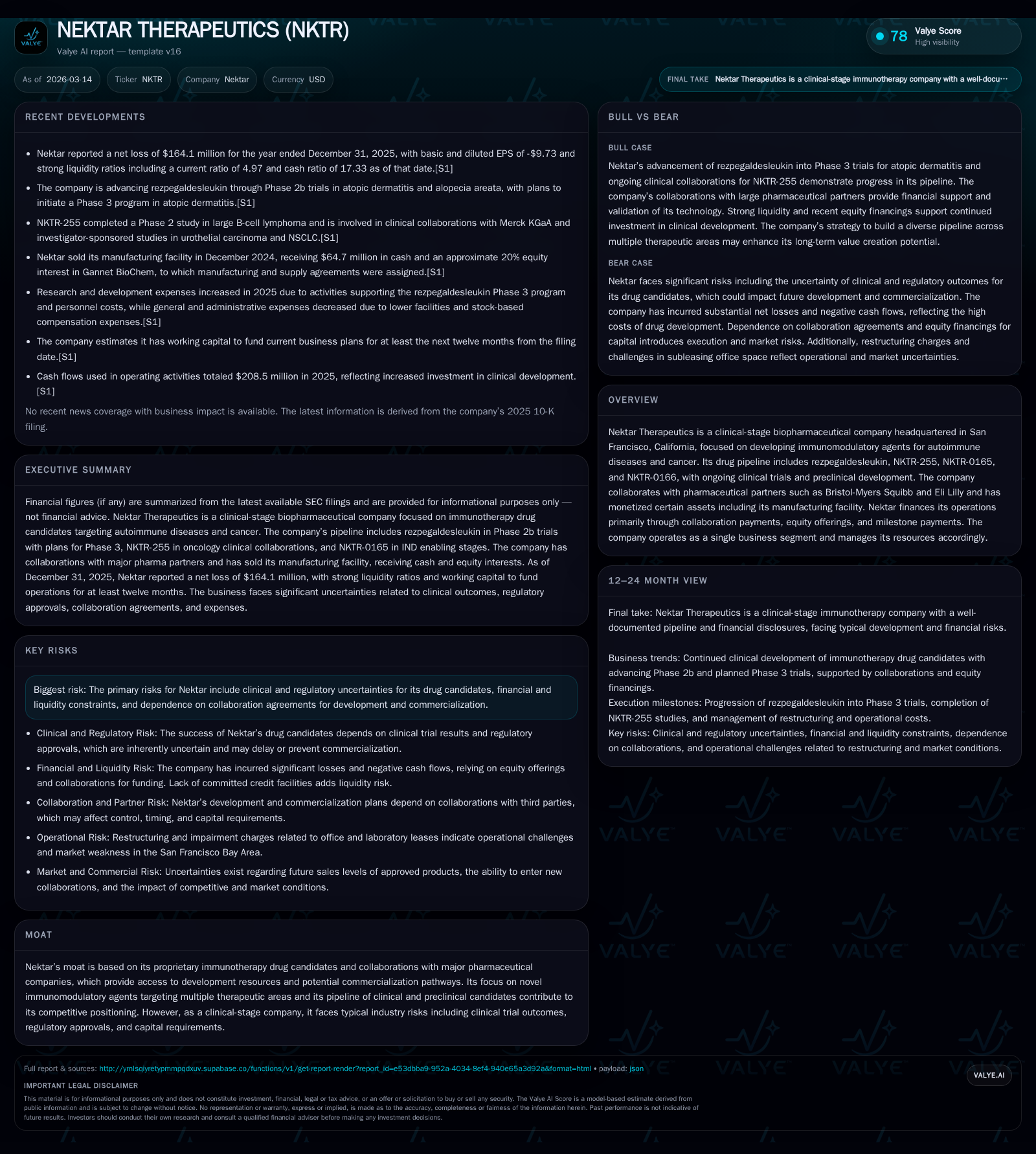
Nektar Therapeutics, a clinical-stage biopharma focused on immunomodulation for autoimmune diseases and cancer, pursued significant pipeline progress in 2025, notably preparing rezpegaldesleukin for Phase 3 trials. However, these clinical strides were matched by escalating research expenditures and widening operating losses. Collaboration revenues shrank from prior years, increasing pressure on cash flows despite equity raises. The company faces ongoing litigation risks and regulatory uncertainties, underscoring a delicate balance between advancing clinical priorities and financial resilience.
Nektar’s Growth Path: From Early Achievements to Escalating R&D Commitments
Nektar Therapeutics expanded revenue significantly early in its growth trajectory, increasing from $37.45 million in FY2016 to $95.47 million in FY2017 [F1]. This growth reflected successful collaborations and operational expansion. However, subsequent years saw a revenue contraction linked to strategic repositioning away from manufacturing operations, including the sale of its manufacturing facility late in 2024 [S1], [S23].
Operating losses deepened over this period, reaching an operating loss of $140.1 million by FY2025 [F1]. This trend coincided with rising R&D expenses totaling $117.3 million in 2025, driven largely by rezpegaldesleukin’s advancement into Phase 3 trials [S1], [S28]. Personnel and overhead costs also contributed to the expense increase.
Historical performance (annual)
| FY | Net ($mm) | CFO ($mm) | OpInc ($mm) | Capex ($mm) | Net YoY |
|---|---|---|---|---|---|
| 2025 | -164 | -209 | -140 | 0 | -37.9% |
| 2024 | -119 | -176 | -105 | 1 | +56.9% |
| 2023 | -276 | -193 | -264 | 1 | +25.0% |
| 2022 | -368 | -304 | -376 | 6 |
Source: SEC companyfacts cache [F1].
Capital returns and efficiency (annual)
| FY | Buybacks ($mm) | FCF ($mm) | ROE% |
|---|---|---|---|
| 2025 | 0 | -209 | -182.6 |
| 2024 | 3 | -177 | -195.9 |
| 2023 | -193 | -210.8 | |
| 2022 | -310 | -100.4 |
Source: SEC companyfacts cache [F1].
Table: Historical Financial Summary illustrating early top-line growth followed by retrenchment due to asset disposition and escalating losses amid R&D investment [F1]
Pipeline Progress: Key Candidates Drive Clinical and Regulatory Outlook
Rezpegaldesleukin, an IL-2 receptor agonist targeting autoimmune diseases such as atopic dermatitis, remains Nektar’s lead candidate [S1]. In FY2025, development costs rose with initiation of Phase 3 activities beyond ongoing Phase 2b trials RESOLVE-AD and RESOLVE-AA; clinical study expenses for rezpegaldesleukin increased slightly to approximately $51.5 million from $49.4 million the prior year [S1]. This Phase 3 program represents a pivotal milestone for potential regulatory approval.
NKTR-255, an IL-15 receptor agonist for oncology indications, saw expenditure decline sharply from about $15.8 million in FY2024 to $6.5 million in FY2025 as Phase 2 studies concluded and investigator-sponsored trials wound down [S1]. NKTR-0165 remains in preclinical IND-enabling stages with relatively stable spend around $9.6 million annually; management anticipates reduced costs going forward as enabling activities complete [S1].
R&D expenses encompass clinical trial costs, contract manufacturing, personnel allocations across programs, stock-based compensation, and overhead previously allocated partially to cost of goods sold before facility divestiture [S28]. The transition of rezpegaldesleukin into full Phase 3 studies is expected to dominate pipeline spending through fiscal year 2026.
Partnerships and Collaborations Fuel Development While Mitigating Risks
Collaborations are critical revenue sources and risk mitigants despite declining contract revenues linked to asset sales and geographic shifts [S4], [S7]. Revenue from partners such as Bristol-Myers Squibb (BMS), Eli Lilly, Merck KGaA, Baxalta (Takeda), AstraZeneca, UCB, Pfizer Inc., and Roche comprised most of the company's income but declined from about $98 million in calendar year 2024 to roughly $55 million in calendar year 2025 [S4], [S5].
These partnerships provide upfront payments (e.g., Eli Lilly's $150 million for rezpegaldesleukin), milestone payments contingent on clinical progress, cost reimbursements (notably BMS), and shared trial responsibilities [S7]. Given high capital demands without approved products generating royalties yet, these collaborations are essential for funding development.
However, reliance on partner commitments introduces risks related to trial outcomes or shifting strategic priorities common to biopharma alliances.
Financial Profile: Revenue Shifts, Operating Losses, and Cash Flow Challenges
The financials depict a company heavily investing in clinical progression but not yet profitable or cash flow positive [F1], [S1]. Revenues dropped markedly year-over-year due mainly to portfolio restructuring including facility sale.
Operating losses deepened to negative $140 million in FY2025—a roughly one-third deterioration versus FY2024—as R&D outlays expanded alongside incremental administrative costs supporting Phase 3 efforts [F1], [S28]. Net losses widened further to around negative $164 million.
Operating cash flow burn increased to over $208 million during FY2025 compared with approximately $176 million the prior year amid pipeline investments absent product sales inflows [F1], [S24]. Capital expenditures fell sharply post-facility sale—down over 88% year-over-year—reflecting a leaner asset base aligned with a focus on drug development rather than manufacturing operations.
Capital Allocation: Equity Raises, Cash Reserves, and Absent Buybacks
To fund development amidst negative cash flow generation typical of clinical-stage biopharma firms, Nektar raised capital through equity markets [S7], [F1]. Early in calendar year 2026 under at-the-market offerings initiated late prior year (November ATM Sales Agreement), approximately 639 thousand shares were issued generating net proceeds near $44 million—providing liquidity support without new debt facilities [S7], [S12]. The company holds no credit lines or committed financing facilities.
Cash & equivalents stood at roughly $15 million at December 31, 2025 against current assets near $266 million largely composed of marketable securities offering limited runway without additional financing or collaboration milestones receipt [F1], [S7]. No share repurchases occurred during FY2025 after modest buybacks of about $3 million recorded in FY2024 indicating cash preservation priority.
Capex reduction aligns with asset divestment completed late prior fiscal year minimizing maintenance or expansion spending consistent with streamlined operations focused on drug development expense streams.
Regulatory and Litigation Risks Shadow Strategic Agenda
Legal contingencies pose notable risks though no liabilities have been accrued as of December 31, 2025 [S6], [S10], [S13], [S17]. A putative class action alleges securities law violations related to trial disclosures concerning REZOLVE-AA performance claims spanning most of calendar year 2025; Nektar disputes these claims vigorously seeking dismissal or favorable resolution without material financial impact thus far.
Litigation with Eli Lilly regarding contractual disputes remains pending with summary judgment motions unresolved; jury trial rescheduled for September 2026 placing partnership dynamics under scrutiny despite partial favorable dismissals so far [S6].
Additionally, tax disputes involve Indian authorities seeking refund recoveries dating back several years contested via appeals; management assesses no probable loss requiring accrual though exposure remains legally contingent beyond accounting provisions norms [S6], [S19].
These regulatory and legal factors add cautionary considerations against operational advancements.
Forward Focus: Upcoming Milestones and What Investors Should Monitor
In CY26 management signals planned substantial ramp-up of expenditures underpinning rezpegaldesleukin’s Phase 3 trial execution—a critical path milestone potentially defining market entry if successful—while investment intensity on earlier stage candidates like NKTR-255 may decline as investigator-sponsored studies conclude; NKTR-0165 costs may reduce post-IND enabling phases pending future partnering decisions [S1], [S28].
Key monitoring points include:
- Timing and data release from pivotal Rezpegaldesleukin AD trials influencing regulatory submissions;
- New or expanded collaborations unlocking milestone payments or capital contributions reducing burn rate;
- Developments in litigation affecting corporate governance perceptions;
- Cash runway status against anticipated accelerated resource deployment.
Nektar balances an ambitious immunotherapy innovation agenda against persistent operating losses necessitating prudent capital strategy execution amid evolving clinical readouts.
This analysis uses publicly filed data up to March 14, 2026; it is not investment advice or recommendations.

Comments