
Vaxart’s Revenue Surge Driven by Government Contracts Balances Clinical Risks and Liquidity Needs
Vaxart’s strong revenue growth in 2025 reflects ramped government contract activity alongside ongoing clinical development risks and financing dependence.
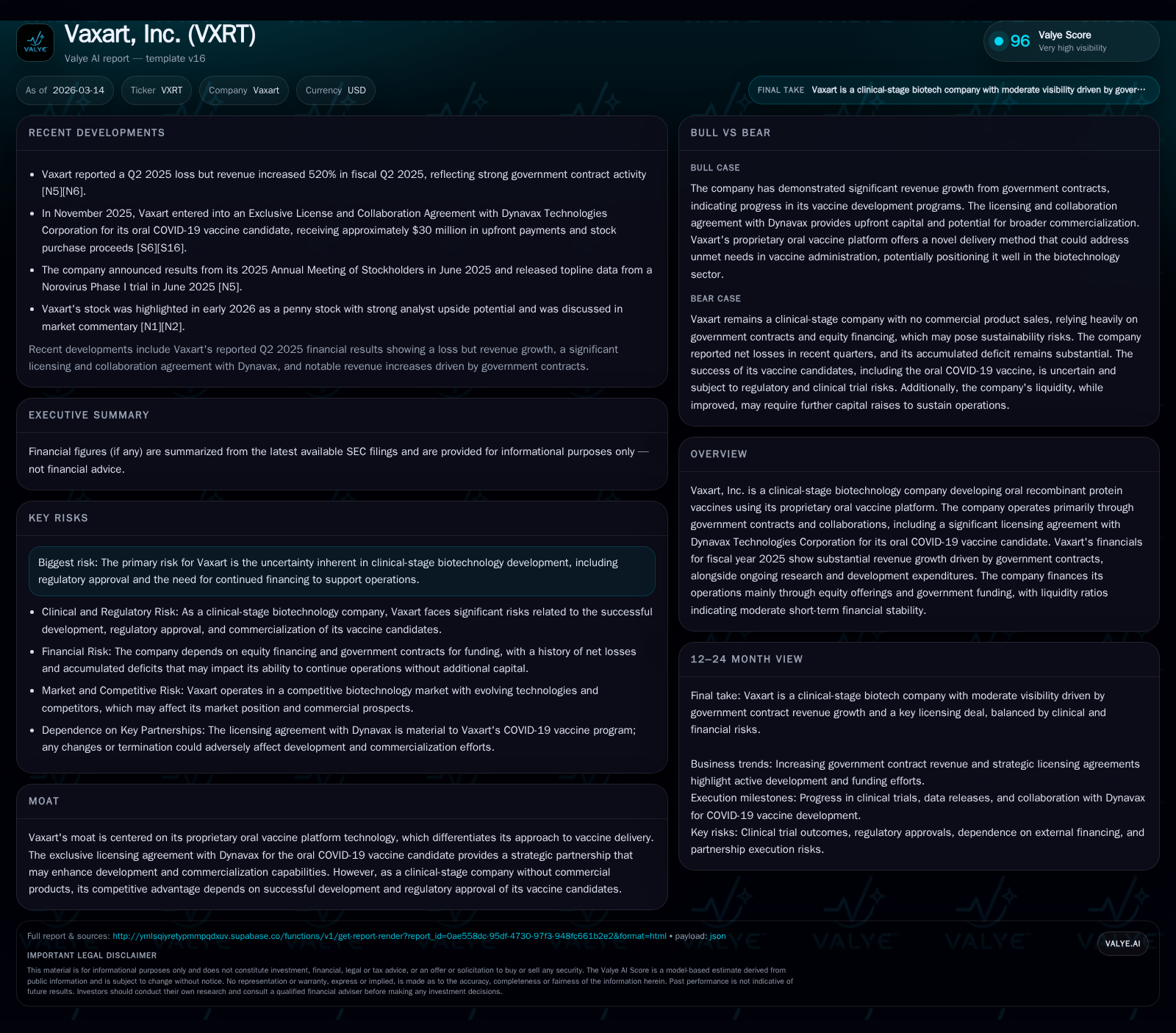
Vaxart, Inc. reported substantial revenue growth in fiscal 2025 fueled primarily by government contracts, particularly the 2024 ATI-RRPV contract with HHS BARDA. Despite moving into operating profitability, risks linked to regulatory approval and clinical trial progress persist due to its clinical-stage vaccine pipeline. The company extended its cash runway through a strategic licensing deal with Dynavax, yet remains reliant on external financing to sustain research efforts. Critical milestones include the outcome of Phase 2b studies and decisions on additional funding under the ATI-RRPV contract.
Company Overview and Business Model
Vaxart, Inc. is a clinical-stage biotechnology company specializing in the development of oral recombinant protein vaccines based on its proprietary oral vaccine platform. Headquartered in South San Francisco, California, Vaxart’s product pipeline includes vaccines targeting infectious diseases such as COVID-19 using pill-based delivery methods aimed at improving immunogenicity and patient compliance compared to traditional injection formats [S22].
The company does not yet have approved commercial products and relies heavily on government contracts and partnerships to fund ongoing research and development activities. A notable transaction was completed in November 2025 when Vaxart entered into an exclusive licensing and collaboration agreement with Dynavax Technologies Corporation granting worldwide rights to develop and commercialize its oral COVID-19 vaccine candidate. This deal included an upfront license fee of $25 million plus a $5 million equity investment from Dynavax through common stock purchase [S14][S3].
Historical Financial Performance
Fiscal year 2025 marked a pivotal shift for Vaxart with top-line revenue scaling dramatically to $237.3 million versus only $28.7 million in fiscal 2024 (a growth rate of +726.7%) [F1]. This sharp increase was driven predominantly by revenues recognized under large cost-plus-fixed-fee government contracts administered by the Biomedical Advanced Research and Development Authority (BARDA), particularly the extensive ATI-RRPV contract signed in 2024 for pandemic preparedness vaccine development [S25]. Revenue recognition aligns with allowable costs incurred plus fixed fees earned as milestones are achieved.
Operating income mirrored this inflection, shifting from a loss of about $66 million in 2024 to a positive $18.1 million by end-2025 — indicating the company's operational scale-up amid cost efficiencies [F1]. Net income followed suit with a positive $16.3 million in 2025 after sizable net losses in earlier years.
Cash flow from operations improved materially but remained modest at $7.7 million given the R&D intensity typical of clinical-stage biotechs; capital expenditures were minimal at roughly $145,000 reflecting limited fixed asset investment needs [F1]. The company's balance sheet strengthened substantially via equity offerings ($37.5 million raised in June 2024) and ongoing government funding while maintaining liquidity levels conducive to current operational demands [S10][S12].
Historical performance (annual)
| FY | Rev ($mm) | Net ($mm) | CFO ($mm) | OpInc ($mm) | Rev YoY | Net YoY |
|---|---|---|---|---|---|---|
| 2025 | 237 | 16 | 8 | 18 | +726.7% | +124.4% |
| 2024 | 29 | -67 | -45 | -66 | +18.8% | |
| 2023 | -82 | -70 | -83 | +23.5% | ||
| 2022 | -108 | -95 | -115 |
Source: SEC companyfacts cache [F1].
Capital returns and efficiency (annual)
| FY | FCF ($mm) | ROE% |
|---|---|---|
| 2025 | 8 | 18.6 |
| 2024 | -45 | -113.6 |
| 2023 | -72 | -142.7 |
| 2022 | -104 | -97.4 |
Source: SEC companyfacts cache [F1].
Note: All figures drawn directly from company filings for respective fiscal years[F1]
Growth Drivers and Challenges
Revenue Catalysts:
- Government Contracts: The core driver of revenue expansion is Vaxart’s government-funded contracts focusing on pandemic vaccines including influenza and emerging pathogens such as SARS-CoV-2 variants under BARDA programs [S25].
- Dynavax Collaboration: Licensing arrangements with Dynavax create opportunities for leveraging Dynavax's expertise in adjuvants and manufacturing scale-up which can accelerate timeline-to-market if clinical results are positive [S14][N1].
- Advancement of Clinical Trials: Successful progression through Phase 2b trials would validate Vaxart’s oral vaccine candidates’ profiles potentially unlocking further funding tranches as well as long-term commercial value [S25].
Growth Constraints:
- Clinical Uncertainty: Enrollment challenges arose following an August 2025 stop work order reducing planned participant numbers roughly by half for key Phase 2b studies; this creates uncertainty around timelines, regulatory review outcomes, and total funding available under existing contracts [S25].
- Regulatory Risks: As is typical for clinical-stage biotechs without product approvals, regulatory approval is not guaranteed which means lengthy review periods or additional studies may be required.
- Funding Dependence: Without commercial product revenue streams, Vaxart remains dependent on continued equity financing paired with government support — any disruptions could strain operations given current cash burn dynamics despite recent improvements [S19][S20].
Upcoming Milestones & Expectations
The company did not provide formal earnings guidance or deterministic milestone schedules beyond contract frameworks but critical elements to watch include:
- Enrollment progress or modifications under Phase 2 studies following stop work order impacts.
- Regulatory feedback relating to safety or efficacy thresholds needed for emergency use or eventual approval pathways.
- Performance metrics against firm fixed-price milestones embedded within BARDA contracts influencing near-term revenue recognition.
- Outcomes stemming from collaboration activities with Dynavax such as technology transfers or manufacturing capacity expansion.
Given these uncertainties, investors should monitor quarterly updates for disclosures surrounding enrollment statistics, trial redesigns if applicable, capital raises or partnership announcements that could recalibrate strategy.
Returns & Capital Allocation Analysis
ROE calculated approximately at 18.6% from FY2025 net income relative to year-end equity suggests improving profitability trends driven by scaled revenue bases rather than cost containment alone [F1]. This marks a significant turnaround compared to multi-year losses prior.
Operating cash flows improved markedly though still modest versus revenue size ($7.7M CFO vs $237M revenue), typical given upfront R&D expense impacts concentrated in biological drug development cycles [F1]. Capital expenditures remain minimal relative to total spending indicating asset-light operations concentrated on clinical trials and contract fulfillments.
The company has not pursued share buybacks recently as it focused issuance efforts on bolstering liquidity through registered direct offerings garnering about $40 million gross proceeds mid-2024 plus follow-on transactions including ATM facilities raising small amounts incrementally throughout early-mid FY2025 periods [S12][S18].[N1]
While dividend activity is nonexistent—as expected for growth/clinical-stage biotech—the capital allocation emphasizes financing through equity issuance alongside strategic licensing deals such as with Dynavax for enhanced collaborative development terms instead of debt leverage which remains negligible.[F1][S10]
Industry Context & Strategic Positioning (Analysis)
In an environment where many vaccine developers have transitioned away from emergency pandemic programs post-COVID peak demand phases, Vaxart’s niche lies in the novel oral delivery mechanism which could reduce logistical burdens seen with cold-chain injectable vaccines frequently used during pandemics or endemic vaccination campaigns.
Their platform allows eliciting mucosal immunity potentially offering better localized protection at entry points like respiratory tracts—a strategic advantage if proven efficacious clinically compared with traditional systemic-only immunity vaccines.
However, competition from established vaccine manufacturers expanding into similar spaces or leveraging mRNA-based therapeutics poses formidable pressure on pricing power while requiring substantial capital investments to navigate lengthy FDA approvals typical across this sector.
Therefore maintaining steady government contract inflows combined with nimble partnership models remains vital as commercialization prospects unfold over multiple years beyond pivotal trial readouts.[N1]
Legal Proceedings & Risk Factors Summary
Historical securities class action lawsuits alleging alleged misstatements regarding vaccine development progress have mostly been resolved through settlements minimizing lingering distractions on management focus though legal risks always remain material for small-cap biotech issuers subject to public scrutiny.[S4][S11]
Material risk factors continue to underline volatility arising from trial outcomes unpredictability along with liquidity sufficiency extending beyond current operating horizons—all aptly disclosed in recent SEC filings.[S6][S24]
Conclusion & Monitoring Points (Analysis)
Vaxart stands at an inflection point where its aggressive scaling under major government contracts has delivered meaningful financial improvements yet leaves clinical execution risks intact—especially surrounding Phase 2b trial disruptions induced in mid-2025.
The collaboration arrangement with Dynavax provides incremental funding stability alongside potential commercialization know-how; however, pipeline validation is imperative before Vaxart can transition beyond dependency on external funding sources towards sustainable profitability founded upon product sales.
Key indicators warranting close observation include evolving trial enrollment figures post-stop work order; regulatory reviews or requests for additional data; financial health signals like upcoming fundraising needs; and corporate announcements regarding technology maturation via partnerships or licensing expansions.
This analysis is based solely on publicly available SEC filings through March 14, 2026 ([F1],) and relevant news reports ([N1]). It aims to provide an objective summary of Vaxart's historical performance, outlook considerations, financial position, and operational challenges without constituting investment advice.
Disclaimer: This is research-only, informational analysis and not investment advice. It may include AI-generated interpretation and general industry context. Always verify important details using primary sources.

Comments