
Stereotaxis, Inc. Drives Precision in Cardiac Care with Robotic Magnetic Navigation
Stereotaxis leverages proprietary robotic magnetic catheter navigation to enhance cardiac electrophysiology while navigating persistent financial and operational challenges.
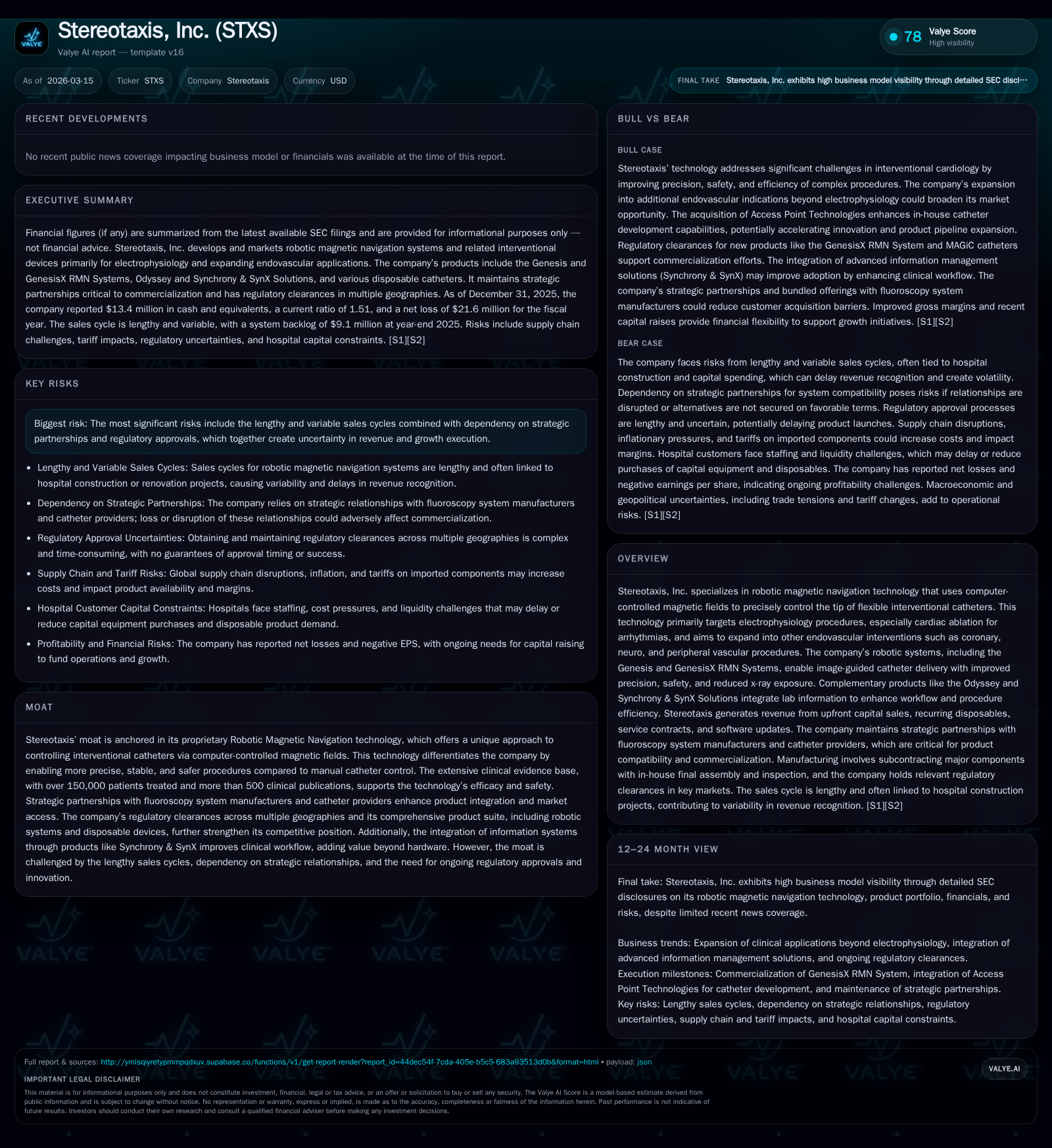
Stereotaxis, Inc. specializes in computer-controlled magnetic navigation technology that precisely manipulates flexible catheter tips during cardiac ablation and other endovascular interventions. Despite advancing its product portfolio and regulatory clearances, the company has faced declining revenue and sustained operating losses. Its commercial model balances capital system sales with recurring disposables and service contracts, but lengthy sales cycles and strategic dependencies limit growth visibility. Expansion into neurovascular and peripheral vascular procedures alongside recent acquisitions offer diversification opportunities, while significant risks remain in regulatory approvals, supply chain single sourcing, and market adoption.
Stereotaxis’s Revenue and Profitability Trends
Since peaking at approximately $37.7 million in revenue in FY2015 [F1], Stereotaxis has experienced a steady decline in top-line sales to about $29.3 million by FY2018. This downward trend continued through FY2025 with an estimated further contraction of roughly 5.8% year-over-year [F1]. Operating income remains persistently negative but showed some improvement from a loss of $24.7 million in FY2024 to approximately $22.1 million in FY2025 [F1]. Net income follows a similar pattern, while cash flow from operations deteriorated significantly to a negative $13.7 million in FY2025, a nearly 61% increase in cash burn compared to the prior year [F1]. Capital expenditures have been tightly controlled at under $0.1 million for the latest fiscal year [F1].
Historical performance (annual)
| FY | Net ($mm) | CFO ($mm) | OpInc ($mm) | Capex ($mm) | Net YoY |
|---|---|---|---|---|---|
| 2025 | -22 | -14 | -22 | 0 | +10.0% |
| 2024 | -24 | -8 | -25 | 0 | -16.1% |
| 2023 | -21 | -9 | -22 | 0 | -13.2% |
| 2022 | -18 | -8 | -19 | 2 |
Source: SEC companyfacts cache [F1].
Capital returns and efficiency (annual)
| FY | FCF ($mm) | ROE% |
|---|---|---|
| 2025 | -14 | -160.5 |
| 2024 | -9 | -395.5 |
| 2023 | -10 | -126.7 |
| 2022 | -11 | -69.4 |
Source: SEC companyfacts cache [F1].
Commercial Model: Capital Systems Coupled with Recurring Consumables and Services
Stereotaxis’s revenue model is based on capital sales of its Robotic Magnetic Navigation systems followed by recurring revenue streams from disposable interventional devices designed exclusively for use with their systems [S6]. This dual stream approach provides a foundation for stable consumable revenue post-system placement.
The company also offers maintenance and technical support services including hardware warranties and software updates through various service agreements [S6]. Support infrastructure includes call centers providing real-time clinical and technical assistance worldwide.
Manufacturing focuses on subcontracting major subassemblies to maintain flexibility while final assembly and quality control are performed in-house [S6]. Some components are sourced from sole or single suppliers which creates supply chain concentration risks.
Technology Differentiation: Robotic Magnetic Navigation Platform
The patented Robotic Magnetic Navigation platform utilizes computer-controlled magnetic fields to precisely steer the distal tip of flexible catheters during complex endovascular procedures—a capability distinct from manual catheter manipulation relying on handle movements [S2].
This precision enables improved procedural safety by reducing vascular trauma risk and minimizes operator radiation exposure through reduced fluoroscopy time [S2]. The technology has been clinically validated with over 150,000 patients treated worldwide using Stereotaxis’s systems supported by extensive published evidence [S2].
Integration with imaging modalities such as fluoroscopy enhances procedural workflow efficiency.
Expansion Strategy: Targeting New Clinical Indications
While electrophysiology remains the core indication driving most device placements today [S2], Stereotaxis aims to expand into additional endovascular territories including coronary artery disease interventions as well as neurovascular and peripheral vascular procedures where robotic catheter control could address complex anatomy challenges [S2][S7].
Achieving this expansion depends heavily on securing regulatory approvals for new disposable devices tailored to these indications across multiple jurisdictions—a process that can be lengthy and complex given varying international requirements [S2][S7].
Recent acquisition of Access Point Technologies EP Inc (APT), a manufacturer of compatible robotic catheters supports this diversification strategy by broadening product development capabilities [S22][S23].
Sales Cycle Dynamics and Partnership Dependencies
Capital equipment like RMN systems typically undergo prolonged hospital procurement processes involving multiple stakeholders including physicians and administrators controlling budgets resulting in variable quarterly results [S1][S14].
Growth also relies on strategic partnerships with fluoroscopy system manufacturers for integration modules as well as catheter providers creating dependency risks that could affect supply continuity or product availability if collaborations falter or terms change unfavorably [S6][S14].
These external factors limit direct control over customer acquisition velocity despite clinical advantages.
Capital Allocation: Conservative Spending Amid Operating Losses
Capital expenditures have been minimal—$93 thousand in FY2025—reflecting a strategy focused on subcontracted manufacturing rather than large fixed asset investments [F1][S6][S10].
However operating losses remain substantial exceeding $22 million annually recently with operating cash flow at negative $13.7 million in FY2025 alone reflecting ongoing investment phases typical for medtech innovators transitioning toward scale [F1].
Equity has decreased to approximately $13.5 million as of FY2025 resulting in an implied return on equity near negative 160%, indicating significant financial strain consistent with continued net losses [F1]. Liquidity metrics such as current ratio around 1.51 provide some short-term cushion but ongoing capital raises appear necessary given persistent cash burn [F1][S10].
Outlook: Milestones and Guidance Considerations
No formal third-party revenue or profitability guidance has been provided publicly beyond ongoing commercial launches of next-generation RMN systems such as GenesisX and progressive regulatory clearances for novel robotically navigated catheters like MAGiC Sweep™ mapping catheters recently cleared by FDA [S2].
Investors should monitor quarterly system placements relative to backlog conversion rates along with progress on milestone-triggered earnouts linked to the APT acquisition which may impact stock dilution levels as disclosed [S1][S2]. Regulatory approvals across broader peripheral indications will be key indicators of successful market diversification.
Risks: Regulatory Challenges, Market Adoption Barriers & Supply Chain Concentration
Regulatory risk is prominent given dependence on FDA clearances and CE Mark certifications not only for initial commercialization but also for geographic expansion under evolving quality system regulations enforced by the FDA and other authorities [S4][S7][S14]. Delays or failures could lead to costly recalls or suspension limiting revenue generation.
Market adoption may be constrained by hospital reimbursement uncertainties coupled with buyer sensitivity towards high pricing relative to manual alternatives potentially curbing new account wins or consumables usage intensity [S4][S7]. Maintaining strong relationships with clinical thought leaders is critical amid competitive pressures.
Supply chain vulnerabilities arise from sole sourcing arrangements for essential magnetic components sourced internationally exposing risks related to geopolitical tensions or trade disruptions affecting costs or delivery schedules [S4][S6].
Software defects within complex robotics control environments pose reputational risks potentially undermining physician confidence during sensitive electrophysiology procedures leading to delayed market acceptance or increased warranty costs [S5].
Legal proceedings currently do not present material risk per recent filings but vigilance is warranted given the inherently litigious nature of the medtech sector [S4].
This analysis synthesizes information from SEC filings through March 2026 alongside company disclosures without extrapolating beyond explicitly stated data points.
Disclaimer: This is research-only, informational analysis and not investment advice. It may include AI-generated interpretation and general industry context. Always verify important details using primary sources.

Comments