
GRAIL, Inc.’s Galleri Test: Advancing Multi-Cancer Early Detection with Clinical Validation
GRAIL’s Galleri test leverages extensive clinical trials and strategic collaborations as it seeks FDA approval and scales commercial operations.
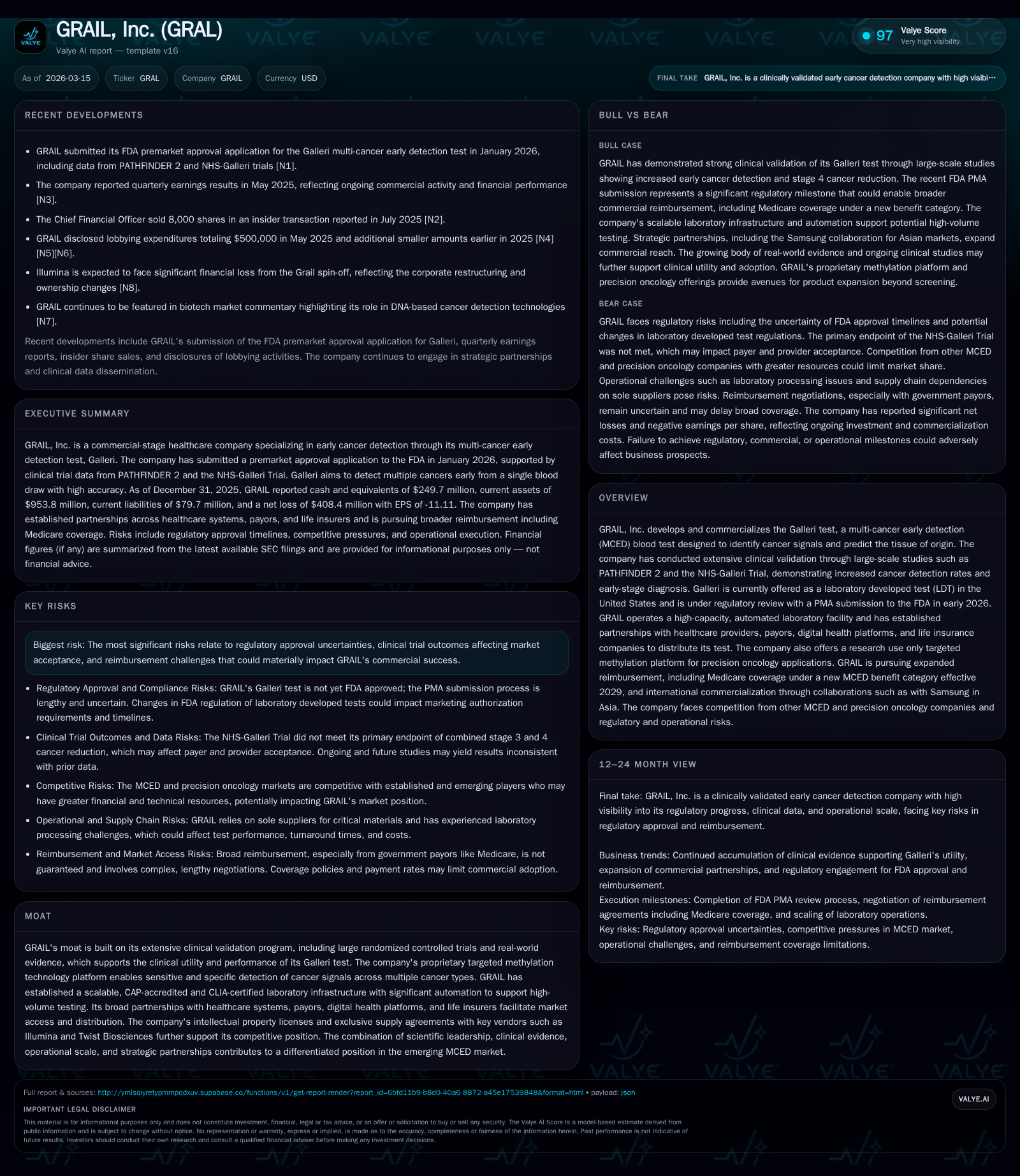
GRAIL, Inc. has established a substantial clinical evidence base for its Galleri multi-cancer early detection (MCED) blood test through large-scale studies such as PATHFINDER 2 and the NHS-Galleri Trial. The company submitted its PMA application to the FDA in early 2026, marking a critical regulatory inflection point that could drive broader market adoption. While operational losses narrowed substantially in 2025, driven by scaling efficiencies, reimbursement uncertainty and regulatory risks remain significant challenges. GRAIL’s capital position is solid with strong liquidity supported by equity infusions from Samsung, though it has yet to generate positive cash flows or returns.
Clinical Validation: Powering Galleri’s Acceptance
GRAIL’s scientific moat primarily derives from its comprehensive clinical validation program supporting the Galleri multi-cancer early detection test. The company has harnessed data from over 385,000 participants across several studies, including two marquee trials—PATHFINDER 2 and the NHS-Galleri Trial [S1][N1]. PATHFINDER 2 enrolled approximately 35,000 individuals; initial findings showed that integrating Galleri with standard recommended cancer screenings yielded a more-than-seven-fold increase in cancers detected within one year. When prostate screening was added to this regimen, the detection rate improvement was approximately threefold [S1]. Importantly, these gains extended to some of the most lethal cancers such as pancreatic and esophageal types.
Similarly, results from the NHS-Galleri Trial demonstrated notable reductions (>20%) in late-stage (stage 4) diagnoses during successive screening rounds alongside an increased proportion of early-stage detections (stage 1 and 2). Though the primary endpoint—a statistically significant combined reduction of stage 3 and 4 cancers—was not met at the population level, a favorable trend was observed within a pre-specified subset of twelve deadly cancer types [S1]. These data were submitted as part of GRAIL’s premarket approval (PMA) application package to the FDA in early 2026 [N1][S1][S3].
This rigorously validated clinical performance coupled with predicted tissue of origin capabilities positions Galleri as a potentially transformative tool in population-wide cancer screening paradigms. The extensive real-world evidence base accumulated through over 800,000 tests executed enhances confidence among clinicians and payors regarding Galleri's clinical utility [S9].
Operating Performance Trends and Financial Recovery
Historically facing deep operating losses typical for innovative diagnostics ventures scaling high-complexity lab infrastructure, GRAIL has made considerable strides narrowing its financial deficit in FY2025. Operating income loss contracted by approximately 74% year-over-year from -$2.19 billion in FY2024 to -$562 million in FY2025 according to latest SEC-reported figures [F1]. Net losses improved similarly from -$2.03 billion to -$408 million in absolute terms. Operating cash flow losses narrowed nearly by half (48%), declining from -$577 million to -$299 million. Capital expenditures fell sharply (83%) reflecting a shift from heavy upfront buildout towards more efficient laboratory operation phases [F1].
These improvements reflect scaling efficiencies as test volumes rose leveraging GRAIL's extensive automated CAP-accredited and CLIA-certified laboratory facility [S9], combined with disciplined cost management. Despite persistent negative returns approximately -15.8% ROE for FY2025 computed on net loss versus equity base ($2.58 billion equity), trends suggest progression toward sustainability if commercial momentum continues [F1].
Historical performance (annual)
| FY | Net ($bn) | CFO ($mm) | OpInc ($bn) | Capex ($mm) | Net YoY |
|---|---|---|---|---|---|
| 2025 | -0.4 | -299 | -0.6 | 1 | +79.9% |
| 2024 | -2.0 | -577 | -2.2 | 5 |
Source: SEC companyfacts cache [F1].
Capital returns and efficiency (annual)
| FY | FCF ($mm) | ROE% |
|---|---|---|
| 2025 | -300 | -15.8 |
| 2024 | -582 | -81.0 |
Source: SEC companyfacts cache [F1].
(Reported figures per fiscal year-end detailed filings [F1])
Regulatory Filing and Anticipated Approval Milestones
In a key regulatory advancement signaling transition from an LDT-based commercial model toward traditional medical device oversight, GRAIL submitted the final module of its PMA application for Galleri to the FDA in January 2026 [N1][S1][S3]. This submission leverages pivotal study results including those from PATHFINDER 2 and NHS-Galleri trials.
The PMA pathway’s complexity underscores the novelty of MCED diagnostics—combining genomics with tissue prediction capabilities—and requires extensive analytical validation plus post-approval surveillance commitments per Quality System Regulation requirements [S17]. Although FDA enforcement discretion historically applied for Laboratory Developed Tests (LDTs), recent court decisions have vacated efforts to broadly regulate LDTs under device rules creating some ambiguity around future LDT regulation landscape [S18].
Approval would confer formal marketing authorization replacing current LDT framework—a milestone expected to unlock broader provider adoption while facilitating insurance coverage negotiations that demand regulatory validation [S13][S19]. However, timing remains uncertain given the nascent FDA experience regulating multi-analyte genomic diagnostics at scale.
Partnerships, Market Access, and Distribution Strategies
Commercial adoption is accelerated through GRAIL's wide network of partnerships across healthcare channels [S9][S12]. The company collaborates with large self-insured employers — particularly tech firms and life insurers — using Galleri as an innovative preventive care benefit that can reduce long-term cancer treatment costs.
Health system integration efforts focus on embedding Galleri within population health management workflows supported by electronic medical record interfacing. Concierge practices seeking cutting-edge prevention tools also represent a target segment.
Digital health platforms offering wellness-oriented telemedicine have incorporated Galleri as a membership perk enhancing consumer engagement metrics.
Internationally, partnerships facilitate localized blood draw logistics and patient support pending regulatory clearances; notably an equity-backed collaboration with Samsung envisions commercialization rights for Korea alongside laboratory infrastructure development contemplated within early-2026 deal terms [S2].
Laboratory capacity expansion has been optimized through automation within GRAIL's CLIA-certified facilities enabling high-throughput sample processing crucial for rapid scaling demands [S9].
Reimbursement Environment and Commercial Constraints
Despite scientific progress, achieving consistent payer reimbursement remains a critical barrier for MCED diagnostics like Galleri [S19][S25]. Traditional Medicare does not typically reimburse cancer screening unless encompassed by preventive service guidelines endorsed after FDA authorization.
Medicare Advantage plans offer some nearer-term pathways due to their discretionary supplemental benefit programs but require lengthy individual plan negotiations impacting scale economics. Private payors mirror this cautious stance demanding robust economic studies substantiating cost-effectiveness alongside clinical benefit.
Federal legislative reforms continue influencing coverage policies; proposals aimed at cost containment might both restrict or reshape MCED test payment models moving forward [S4][S19]. Coverage inconsistency poses risk to predictable top-line growth pending demonstrable long-term outcomes data.
Moreover, the sizable screened populations could generate higher absolute false positive rates necessitating additional downstream diagnostic resources further complicating payer calculus.
Capital Structure, Cash Flow Dynamics, and Shareholder Returns
As of December 31, 2025, GRAIL held approximately $250 million in cash and equivalents yielding a strong current ratio near twelve times current liabilities highlighting substantial liquidity buffer despite ongoing losses [F1]. Capital allocation prioritizes reinvestment into R&D expansion and commercial infrastructure rather than distributions; no dividends or share repurchases have been initiated reflecting long-term growth orientation.
The company secured significant equity funding linked to partnerships such as those with Samsung C&T Corporation providing critical financing for international commercialization efforts hitched to defined closing conditions around approvals and collaborative agreement execution expected in early 2026 [S2].
Capital expenditure sharply declined year-over-year aligning with maturation of existing labs offsetting operational burn still reflected in negative free cash flow near -$300 million annually suggesting sustained funding needs ahead absent near-term profitability [F1][S3].
Risks in Regulatory, Reimbursement, and Litigation Landscape
Material risk vectors center on regulatory uncertainty surrounding LDT classification changes which could compel additional FDA processes delaying market traction or imposing costly validations beyond current PMA submissions [S13][S26]. Failure to secure timely marketing authorization or labeling consistent with trial claims may impede clinical uptake.
Reimbursement volatility persists given healthcare policy flux where cost pressures challenge pricing power; prolonged negotiations elevate commercialization hurdles risking slower revenue scale [S4][S19][S25].
Healthcare fraud statutes such as Anti-Kickback laws impose compliance complexity on arrangements with referral sources risking sanctions if violated inadvertently; similar scrutiny applies under HIPAA privacy obligations given sensitive genomic data handling practices requiring rigorous cybersecurity regimes now established per NIST CSF2.0 frameworks complemented by ISO/IEC certifications supporting enterprise resilience against cyber threats [S4][S5][S6][S8][S10][S16]
Ongoing legal proceedings present additional downside exposures though specifics remain sparse publicly beyond routine disclosures [S14]. Global geopolitical developments affecting supply chains or personnel mobility could exacerbate operational risks especially amid expanding international footprints [S21][S22].
Looking Ahead: Catalysts and Key Watching Points
Investors should monitor several pivotal milestones shaping GRAIL’s trajectory:
- Outcomes of the FDA review cycle following PMA submission anticipated over a multi-month horizon will critically influence market stance on Galleri's regulatory positioning;
- Development around Medicare preventive service determinations including USPSTF ratings expected to pave pathways for broader CMS coverage impacting commercial scale;
- Post-approval commercial rollout effectiveness measured by partnership expansions especially digital health integrations and employer penetration;
- Progress updates on Samsung collaborations contextualizing Asia-Pacific market entry feasibility;
- Outcome of any bridging studies planned comparing versions of Galleri tests relevant to PMA claims will affect product positioning.
Strategic execution while navigating reimbursement complexities forms the fulcrum between transitioning clinical promise into profitable commercial reality over coming years.
This analysis is based solely on disclosed public filings as of March 2026 without projections beyond stated facts or guidance.
Disclaimer: This is research-only, informational analysis and not investment advice. It may include AI-generated interpretation and general industry context. Always verify important details using primary sources.

Comments