
Funko’s Financial Strain Despite Diversified Pop Culture Portfolio and Global Reach
Funko's expansive licensing strategy and broad product offering contrast with ongoing liquidity challenges and persistent losses.
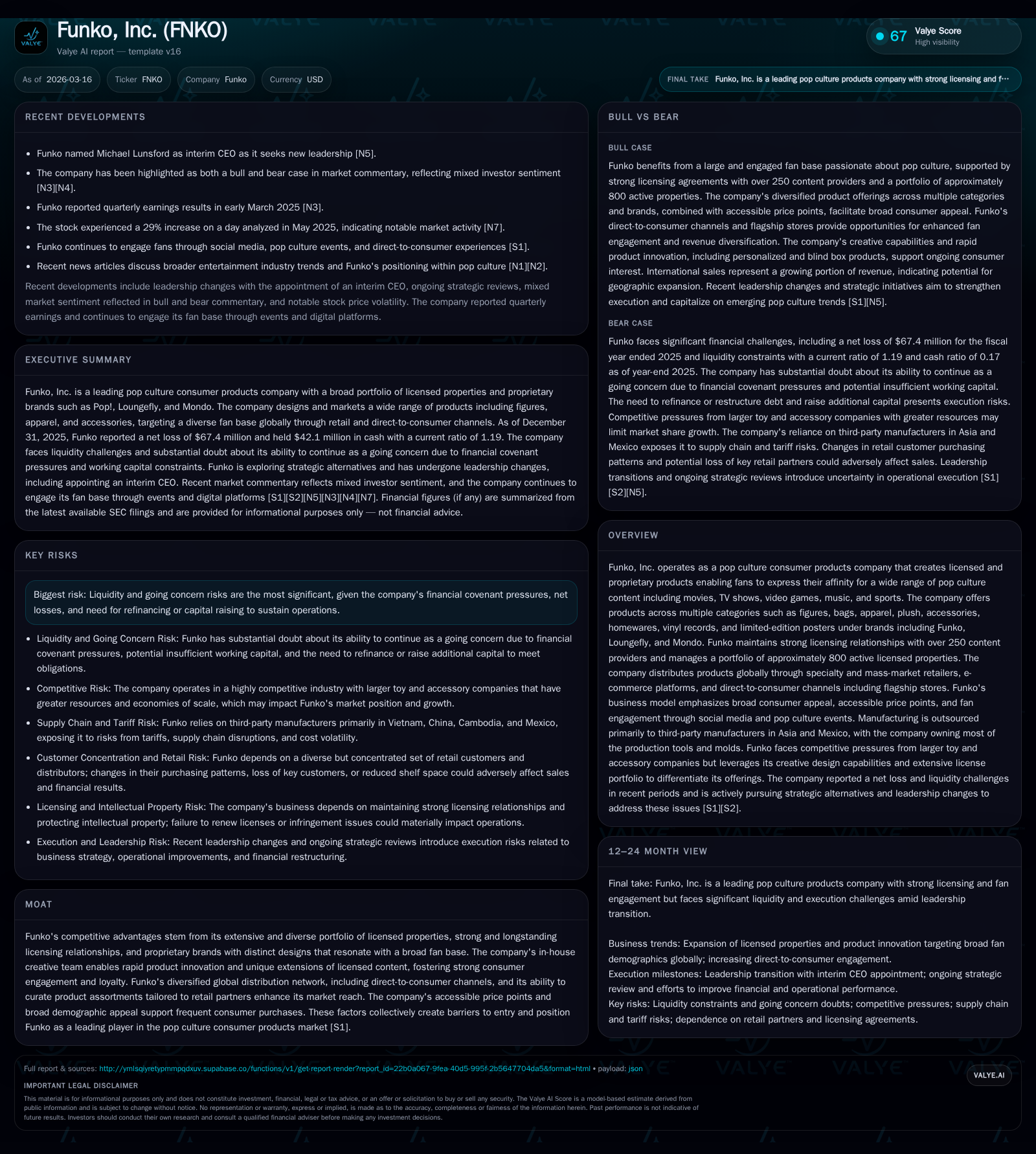
Funko, Inc. operates as a prominent player in the pop culture consumer products market with a diversified portfolio of licensed properties and proprietary brands, offering collectible figures, accessories, and apparel globally. Despite strong brand engagement and an international expansion strategy, Funko’s recent financials reveal substantial operating losses and tight liquidity, driven by cost pressures and high leverage. The company faces significant refinancing risks amid restrictive debt covenants and negative free cash flow, while efforts to improve margins and expand direct-to-consumer channels remain critical for future growth.
Company Overview and Industry Position
Funko, Inc. positions itself as a leading global pop culture consumer products company that creates licensed and proprietary products allowing fans to express affinity for a vast array of entertainment content including movies, TV shows, video games, music, and sports [S1][S8]. Its portfolio includes collectible figures (notably its iconic Pop! Vinyl line), bags, apparel, plush toys, accessories, homewares, vinyl records, and limited-edition posters spread across multiple licensed properties.
The breadth spans approximately 800 active licensed properties from over 250 content providers worldwide. Funko’s core brands—Funko Pop!, Loungefly (softlines), and Mondo (artist-driven collectibles)—leverage distinct designs infused with whimsy to resonate within diverse fan demographics [S8][S15][S24]. The company targets the "kidult" market segment—adults who participate actively in fandom collecting—coupling accessible pricing (standard Pop! Vinyls generally under $15) with compelling fan engagement.
Distribution channels include specialty retailers like Hot Topic along with mass-market partners including Amazon, Walmart, Target, GameStop domestically; international sales accounted for a significant portion via subsidiaries (e.g., Funko UK Ltd.) and distributors serving Europe and other regions [S12][S18][S23]. Direct-to-consumer sales through e-commerce platforms and flagship retail stores represent a growing focus constituting roughly one-quarter of revenue [S12][S18].
Historical Financial Performance
While continuous revenue data beyond 2017 is not disclosed explicitly,[F1] key profitability measures illustrate material volatility:
Historical performance (annual)
| FY | Net ($mm) | CFO ($mm) | OpInc ($mm) | Capex ($mm) | Net YoY |
|---|---|---|---|---|---|
| 2025 | -67 | -5 | -46 | 33 | -357.7% |
| 2024 | -15 | 124 | 13 | 33 | +90.4% |
| 2023 | -154 | 31 | -104 | 35 | -1817.6% |
| 2022 | -8 | -40 | -12 | 59 |
Source: SEC companyfacts cache [F1].
Capital returns and efficiency (annual)
| FY | FCF ($mm) | ROE% |
|---|---|---|
| 2025 | -38 | -36.3 |
| 2024 | 91 | -6.3 |
| 2023 | -4 | -66.4 |
| 2022 | -99 | -2.2 |
Source: SEC companyfacts cache [F1].
The return to operating losses in FY2025 followed a modest profit in FY2024 but came after substantial losses in FY2023 driven by operational challenges [F1]. Net losses expanded markedly last year.
Operating cash flow deteriorated sharply into negative territory despite relatively stable capital expenditures suggesting worsening working capital or earnings quality issues.
Consequently, free cash flow (operating cash flow minus capex) was approximately negative $38 million last fiscal year—a concerning indicator given the company's need for cash generation to service debt obligations and invest for growth.
Total shareholders' equity decreased notably reflecting accumulated losses weighing on the net asset base [F1].
Capital Structure and Liquidity Constraints
Funko’s capital structure features indebtedness totaling approximately $220 million drawn under credit facilities as of December 31, 2025—including term loans of about $95 million net of discounts plus revolving credit borrowings around $125 million [S4][F1]. This leverage combined with operational underperformance and negative free cash flow creates significant refinancing risk.
The Credit Agreement includes restrictive covenants limiting the company's ability to incur additional debt or make dividends or equity buybacks without lender approval [S13]. Recent amendments have provided temporary covenant relief extending maturity dates to December 31, 2027; however, successful refinancing or repayment by then is essential.
Management has expressed substantial doubt about the company's ability to continue as a going concern absent execution of liquidity plans involving commercial pricing strategies, supply chain adjustments including shifting manufacturing out of China, overhead cost reductions, an improved sales mix focusing on higher-margin products internationally—and crucially obtaining refinancing or additional capital raising [S7][S11][S16][S27].
Failure to meet these objectives could trigger defaults allowing lenders to enforce remedies against company assets.
Growth Prospects and Strategic Considerations
Despite near-term financial challenges, Funko maintains strategic advantages rooted in its entrenched position within pop culture fandom:
- Expansive Licensing Portfolio: Approximately 800 active licenses from more than 250 content providers spanning movies, TV shows, video games, music, sports and more provide diverse consumer appeal aligned with new content cycles or viral trends [S1][S24].
- In-House Creative Innovation: Proprietary creative teams produce distinctive collectible designs that drive consumer loyalty; ongoing launches such as personalized products like Pop! Yourself enhance differentiation [S8][S24].
- Global Market Expansion: International sales constitute a growing portion supported by direct retailer relationships overseas plus distributor partnerships targeting emerging markets in Asia & Latin America where penetration remains lower than developed markets [S23][S24].
- Direct-to-Consumer Focus: Investment into e-commerce platforms enhanced by digital experiences alongside flagship retail stores fosters higher-margin proprietary channels representing ~24% of revenue [S12][S18].
- Product Diversification: Beyond collectibles including figures under Funko Pop!, the company expands into softlines via Loungefly bags/apparel and artist-driven collectibles through Mondo brand offerings [S8][S15].
Headwinds include tariff-driven supply chain disruptions primarily affecting Asian sourcing; shifts in retail customer purchasing patterns causing order cancellations or reductions impacting inventory management; plus competitive pressures from private label lines vying for retail shelf space particularly among mass-market retailers.
Returns & Capital Allocation Patterns
Profitability remains challenged with an approximate return on equity near -36% based on latest annual net loss relative to equity levels signaling negative shareholder returns [F1]. Free cash flow deficits constrain capital allocation flexibility.
No recent dividends or share repurchase activity is indicated amid covenant restrictions linked to debt agreements preventing distributions while noncompliance risks creditor remedies if unresolved [S13][S21]. Investment appears focused on sustaining product innovation and expanding distribution footprint rather than returning capital directly to shareholders given current financial conditions.
What To Watch Next
Absent explicit public guidance on near-term revenue or earnings targets,[N/A] key indicators include:
- Compliance with upcoming debt covenants such as Net Leverage Ratio & Fixed Charge Coverage Ratio testing through mid-2026,
- Progress on refinancing Credit Facilities before maturity December 31, 2027,
- Growth trends in direct-to-consumer sales reflecting effectiveness of digital enhancements,
- Inventory levels versus wholesale order patterns signaling demand health,
- Developments related to legal proceedings which may impose costs,[N/A]
- Success expanding emerging international market presence measured by revenue gains,
- Potential management changes or strategic transactions affecting liquidity.
Conclusion
Funko stands as a culturally resonant brand bridging wide-ranging fandoms through an extensive licensed portfolio coupled with creative design capabilities supporting diverse global product offerings. However financial performance currently suffers from supply chain cost pressures, macroeconomic uncertainty impacting retail demand patterns, significant leverage requiring near-term refinancing efforts, and persistent operating losses eroding shareholder equity.
Strategic initiatives targeting international growth particularly within Asia/Latin America segments alongside deepening direct consumer relationships via ecommerce innovations offer growth pathways amid expanding product lines catering to collectors’ evolving preferences.
Nonetheless liquidity enhancement through refined pricing strategies, cost management initiatives and successful access to capital markets remain critical imperatives given looming covenant tests restricting financial flexibility.
Investors should monitor operational trends closely alongside debt covenant compliance developments as key determinants of Funko’s ability to sustain competitive momentum within the dynamic pop culture consumer products sector.
Disclaimer: This analysis is based solely on publicly available filings cited herein and does not constitute investment advice regarding Funko Inc.'s securities.
Disclaimer: This is research-only, informational analysis and not investment advice. It may include AI-generated interpretation and general industry context. Always verify important details using primary sources.

Comments