
Petco Health & Wellness: Resilience in Refinancing and Modest Growth Amid Sector Pressures
Petco leverages a recent refinancing and integrated wellness offerings to steady its financial footing despite softening sales in a competitive pet care landscape.
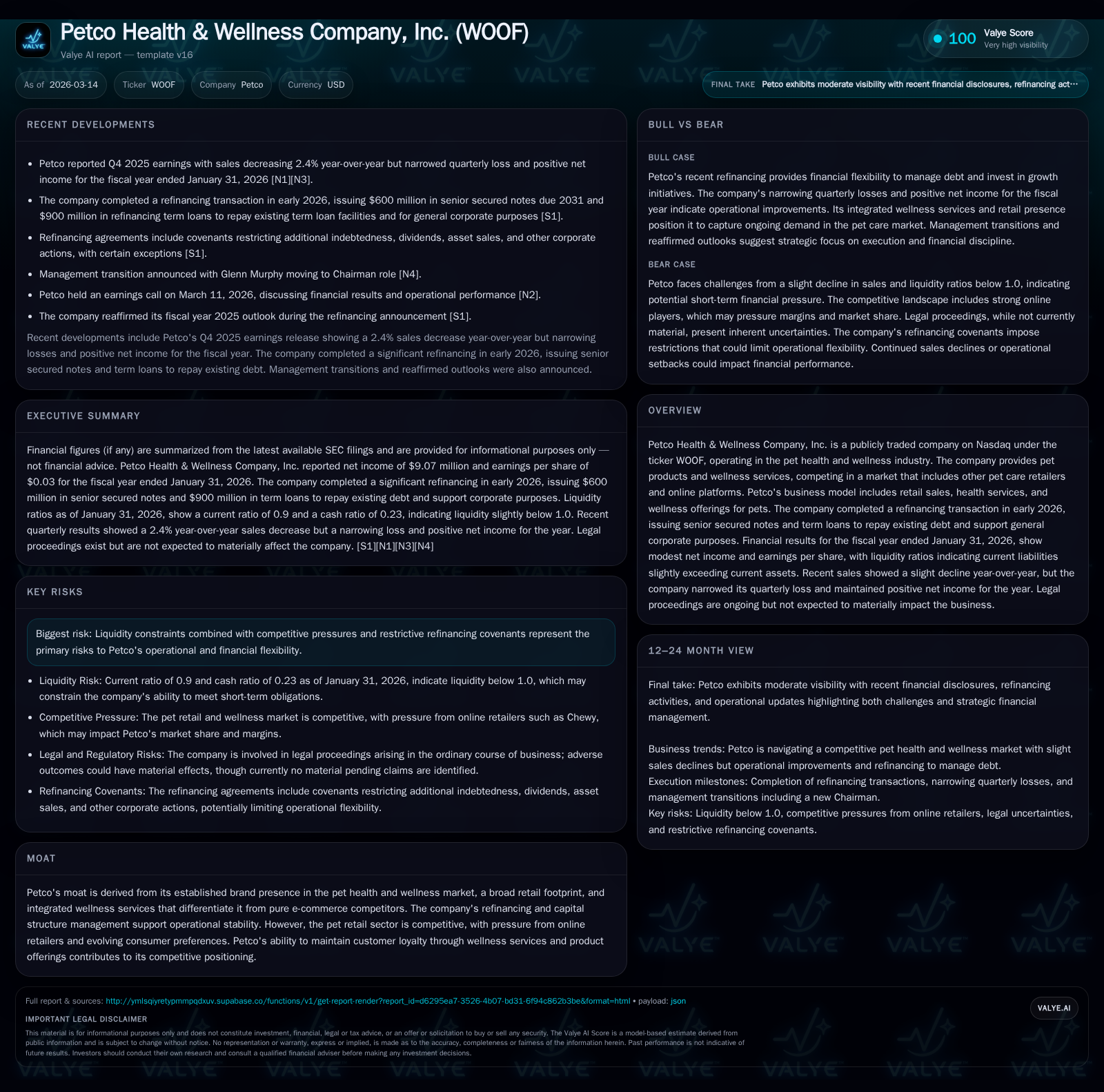
Petco Health & Wellness Company, Inc. posted a substantial rebound in operating income in FY2025 following several years of losses, supported by prudent cost management and service integration amid a slight decline in sales. The company’s February 2026 refinancing introduced $600 million in senior secured notes and $900 million in term loans that recalibrated its capital structure but imposed covenant restrictions impacting liquidity and capital allocation. Its established retail presence combined with wellness services underpin customer loyalty, differentiating Petco from online-only rivals. While liquidity constraints and competitive pressures persist, ongoing operational discipline and wellness-led omnichannel engagement offer avenues for stable, if modest, future growth.
From Losses to Profitability: Tracking Petco’s Recent Financial Turnaround
Petco Health & Wellness Company experienced a marked financial recovery in FY2025 after multiple years characterized by significant losses. Operating income jumped by over sixteen-fold—from roughly $7.05 million in FY2024 up to $120.4 million in FY2025—an extraordinary 1608% year-over-year increase according to SEC filings [F1]. This rebound contrasts sharply with the deep operating loss exceeding a billion dollars recorded just two years earlier in FY2023.
Net income similarly reflected this improvement; while the company reported a substantial net loss of about $102 million in FY2024, it swung back to a modest profit of approximately $9.1 million in FY2025 [F1]. This transition underscores operational stabilization despite still narrow profitability margins.
Notably, while overall sales declined slightly year-over-year—by around 2.4% during Q4 FY2025 as reported—Petco successfully narrowed its quarterly losses heading into early calendar 2026, buoyed by improved cost controls and revenue diversification strategies centered on pet wellness services [N1][N2].
Drivers Behind the FY2025 Operating Income Surge
The surge in operating income owes primarily to enhanced cost discipline combined with growth in integrated wellness offerings that leverage Petco’s retail footprint beyond pure product sales. Commentary from the Q4 earnings call detailed how tighter operational efficiencies helped offset headwinds from declining comparable store sales [N2].
The company emphasized the increasing contribution of wellness services—such as pet health consultations and vaccinations—to its revenue mix, which improves margin profiles relative to commodity product sales. The focus on cross-selling health products alongside services cultivates customer stickiness and better utilizes store traffic [N1][N2].[F1]
In a sector increasingly dominated by online disruptors, Petco’s ability to blend physical retail with differentiated wellness programming supports improved unit economics and partially insulates profitability against price competition.
Refinancing Initiatives Reshape Capital Structure and Liquidity Dynamics
Petco’s refinancing transaction announced and completed between January and February 2026 stands as a critical financial milestone shaping its near-term stability. The company issued $600 million aggregate principal amount of senior secured notes bearing an 8.25% coupon with maturity in 2031, alongside $900 million of new term loans under amended credit agreements replacing prior facilities [S8][S10][S12][N14].
These changes reduced immediate refinancing risk but introduced strict affirmative and negative covenants restricting incremental debt issuance, dividends, share repurchases, affiliate transactions, asset sales, and liabilities among subsidiaries [S8][S12]. The notes carry provisions including “soft call” premiums applicable within six months post-issuance—the company faces amortization obligations starting at 1% per annum maturing five years from amendment date [S10][S12].
Financially, these measures reflect in the current ratio of approximately 0.9 as of January 31, 2026—indicating current liabilities slightly exceed current assets—and signal ongoing liquidity constraint requiring careful working capital management [F1]. Interest expense implications from this capital structure shift will pressure near-term earnings.
Integrated Wellness Services: A Strategic Moat Against Pure E-Commerce Competitors
Petco differentiates itself through an omnichannel model emphasizing not just product sales but health-focused pet wellness services including behavioral training, grooming, veterinary care partnerships, and nutrition counseling—a portfolio enhancing customer lifetime value compared to purely transactional e-commerce players [N4][N7].
This strategy leverages Petco's extensive physical store network allowing hands-on experiences combined with digital ordering options—a hallmark of effective omnichannel engagement driving loyalty in the pet care category where consumers often seek trusted advice alongside purchases.
The ability to cross-sell bundled health products with complementary services creates synergy that bolsters margin expansions despite retail industry pressure points.
Growth Outlook: Opportunities Within Constraints
Looking ahead, Petco faces headwinds primarily from intensifying online retailer competition and evolving consumer preferences shifting toward convenience-oriented shopping complemented by digital platforms [N2][S4][S5]. Additionally, restrictive refinancing covenants temper aggressive growth capital deployment.
However, strategic initiatives targeting modest expansion of wellness service penetration along with controlled cost optimization offer achievable growth levers without overleveraging balance sheet health. Management commentary has highlighted focusing on enhancing omni-experience capabilities as well as selective product innovation while preserving operational discipline [N2].
In sum, prospects hinge on balancing incremental investments within liquidity constraints amid competitive market dynamics.
Capital Allocation Priorities: Cash Flow, Dividends, and Buybacks Under Covenants
Operating cash flow exhibited robust acceleration in FY2025—a jump of nearly +76.8% YoY—to over $314 million; capital expenditures held relatively steady around $127 million representing prudent investment levels supporting store network maintenance plus technology enhancements [F1].
Consequently free cash flow exceeded $186 million (approximated as CFO minus capex) signifying healthy internal funding capacity amidst rigorous refinancings.[F1]
Return on equity remains thin at roughly 0.8%, reflective of narrow net income margins against substantial equity base following historical losses recovery.[F1]
Due to stringent covenant restrictions stemming from the new credit facilities and debt instruments issued early 2026,[S13][S14] Petco has not engaged materially in share repurchases or dividend increase programs recently—the focus appears firmly on deleveraging path stabilization rather than shareholder yield maximization at present.
What to Watch: Key Milestones and Risks in the Coming Year
Absent explicit forward guidance published recently,[N1][N10] important monitoring areas will include quarterly top-line trends—particularly how product sales balance against trajectory gains within the wellness segment—as well as working capital metrics reflecting liquidity tightness under covenant frameworks.[S4]
Interest expense flux post-refinancing should be scrutinized due to elevated coupon levels impacting adjusted earnings outcomes.[S8]
Refinancing redemption options expiring earliest February 2028 introduce another potential reset point for debt management strategies.[S12]
Sector-wide shifts including competitor pricing strategies or regulatory changes related to pet health protocols could also influence performance dynamics.
Legal Landscape: Litigation Risks and Regulatory Considerations
Like many retailers operating nationwide, Petco is involved in various legal proceedings typical for the business sector but discloses no pending lawsuits individually or collectively assessed with material adverse effects expected per latest SEC filings.[S4][S6]
Management maintains disclosure transparency around contingent liabilities within commitments sections reinforcing that current legal exposures do not pose significant risks warranting operational disruption.
Petco Historical Financials Summary (FY2022–FY2025)
Historical performance (annual)
| FY | Net ($mm) | CFO ($mm) | OpInc ($mm) | Capex ($mm) | Net YoY |
|---|---|---|---|---|---|
| 2025 | 9 | 314 | 120 | 127 | +108.9% |
| 2024 | -102 | 178 | 7 | 128 | +92.0% |
| 2023 | -1280 | 216 | -1180 | 226 | -1509.9% |
| 2022 | 91 | 346 | 226 | 278 |
Source: SEC companyfacts cache [F1].
Capital returns and efficiency (annual)
| FY | FCF ($mm) | ROE% |
|---|---|---|
| 2025 | 187 | 0.8 |
| 2024 | 50 | -9.1 |
| 2023 | -10 | -108.1 |
| 2022 | 68 | 3.8 |
Source: SEC companyfacts cache [F1]. Note: Operating income YoY percentage computed between consecutive fiscal years where data available.
This analysis is based entirely on publicly disclosed SEC filings and reported news items through March 14, 2026 without extrapolation beyond stated figures or forward-looking projections not explicitly cited above.
Disclaimer: This report is for informational purposes only and does not constitute investment advice or recommendations.
Disclaimer: This is research-only, informational analysis and not investment advice. It may include AI-generated interpretation and general industry context. Always verify important details using primary sources.

Comments