
BK Technologies Corp Reinvents Public Safety Communications with Project 25 Innovation
BK Technologies leverages specialized P25-compliant radios and integrated smartphone apps to unlock growth and enhance returns despite market challenges.
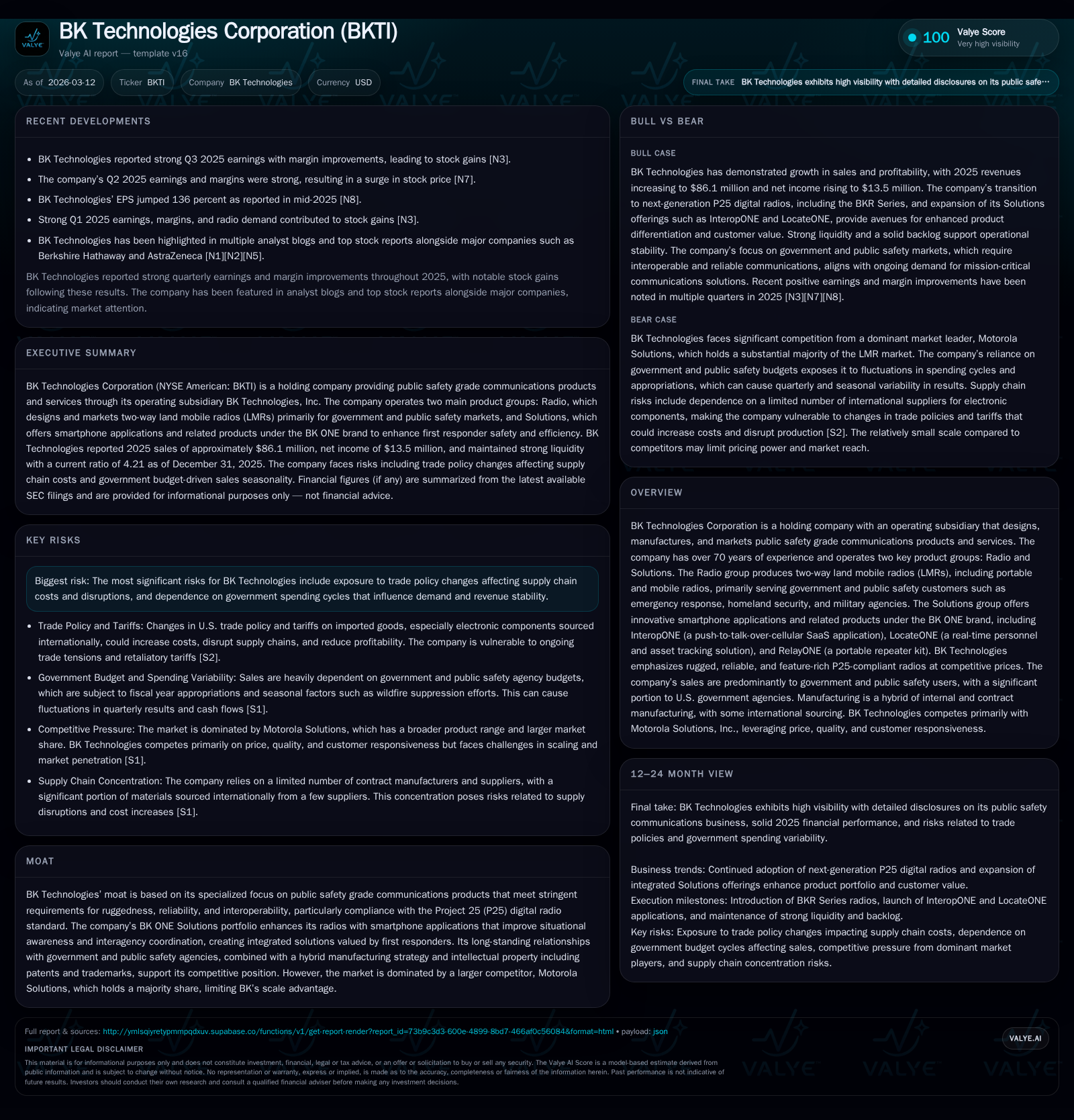
BK Technologies Corp has evolved from modest beginnings into a growing player in the public safety communications sector, driven by a focus on rugged, interoperable Project 25 (P25) digital radios tailored for government and first responder customers. While the LMR market faces maturity and spectrum constraints, BK’s innovation in its BK ONE solutions portfolio—combining radios with smartphone-based situational tools—broadens its addressable market beyond traditional devices. The company reported a substantial turnaround with operating income more than doubling year-over-year in 2025, fueled by improved margins and operational efficiencies. Prudent capital allocation backs buybacks funded by strong cash flows amid supply chain and geopolitical uncertainties. Upcoming milestones to watch include accelerated adoption of new radio models and further integration of the BK ONE ecosystem.
From Modest Beginnings to Surge: Historical Growth and Revenue Drivers
BK Technologies has charted an impressive revenue ascent in recent years rooted in its specialization on Land Mobile Radios (LMRs). Annual revenues expanded from approximately $40.1 million in fiscal 2019 to $74.1 million by the end of 2023 [F1], representing a compound annual growth rate exceeding 15%. This growth trajectory aligns closely with increasing demand for ruggedized public safety radios compliant with the Project 25 (P25) digital standard – a technology critical for interoperability across government agencies.
Crucially, the operating performance narrative reveals a turnaround arc steepening after initial losses stretching until early 2023. Operating income posted a modest loss of $0.8 million in 2023 before rebounding strongly to $7.8 million in 2024, then accelerating sharply to $15.9 million in 2025 – an increase of over 104% year-over-year [F1]. Net income followed suit, shifting from a loss of approximately $2.2 million in 2023 to positive territory of $8.4 million in 2024 and further climbing to $13.5 million in 2025 [F1].
The driver beneath this financial momentum includes successful penetration into federal, state, and municipal markets deploying BK’s flagship BKR9000 Series portable radios, coupled with improved manufacturing efficiency following their transition to contract manufacturing with East West Manufacturing LLC [S7]. Over these years, BK also refined strategic operations post reorganization into a holding company format implemented in March 2019 aimed at enhancing operational flexibility [S1].
Historical performance (annual)
| FY | Rev ($mm) | Net ($mm) | CFO ($mm) | OpInc ($mm) | Rev YoY | Net YoY |
|---|---|---|---|---|---|---|
| 2025 | 14 | 19 | 16 | +61.9% | ||
| 2024 | 8 | 11 | 8 | +474.8% | ||
| 2023 | 74 | -2 | 2 | -1 | ||
| 2021 | 45 | -2 | -6 | -1 | +2.8% |
Source: SEC companyfacts cache [F1].
Capital returns and efficiency (annual)
| FY | Buybacks ($) | FCF ($mm) | ROE% |
|---|---|---|---|
| 2025 | 1193000 | 18 | 30.3 |
| 2024 | 10 | 28.0 | |
| 2023 | 0 | -10.5 | |
| 2021 | 0 | -9 | -5.2 |
Source: SEC companyfacts cache [F1].
Note: Revenue data is available through FY23; subsequent years’ revenue metrics are not explicitly reported.
Market Maturity, Spectrum Limitations, and the Role of P25 Compliance
BK operates within the niche but mature Land Mobile Radio market that has evolved into the backbone communications platform for public safety across North America and other regions [S1]. The Federal Communications Commission’s spectrum allocations have imposed structural limits on available radio frequencies for LMR use, leading regulators years ago to enforce transitions toward more spectrum-efficient digital technologies.
Project 25 compliance stands as an industry standard developed collaboratively by bodies such as APCO International, NASTD, TIA, and manufacturers including BK itself [S1]. This open architecture mandates interoperability so multiple agencies can effectively communicate using compliant devices irrespective of vendor brand—critical during coordinated emergency responses.
While the market is heavily dominated by Motorola Solutions capturing well over half share due to product breadth [S7], BK’s focus on competitively priced but ruggedized P25-capable devices targets customers seeking quality alternatives without license lock-ins imposed by proprietary systems common previously.
However, FCC mandates do not strictly require adoption of P25; rather funding programs favor its compliance particularly for state/local government grants incentivizing interoperable communications upgrades [S1]. This dynamic anchors sustained replacement demand but moderates expansion into adjacent commercial sectors where distinct technologies prevail.
Innovative Extensions: BK ONE Solutions Expanding Addressable Markets
Recognizing limitations inherent solely selling radios amid market saturation risks, BK has incubated its BK ONE portfolio—an integrated suite embedding PTT-over-cellular services alongside real-time tracking capabilities enhancing traditional device functions [S1].
Key products like InteropONE offer SaaS push-to-talk workflows seamless across smartphones leveraging ubiquitous cellular networks while LocateONE enables real-time personnel monitoring critical for operational safety during field deployments.
RelayONE offers modular repeater kits extending signal coverage temporarily at incident sites compensating for environmental communication challenges . These extensions provide multidimensional solutions improving situational awareness and interagency coordination—a competitive edge fostering deeper customer stickiness.
By hybridizing expensive hardware with flexible software overlays on commoditized handhelds familiar to many users, BK broadens sales opportunity beyond pure radio connectivity into comprehensive communications ecosystems valued by first responders concerned with operational effectiveness.
Financial Snapshot: Profitability Leaps and Operational Cash Flow Expansion
BK’s financial statements reflect compelling profitability inflection points underpinned by top-line expansion paired with disciplined cost management [F1]. The company generated operating income of nearly $16 million in fiscal year ended December 31, 2025—a remarkable advance more than doubling prior-year profits (+104%) driven largely by product mix shifts favoring the BKR9000 series radios benefiting gross margins that rose above historic lows [F1] [S17].
Net income reached $13.5 million (+61.9%) supported by moderate effective tax rates and operational gearing [F1]. A parallel expansion in operating cash flow (~$19.4 million) growing almost +70% Y/Y spotlighted enhanced working capital management alongside revenue gains substantiating free cash flows near $18.4 million after subdued capex investment declining ~16% as efficiencies from contract manufacturing stabilized production cycles [F1] [S17].
Approximately a third return on equity (~30%) estimated from net income relative to shareholders’ equity demonstrates successful capital deployment generating meaningful shareholder value creation within core operations absent notable leverage usage given zero drawn debt commitments under the revolving credit facility as of late fiscal periods [F1] [S6].
Capital Strategy: Share Repurchases, Cash Management, and Return on Equity
Since authorization in late December 2021 of a flexible share repurchase program up to $5 million funded exclusively from cash balances and operating surpluses [S10], BK has selectively executed buybacks at management discretion responding opportunistically to share price dynamics during calendar years culminating in meaningful treasury stock retirements totaling over $1 million aligned with prudent liquidity posture supported by robust cash equivalents totaling approximately $22.8 million at year-end 2025 reflecting solid near-term solvency (current ratio >4x) [F1] [S23].
This disciplined capital allocation offsets absence of dividend distributions maintaining financial optionality amidst investment cycles underpinning product R&D such as ongoing BKR9500 all-band radio developments validated via incremental capitalization of software and system integration costs totaling around $2 million annually signaling pipeline depth sustaining competitive positioning [S17] [S18].
Cash flow strength permits balanced reinvestment without incurring indebtedness while optimizing shareholder returns through efficient share count reduction amplifying per-share metrics—all suggesting managerial alignment toward sustained ROE maximization consistent with public safety market cyclicality.
Navigating Supply Chain Risks and Trade Policy Uncertainties
Despite operational gains, BK remains exposed explicitly to global supply chain bottlenecks notably semiconductor component shortages impacting lead times exacerbated periodically since pandemic onset limiting scaling agility for new product deliveries at volume levels centralized around suppliers concentrated overseas with tariff exposure potential given ongoing US trade policy oscillations including retaliatory measures raising costs unpredictably [S2] .
The company acknowledges risks embedded within fluctuating material costs driven by tariffs affecting electronic component imports primarily sourced abroad which could erode profitability should full price pass-through fail or dampen customer demand sensitive to equipment pricing increases critical within constrained government budgets emphasizing cost justification rigor particularly amid regional geopolitical conflicts adding macroeconomic uncertainty layers [S2].
Alongside external trade policy variables sensibly beyond direct control resides cyclical dependence on governmental appropriations shaping exact procurement timing posing quarterly earnings lumpy patterns related to wildland fire seasonality or grant fund releases managing contracts with sizable backlog oscillations (~$14-$22 million range recently) intertwined tightly with federal/state fiscal cycles constraining forward visibility albeit manageable via funnel-depth forecasting approaches utilized internally per filings indications [S21].
What Comes Next: Key Milestones and Growth Catalysts to Watch
Looking ahead without explicit numerical guidance publicly disclosed yet analytical viewpoint suggests several pivotal developments warranting close watch:
- Accelerated customer uptake of BKR Series radios focused on expanding interoperability-driven purchases by federal/state/local agencies driven partially by ongoing grant funding incentives encouraging P25 migration;
- Progressive rollouts and user adoption rates within BK ONE smartphone application ecosystem solidifying multi-modal communications platforms amplifying solution stickiness versus legacy single-hardware reliance;
- Continued refinement of manufacturing footprint balancing internal capabilities blended with contract manufacturers fostering scalable cost structures critical for competitive pricing pressures;
- Potential legal outcomes stemming from patent infringement complaint filed against AT&T Mobility adding intellectual property enforcement dimensions that could impact licensing arrangements or competitive positioning if resolved favorably or otherwise impose monetized settlements respectively;
- Market share dynamics vis-à-vis entrenched incumbents like Motorola Solutions requiring sustained product innovation agility preserving differentiation within regulatory-driven interoperability frameworks;
- Future capital deployment choices balancing R&D intensity consonant with emerging technology standards possibly influencing upgrade cycles inclusively involving all-band radio development efforts signaled by rising capitalization trends noted recently.
Operational execution over these vectors alongside macro factors such as supply stability will define ability for BK Technologies to extend its niche foothold translating technological excellence into continued profitable growth well beyond current trough-to-peak transformations.
This analysis is based exclusively on SEC filings dated through March 12, 2026 ([F1], [S#]) without external news inputs or investment advice intentions.
Disclaimer: This is research-only, informational analysis and not investment advice. It may include AI-generated interpretation and general industry context. Always verify important details using primary sources.

Comments