
Surf Air Mobility Scales Regional Air Service While Grappling with Liquidity and Electrification Execution
Surf Air Mobility operates one of the largest U.S. commuter airlines and develops electrification technology amid ongoing financial strain.
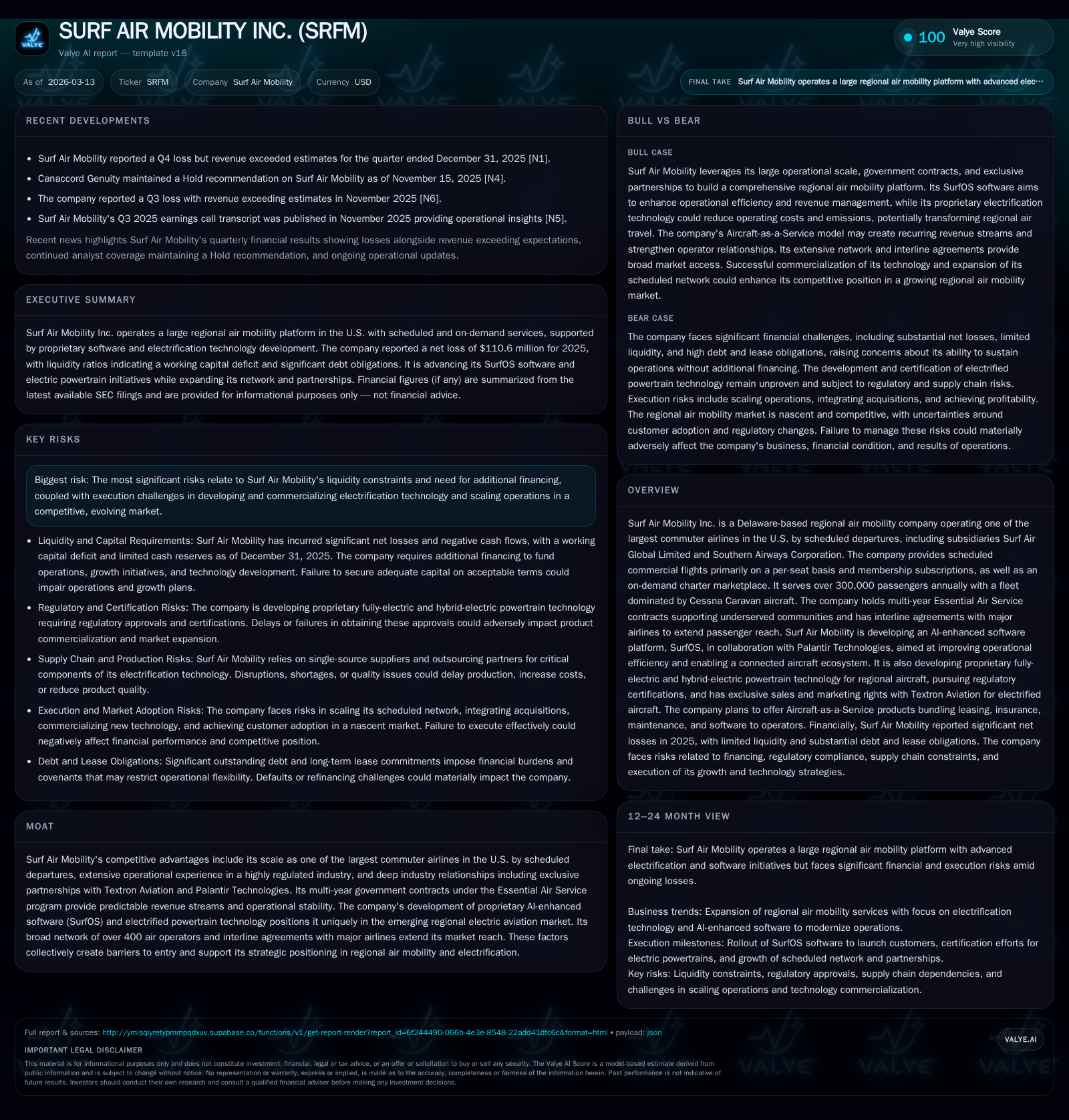
Surf Air Mobility Inc. expanded its regional network through the July 2023 acquisition of Southern Airways, operating over 62,000 scheduled departures and serving more than 300,000 passengers in 2025. The company is advancing proprietary AI software (SurfOS) and electric powertrain development to modernize regional aviation. Despite strategic scale and partnerships, SRFM faces substantial liquidity challenges, recurring operating losses, and debt defaults that raise going concern risks without additional capital. Monitoring financing developments, SurfOS commercialization, and electrification progress will be key to assessing future growth potential.
Company Overview and Historical Performance
Surf Air Mobility Inc., incorporated in Delaware, operates one of the largest commuter airlines in the United States by scheduled departures following its acquisition of Southern Airways in July 2023 [S1][S14]. In 2025, the combined operations delivered approximately 62,000 scheduled departures serving over 300,000 passengers primarily using Cessna Caravan turboprop aircraft. The business model includes scheduled commercial flights sold per seat or via membership subscriptions alongside an on-demand charter marketplace [S14][S15]. Multi-year U.S. Essential Air Service (EAS) contracts provide a revenue foundation servicing underserved regional markets [S14][S15].
Financially, Surf Air Mobility has experienced persistent operating losses reflecting investments to build scale and develop new technologies. Operating income narrowed from -$196.8 million in 2023 to -$60.3 million in 2024 before widening again to -$76.9 million in 2025 [F1]. Net loss increased substantially to -$110.6 million in 2025 from -$74.9 million the prior year [F1]. Operating cash flow remained deeply negative at -$64.2 million in 2025, contributing to a deteriorated balance sheet characterized by working capital deficits and negative equity at fiscal year-end [F1]. Capital expenditures decreased nearly half in 2025 compared to the prior year ($5.9 million vs $11.8 million), reflecting cost containment amid cash constraints [F1].
Historical performance (annual)
| FY | Net ($mm) | CFO ($mm) | OpInc ($mm) | Capex ($mm) | Net YoY |
|---|---|---|---|---|---|
| 2025 | -111 | -64 | -77 | 6 | -47.6% |
| 2024 | -75 | -54 | -60 | 12 | +70.1% |
| 2023 | -251 | -64 | -197 | 8 |
Source: SEC companyfacts cache [F1].
Capital returns and efficiency (annual)
| FY | Buybacks ($) | FCF ($mm) | ROE% |
|---|---|---|---|
| 2025 | -70 | 201.5 | |
| 2024 | 1300000 | -66 | 62.4 |
| 2023 | 1300000 | -72 | 323.5 |
Source: SEC companyfacts cache [F1].
*Note: Revenue figures are not explicitly disclosed.
This financial performance underscores the tension between growth ambitions—expanding network capacity and pioneering new aviation technologies—and significant liquidity challenges.
Growth Drivers and Future Prospects
Key pillars supporting Surf Air Mobility's near-term growth include:
Network Expansion: Post-acquisition integration has created a regional platform spanning Mid-Atlantic to Gulf South regions with plans to scale operations profitably across about 30 regional networks comprising roughly 200 tier-1 routes identified via demographic analysis [S14][S15]. Profitability will depend on optimizing route economics amid changes in FAA Essential Air Service subsidy programs [S26].
Technological Innovation: Development of SurfOS — an AI-enhanced operational software platform built with Palantir Technologies — aims to improve efficiency by streamlining crew scheduling, maintenance tracking, dynamic pricing and flight distribution [S18][S22]. Initial rollout is planned during 2026 for internal use with potential expansion into third-party licensing.
Electrification Leadership: Investment focuses on proprietary electric powertrain technology targeting the Cessna Grand Caravan fleet [S18][S22]. Efforts include pursuing Supplemental Type Certificates for hybrid/electric conversions with exclusive sales rights through Textron Aviation [S18][S22]. Memoranda of understanding with seven global operators representing about 100 aircraft demonstrate initial market interest pending certification.
Marketplace Platform: The digital marketplace supports both scheduled ticket sales and ad-hoc charter bookings generating $29.6 million revenue from on-demand operations in 2025 [S15], providing a scalable capital-light revenue stream.
These initiatives leverage Surf Air Mobility's scale — ranking among the largest by departures nationwide — alongside deep industry experience navigating FAA Part 135 regulations for small commuter aircraft operations since its predecessor's founding in 2016 [S1][S14][S19]. Interline agreements with major carriers such as United Airlines and American Airlines extend passenger connectivity beyond regional hubs [S6], while focus on local airports reduces travel times relative to major airport flying experiences [S14].
Risks and Capital Allocation
Despite structural advantages stemming from scale and strategic partnerships — including exclusive relationships with Textron Aviation for electrification sales/distribution and Palantir Technologies for AI software development — significant financial headwinds persist.
As of December 31, 2025, Surf Air Mobility reported $97.1 million total debt comprising term loans and convertible notes [F1][S4][S5]. The company has experienced defaults on certain debt obligations as well as excise and property tax delinquencies; current liabilities exceed current assets significantly yielding a current ratio near 0.23x indicative of acute liquidity stress [F1][S13]. Debt covenants impose restrictions limiting dividends or asset sales among other operational constraints [S4][S7][S11]. Recent capital raises have been heavily reliant on affiliated entities related to company co-founders exposing shareholders to concentrated funding risk [S10].
Cash burn remains elevated; operating cash flows stayed deeply negative at -$64.2 million even as capital expenditures were curtailed below $6 million suggesting limited reinvestment capacity outside core maintenance or minor projects [F1]. Free cash flow approximates negative $70 million for fiscal year 2025.
The company has outlined multiple potential funding avenues including equity raises under share subscription facilities totaling up to $400 million from GEM Global Yield LLC SCS; however access depends on stock price dynamics and investor appetite which remain uncertain amidst ongoing losses [S9][S16][S17]. Failure to secure adequate financing may necessitate operational restructuring or divestitures potentially threatening going concern status [N1][S21].
Commercialization of SurfOS entails material investment with inherent execution risks; software development delays or cost overruns could impact returns negatively [S18]. Similarly early-stage electrified aircraft conversion efforts face certification hurdles before meaningful fleet transition can occur.
Industry Context and Competitive Landscape
The regional air mobility sector is rapidly evolving driven by pilot shortages impacting large multi-engine operators alongside technological advances enabling smaller single-engine electrified aircraft to replace short-haul driving trips underserved by legacy carriers. Surf Air Mobility’s Part 135 regulatory focus offers competitive advantages by providing pilot training pipelines earlier than typical regional airline models.
New entrants focusing on electric vertical takeoff or urban air mobility operate under different regulatory regimes; SRFM’s strategy prioritizes incremental innovation via proven platforms enhanced with electrified powertrains mitigating certification risks associated with radical change.
Government Essential Air Service contracts provide stable revenue streams linking remote communities but also face increasing competition pressures following FAA program reforms requiring competitive bidding which could compress subsidies.
What To Watch Going Forward
- Progress securing committed equity/debt financing tranches that alleviate immediate liquidity constraints.
- Successful internal deployment then broader market acceptance of SurfOS driving operational efficiencies and licensing revenues.
- Certification milestones for hybrid/electric Caravan Supplemental Type Certificates enabling launch customers’ fleet upgrades aligned with carbon reduction goals.
- Passenger load factor trends indicating effectiveness of network expansion strategies amid rising competition on EAS routes.
- Regulatory developments impacting Essential Air Service program structure or pilot training mandates affecting cost structures or barriers.
Conclusion
Surf Air Mobility combines scale integration post-Southern Airways acquisition with forward-looking investments in AI-enabled operations management software and electric propulsion technology aimed at transforming regional air travel sustainability.
However this vision contends with immediate financial headwinds manifested in steep recurring losses coupled with liquidity strain posing existential risks absent successful capital raises or operational turnarounds. Execution risks remain around maturing its technology platforms while expanding passenger volumes sufficiently amid competitive pressures compounded by regulatory uncertainties.
Investors face a complex narrative balancing Surf Air’s unique positioning within the evolving regional air mobility ecosystem against stark realities of capital adequacy challenges inherent in emerging transportation technology ventures within regulated environments.
This analysis is based solely on publicly available data as of March 13th, 2026 including SEC filings and relevant news articles without offering investment advice.
Disclaimer: This is research-only, informational analysis and not investment advice. It may include AI-generated interpretation and general industry context. Always verify important details using primary sources.

Comments