
Beauty Health Co’s Patented Hydrafacial Platform Supports Revenue Growth Despite Profit Challenges
SKIN leverages proprietary delivery systems and consumables to drive recurring revenue amid operational and litigation risks.
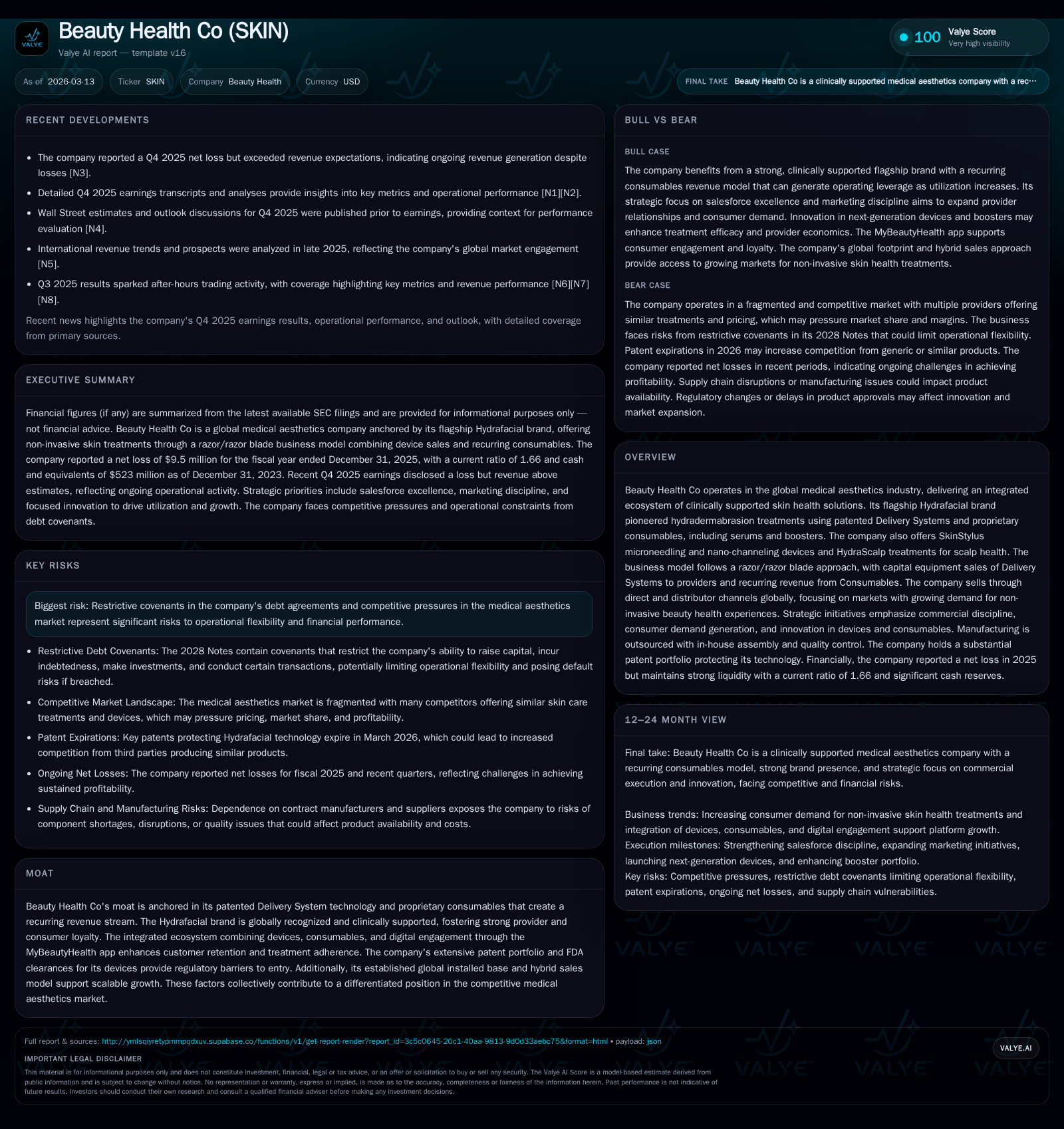
Beauty Health Co, operating under the Hydrafacial brand, has shown improving operating income from a deep loss in recent years but remains unprofitable as of FY2025. The company’s integrated ecosystem of patented devices and consumables underpins its recurring revenue model. Strategic emphasis on provider activation, consumer demand generation, and innovation positions the firm for growth, albeit constrained by legal proceedings and debt covenants. Consistent cash flow generation contrasts with negative net income, reflecting investment in commercial and product development activities.
Company Overview and Business Model
Beauty Health Co operates primarily through its flagship Hydrafacial brand, pioneering hydradermabrasion treatments via patented Delivery Systems combined with proprietary single-use consumables such as serums and tips. The company also markets complementary technologies including SkinStylus microneedling devices and HydraScalp treatments for scalp health. The core business approach follows a razor/razor blade model where capital equipment sales (the Delivery Systems) are supplemented by recurring revenue from consumables sold to provider practices worldwide [S11].
Notably, the Delivery System "Syndeo" is classified as a Class I exempt medical device per FDA regulations and incorporates advanced hardware/software capabilities like Wi-Fi and RFID for personalized skin care delivery and data collection. This deep integration of device technology, clinical validation, and consumables enables Beauty Health to maintain a differentiated technology moat supported by significant patent protection (226 patents granted with 84 pending worldwide) and FDA clearances [S11, S20].
The company sells predominantly through direct channels as well as distributors globally, emphasizing regions with growing interest in non-invasive aesthetic treatments anchored in clinical credibility. Approximately 69% of Delivery Systems and consumable sales come from the professional medical channel in North America with international markets comprising roughly 35% of revenues—a geographic mix likely to persist [S20].
Historical Financial Performance
Beauty Health Co has demonstrated material improvement across operating results from FY2023 through FY2025 while still not achieving net profitability. The table below summarizes key income statement and cash flow measures:
Historical performance (annual)
| FY | Net ($mm) | CFO ($mm) | OpInc ($mm) | Capex ($mm) | Net YoY |
|---|---|---|---|---|---|
| 2025 | -10 | 37 | -21 | 0 | +67.3% |
| 2024 | -29 | 16 | -68 | 1 | +70.9% |
| 2023 | -100 | 22 | -131 | 4 | -325.6% |
| 2022 | 44 | -107 | -24 | 11 |
Source: SEC companyfacts cache [F1].
Capital returns and efficiency (annual)
| FY | Buybacks ($mm) | FCF ($mm) | ROE% |
|---|---|---|---|
| 2025 | 0 | 37 | -15.6 |
| 2024 | 0 | 15 | -56.2 |
| 2023 | 30 | 18 | -168.6 |
| 2022 | 160 | -117 | 25.9 |
Source: SEC companyfacts cache [F1].
[F1]
Operating losses have shrunk meaningfully due to improved operating leverage driven by recurring revenue growth and controlled expenses. Net losses narrowed sharply but remain negative reflecting continued investments in commercial infrastructure, R&D and marketing efforts to build provider adoption and consumer demand [N1][S21].
Operating cash flows have been consistently positive since FY2023 with a remarkable doubling in FY2025 aided by tighter working capital management contrasted against sharply lower capex spending (which declined roughly 60% year-over-year). This generated free cash flow near $37M last year—a positive sign of financial health outside reported earnings metrics [F1].
There were no dividends paid or share repurchases in FY2024 or FY2025 following historic repurchases totaling $30M in FY2023 signaling a conservation of cash amid ongoing challenges [F1]. A rough return on equity calculation for FY2025 reflects a negative ROE of approximately -15.6%, consistent with sustained near-term unprofitability despite operational progress.
Growth Drivers and Future Prospects
Beauty Health’s strategic priorities focus on enhancing "salesforce excellence," optimizing marketing discipline aimed at both providers (the B2B push side) and consumers directly (the B2C pull), along with focused product innovation targeting clinical efficacy and provider economics [S21].
- Salesforce initiatives include shifting toward value-based selling models incorporating clinical-economic evidence that demonstrate ROI for providers, better account segmentation prioritization, improved utilization tracking across the installed base and reactivation of low-usage accounts.
- Marketing efforts capitalize on Hydrafacial’s broad appeal across demographics plus digital outreach via platforms like the MyBeautyHealth application (launched November 2023), encouraging treatment adherence through loyalty programs and personalized care plans.
- Innovation pipelines target next-generation Hydrafacial devices expected to trigger hardware upgrades within their substantial installed base alongside new booster products designed collaboratively with partner brands offering tailored treatment options.
The synergy between increasing consumer demand that drives higher treatment frequency per installed device fuels greater consumable replacement sales—crucial given their higher margin contribution relative to hardware—and supports economies of scale as utilization rises globally [S11][S21].[N1]
Longer term growth could be constrained or affected by legal actions currently facing the company—multiple derivative lawsuits alleging fiduciary breaches relating to past disclosures about device performance have been consolidated for litigation as of mid-2024—with additional regulatory scrutiny given the ongoing SEC investigation concerning allegations around disclosure accuracy concerning earlier Syndeo machine versions [S6][S7][S10]. The company intends to vigorously defend claims while cooperating with investigations.
Furthermore, restrictive covenants embedded within its senior notes issued through 2028 curtail potential leverage-based actions such as dividend payouts or stock buybacks which might otherwise be considered when excess liquidity builds due to positive cash flows [S2]. These conditions highlight possible limitations on balance sheet agility if market circumstances or operational needs shift abruptly.
Competitive Positioning and Industry Context
Hydrafacial holds a distinctive position within an increasingly crowded medical aesthetics landscape marked by fragmentation among numerous mid-sized specialized competitors offering comparable skin care modalities such as DiamondGlow or Cartessa Aesthetics—against whom Beauty Health has engaged litigation protecting intellectual property rights around hydradermabrasion technology patents [S4][S20][S28].
The company emphasizes clinically validated outcomes supported by research evidence combined with elevated digital engagement approaches—such as AI-enhanced marketing targeting—to fortify brand awareness (estimated at ~38% aided U.S. recognition among esthetic consumers) along with provider loyalty programs incentivizing volume consumption of consumables via tiered pricing methodologies [S15][N2].
This multi-pronged approach aligns well with broader skin health trends favoring non-invasive procedures yielding natural-looking results integrated into routine wellness routines rather than occasional cosmetic interventions.
Capital Allocation Priorities and Financial Discipline
Despite sequential improvement in earnings quality metrics, Beauty Health continues to prioritize reinvestment over shareholder distributions owing largely to the residual effects of past investment cycles combined with managing the financial exposure linked to ongoing legal matters.
Capital expenditures have contracted significantly since peak investments but remain focused on maintaining capacity for delivering new product iterations rather than aggressive expansion at this stage [F1].
The absence of share repurchases post-FY2023 suggests a conservative cash deployment stance aligned with restrictive note covenants while positive operating cash flow underlines underlying business resilience.
Future monitoring should focus on: evolution in device upgrade cycles triggered by next-generation product launches; legal resolution timelines especially surrounding consolidated derivative claims; trajectory of consumer engagement metrics via app adoption rates; receivables collection quality related to distributor channel shifts; FDA or international regulatory developments impacting market access or compliance costs; changes in competitive intensity particularly within global expansion geographies including Asia-Pacific; and impact of macroeconomic factors influencing elective medical aesthetic spend patterns.
Conclusion
Beauty Health Co’s Hydrafacial-led platform exemplifies an integrated razor/razor blade business model that leverages proprietary technology assets to generate recurring revenues from consumables amid expanding global demand for non-invasive skin health treatments. Operational improvements have driven substantial narrowing of losses coupled with robust free cash flow generation.
However, near-term profitability remains challenged as investments persist alongside significant ongoing legal exposures plus debt covenant constraints imposing capital allocation discipline into potentially uncertain market dynamics.
The company’s future outlook hinges critically on its ability to convert clinical innovations into higher account utilization rates globally while navigating regulatory scrutiny successfully—all executed within a framework balancing measured financial discipline against growth ambitions rooted in evolving consumer wellness trends.
This report is prepared solely for informational purposes based on publicly available information as of March 13, 2026, without providing any investment recommendations.
Disclaimer: This is research-only, informational analysis and not investment advice. It may include AI-generated interpretation and general industry context. Always verify important details using primary sources.

Comments