
Oatly Group’s Journey to Profitability Amid Supply Chain Restructuring
Oatly achieved its first full year of profitability in 2025 by streamlining operations and optimizing its supply chain while managing macroeconomic headwinds.
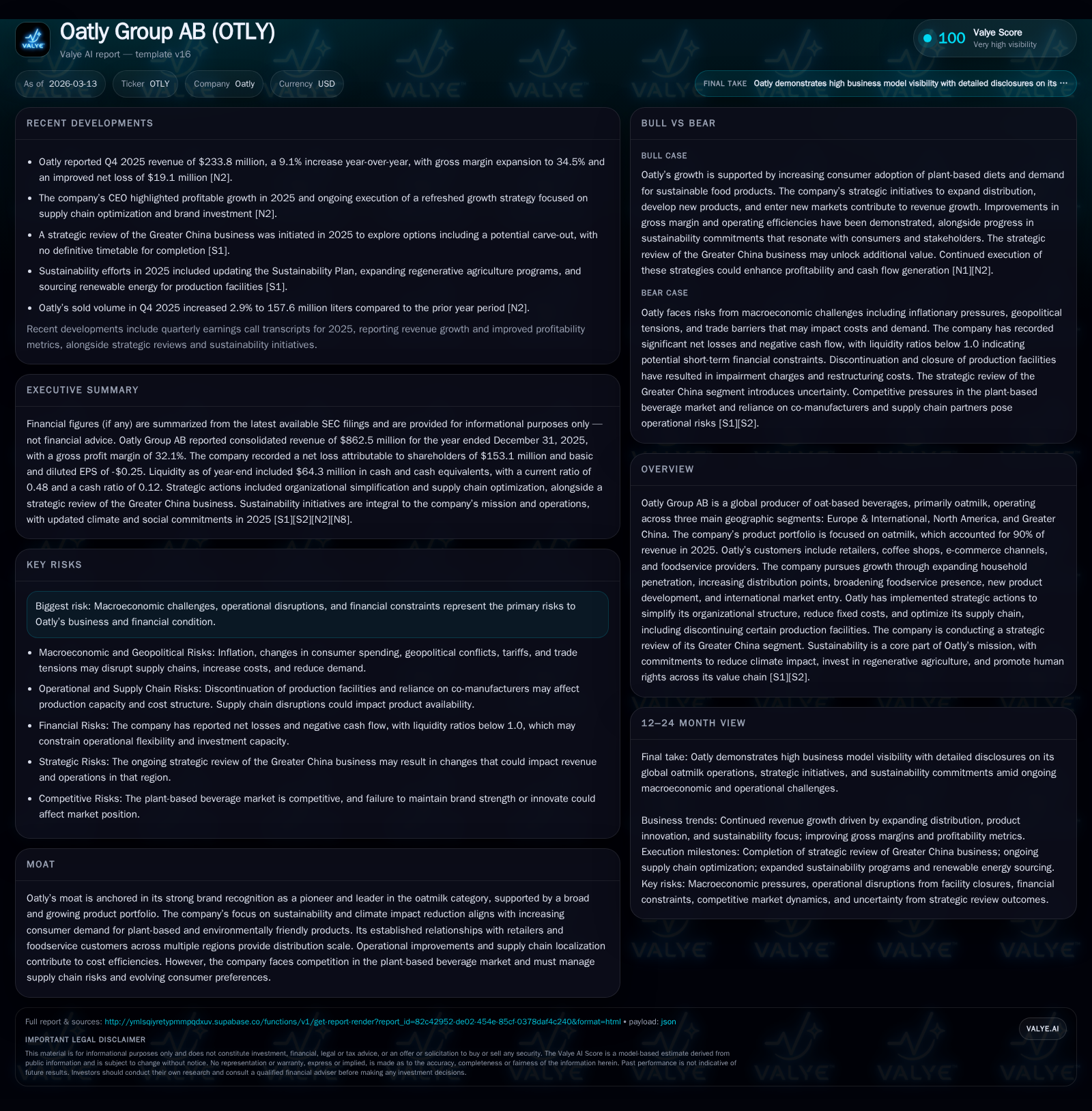
After years of rapid expansion and significant operational investment, Oatly Group AB reported its first profitable fiscal year in 2025, driven primarily by strategic cost reductions, supply chain localization, and focused market execution. The company cautions that despite this milestone, ongoing macroeconomic challenges and a comprehensive review of its Greater China business pose near-term uncertainties. Going forward, growth will rely on deepening household penetration, expanding foodservice channels, and executing on new product innovation within a leaner cost base.
From Rapid Expansion to Focused Restructuring: Oatly’s Historical Growth Trajectory
Oatly Group AB has undergone a dramatic evolution over the last four years marked by rapid top-line expansion but also sizable net losses tied to aggressive growth investment and capacity build-outs. Revenue expanded from approximately $722 million in FY 2022 to $862 million in FY 2025—a cumulative increase of nearly 20% over this period ([F1]). This growth was supported by expanding distribution points across core markets—primarily Europe & International and North America—and continued consumer adoption of plant-based oatmilk products.
Concurrently, net income showed sharp improvement; from a loss of -$417 million in FY 2023 to -$153 million by FY 2025 ([F1]). This contraction reflects not only revenue growth but also deliberate restructuring efforts aimed at reducing fixed costs and optimizing operations. For instance, beginning late 2023, Oatly ceased construction of new production facilities in Peterborough (UK), Dallas-Fort Worth (US), and a second Chinese plant known as "Asia III," conditions which had been weighing heavily on the balance sheet ([S1], [S19]). The disposal and closure of an existing Singapore facility further reduced overhead during 2024.
Management's commentary during the Q4 earnings call explicitly framed these moves as critical to shaping a more scalable and profitable business model ([N1]). CEO Jean-Christophe Flatin highlighted that the years of investment laid the foundation for profitable growth but prioritized "right-sizing our supply chain and overhead structure" alongside reinvestment behind their refreshed growth strategy.
Historical performance (annual)
| FY | Rev ($mm) | Net ($mm) | Rev YoY | Net YoY |
|---|---|---|---|---|
| 2025 | 862 | -153 | +4.7% | +24.3% |
| 2024 | 824 | -202 | +5.1% | +51.5% |
| 2023 | 783 | -417 | +8.5% | |
| 2022 | 722 |
Source: SEC companyfacts cache [F1].
Capital returns and efficiency (annual)
| FY | ROE% |
|---|---|
| 2025 | -778.4 |
| 2024 | -190.6 |
| 2023 | -124.2 |
| 2022 |
Source: SEC companyfacts cache [F1].
Note: Revenue figures derived from consolidated financials [F1]. ROE is net income divided by equity for the respective year.
Strategic Simplification and Supply Chain Optimization Drive Margin Expansion
The company's push toward operational efficiency is underscored by an emphasis on simplifying organizational structures globally—a process that involved workforce adjustments as well as discontinuing capital-intensive projects ([S1], [S5]). Reported restructuring costs totaled approximately $4.9 million in FY 2025, down from $8.2 million the prior year, indicating progress but ongoing expenses related to transformation ([S1]).
Supply chain localization has been another lever for margin improvement. By shifting production closer to consumers—principally via mature facilities in Europe & International—the company has achieved dilution of fixed manufacturing costs alongside gains in procurement scale ([S5], [S6]). Gross profit margin increased sharply from roughly 28.7% in FY 2024 to over 32% in FY 2025 ([F1], [S16]), illustrating notable progress against previous margin compression caused by elevated commodity prices.
Pricing strategies have evolved as well; Oatly has taken measured price increases over prior years to counteract inflationary input costs while adjusting product mix toward higher-volume fortified unsweetened oatmilk variants that align with consumer value-seeking during uncertain economic times ([S6], [N1]). R&D spend was reduced substantially—to $18.6 million or just over two percent of revenues—in FY25 compared with previous periods suggesting a focus on commercializing existing product lines rather than exploratory launches ([S10]).
Operating expenses reflect this streamlined approach too: selling, general, and administrative costs declined slightly despite volume growth and are now about mid-thirty percent levels relative to revenue ([S10]). Increased customer distribution costs relate primarily to higher sold volumes and tax dynamics across geographies.
Geographic Segments Spotlight: The Case for Greater China and International Priorities
Oatly’s three geographic segments present divergent performance profiles that shape its strategic considerations. Europe & International remains the largest contributor; it experienced consistent revenue growth of about +23.3% YoY for Q4 alone in reporting currency terms although somewhat muted when adjusting foreign exchange effects ([N1], [S19], [S23]). Key mature markets such as the UK, Germany, Sweden benefit from deep household penetration and broad channel presence.
North America revenue has been relatively flat recently with some headwinds due primarily to competitive pressures and channel mix challenges ([N1]). The foodservice channel continues as a critical expansion opportunity with independent coffee shops and branded chains supporting incremental demand.
The Greater China segment remains under strategic review amid mixed results since initial entry. Management is exploring options ranging up to a potential carve-out intended to unlock value and accelerate segment-specific growth ([S1], [S19]). A final decision is expected within calendar year 2026 but no concrete timetable exists beyond that horizon. The review underscores inherent geopolitical tension impacts, logistical disruptions (e.g., rerouting freight away from Russia), currency fluctuations, and market-specific consumer dynamics impacting profitability ([S1]).
Despite uncertainty regarding Greater China’s trajectory or ownership structure outcomes, Oatly has affirmed ongoing commitment to customers and production operations there during this process ([S1]).
Consumer and Market Dynamics Shaping Demand: Pricing, Product Mix, and Macro Pressures
Informed by evolving global macroeconomic conditions characterized by rising inflation rates, changing discretionary spending patterns have influenced consumer buying decisions within plant-based beverage categories ([S1]). Labeled "premium," Oatly’s offerings face growing demand elasticity with consumers increasingly seeking cost-efficient alternatives amid tightening wallets ([N1], [S6]).
Oatmilk continues accounting for roughly ninety percent of total revenues globally—underscoring the company’s strong positioning within this core category—but Oatly engages actively with promotional pricing campaigns involving trade rebates, retail discounts, coupons, and other marketing support programs that impact reported top-line metrics due to gross revenue reductions factored therein ([S13], [S20]).
Product mix optimization keeps pace through innovation within fortified unsweetened oatmilk variants that cater both nutritionally conscious consumers alongside mainstream households desiring affordable functional beverages. About ten percent of volumes constitute organic or indulgent formulations which target niche tastes but remain smaller contributors overall ([S23]).
Supply chain disturbances stemming from geopolitical conflicts—in particular sanctions relating to Russia-Ukraine war fallout—and shipping delays represent persistent risks potentially affecting product availability or input costs moving forward ([S1]).
Capital Structure and Liquidity: Managing Debt Facilities Amid Growth Investments
Financing for Oatly’s investments during the transformation phase comes primarily through equity issuance complemented by debt instruments including convertible notes totaling approximately $300 million issued between March-April 2023 bearing a high coupon (~9.25%) with maturity extended into late decade horizons ([S14], [S18], [S19]). These notes carry standard covenants restricting incremental debt issuance without majority holder approval.
In September-October of 2025, the company secured SEK denominated Nordic Bonds (~$180 million equivalent) alongside a SEK750 million ($79.8 million) Super Senior Revolving Credit Facility (SSRCF), providing enhanced liquidity buffers while embedding sustainability-linked covenants tied directly to greenhouse gas emission reductions and diversity targets within management ranks ([S4], [S7], [S11]).
Cash balances stood at just over $64 million end-December 2025 against current liabilities exceeding twice that amount resulting in a constrained current ratio (~0.48), highlighting working capital management challenges even as operating cash flows improved substantially from negative $114 million usage in FY24 down to about minus $24 million by FY25 ([F1], [S21], [S22]). Capital expenditure plans for fiscal year ending December 31 2026 forecast outlays between $20 million–$30 million focused mainly on sustaining production assets aligned with their asset-light strategy ([S15], [S29]).
Dividend payments remain restricted under loan covenant terms requiring leverage ratios below defined thresholds which currently constrain capital returns absent materially improved cash generation or balance sheet repair initiatives ([S12],[S14],[N1]).
Evaluating Returns: Profitability Milestones Versus Persistent Challenges
Notwithstanding narrow net losses recorded in calendar year ending December 31 2025 (-$153 million), Oatly demonstrated foundational improvements necessary for eventual positive returns on equity although calculated ROE remains deeply negative (-778%), reflective largely of diminished equity base after years of losses wiping down shareholders’ funds ([F1]). Reduction of SG&A expenses coupled with gross margin uptick illustrate early benefits from operating leverage associated with scale gains synergized through product mix management coupled with supply chain localization efforts ([S16],[S10]).
Impairments related mainly to discontinued projects like Asia III facility alongside severance charge rationalization indicate one-time adjustment items still exerting downward pressure on headline profitability though these should abate over coming periods barring unforeseen external shocks ([S17],[N1]). Finance expenses remain elevated given convertible note interest obligations complicated further by currency revaluation impacts adding volatility beyond normalized cash interest costs.
CEO commentary repeatedly emphasized that full-year profitability represents a milestone but not an end state—as ongoing execution is required to translate operating gains into sustainable net profitability encouragingly foreshadowing improving free cash flow generation once scaled efficiently across key regions simultaneously managing complexity reduction objectives concurrently ([N1],[N3]).
What To Watch: Catalysts and Risks in Oatly’s Growth Outlook
Several developments merit close scrutiny going forward:
- Completion timeline for the Greater China strategic review is anticipated sometime within calendar year 2026; potential carve-out or divestiture scenarios hold meaningful implications for consolidated results as well as regional strategic focus adjustments ([N1],[S1],[N9]).
- Commodity price trajectories—especially oats-related inputs—and transportation costs remain exposed to global inflation trends amidst persistent geopolitical tensions potentially disrupting supply chains or triggering currency volatility impacts affecting margins ([S1],[N7],[N9]).
- Progression of product innovation pipeline beyond fortified unsweetened oatmilk along with successful scaling into newer international markets using foodservice-led go-to-market approaches could drive successive waves of volume growth beyond mature regions where penetration plateaus faster ( [S6],[N1]) .
- Macro consumer behavior adjusting toward more value-oriented-packaged goods amidst economic uncertainty may pressure premium branded offerings necessitating adaptive pricing models or channel shifts ( [S13]) .
- Maintaining disciplined capital allocation without compromising liquidity amid financing covenant requirements constraining dividend/buyback flexibility demands careful financial engineering inflecting credit spreads or refinancing risk management strategies ( [S12],[S15]) .
Overall Oatly is positioned at an inflection point—with credible evidence it has moved toward sustainable profitability bolstered by operational streamlining coupled with brand leadership within oatmilk category while simultaneously navigating diverse risks spanning broader market cyclicality through geopolitics down through granular input costs rigors . How well it accelerates execution across these dimensions will ultimately define its durability beyond this landmark breakthrough.
This analysis strictly reflects available data sourced from Oatly Group AB's publicly filed financial reports (Form 20-F) as of March 13, 2026 [F1]–[S29] alongside verified earnings call transcripts [N1]–[N10]. All interpretations avoid forecast speculation not expressly supported by management commentary or documented guidance per compliance rules stated above. This write-up does not constitute investment advice or recommendations.
Disclaimer: This is research-only, informational analysis and not investment advice. It may include AI-generated interpretation and general industry context. Always verify important details using primary sources.

Comments