
Network-1 Technologies: Balancing Patent Litigation Risks Against Legacy Revenue and Dividend Commitments
Network-1 sustains operations through selective patent portfolios and litigation despite steep revenue declines after its Remote Power Patent expired.
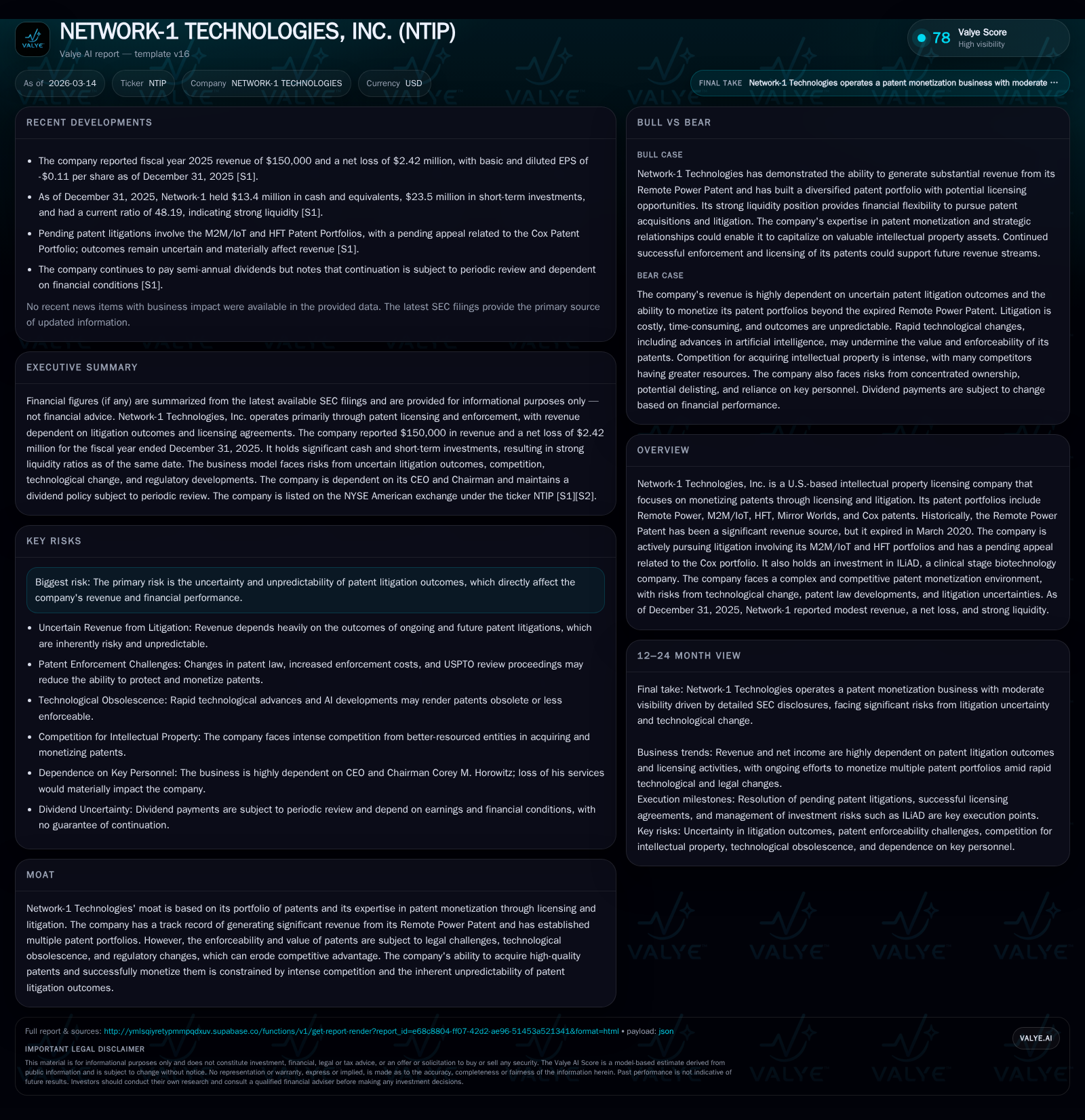
Network-1 Technologies, a U.S.-based patent monetization company, has experienced significant revenue contraction following the expiration of its key Remote Power Patent in 2020. While the company continues to pursue litigation on its M2M/IoT, HFT, and Cox patent portfolios, outcomes remain uncertain and crucial to future earnings. The company's financials reflect ongoing net losses, negative operating cash flows, but robust liquidity and a strong current ratio. Dividends have been consistently paid since 2016 despite declining profitability, backed by substantial cash reserves. Network-1's future hinges on favorable patent enforcement outcomes amid technological change and evolving patent law, alongside strategic acquisitions or partnerships for new intellectual property assets.
Company Overview
Network-1 Technologies operates as an intellectual property licensing entity focused primarily on monetizing patents via licensing agreements and litigation enforcement. Its historical revenue engine was the Remote Power Patent portfolio, which generated cumulative revenue exceeding $188 million from its inception through December 31, 2025. However, expiration of that portfolio's principal patent in March 2020 precipitated a steep decline in licensing revenue. To offset this sharp drop-off, Network-1 has concentrated resources on enforcing its remaining patent assets including the M2M/IoT (Machine-to-Machine/Internet of Things), High-Frequency Trading (HFT), Mirror Worlds, and Cox portfolios.
Historical Performance
The company’s revenue trajectory illustrates the reliance on the Remote Power Patent historically coupled with volatility inherent to patent monetization strategies:
Historical performance (annual)
| FY | Rev ($mm) | Net ($mm) | CFO ($mm) | OpInc ($mm) | Rev YoY | Net YoY |
|---|---|---|---|---|---|---|
| 2025 | 0 | -2 | -1 | -3 | +50.0% | +20.2% |
| 2024 | 0 | -3 | -1 | -4 | -96.2% | -108.2% |
| 2023 | 3 | -1 | 0 | -2 | -92.8% | +37.4% |
| 2022 | 36 | -2 | -5 | -4 |
Source: SEC companyfacts cache [F1].
Capital returns and efficiency (annual)
| FY | Div ($mm) | Buybacks ($) | ROE% |
|---|---|---|---|
| 2025 | 2 | 293000 | -6.1 |
| 2024 | 2 | 1295000 | -6.8 |
| 2023 | 2 | 966000 | -2.9 |
| 2022 | 2 | 534000 | -4.2 |
Source: SEC companyfacts cache [F1].
Revenue plummeted after the expiration of the Remote Power Patent which accounted for nearly all revenue in recent years (100% in both 2024 and 2025). Operating losses have been consistent yet roughly stable relative to prior years despite lower top-line receipts, indicating ongoing fixed costs or litigation expenditures.
Operating cash flow also turned negative again after a positive reading in 2023 possibly reflecting timing differences or episodic collections from licensees.
Litigation & Portfolio Strategies
Network-1’s current business model rests heavily on active enforcement across key portfolios:
M2M/IoT: Lawsuits filed against Samsung Electronics target alleged infringements related to eSIMs and 5G in devices such as Galaxy smartphones and tablets, with a trial scheduled for June 7, 2027 [S11].
HFT Portfolio: Litigation commenced against large market participants Citadel Securities, Jump Trading, Optiver US LLC and others since late 2024 [S11], with defenses raised on grounds including non-infringement and patent invalidity leading to motions denied but ongoing counterclaims.
Cox Portfolio: Appeals are pending following unfavorable district court dismissal regarding internet media content identification patents [S11].
The company acknowledges that these litigations are inherently risky and outcomes remain unpredictable [S4][S7]. Adverse rulings could substantially diminish enforcement potential and thus revenue generation capabilities.
Capital Allocation & Returns
Despite sustained losses, Network-1 maintains disciplined capital return policies:
A semi-annual cash dividend policy paying $0.05 per share twice yearly has been adhered to consistently since introduction in December 2016 [S10][S26]. Total dividends paid approximated $2.3 million for fiscal year 2025.
Share repurchases continue at lower levels relative to prior years (approximately $293K in FY2025 vs above $1 million previously), facilitated by a Rule 10b5-1 trading plan ensuring compliance with insider trading regulations [S20].
Balance sheet strength is notable with cash plus equivalents standing at around $13.4 million as of December 31, 2025, alongside a current ratio reflecting ample liquidity (over 48x) [F1][S25]. However free cash flow remains negative due principally to operating deficits.
Return metrics highlight a low ROE near -6%, consistent with ongoing net losses [F1]. The challenging environment means capital allocation choices must balance sustaining dividends with litigation funding needs.
Growth Prospects & Risks
Growth drivers hinge primarily on:
- Winning favorable verdicts or settlements from ongoing lawsuits involving technologically significant patents.
- Acquiring additional high-quality patent assets that can generate licensing opportunities or serve as litigation leverage [S15].
- Establishing strategic partnerships to monetize third-party IP effectively.
However substantial growth constraints exist:
- Litigation uncertainty: The timing and outcomes of complex patent disputes are difficult to predict; adverse decisions could materially hurt revenues [S4][S8].
- Technological disruption: Advances in AI/ML could undercut patent relevance by enabling design-arounds or alternative technologies [S13].
- Changes in U.S. patent law mandated by legislation such as the America Invents Act have increased enforcement risks via mechanisms like Inter Partes Review (IPR) proceedings [S5].
- Competitive pressures for acquiring lucrative patents are intense due to well-funded corporate buyers and investment firms competing for valuable IP [S6].
- The company’s investment in ILiAD biotechnology presents diversification but clinical-stage uncertainty remains high [S8].
Strategic Considerations & Outlook (Analysis)
Absent formal guidance from management beyond reaffirmation of dividend continuity if feasible [S10][S26], investors should focus on several key milestones:
- Legal developments culminating in trial verdicts slated for mid-2027 particularly for HFT and M2M/IoT suits.
- Progress on Cox portfolio appeals.
- Potential announcements regarding new intellectual property acquisitions or strategic collaborations.
- Cash flow trends reflecting resolution or escalation of legal expenses.
- Dividend policy changes contingent on operating results.
The company’s concentrated ownership structure (with over 30% held by officers/directors) may influence tactical decisions related to settlements or asset sales [S4], which can affect shareholder interests.
Conclusion
Network-1 Technologies operates within an inherently volatile niche defined by intellectual property enforcement amid fast-evolving technology landscapes. Its historical success was tightly linked to the now-expired Remote Power Patent portfolio; recovering comparable scale financially depends upon successful monetization of remaining patent assets through contentious litigation channels.
Financial data attest to constrained top-line inflows countered by persistent operational expenses causing continued net losses but maintaining solid liquidity positions able to support dividend payments for now. Legal battles underway against prominent technology companies present both opportunity and risk—outcomes will determine whether Network-1 revitalizes its royalty streams or further contracts activity levels. Investors must weigh uncertainties inherent in costly legal pursuits combined with risks imposed by advancing disruptive technologies and changing regulatory frameworks shaping the value proposition of Network-1’s intellectual property holdings going forward.
This analysis is based solely on publicly available SEC filings up to March 14, 2026; it does not constitute investment advice.
Disclaimer: This is research-only, informational analysis and not investment advice. It may include AI-generated interpretation and general industry context. Always verify important details using primary sources.

Comments