
GERDAU S.A. Steel Revenues Rebound but Profit Dips in 2025
Despite a 4.2% revenue increase, GERDAU’s net income contracted sharply due to margin pressures and impairments in 2025.
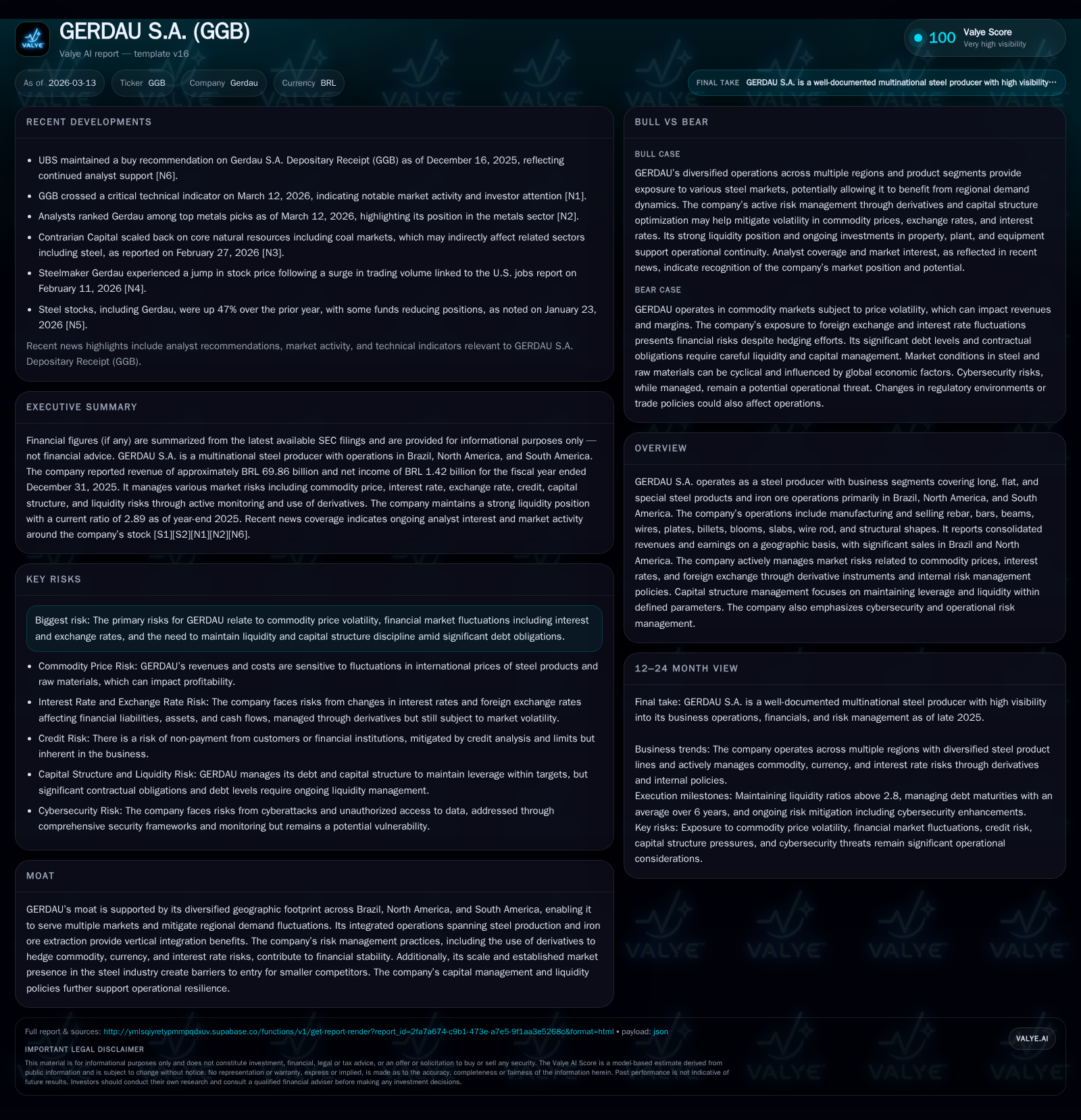
GERDAU S.A.’s full-year 2025 results reveal resilient top-line growth with revenues up 4.2% year-over-year to BRL 69.9 billion, contrasted by a steep 69.2% decline in net income to BRL 1.42 billion [F1]. The company’s diversified steel and iron ore operations across Brazil, North America, and South America supported revenue growth amid volatile raw material prices and foreign exchange movements [S4][S17]. However, significant impairment losses in the Brazil segment and rising cost pressures compressed margins notably [S22]. Risk management via derivatives has mitigated commodity, currency, and interest rate risks [S1][S29]. Capital discipline remains a priority with ongoing debt repayments and leverage targets (Net Debt/EBITDA ≤ 1.5) guiding financial strategy [S5][S6][S18]. Completed share buybacks and dividend payments reflect balanced capital allocation amid constrained cash flow generation [S8][F1]. Operational focus includes sustaining plant efficiency and cybersecurity measures to ensure continuity [N2]. Key headwinds include commodity price volatility, foreign exchange regulations affecting repatriation, and medium-term debt maturities requiring vigilant capital structure management [S29][F1].
Historical Performance: Revenue Growth Amid Earnings Pressure
GERDAU S.A.’s FY2025 revenues rose by +4.2% year-over-year to BRL 69.9 billion from BRL 67.0 billion in FY2024, reflecting resilience after prior market challenges [F1]. Despite this top-line growth, net income declined sharply by -69.2% YoY to BRL 1.42 billion versus BRL 4.60 billion in the prior year, driven largely by increasing cost pressures and significant impairment losses primarily in the Brazil segment [F1][S22].
Gross margins were compressed as cost of sales rose amid commodity inflation while selling and administrative expenses remained steady but weighed on operating leverage [S19]. This divergence highlights challenges balancing higher sales volumes or pricing against rising input costs and asset write-downs.
Historical performance (annual)
| FY | Rev ($bn) | Net ($bn) | Rev YoY | Net YoY |
|---|---|---|---|---|
| 2025 | 69.9 | 1.4 | +4.2% | -69.2% |
| 2024 | 67.0 | 4.6 | -2.7% | -39.0% |
| 2023 | 68.9 | 7.5 | -16.4% | -34.3% |
| 2022 | 82.4 | 11.5 |
Source: SEC companyfacts cache [F1].
Capital returns and efficiency (annual)
| FY | ROE% |
|---|---|
| 2025 | 2.6 |
| 2024 | 7.9 |
| 2023 | 15.3 |
| 2022 | 24.8 |
Source: SEC companyfacts cache [F1].
*Note: Percent changes for FY2023 are approximate based on available data.
Segmental and Geographic Overview
Gerdau operates three main segments: Brazil (long, flat steel products plus iron ore), North America (long/specialty steel), and South America excluding Brazil (Argentina, Peru, Uruguay primarily long steel products) [S4][S10][S17].
Brazil contributed roughly BRL 29.7 billion in net sales in FY2025, North America approximately BRL 35.8 billion, and South America about BRL 5.6 billion after intercompany eliminations [S17]. This geographic mix exposes Gerdau to diverse demand cycles; Brazil faces domestic economic volatility while North American construction markets underpin steady demand.
The Brazil segment recorded impairment losses around BRL 1.96 billion including goodwill write-offs that significantly impacted earnings; no comparable impairments occurred in other regions indicating localized operational stresses [S22].
Gerdau's integrated model spans iron ore mining to finished steel products such as rebar, wire rods, plates, beams, and special bar quality steel—providing some margin resilience despite exposure to global input cost inflation.
Risk Management: Hedging Commodity Prices, FX, and Interest Rates
Operating internationally with exposure to commodity prices necessitates active risk mitigation through derivatives targeting energy costs, foreign currency fluctuations, and interest rates benchmarked against SOFR/CDI [S1][S5][S6][S13][S29].
As of December 31, 2025, commodity energy derivatives were held with mark-to-market valuations impacting P&L within manageable ranges; a simulated ±5% commodity price change translates into modest revenue or expense shifts reflecting calibrated hedge use rather than speculative bets [S13]. Foreign exchange risk from Brazilian real denominated assets versus US dollar liabilities is closely monitored at operation levels with offsetting assets abroad providing natural hedges.
Interest rate risk sensitivity analysis shows that a ±10 basis point change in floating rates impacts financial expenses by approximately R$43k—indicative of disciplined debt structuring with mostly fixed or hedged floating rates ensuring stable financial results amidst monetary tightening globally [S13].
Capital Structure Discipline & Debt Profile
Gerdau maintains a conservative capital structure with strategic deleveraging amid ongoing investments focused on sustaining competitiveness without excessive leverage risk [S5][S6][S18]. Total debt includes bonds maturing between 2027-2044 with early redemption of US$500 million worth of bonds in December '25 reducing refinancing risk.
The outstanding bond balance was approximately US$1.311 billion (~R$7.212 billion) supported by guarantees from key subsidiaries preserving creditworthiness [S18]. Management targets a Net Debt/EBITDA ratio of ≤1.5x as part of its internal policy to provide buffers during cyclical downturns.
Liquidity is supported by undrawn revolving credit facilities totaling about US$875 million available for working capital needs alongside cash reserves exceeding R$5.9 billion at year-end [F1][S18][S20], underscoring solid short- to medium-term financial flexibility.
Capital Allocation: Dividends & Share Buybacks
Dividend payments totaled approximately R$1.23 billion in line with subdued returns on equity (~2.6%) impacted by earnings contraction due to impairments and cost pressures [F1][S8]. Two consecutive share buyback programs initiated since mid-2024 concluded during CY2025 acquiring over 64 million preferred shares plus common shares that were subsequently canceled or held in treasury supporting equity stability without aggressive capital deployment amid uncertain market conditions [S8][S9].
Capex focuses predominantly on maintenance and efficiency improvements rather than major greenfield expansions consistent with industry trends favoring asset optimization given high expenditure intensity inherent to integrated mills plus evolving environmental regulations especially relevant for Brazilian operations [N2][S19].
Operational Outlook & Priorities
While no explicit future expansion plans are detailed publicly, management prioritizes operational resilience including enhanced cybersecurity measures aimed at protecting production continuity against increasing industrial cyber threats affecting metals producers globally [N2]. Incremental capacity improvements rather than large-scale expansions align with prudent investment amid ongoing raw material price volatility.
Analyst Sentiment & Market Technical Indicators
Recent analyst reports highlight Gerdau as a favored pick within the metals sector driven by its geographic diversification mitigating regional risks alongside effective hedge programs reducing earnings volatility [N2]. Technical charts indicate positive momentum following critical resistance breakouts coinciding with strong U.S.jobs data fueling trading volume spikes suggestive of renewed investor interest supporting potential cyclical rebounds typical for steel demand during economic recoveries [N1][N4].
Key Risks & Challenges Ahead
Persistent volatility in primary inputs such as iron ore pricing driven by global demand dynamics remains a significant uncertainty alongside fluctuating Brazilian real exchange rates compounded by foreign investment regulations that affect dividend repatriation mechanisms adding complexity for offshore shareholders converting proceeds from ADR holdings or direct equity investments under evolving Central Bank rules [S1][S29].
Medium-term liquidity management will require sustained discipline as substantial bond maturities come due post-2027 necessitating proactive refinancing or cash flow preservation strategies without breaching leverage covenants essential for maintaining credit ratings crucial in the capital-intensive steel industry.
This analysis is based solely on publicly available information including GERDAU S.A.'s filings dated March 13, 2026 ([F1],[S#]) plus related news articles ([N#]). It does not constitute investment advice or recommendations.
Disclaimer: This is research-only, informational analysis and not investment advice. It may include AI-generated interpretation and general industry context. Always verify important details using primary sources.

Comments