
CervoMed Navigates Accelerating Losses and Revenue Decline Amid Clinical-Stage Development
A clinical-stage biotech focused on Dementia with Lewy Bodies advances its lead candidate while managing capital needs and regulatory complexities.
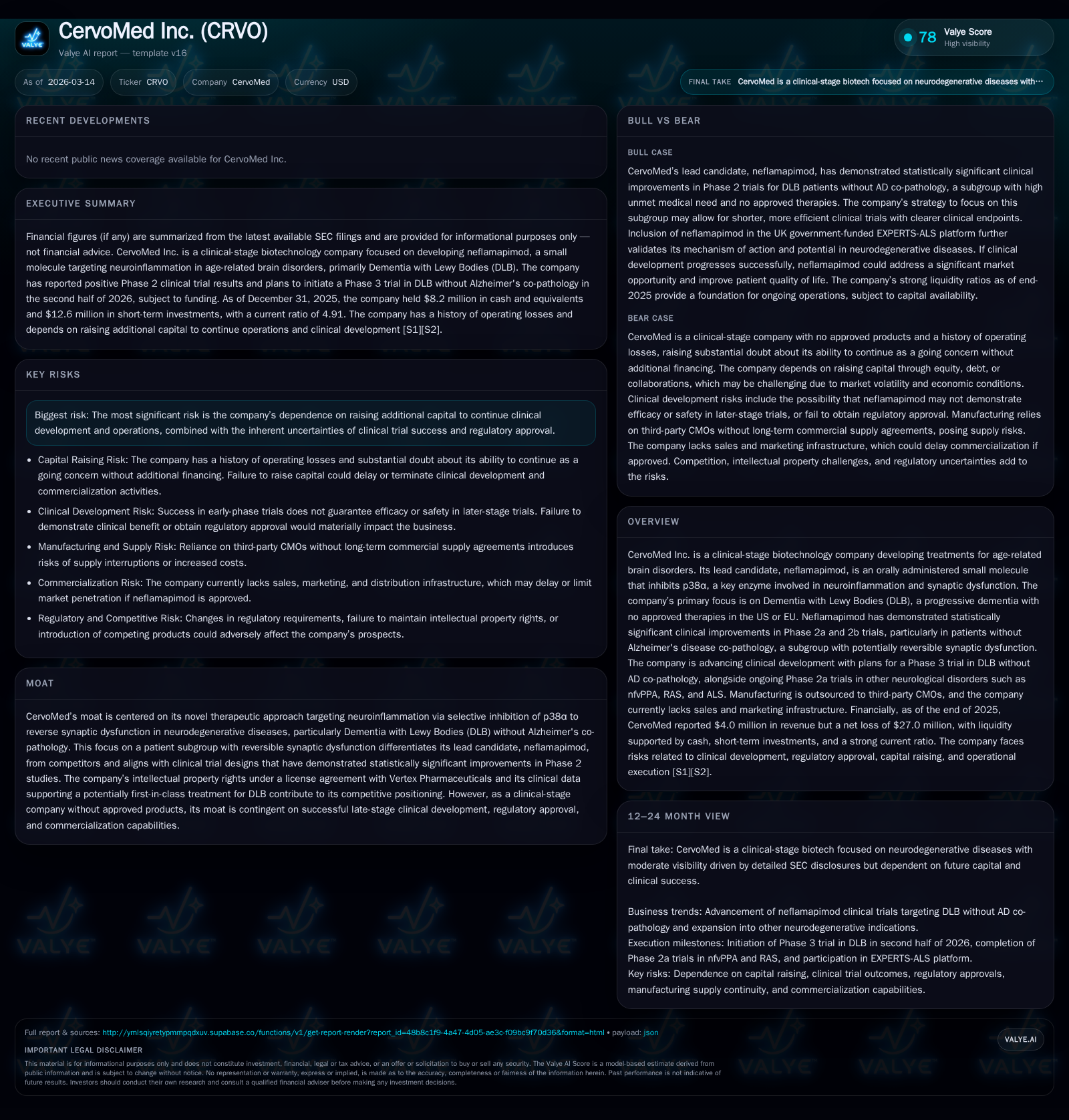
CervoMed Inc. is a clinical-stage biotechnology company developing neflamapimod, an investigational oral small molecule targeting neuroinflammation and synaptic dysfunction in Dementia with Lewy Bodies (DLB) without Alzheimer's co-pathology. Despite promising Phase 2 data, the company faces a steep revenue decline and widening losses, reflecting its dependence on clinical progress and external funding. With no approved products yet, CervoMed’s future hinges on successful late-stage trials, capital raises, and navigating regulatory and manufacturing risks amid evolving healthcare policies.
Company Overview
CervoMed Inc., based in Boston, Massachusetts, is a clinical-stage biotechnology company focused on developing treatments for age-related brain disorders. Its lead asset is neflamapimod, an orally administered small molecule that selectively inhibits p38α kinase implicated in neuroinflammation and synaptic dysfunction.
The company's primary target indication is Dementia with Lewy Bodies (DLB) without Alzheimer’s disease co-pathology—a subgroup characterized by reversible synaptic deficits rather than irreversible neuronal loss. This targeted approach differentiates CervoMed by focusing on potentially more treatable patients within the broader dementia spectrum.
Neflamapimod has shown statistically significant improvements on clinical endpoints and biomarkers in Phase 2a and Phase 2b trials. Beyond DLB, CervoMed is exploring additional neurological indications such as non-fluent variant primary progressive aphasia (nfvPPA), Remitting Ataxia Syndrome (RAS), and amyotrophic lateral sclerosis (ALS), with recent inclusion in the UK EXPERTS-ALS platform reflecting pipeline diversification [N3][S13].
Historical Financial Performance
Historical performance (annual)
| FY | Rev ($mm) | Net ($mm) | CFO ($mm) | OpInc ($mm) | Rev YoY | Net YoY |
|---|---|---|---|---|---|---|
| 2025 | 4 | -27 | -23 | -28 | -58.9% | -65.5% |
| 2024 | 10 | -16 | -17 | -18 | +36.3% | -650.1% |
| 2023 | 7 | -2 | -7 | -8 | +86.1% | |
| 2022 | -16 | -15 | -16 |
Source: SEC companyfacts cache [F1].
Capital returns and efficiency (annual)
| FY | Buybacks | ROE% |
|---|---|---|
| 2025 | -148.0 | |
| 2024 | 0 | -41.6 |
| 2023 | 0 | -29.4 |
| 2022 | -77.1 |
Source: SEC companyfacts cache [F1].
Revenue declined sharply by approximately 59% year-over-year from FY2024 to FY2025. Operating losses nearly doubled over the same period while net losses also widened substantially ([F1]). Negative operating cash flow intensified correspondingly.
Despite these challenges, the company maintained a strong liquidity position at the end of FY2025 with a current ratio near 4.9x driven by $22.9 million in current assets against $4.7 million in current liabilities ([F1]). However, cash on hand stood at $8.2 million — a level that underscores the critical need for additional financing to sustain operations.
Growth Drivers and Outlook
Advancement of neflamapimod through late-stage clinical development remains central to CervoMed's growth prospects. The planned Phase 3 trial focuses on DLB patients without AD co-pathology—a population hypothesized to benefit most from this mechanism due to primarily functional synaptic impairment [N3][S1][S13].
Additional clinical programs targeting nfvPPA and ALS provide potential expansion avenues if early signals translate into meaningful efficacy [N3][S13].
Regulatory approval pathways remain uncertain given the complexity of CNS disorders and evolving FDA/EMA requirements. Moreover, emerging US healthcare reforms—such as Medicare drug price negotiations beginning in 2026—introduce pricing and reimbursement uncertainties that could affect commercial viability post-approval [S7][S10][S25].
Manufacturing relies exclusively on third-party contract manufacturing organizations (CMOs), which presents supply chain risks that could impact clinical supply continuity or commercial scale-up if disruptions occur [S13].
Capital Allocation and Financial Health
CervoMed has not generated profits historically nor paid dividends or conducted share buybacks due to its early-stage status and prioritization of reinvestment into R&D activities ([F1],[S13]).
The company’s equity was approximately $18.2 million at FY2025 end—down from prior periods due primarily to accumulated net losses ([F1]). Using FY2025 data yields an approximate negative return-on-equity of -148%, indicative of substantial capital consumption characteristic of clinical-stage biotechs ([F1]).
Liquidity remains constrained with $8.2 million cash available at year-end FY2025 ([F1]). The company acknowledges the necessity of raising additional funds through equity offerings, debt financings or collaborations to continue costly late-stage development programs [S11][S18]. Failure to secure financing on acceptable terms may require delaying or reducing planned activities.
Strategic Risks
- Clinical Risk: Success depends heavily on achieving positive pivotal Phase 3 results; CNS drug development bears high attrition rates [S1][S13].
- Capital Risk: Ongoing losses necessitate frequent capital raises which may dilute shareholders; market volatility may hamper access to financing when needed [S11][S18].
- Manufacturing Risk: Dependence on third-party CMOs entails potential supply interruptions impacting timelines [S13].
- Intellectual Property Risk: Patent protection under licensing agreements with Vertex Pharmaceuticals faces challenges from evolving patent laws or litigation outcomes [S12][S21][S23].
- Regulatory & Compliance Risk: Compliance with complex healthcare laws including pricing transparency and anti-fraud statutes imposes operational burdens; violations could result in penalties [S4][S5][S6][S14][S15][S17].
- Legal Proceedings: Ongoing litigation including matters related to former executives may impose financial or reputational costs though management currently expects no material impact [S9].
Key Milestones To Monitor
- Initiation and enrollment progress of pivotal Phase 3 trial targeting DLB without AD co-pathology.
- Updates from ongoing Phase 2 studies in ALS and other neurological indications.
- Regulatory feedback confirming acceptance of trial designs aligned with neflamapimod's mechanism.
- Announcements regarding funding rounds or strategic partnerships extending financial runway.
- Developments around intellectual property disputes or licensing arrangements.
- Impact assessments of emerging healthcare reforms affecting drug pricing and reimbursement.
Conclusion
CervoMed is positioned at a critical juncture within neurodegenerative disease treatment development by focusing on reversing synaptic dysfunction via p38α inhibition in DLB patients without Alzheimer’s pathology. While early-phase clinical data offer promise for addressing an unmet medical need, the company faces significant headwinds marked by declining revenues and escalating losses requiring urgent capital infusion. Its long-term viability depends on successfully advancing neflamapimod through pivotal trials alongside effective capital management within a challenging regulatory landscape. Investors should weigh the scientific potential against high execution risks inherent in CNS drug development along with macroeconomic uncertainties influencing funding availability.
This analysis is based solely on publicly available information up to March 2026.
Disclaimer: This is research-only, informational analysis and not investment advice. It may include AI-generated interpretation and general industry context. Always verify important details using primary sources.

Comments