
Acacia Research Corp’s Turnaround: From Volatile Earnings to Renewed Stability
After years of volatile earnings driven by complex acquisitions and patent litigation, Acacia Research is showing signs of financial stabilization backed by disciplined capital management and operational focus.
Acacia Research Corporation has historically exhibited sharp fluctuations in its income statements, reflective of the challenges inherent in integrating diverse acquisitions and managing costly intellectual property litigations. However, recent fiscal year 2025 results highlight a significant improvement in operating income, net income, and operating cash flow, underscoring renewed operational resilience. This turnaround is underpinned by the company's disciplined acquisition strategy, long-term ownership philosophy, and its strategic partnership with Starboard Value, LP, which collectively anchor its ability to unlock value and navigate patent enforcement complexities. Despite ongoing risks in patent litigation and integration hurdles, Acacia's robust liquidity position and improved capital structure provide a foundation for measured growth going forward.
Historic Earnings Volatility Amid Strategic Acquisitions
Acacia Research Corporation's financial history from fiscal year 2018 through 2025 reveals a pattern of substantial volatility that many sector insiders would associate closely with its acquisition-driven business model [F1][S1]. Revenues swung notably — starting at $49.2 million in FY2018 before plunging to $0.7 million in FY2019. Partial recovery was seen thereafter, though revenue data beyond FY2021 are not available [F1].
Operating income exhibits a rollercoaster profile: positive peaks such as $20.9 million in FY2023 were sandwiched between steep losses including -$33 million in FY2024 and -$40 million in FY2022 [F1]. Net income variability was even more extreme; for example, an enormous net loss of -$125 million occurred in FY2022 before rebounding to a gain of $67 million in FY2023 [F1].
This oscillation largely reflects complexities associated with acquiring entities across industrial, energy, and technology verticals—sectors where consolidation tends to generate short-term operational disruptions. The integration risk factors echo those stipulated clearly in the company’s regulatory disclosures: challenges include maintaining key customer relationships post-acquisition, managing cultural alignments, realizing expected synergies promptly, and addressing unforeseen liabilities [S1]. Such swings are symptomatic of the initial turmoil typically encountered when melding diverse operations under a unified management umbrella.
Historical performance (annual)
| FY | Net ($mm) | CFO ($mm) | OpInc ($mm) | Capex ($mm) | Net YoY |
|---|---|---|---|---|---|
| 2025 | 22 | 75 | 6 | +160.1% | |
| 2024 | -36 | 50 | -33 | 149 | -153.8% |
| 2023 | 67 | -23 | 21 | 0 | +153.6% |
| 2022 | -125 | -37 | -40 | 1 |
Source: SEC companyfacts cache [F1].
Capital returns and efficiency (annual)
| FY | Div ($mm) | Buybacks ($mm) | FCF ($mm) |
|---|---|---|---|
| 2025 | 0 | ||
| 2024 | 0 | 20 | -99 |
| 2023 | 1 | 0 | -23 |
| 2022 | 3 | 51 | -38 |
Source: SEC companyfacts cache [F1].
Note: Revenue data limited beyond FY2021; other metrics as available from latest filings
Intellectual Property Licensing and Litigation: Double-Edged Revenue Source
A cornerstone of Acacia's business is its Intellectual Property (IP) segment that licenses extensive patent portfolios spanning multiple industries [S1][S4]. This IP business delivers recurring licensing revenue streams but depends heavily on active patent enforcement programs involving infringement litigations where outcomes remain unpredictable.
The company faces substantial risks related to patent enforcement litigation including costs associated with legal actions, potential monetary sanctions if procedural or substantive rules are breached during enforcement activities, and the unpredictability of court rulings [S6][S7]. These litigations often involve well-funded adversaries and may continue for years consuming significant management attention and financial resources [S6][S13].
Furthermore, evolving U.S. patent laws and regulatory changes increase complexity around enforceability and litigation risk exposure [S22][S25]. Patent portfolio strength remains critical for revenue protection but navigating this landscape requires careful risk management.
2025 Financial Results: Signs of Operational and Cash Flow Resilience
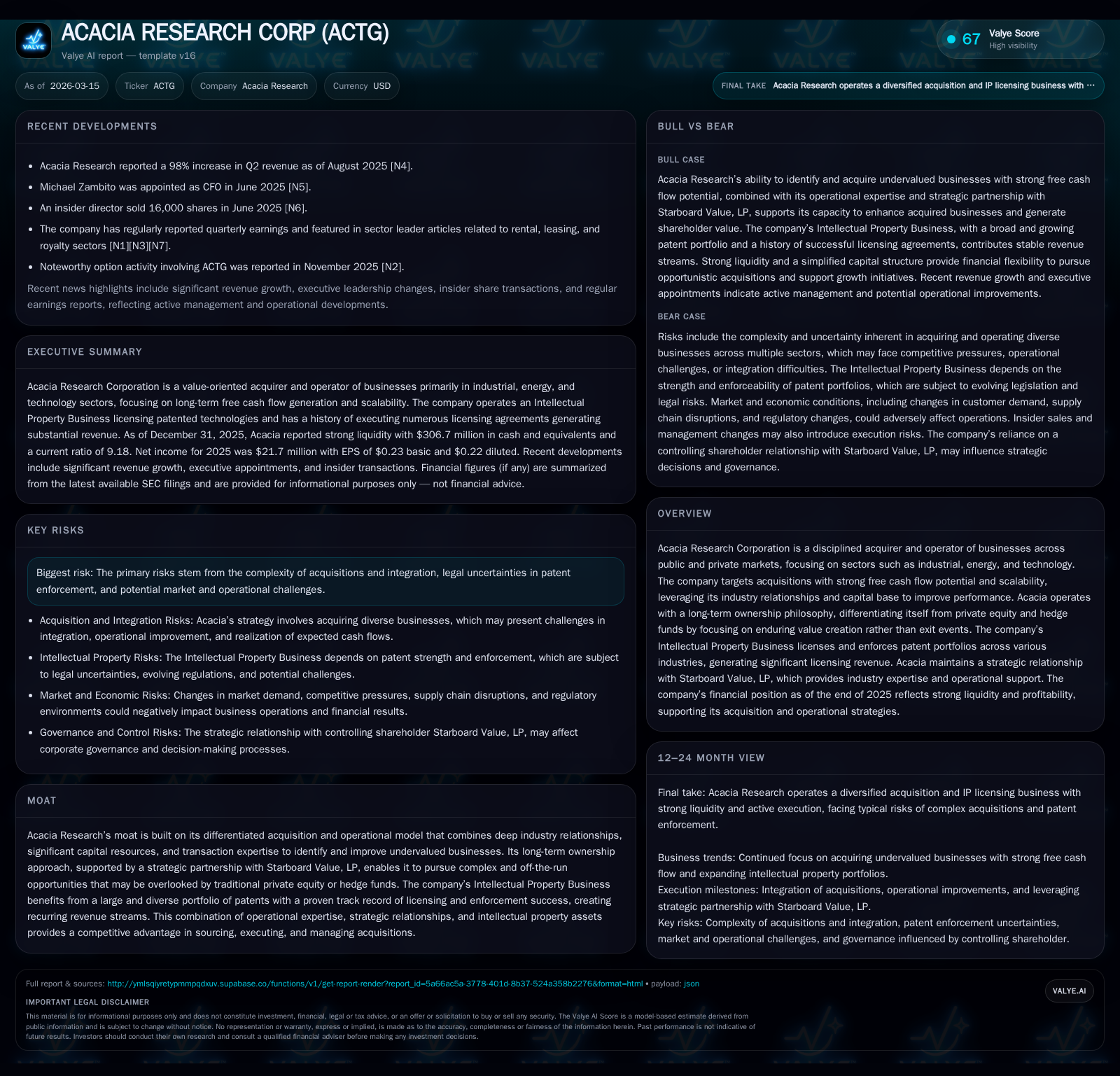
Fiscal year 2025 evidences clear signs of operational maturity at Acacia Research [F1][N1]. The company posted positive operating income of $6.4 million—a stark contrast to prior heavy losses—and net income turned profitable at $21.7 million with a +160% year-over-year increase [F1]. Operating cash flow (CFO) rose substantially to $75.2 million representing a +50% improvement versus FY2024 [F1], signaling stronger core operations generating cash despite prior headwinds.
Liquidity metrics further underscore financial strength: as of December 31, 2025, current assets vastly exceeded liabilities yielding an enviable current ratio around 9.18—a buffer supporting both strategic investments and cushioning downside risks [F1]. This enhanced capital position follows the company’s capital structure simplification after repaying all senior secured notes held by controlling shareholder Starboard Value under recapitalization agreements completed recently [S8][S17].
Despite improved cash flows, free cash flow remains pressured as elevated capital expenditures—$148.7 million in FY2024—outpaced cash from operations significantly resulting in negative free cash flow during that period [F1]. These large outlays likely relate to acquisition-related investments or platform enhancements underpinning long-term scalability.
Capital Allocation Discipline Amid Growth Investments
Management has demonstrated capital allocation discipline amid volatile earnings [F1][S17][S18]. Dividends paid declined steadily leading up to cessation after FY2023; dividend payments fell from $2.8 million in FY2022 to zero thereafter without reinstatement reported [F1]. Share repurchases also halted after approximately $20 million were executed by end-2024 reflecting cautious approach given substantial capex needs.
The equity base expanded notably through this period though return on equity remains moderate at roughly four percent based on latest net income relative to equity balances suggesting ongoing profitability maturation relative to book value accumulation [F1]. This approach aligns with the company’s philosophy favoring long-term ownership over rapid monetization typical of private equity strategies [S18].
Outlook: Balancing Acquisition Opportunities Against Integration and Litigation Risks
Looking ahead involves balancing appetites for pipeline acquisitions against inherent execution risks detailed extensively within regulatory disclosures addressing integration hurdles alongside evolving patent regimes impacting enforceability profiles [N1][S1][S4].
Disciplined sourcing is critical given competitive tension for undervalued public/private targets fitting Acacia’s criteria centered on scalable free cash flow potential linked to industrial technology sectors favored due to technical barriers-of-entry combined with manageable complexity discounts [S18][S20]. The long-term holding outlook enables patience during cyclical slowdowns facilitating gradual realization of operational synergies.
Equally pivotal will be progress mitigating legal uncertainties stemming from evolving jurisprudence on patent validity thresholds and remedies including fee shifting exposures increasing financial risk attached to enforcement tactics [S25][S26]. Successful navigation requires calibrated assessments weighing prospective benefits against escalating cost burdens amidst continual regulatory flux.
Key Metrics for Future Monitoring
Investors should monitor several key performance indicators aligned with sector norms:
- Progression toward consistent revenue growth accompanied by stable or improving operating income levels beyond episodic fluctuations.
- Free cash flow trajectory post normalization of capital expenditure spikes providing validation for sustainable investment discipline.
- Ratio analysis comparing litigation-related legal expenses against realized settlements or licensing fees highlighting cost-benefit dynamics within IP enforcement strategy.
- Signals from dividend resumption or new stock repurchase programs indicating shifts toward enhanced shareholder returns aligned with profitability maturation.
- Liquidity health reflected by current ratios coupled with compliance under debt covenants demonstrating capacity for financing expansion despite market uncertainties.
By tracking these practitioner-aligned metrics closely, stakeholders can better assess durability underpinning Acacia's transition from historically volatile earnings toward stable long-term value creation intrinsic to its strategic approach.
This analysis is based solely on publicly available information through March 15, 2026, including SEC filings and news releases cited herein; it does not constitute investment advice.
Disclaimer: This is research-only, informational analysis and not investment advice. It may include AI-generated interpretation and general industry context. Always verify important details using primary sources.

Comments