
GoPro’s Strategic Reboot: Innovation and Investment Amid Market Shifts
GoPro aims to reverse prolonged revenue decline through advanced AI-driven hardware, subscription growth, and disciplined capital management in a competitive landscape.
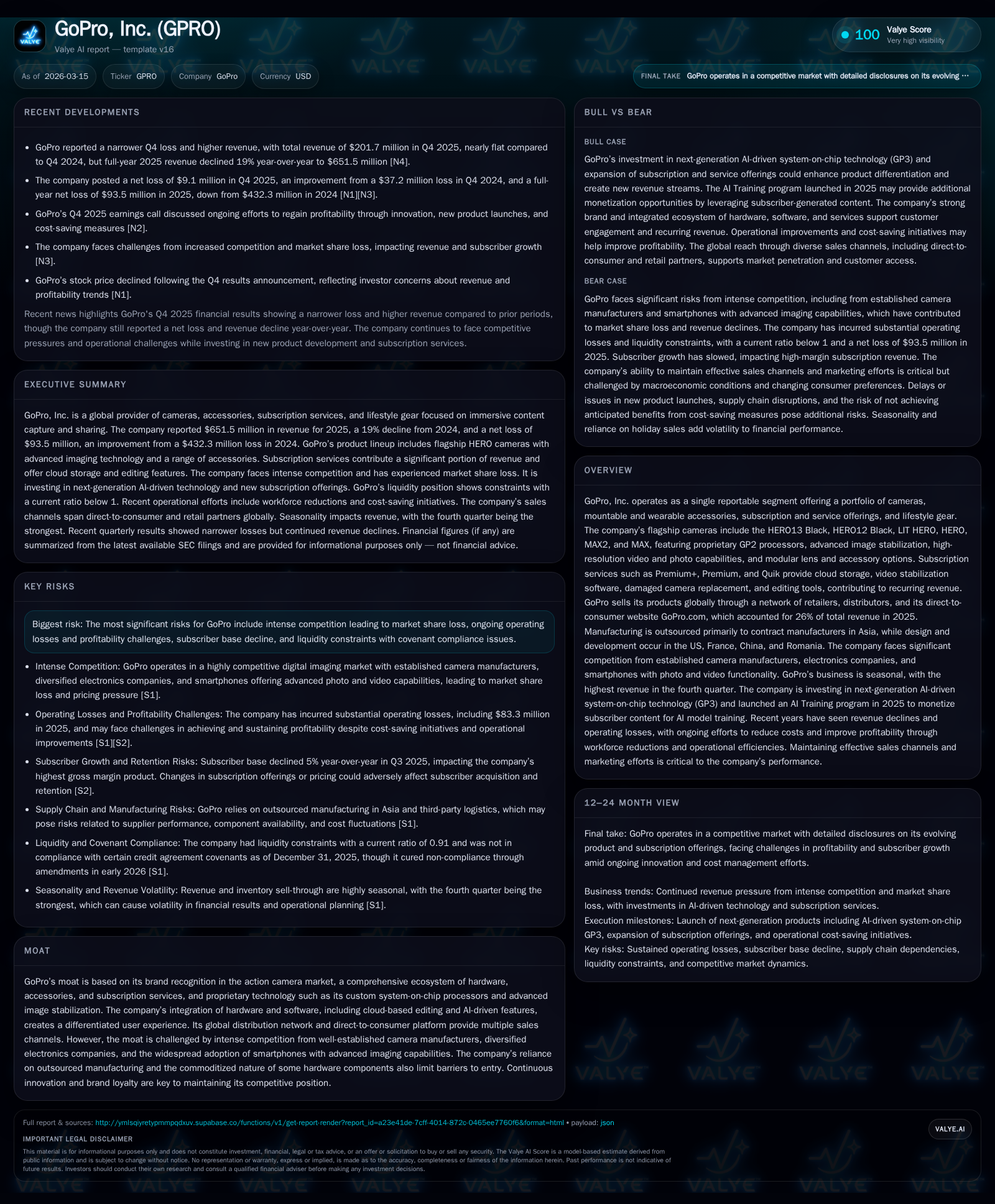
In FY2025, GoPro faced a marked 19% revenue contraction and operational losses driven by shrinking hardware shipments amid intensifying competition. The company’s flagship HERO13 Black leverages its GP2 processor and advanced stabilization, with development underway on an AI-powered GP3 SoC to differentiate in a commoditized market. Recurring subscription revenue of $106 million remains stable, providing steady cash flow amid hardware volatility. Liquidity pressures and covenant challenges have been managed through credit facility amendments and convertible debenture issuance, while no share repurchases occurred as cash conservation remains key. Market headwinds from smartphone encroachment and supplier concentration pose ongoing risks. Future growth hinges on successful product launches, subscription expansion, and managing operational efficiencies.
Historical Performance: Dissecting Revenue Decline and Operational Losses
GoPro closed FY2025 with total revenue of approximately $651.5 million, representing a significant 18.7% decrease compared to $801.5 million in FY2024 [F1]. This decline was principally driven by hardware sales falling 21.5%, linked to softer global consumer demand and increased competition resulting in market share erosion [S1]. Camera unit shipments declined nearly 25% year-over-year to 1.8 million units [S1], underscoring cooling demand during broader macroeconomic pressures and rapid smartphone adoption.
Gross margin remained relatively stable at approximately 33.6% (-20 bps YoY), but operating expenses decreased by 26%, reflecting management’s efforts to streamline costs following prior restructuring initiatives [F1]. Despite these expense reductions, GoPro recorded a substantial operating loss of $83.3 million in FY2025, although an improvement over the $135 million loss in FY2024 [F1]. Similarly, net loss narrowed notably to $93.5 million from a severe $432 million deficit the prior year [F1], partially boosted by non-recurring impairment reversals.
The contraction in revenue combined with shrinking shipment volumes negatively impacted economies of scale essential for hardware profitability, limiting operational leverage benefits despite reduced overheads [N1]. Retail channels still contributed approximately three quarters of overall revenue while direct-to-consumer via GoPro.com accounted for roughly one quarter [S12]. The average selling price increased modestly by over 8%, indicating possible premium pricing on flagship models despite volume softness [S1].
Historical performance (annual)
| FY | Rev ($mm) | Net ($mm) | CFO ($mm) | OpInc ($mm) | Rev YoY | Net YoY |
|---|---|---|---|---|---|---|
| 2025 | 652 | -93 | -21 | -83 | -18.7% | +78.4% |
| 2024 | 801 | -432 | -125 | -135 | -20.3% | -712.9% |
| 2023 | 1005 | -53 | -33 | -75 | -8.1% | -284.4% |
| 2022 | 1094 | 29 | 6 | 39 |
Source: SEC companyfacts cache [F1].
Capital returns and efficiency (annual)
| FY | Buybacks ($mm) | FCF ($mm) | ROE% |
|---|---|---|---|
| 2025 | 0 | -24 | -122.1 |
| 2024 | 0 | -129 | -285.0 |
| 2023 | 40 | -34 | -9.6 |
| 2022 | 40 | 2 | 4.7 |
Source: SEC companyfacts cache [F1].
Table notes: Revenue figures reflect reported full-year amounts; YoY calculated against prior year filings.
Product Innovation as the Growth Engine: From GP2 to GP3 AI-Driven Ecosystem
GoPro’s product strategy centers on technologically sophisticated cameras targeting prosumers and enthusiasts who seek versatile functionality beyond what typical smartphones offer [S11]. Its flagship HERO13 Black leverages the proprietary GP2 system-on-chip processor enabling advanced HyperSmooth 6.0 image stabilization that analyzes up to four times more data than its predecessor, supporting smooth footage even under extreme conditions [S11]. Features such as hybrid-log gamma HDR video capture at up to 5.3K resolution at 60 fps, combined with modular lens architecture allowing accessory interoperability, cater specifically to professional-grade content creators.
Additionally, HDR capabilities extend not only visual fidelity but also prosumer appeal given the growing demands for high dynamic range videos across streaming platforms [S11]. The HERO13 also integrates front/rear touch displays optimized for user interaction during active recording scenarios.
GoPro is investing heavily in next-generation AI-driven SoC development termed GP3 aiming to innovate camera form factors beyond traditional action cams with embedded AI computational capabilities for features like real-time video enhancement, intelligent auto-editing, and contextual scene recognition trained via customer-generated content across its user base [S11,S16]. This approach aims to drive differentiation through hardware-software integration that leverages proprietary algorithms trained within its ecosystem—an increasingly vital moat given commoditization risk.
For developers familiar with embedded systems design in camera markets, GoPro’s shift toward AI model training via opt-in subscriber cloud content usage signals cross-leveraging of data assets into personalized customer experiences and potential new monetization pathways [S1]. The company's ability to marginally increase ASPs supports that consumers value these technological advancements despite intensified price competition.
Subscription Services: The Road to Recurring Revenue and Customer Retention
Subscription revenues held steady at approximately $106 million for FY2025 amidst volatile hardware sales [S1], now representing a meaningful recurring revenue stream that smooths GoPro’s top-line fluctuations [N1]. The subscription tiers—Premium+, Premium, and Quik app services—offer cloud storage for media content, advanced software-based video stabilization tools leveraging machine learning models, damaged camera replacement insurance, and enhanced editing capabilities via mobile applications [S11].
Importantly, GoPro launched an AI training program during the year allowing U.S.-based subscribers who opted-in to monetize their cloud-stored videos used anonymously for improving proprietary AI models that underpin editing automation and scene recognition features [S16]. This novel monetization attempt harnesses consumer creativity while deepening engagement within the ecosystem.
The 'recurring revenue' terminology denotes increasing wallet share from existing customers rather than solely relying on discrete hardware purchases—a crucial pivot amidst declining shipment volumes [N1]. However, churn risk remains pertinent especially if competing offerings or smartphone improvements reduce perceived incremental value of subscription services.
The integrated suite combining hardware performance enhancements alongside compelling cloud-based tools creates a broader value proposition that can augment retention metrics if effectively marketed through digital sales channels including GoPro.com which contributed about 26% of total revenues in FY2025 [S12].
Capital Structure and Liquidity: Navigating Debt Covenants and Cash Flows
Liquidity constraints represent a critical challenge for GoPro given operational losses amounting to $93.5 million in FY2025 alongside negative free cash flow estimated near -$24 million after capital expenditures of roughly $3.4 million [F1,S8,S14]. Cash reserves declined materially from approximately $103 million at end-FY2024 to around $50 million by December 31, 2025 [F1,S8].
The company maintains revolving credit facilities under the amended 2021 Credit Agreement with borrowing capacity initially limited to $35 million but subject to customary borrowing base calculations tethered to collateral valuations including accounts receivable and inventory levels [S6,S7]. Covenants require maintenance of liquidity thresholds ranging from $25 million through mid-2026 incrementally rising later in the agreement term alongside asset coverage ratios suggesting close monitoring of financial health is enforced by creditors [S6,S10,S14].
GoPro was momentarily non-compliant with asset coverage ratio (minimum 1.25x) and EBITDA minimum covenants under its recently issued second lien credit facility capped at $50 million drawn by Feb’26 but subsequently cured this through amendments finalized on February 27, 2026 including easing EBITDA floors and liquidity requirements [S10,S15,S20]. The issuance of convertible debentures up to an aggregate principal amount of $50 million provides additional financing optionality enhancing runway but introduces equity dilution risks given conversion mechanics tied to Class A common stock shares [S3].
No dividend distributions or share buybacks occurred during FY2025 evidencing deliberate cash conservation reflective of ongoing operational losses and debt service commitments [F1,S14]. Working capital management efforts manifest through inventory reduction initiatives also contribute positively towards near-term liquidity relief.
Market Challenges: Competition, Smartphone Encroachment, and Supply Chain Risks
GoPro’s moat faces significant pressure from multiple fronts including rapid innovations by smartphone manufacturers embedding multi-lens cameras capable of high-resolution imaging with integrated computational photography reducing entry points for dedicated action cams among casual users [S18,S24]. Established digital imaging companies along with emerging competitors offering competitively priced alternatives have intensified rivalry leading to market share dilution as discussed by management reports highlighting ‘increasingly global competitive landscape’ impact on shipments declines [-25% units shipped Y/Y] [S1,N2].
Outsourcing production primarily across Asian contract manufacturers—China and Thailand facilities handling final pack-out—and logistics dependency on third-party distributors introduces supplier concentration risks whereby failure or delays can disrupt product availability timing critical around seasonal peaks especially Q4 holiday shopping windows where revenue contribution traditionally spikes [S12,S23,S29]. Sole-source agreements heighten vulnerability as alternate suppliers may not be readily accessible causing potential inventory shortfalls that hinder timely retail channel fulfillment.
Trade policies including tariffs implement added complexities affecting cost structures variably per sourcing geography; tariff rate fluctuations feed contractual adjustments seen embedded within credit agreements linked covenants providing some cushion albeit uncertain macroeconomic headwinds remain present into foreseeable future periods [S14,S29].
Adherence to evolving regulatory frameworks regarding customer data privacy necessitates elevated cybersecurity postures particularly around subscription service platforms collecting personal information under U.S., EU jurisdictions heightening compliance associated costs further pressuring margins beyond core product development investments [S18,S22].
Future Outlook: Evaluating Milestones, Strategic Priorities, and Risks to Watch
Management guidance underscores priorities toward bolstering new product introductions centered on AI-enabled GP3 chipset innovation set for rollout beginning Q2 CY2026 aiming to revitalize demand traction through expanded camera features attracting both core enthusiasts as well as broader segments seeking immersive capture solutions beyond cell phones [N1,N2,S1,S2]. Planned expansion of subscription offerings leveraging AI-content monetization ecosystems seeks incremental recurring revenue uplift anchoring longer-term customer lifetime values.
Cost saving measures approved by the board target operating expense reductions particularly within SG&A lines anticipated from H2 FY2026 onward evidencing strategic cost discipline aligned with growth investments all while maintaining rigorous production planning optimizing inventory turns consistent with seasonal buying patterns noted historically tied heavily to holiday periods [S17,N1,N2].
Risks continue surrounding consumer spending uncertainties linked to macroeconomic cycles affecting discretionary purchase decisions potentially elongating recovery timelines for shipment volumes alongside dependence on continual innovation success sustaining brand loyalty amidst intensifying competitor incursions remain vital watchpoints going forward [N2,S24,S29]. Monitoring covenant compliance under amended debt arrangements will be essential for financial stability avoiding liquidity shocks requiring emergency refinancing.
Financial Metrics Deep Dive: Profitability, ROE, and Cash Flow Analysis
A closer inspection of key financial ratios highlights sustained profitability challenges despite improved margins indicating residual negative operating leverage effects:
- Return on Equity (ROE) approximated at negative -122%, indicative of persistent net losses eroding shareholder equity base substantially over recent periods given cumulative deficits eclipsing initial equity funding levels [F1];
- Operating cash flows remain negative at nearly -$20.7 million for FY2025 though an improvement compared with prior years bespeaking early signs of better working capital management though still insufficient overtime signifying ongoing cash burn;
- Capital expenditure expenditure restrained around $3.4 million maintaining prudent capex intensity consistent with upgrading product lines without overextending fixed asset investment commitments thereby balancing innovation needs versus capital allocation conservatism.
In summary financial discipline coupled with innovation-centric product roadmaps represent GoPro’s dual pillars attempting recovery amid structural industry transformation where competitive dynamics favor integrated software-hardware solutions supported by cloud ecosystems anchored by consistent recurring revenues challenging legacy single-product reliance postures.
This analysis summarizes publicly available information from SEC filings dated March 12, 2026 ([F1],[S#]) alongside recent earnings call transcripts ([N#]) without extending investment recommendations or forward-looking predictions beyond documented disclosures.
Disclaimer: This is research-only, informational analysis and not investment advice. It may include AI-generated interpretation and general industry context. Always verify important details using primary sources.

Comments