
Inflection Point Acquisition Corp IV’s Transformation through Merlin’s Autonomous Flight Vision
The completion of BACQ’s business combination with Merlin Labs reorients its trajectory towards AI-powered aerospace autonomy, accompanied by bespoke financial and operational complexities.
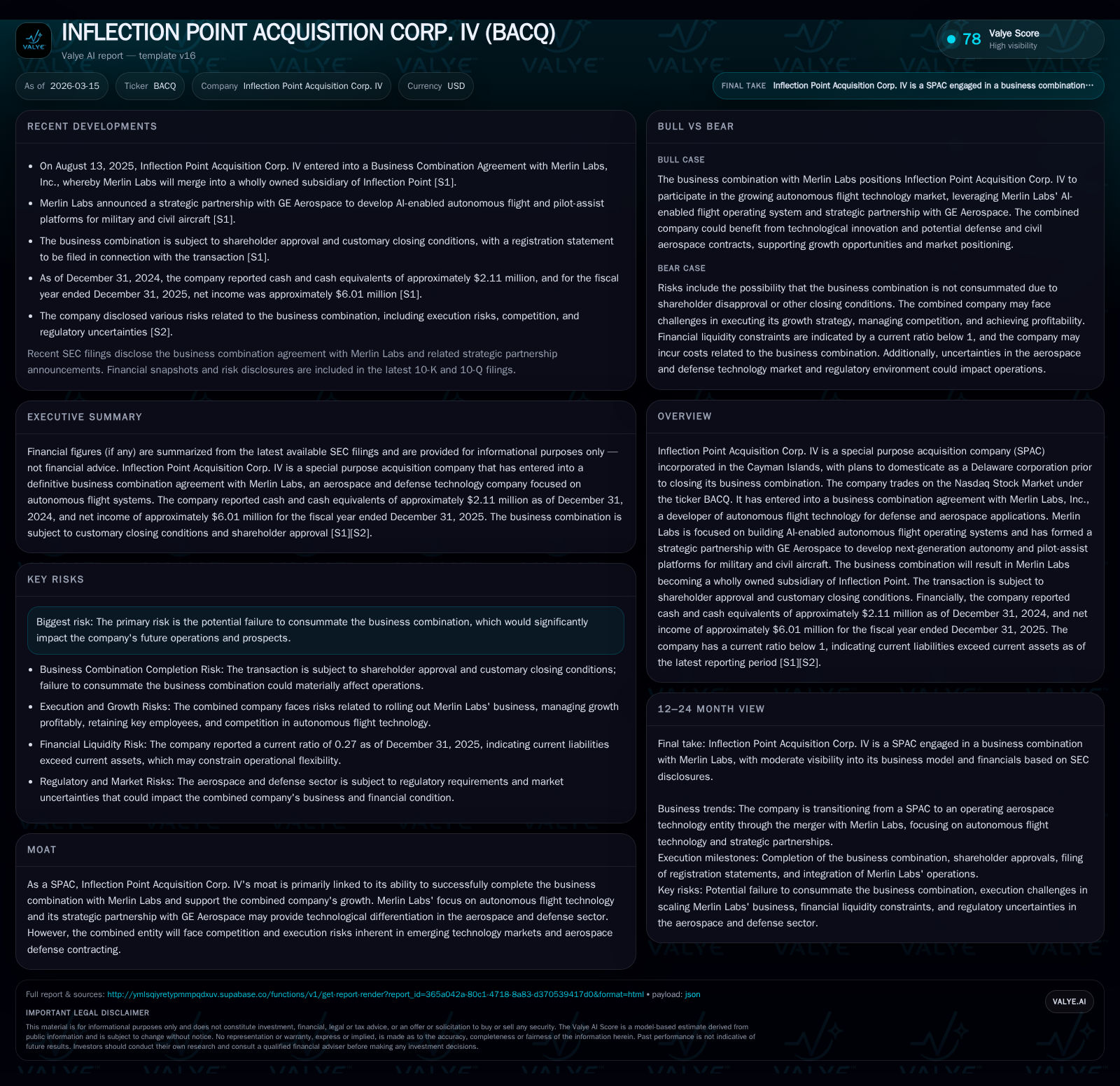
Inflection Point Acquisition Corp. IV (BACQ) is transitioning from a Cayman Islands-rooted SPAC to a Delaware-based corporation as it completes its merger with Merlin Labs, an autonomous flight technology developer with defense partnerships. Historically, BACQ has deepened operating losses despite positive net income figures influenced by accounting or transactional factors, while demonstrating constrained liquidity and negative equity. Merlin Labs’ advanced AI-enabled flight stack and strategic alliance with GE Aerospace signal significant growth potential within military and civil aviation autonomy sectors, contingent on regulatory approvals and government contract acquisitions. However, BACQ faces execution risks typical of nascent aerospace tech firms and dilution concerns due to complex capital instruments accompanying the deal.
SPAC Origins and Business Combination Approval
Inflection Point Acquisition Corp. IV (BACQ) was established as a Cayman Islands exempted company formed specifically for effecting an initial business combination. Prior to closing the proposed combination with Merlin Labs — a company developing advanced autonomous flight technology — BACQ plans to domesticate as a Delaware corporation [S1][S11]. The origin story includes founder shares issued at nominal cost with subsequent lock-up agreements restricting transfer for one year following the initial business combination or until certain price thresholds are met [S1].
The Sponsor acquired Private Placement Units contemporaneously with BACQ’s IPO at $10 per unit totaling $4.25 million; these units, like founder shares, are subject to transfer restrictions until at least 30 days post-business combination to avoid market disruption [S1]. Shareholders approved the business combination agreement with Merlin Labs at an Extraordinary General Meeting in March 2026 by a quorum vote of over 60% [S7].
The deal contemplates utilizing cash proceeds from the IPO trust account combined with private placements and potential debt issuance to fund the integration and growth initiatives post-merger [S1]. The structure allows for significant flexibility but introduces dilution possibilities depending on anti-dilution provisions tied to Class B Ordinary Shares conversion mechanics.
Historical Financial Footprint and Operational Snapshot
Prior to Merlin Labs' integration, BACQ exhibited a financial profile characteristic of early-stage SPACs transitioning into active operations. Examining FY2024 and FY2025 reveals a marked deterioration in operating income from -$251k in 2024 to -$3.86 million in 2025, representing an adverse change of roughly -1436% year-over-year [F1]. This sharp loss expansion suggests increased investment activities or operational overheads related to business combination preparation.
Conversely, net income rose significantly during the same period to $6 million, likely reflecting non-operational gains related to revaluation or transaction-related accounting entries rather than underlying profitability.
Operating cash flow remained negative and worsened by approximately 185%, falling from -$466k in FY2024 to -$1.33 million in FY2025 [F1], underscoring continuing cash burn before revenue scaling.
The company's equity base was negative at about -$11.2 million as of end-2025 compared to -$7.36 million the prior year, indicating accumulated losses that outpace contributed capital [F1]. This position yields an approximate return on equity of -53.8%, highlighting leveraged losses intrinsic to this developmental phase.
Liquidity metrics reinforce operational challenges: the current ratio at year-end 2025 stood near 0.27 (current assets $914k vs current liabilities $3.33 million), signifying strained short-term financial flexibility [F1]. These elements frame BACQ's status pre-merger as financially fragile but structurally poised to evolve once combined with its target.
Historical performance (annual)
| FY | Net ($mm) | CFO ($) | OpInc ($mm) | Net YoY |
|---|---|---|---|---|
| 2025 | 6 | -1328713 | -4 | +295.4% |
| 2024 | 2 | -466474 | 0 |
Source: SEC companyfacts cache [F1].
Capital returns and efficiency (annual)
| FY | ROE% |
|---|---|
| 2025 | -53.8 |
| 2024 | -20.6 |
Source: SEC companyfacts cache [F1].
Table shows annual financial performance highlighting worsening operational losses alongside improving net income due primarily to non-cash factors.
Merlin Labs: Technology Proposition and Strategic Partnerships
Merlin Labs stands at the forefront of autonomous aviation innovation, developing an AI-enabled autonomous flight stack tailored for defense contractors and aerospace integrators [N1][N2]. The core offering comprises a modular software platform capable of assuming pilot functions autonomously or augmenting pilot controls through next-generation pilot-assist avionics — critical design elements that promise both assured autonomy and scalable integration across multiple aircraft platforms.
A pivotal recent milestone was the successful completion of a preliminary design review (PDR) for the USSOCOM C-130J autonomy program — a critical step validating Merlin's technology readiness against stringent military certification standards [N1]. This demonstration instills confidence about Merlin’s ability to meet demanding defense contractor certification processes essential for deployment within tactical aviation fleets.
Strategically, Merlin’s partnership with GE Aerospace focuses on co-developing AI-driven autonomy modules including pilot-assist systems designed not only for military applications but also civil aviation markets aspiring toward augmented safety via automation techniques that blend human oversight with machine learning controls [S16][N2]. Such collaboration leverages GE Aerospace’s avionics development expertise alongside Merlin’s AI capabilities forming barriers to entry given integration complexity and intellectual property depth.
Assessing Growth Prospects Post-Business Combination
Post-integration growth hinges on deploying significant capital — sourced from IPO proceeds held in trust (~$210 million per last filings though not explicitly stated here), private placements, convertible notes, and series A preferred stock issuance totaling $50 million—toward advancing Merlin’s autonomous flight products through prototype scaling, regulatory clearances, testing phases, and initial contract delivery milestones [S22][S24].
Military contracts such as USSOCOM’s C-130J program exemplify targeted high-barrier opportunities leveraging autonomous capabilities within special operations aviation — markets generally resistant to commoditization due to security clearance demands and long certification cycles.
Civil aerospace applications represent an extensible future avenue though encumbered by more layered regulatory approval timelines from bodies such as FAA or EASA for piloted/autonomous aircraft coexistence schemes common in urban air mobility or cargo drone segments.
Growth scalability will demand navigating competitive headwinds from legacy aircraft manufacturers increasingly investing in autonomous tech suites alongside specialized avionics suppliers establishing footholds via defense subcontracting relationships . The successful commercialization timeline remains contingent upon regulatory progressions that impact go-to-market pacing.
Capital Structure, Funding Mechanisms, and Shareholder Returns
BACQ’s pre-combination capital structure incorporates founder shares totaling approximately 8.33 million shares subject to lock-ups preventing trade for at least one year after merger completion unless share prices reach specified thresholds ($12/share adjusted) or liquidity events occur [S1]. The Sponsor also holds Private Placement Units worth $4.25 million locked until at least 30 days post-merger [S1].
Merlin Labs’ financing includes a substantial Series A preferred stock tranche priced at $12 per share amounting to $50 million investment bearing a 12% cumulative dividend accruing daily—compounded semi-annually if paid-in-kind—or alternatively 10% if paid in cash [S22]. Conversion rights allow holders to convert preferred into common stock based on accrued value divided by adjustment mechanisms reducing dilution over time.
Preferred holders possess put rights exercisable starting five years post-closing plus call provisions exercisable by New Merlin Labs under predefined terms that could influence ownership mix downstream impacting shareholder voting power [S22][S27].
Historically BACQ has not paid dividends nor executed share repurchases consistent with typical SPAC evolution stages where capital preservation precedes distributable cash generation [S7]. Post-merger returns hinge critically on New Merlin Labs' operational cash flow improvements enabling future capital allocation decisions potentially including dividends or buybacks once free cash flow stabilizes.
Execution Risks and Market Competitiveness
The definitive risk facing BACQ lies in consummation failure of the business combination with Merlin Labs which would disrupt strategic prospects entirely since current operations remain nascent without standalone revenue streams beyond transaction-related proceeds [S1]. Dilution risk is material considering multiple layers of complex equity securities including founder shares converting into Class A shares under anti-dilution provisions plus preferred stock convertible securities potentially affecting existing shareholder percentages post-merger.
Technology execution risk is inherent given emerging nature of autonomous flight stacks requiring rigorous software validation cycles compounded by external dependencies like military certification hurdles which historically impose iterative design modifications and delay deployment timelines [F1][S1].
Competitive pressure stems from incumbent OEMs who increasingly develop proprietary autonomy systems internally or acquire smaller startups possessing complementary technologies; carving sustainable market share necessitates robust IP protections combined with strong defense contracting credentials typically achieved through multi-year certification programs under DOD auspices . Regulatory uncertainties further add layers of unpredictability regarding civil use cases requiring FAA/EASA acceptance frameworks still evolving globally.
Key Milestones to Track Moving Forward
Investors should closely watch several pivotal developments:
- Final closing date of the Meridian Labs business combination pending customary conditions including regulatory reviews and shareholder redemption levels [S3]
- Progress updates regarding major contracts notably USSOCOM C-130J project delivery stages documented through public disclosures or investor briefings (recently briefed March 3 webinar) [N2]
- New funding rounds or adjustments involving series A preferred stock exercise schedules that could affect capital structure dynamics dramatically within next five years [S22]
- Quarterly filings elucidating operational pacing particularly changes in cash flow dynamics signaling transition from burn phase toward positive FCF generation required for sustainable growth funding without incremental dilution
- Regulatory announcements related to autonomous aircraft certification regimes impacting Merlin’s civil market penetration timetable
This analysis integrates BACQ's latest publicly available financial data alongside SEC-filed documents and news releases regarding its transformation via merger with Merlin Labs. Numerical metrics are drawn strictly from validated filings ([F1],[S#]), with forward-looking assessments clearly labeled as directional analysis grounded in industry context but unsupplemented by speculative forecasts. No investment recommendations have been made herein.
Disclaimer: This is research-only, informational analysis and not investment advice. It may include AI-generated interpretation and general industry context. Always verify important details using primary sources.

Comments